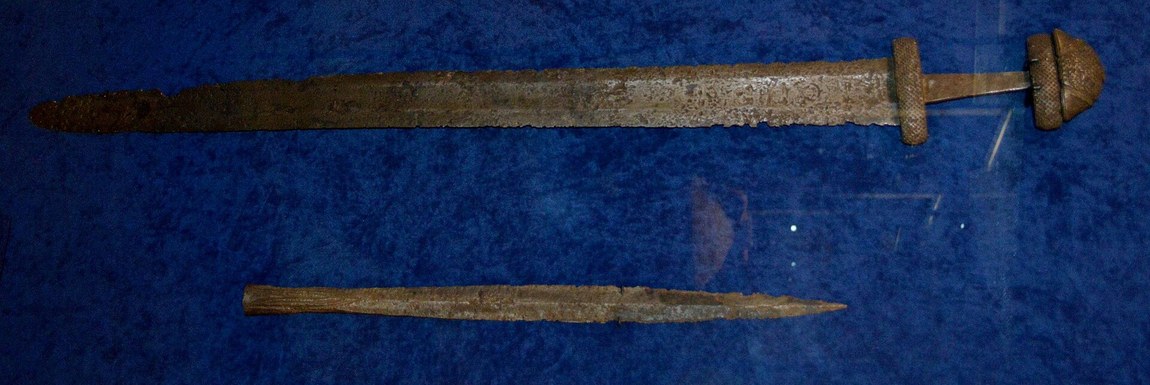
An Ulfberht sword is a Viking Age and Carolingian sword whose blade carries the Frankish personal name +VLFBERH+T (or a variant of it), forge-welded into the steel in iron letters – around 170 such blades are known, most of them from the 9th to the 11th century. Most specialists believe they were made in the Frankish realm, probably in the Rhineland, yet the bulk of them turn up in Scandinavia. Here is why, what the famous steel really is, and what two finds from the Rhine and the Weser add to the story.
Pull an Ulfberht sword out of a river and at first you see nothing special: a brown, crusted bar of iron. Only on an X-ray, or after careful conservation, do the letters appear – set in the fuller of the blade, framed by small crosses. +VLFBERH+T. A name more than a thousand years old, written not in ink but in iron.
The smith laid thin rods or wires of iron – sometimes pattern-welded material built up from several layers – onto the hot blade in the shape of letters and forge-welded them into the body of the sword. Then the surface was ground and polished. The inscription became visible because the inlaid iron reacts differently to polishing and etching than the surrounding steel, leaving a pale or dark shadow in the metal. When conservators in Lower Saxony studied the sword from the River Weser (more on it below), they found the letters had been assembled from small straight rods and arcs, apparently laid on loosely and then welded – some shifted in the process and overlap. You can see the hand of the maker in every crooked stroke.
How smiths of the period actually worked is covered in our piece on Viking blacksmithing. This article is about one particular group of blades – and about how much of their fame comes from science and how much from television.
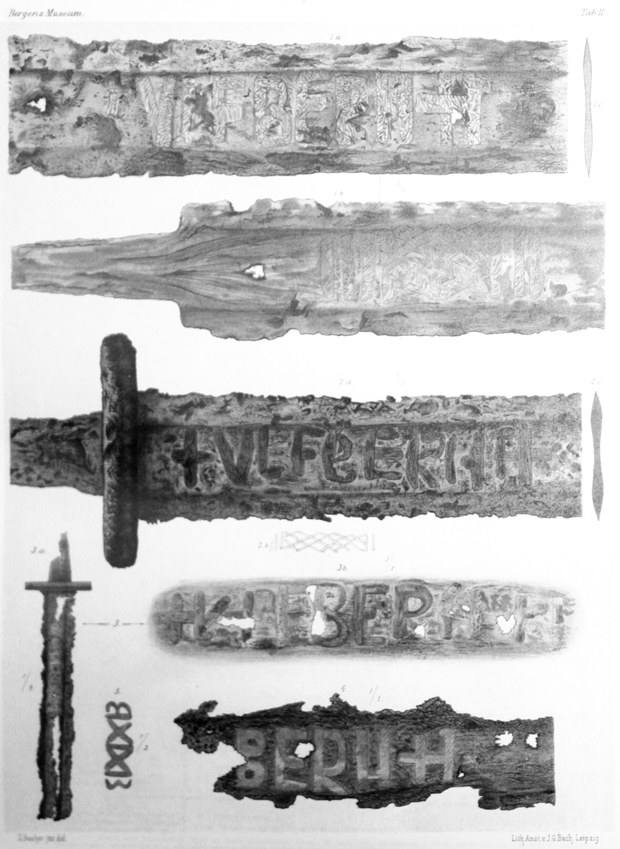
Strictly speaking, there is no single Ulfberht inscription. The Norwegian archaeologist Anne Stalsberg catalogued the known blades in 2008 and sorted the spellings into classes. The most common form is +VLFBERH+T, with a cross squeezed between the H and the T, which looks odd at first glance. The second most common is +VLFBERHT+, with both crosses on the outside. Then there is a long tail of misspellings: letters missing, swapped or mirrored, such as +VLFBEHT+ or +VLEBERHIT. On many blades corrosion has eaten so much of the inlay that the variant can no longer be read with confidence.
Which form is the "correct" one? The British archaeometallurgist Alan Williams treated +VLFBERH+T as the original and linked it to the finest steels (more on that shortly). Stalsberg's dating, however, shows that +VLFBERHT+ occurs mostly in early contexts, while +VLFBERH+T is more typical of later ones. Helmut Föll, a materials scientist at Kiel University, has therefore wondered whether the middle cross is a later development – perhaps even a T misread as a cross. That is a suggestion, not a proof. But it shows how thin the ice is when you try to judge a blade "genuine" or "fake" by its spelling.
The other face of many blades carries no text at all but a geometric pattern of lines and lattices – a second mark of some kind. What it meant, nobody knows. And you will not find runes on an Ulfberht: the inscription is in Latin capitals. For the runic side of the story, see runes on weapons.
The name itself is easy to place. Ulfberht is a Germanic personal name in Frankish form, built from wulf ("wolf") and beraht ("bright, famous") – the same element found in Albert, Hubert or Bertram. A Scandinavian of the period would more likely have written in runes. Latin letters and crosses point to the literate, Christian world of the Frankish realm.
That is where certainty ends. One smith cannot have made them all: the blades span two centuries, three if the late examples are included. Several models are on the table:
The archaeometallurgist Ann Feuerbach has even asked whether the inscription might be a formula rather than a maker's name. That remains a minority view. Most scholars see Ulfberht as a personal name that turned into a brand.
The figure you will see everywhere is "about 170". It goes back largely to Stalsberg's catalogue; depending on whether fragments and doubtful readings are counted, it moves up or down by a dozen or so. For Finland alone, Stalsberg and the Finnish researcher Mikko Moilanen arrive at quite different totals. The finds are spread across more than twenty modern countries, from Ireland to the Volga and from Iceland to Spain and Italy.
The centre of gravity is obvious, though: Norway, Sweden, Finland, the Baltic and Russia. Norway alone has produced more than forty Ulfberht blades. From the old Frankish realm, where they were probably made, only a handful are known. That looks like a paradox, but it is mostly about funerals.
In pagan Scandinavia men were buried with their weapons, together with other objects that allow the grave to be dated. In the Christian Frankish realm, weapons were hardly ever placed in graves by the 9th century. So Frankish Ulfberhts are known almost only as stray finds – from riverbeds, dredged gravel and old oxbow lakes. How many still lie in the Rhine, the Meuse or the Weser, nobody can say. A distribution map shows where swords went into the ground, not where they were used. Keep that in mind with every Viking sword map you see.
Some swords in the North were deliberately bent or broken before burial. What lay behind that custom is explained in our article on ritually "killed" weapons.
Most Ulfberht blades belong to the 9th and 10th centuries, and a sizeable share reaches into the 11th. Stalsberg divides the datable pieces roughly into early, middle and late Viking Age, with the middle phase (10th century) best represented. When the very first blades were made is debated; some authors push the start back into the late 8th century, but that is not securely established for individual pieces. At the other end stand late forms: the Landesmuseum Württemberg in Stuttgart holds an Ulfberht sword it dates to the 12th century, and from eastern Germany there is a late blade that pairs the name with a Christian formula. By then, Ulfberht is no longer a person but a tradition.
Archaeologists use two systems to classify these swords. The Petersen typology, published by the Norwegian Jan Petersen in 1919, sorts Viking swords by the shape of pommel and cross-guard – that is, by the hilt. For the blade itself, the later typology of Ewart Oakeshott is often used. Ulfberht blades are mostly Oakeshott type X: a long, double-edged cutting blade with a broad, shallow fuller (the groove that saves weight) and only a gentle taper towards the point. The hilts, by contrast, vary a great deal – Ulfberht blades turn up with many different Petersen hilt types. That fits a trade in which blades travelled as semi-finished goods and were hilted by their new owners. Ulfberhts stand on a threshold, between the older, often pattern-welded Viking sword and the slimmer knightly sword of the High Middle Ages.
Ulfberht blades did not become famous because of their lettering. They became famous because of a lab study. In 2009 Alan Williams, then archaeometallurgist at the Wallace Collection in London, published in the journal Gladius an examination of 44 Ulfberht swords – out of roughly 100 known at the time. He studied tiny samples under the microscope and measured their carbon content.
His results showed that the blades were anything but uniform. He sorted them into four groups:
Steel with so much carbon and almost no slag inclusions, Williams argued, is characteristic of crucible steel. In this process iron and carbon-bearing material are melted completely in a sealed clay crucible; the slag separates, and the result is a very homogeneous, carbon-rich steel. In early medieval Europe this technique was not in general use, but it was known in Central Asia and the Iranian world. Williams therefore suggested that ingots reached the North along the Volga trade routes – the same routes that carried Islamic silver. When that trade declined in the later 10th century, he argued, production of the best blades dried up too. In 2012 he gathered his research in the book The Sword and the Crucible.
Williams himself presented this as the likely explanation, not as established fact. And such steel is only an advantage if it is forged correctly at relatively low temperatures; overheat it and it crumbles. Worked well, it gives a blade that is both hard and tough.
The idea of eastern steel inside a Frankish sword has not convinced every specialist. The main objections:
Slag-free is hard to prove. Helmut Föll has pointed out that Williams shows only very small sample areas free of slag. Steel from a European bloomery – a simple clay furnace in which ore is reduced with charcoal without the iron ever melting – can also be locally very high in carbon and low in slag. For at least one blade Williams counts as crucible steel, the structure along the edges looks more like folded bloomery steel.
Harder is not automatically better. Very high-carbon steel can be brittle, and micrographs alone do not prove a blade was superior in a fight.
The chemistry partly points to Germany. Robert Lehmann (later at the Helmholtz Institute Ulm) analysed the sword found in the Weser in 2012 and measured a manganese content of about 1.5 per cent. He links this to manganese-rich ores such as those of the Siegerland. So far, though, no smelting sites older than the 10th century are known there, so the trail is tempting but not closed. The weapons specialist Alfred Geibig, whose work on Frankish swords is fundamental, also reckons with local steel.
How do the pieces fit together? The historian Daniel Föller has suggested a compromise: the Franks made their blades from local material, while workshops in the North or East copied them using imported crucible steel. That too is a hypothesis. The honest state of play is this: some Ulfberht blades are made of exceptionally good, carbon-rich steel. Whether that steel is crucible steel, and where it came from, remains open. For an overview of the research, see Ingo Petri's article in History Compass (2019).
One story has proved especially sticky: the misspelled inscriptions are fakes, cheap knock-offs by poor smiths cashing in on a famous name. That is not entirely wrong. Williams' groups C and D, with variant spellings, really do tend to be made of poorer material. Copying a good name is as old as trade itself.
But the picture is too neat. The equation "correct spelling = good steel" rests on a limited sample, and we are not even sure which spelling came first. Stalsberg explains some misspellings simply by people in the smithy who could not read – they set letters as a pattern, not as a word. And "forgery" is a modern idea. A 10th-century workshop that adopted a proven mark may have seen it as tradition rather than fraud. Ulfberht was not the only blade name either: a smaller group of blades carries the name INGELRII, also forge-welded and also Frankish.
If the blades were made in the Frankish realm, how did they end up in the graves of Norwegian farmers and Swedish traders? Open arms trading was certainly not intended. In the Capitulary of Thionville (Diedenhofen) of December 805, a set of royal ordinances issued by Charlemagne, merchants trading with the Slavs and Avars are told not to take arma et brunias – weapons and byrnies, that is, mail shirts – for sale. Anyone caught lost all his goods. The capitulary even names the border trading posts where controls were to take place, among them Bardowick, Magdeburg, Erfurt, Forchheim, Regensburg and Lorch on the Enns.
That ban was aimed east, not directly at Scandinavians. Charlemagne's grandson Charles the Bald was more explicit: the Edict of Pîtres (864) prohibited trading weapons to the Northmen, and selling them horses was to be punished with death. The fact that such bans kept being repeated tells you one thing: they were being broken.
Loot. In the 9th century Scandinavian armies spent years moving through the Frankish realm, setting up winter camps on the Rhine, Meuse and Scheldt and plundering towns, monasteries and palaces. In 881 they even sacked Aachen, Charlemagne's favourite palace – a story we tell in Vikings in Aachen 881. Wherever there was fighting, weapons changed hands. How these armies spent their winters is the subject of our article on the winter camps on the Rhine.
Ransom and tribute. Frankish rulers repeatedly bought off raiders with large amounts of silver. Whether weapons were part of such deals is not recorded in detail – but the Pîtres ban shows that people expected such transactions.
Trade and smuggling. Trading towns such as Dorestad on the Lower Rhine and Hedeby on the Schlei linked the Frankish world with the North. Wine, pottery and glass from the Rhineland moved north along these routes, and bare blades without hilts were easy to slip into a cargo. The fact that Ulfberht blades appear with very different, sometimes Scandinavian hilts fits exactly this pattern: the blade travelled naked, the hilt was fitted on arrival.
A striking hint at the reputation of Frankish blades comes from the Islamic world. The envoy Ibn Faḍlān, who met Scandinavian traders he calls the Rūs on the Volga in 921/922, describes their arms roughly like this (our paraphrase): each man carries an axe, a sword and a knife, and their swords are broad, grooved and of the Frankish kind. Whether any were Ulfberhts we cannot know – but "Frankish" clearly meant something. You can read the whole account in our edition of Ibn Faḍlān. For the wider networks, see Viking trade.
A sword was no everyday tool in the North. Almost every free man owned a spear, an axe and a knife; a sword belonged to those who could afford it or received one as a gift. A man in the front rank of the shield wall often fought mainly with his spear, but the sword at his side showed who he was.
In the Icelandic sagas, written down only in the 13th century, good swords have names and biographies. Skofnung, the sword of the legendary Danish king Hrólfr kraki, is taken from his burial mound in Laxdæla saga and handed on. Fótbítr ("Leg-biter") changes hands in the same saga and becomes the weapon in a deadly family feud. In Gísla saga the broken sword Grásíða is reforged into a spearhead, which is later used for a killing. In heroic poetry, weapons such as Sigurd's Gram or the cursed sword Tyrfing carry entire destinies. Tyrfing's story is told in Hervör wakes the dead, and Sigurd's sword appears in the Völsung saga.
Keep the categories apart, though: no saga sword can be tied to a specific Ulfberht blade. The sagas reflect what people in the High Middle Ages imagined about the past. What they do show is how Northerners thought about swords – as heirlooms that carried honour, ancestry and sometimes doom. A blade with its name already written in the steel fitted that world very well.
Compared with Norway, Germany has few finds – but there are Ulfberht swords here too, and precisely these finds matter for the question of origin. Surveys list a little over a dozen.
Mannheim. In 1960 an Ulfberht sword was found in the Old Rhine near the Friesenheimer Insel in Mannheim; it is now in the Germanisches Nationalmuseum in Nuremberg. Of all things, this blade carries a misspelled inscription, +VLFBEHT+ – the R is missing. So the find from the Rhine, right in the supposed area of manufacture, is one of the "wrong" spellings. A good reminder to be careful with the label "fake".
Großenwieden on the Weser. In spring 2012 dredging work in the River Weser near Großenwieden (town of Hessisch Oldendorf, district of Hameln-Pyrmont) brought up a complete sword. The state of Lower Saxony acquired it in 2013, and the state heritage office examined it thoroughly. It is 96 cm long overall, with an 81 cm blade. It carries the inscription +VLFBERH+T, a geometric mark on the reverse, and a hilt of Petersen type V, pointing to the first half of the 10th century. The cross-guard and pommel were tinned, and remains of leather even survive on the pommel. The results were published in 2015 in Nachrichten aus Niedersachsens Urgeschichte. This is the sword on which Robert Lehmann measured the high manganese content.
Hamburg. As early as 1970 the archaeologist Michael Müller-Wille published a newly found Ulfberht sword from Hamburg. Williams later counted it among his crucible-steel candidates; Föll, by contrast, sees signs of folded bloomery steel along its edges. One blade, two readings.
Add to these late forms such as the Stuttgart sword. For us here in the Rhineland, not far from Aachen, it is an appealing thought that the most famous blade of the North may have its roots in Frankish country between the Rhine and the Weser. Exactly where the workshop stood remains unknown. For more on the Franks and their realm, see our tribal portrait.
Strip away the television legend and you still have a remarkable story: a Frankish name welded into iron, copied, misspelled, fitted with new hilts and finally buried with its owner or lost in a river. Some of these blades were top-of-the-range, others ordinary. Together they speak of trade despite embargoes, of raids and ransoms, and of the fact that more than a thousand years ago a name in the steel was already meant as a promise.
How a sword like this was actually worn is explained in our article on scabbards and suspension.
In our workshop the Ulfberht inscription is a motif that works without much explanation: clean Latin capitals, two crosses, one line. On natural slate it looks as if it were struck from the stone; on glass it comes close to the etched look of a blade. We stick to the attested forms +VLFBERH+T and +VLFBERHT+, and on request we set your own name beneath it in the same lettering – just as the old smiths put their names into their work. What we will not do is invent "runic Ulfberhts" or fantasy symbols that never appeared on any blade.
For courage. For remembrance. For legends that live on.
What does Ulfberht mean? Ulfberht is a Frankish personal name made of "wolf" and "bright, famous". On the swords it appears as +VLFBERH+T or in variants and probably served as a workshop or quality mark.
How many Ulfberht swords are there? Around 170 blades or blade fragments are known. The exact figure varies with the counting method, because some inscriptions survive only in fragments.
Were Ulfberht swords made of crucible steel? Some blades are made of very high-carbon steel that Alan Williams interprets as crucible steel. This is disputed: other researchers think European bloomery steel is possible, and many Ulfberht blades are made of quite ordinary material.
Where were Ulfberht swords made? The name and script point to the Frankish realm, and most specialists think of the Rhineland or the wider Frankish heartland. No specific workshop has been identified.
Have Ulfberht swords been found in Germany? Yes, a little over a dozen, including finds from the Old Rhine at Mannheim (now in Nuremberg), from the Weser near Großenwieden (2012) and from Hamburg.
Were Ulfberht swords the best Viking swords? The best Ulfberht blades were among the finest swords of their time. The group as a whole, however, was very uneven, and "the best sword ever made" is a modern exaggeration.
Hacksilver – silver as currency · Viking jewellery · Slate, Wood or Glass? · The Mästermyr tool chest · Stone ships – ships of stone.
All Everyday Life & Craft articles →
The Viking ship was not merely a tool – it was a status symbol. And at its top there often gleamed a masterpiece of …
Read more →Matted hair, unwashed for years, reeking across the meadhall – that is the Viking of cliché. The finds tell another …
Read more →Coarse brown sacking, a shaggy fur collar, and of course the obligatory horned helmet – that is the Viking of film and …
Read more →Viking jewellery was rarely just decoration. A pair of brooches held the dress, an arm-ring was status symbol and …
Read more →