If you want to find where the writing of the North begins, don't look in libraries – look in the bog, and there, of all places, among spearheads, shield fittings and blades. The oldest runes we know sit on war-gear. And most of the time they say something surprisingly plain: a name.
We like to imagine runes as a secret script full of spells. Yet when you line up the earliest finds, a different, far more down-to-earth picture emerges. The oldest datable runes of the Germanic world sit not on monuments but on weapons and equipment – and what they record often sounds less like an incantation than like a workshop and a claim of ownership. That is exactly what makes them so interesting to us as engravers: a weapon inscription names a thing or a person, plainly and briefly, as honest as a stamp. At heart, that is still what a good engraving does today.
This is no accident. Weapons were valuable; they changed hands, were inherited, sacrificed and buried. Those who could write – and in the early Roman Iron Age very few could – cut or inlaid the signs where they mattered: on the spear, on the shield, on the blade. And there is a lucky circumstance for archaeology: in Scandinavia, captured army equipment was cast into lakes and bogs as sacrifice. The oxygen-poor mud preserved iron, wood and silver for nearly two thousand years – and with them the incised runes. Great sacrificial sites such as Vimose on Funen or Illerup Ådal in Jutland are therefore also the earliest treasuries of runic writing itself.
If you want to dig deeper into the origin and age of the runes, we cover that at length elsewhere – in our scholarly study of the runes. Here we focus on one very concrete place: the weapon itself.
Among the oldest runic witnesses is a comb from the Vimose bog bearing the plain word harja (c. 150–160 AD) – not war-gear, but part of the same weapon deposit. From the same horizon come genuine weapon parts with runes: a lancehead with the mark wagnijo, plus fittings and a scabbard chape. Vimose is thus less a single inscription than a whole early world of writing – and it hangs on equipment.
Even more telling is an iron lancehead from Øvre Stabu in Norway (roughly 150–200 AD). It bears the word raunijaʀ – according to the standard reading by the runologist Wolfgang Krause, "the tester" or "the trier". The remarkable part: the name refers neither to the owner nor to the smith, but to the weapon itself. The spear is called "tester" because it puts the enemy to the test. Weapons were given proper names long before the sagas sang of famous swords like Skofnung, Tyrfing or Gramr. Anyone engraving a blade-name today stands in a very old line – only that we can prove it and the saga cannot.
From Illerup Ådal comes a sentence that deserves a place of honour in any history of the runes. On a silver shield-grip fitting (c. 200 AD) stands niþijo tawide – "Nithijo made (it)". It is the oldest complete sentence we know in runes. Whether Nithijo was the craftsman or the carver cannot be said for certain; what is clear is that a human being here records his authorship. From the same workshop world comes the mark wagnijo, stamped on several lance blades from Illerup and Vimose alike – a hint at something like serial production and a smith or workshop master whose name vouched for the product.
The little word tawide ("made") is no random find. It deliberately mirrors the Latin fecit signatures of Roman craftsmen – "X made it". The Germanic rune-carvers took over a Roman gesture and cast it in their own script. Related is the formula faihido ("carved", literally "painted") on the Gallehus gold horn and elsewhere. Put differently: the earliest longer runic texts are signatures. Not magic, but craftsman's pride.
Sum up the evidence and a clear pattern emerges. Weapon runes are overwhelmingly names – of the maker, of the owner, or of the weapon itself – or brief maker's marks. The famous formula-words of runic magic, alu, laukaʀ, laþu, we know almost exclusively from gold bracteates, amulets and stones, not from blades. The weapon, it seems, wanted to be named more often than bewitched.
This disenchants nothing – on the contrary. A name on a weapon was a serious matter. It turned a piece of iron into a piece of biography: this spear is mine; this blade so-and-so forged; this bow is called thus. In a world without paperwork, the inscription was proof of ownership, certificate of origin and mark of honour in one – and thus closer to the modern sense of an engraving than any rune-oracle kitsch.
Look closer and the weapon-names fall into three roles, all three attested. First the smith or workshop master – wagnijo, niþijo and the proud tawide signature. Second the weapon itself, like the "tester" of Øvre Stabu; a spear with its own name is no longer a tool but a companion. And third the owner: on the chape of a sword-scabbard from the Thorsberg bog (c. 200 AD) stands a personal name (owlþuþewaz), and from somewhat later we know the terse formula "N. owns me", by which an object speaks of its owner in the first person.
That first person is the truly moving part. The object speaks: I belong to you. Precisely this gesture – a thing that names its person – is the origin of what a personal engraving still means to do. Not magic, but a bond between person and object, held fast in metal. And even then the rule held: whoever set the name did it carefully, for the weapon was meant to outlast its owner.
There are exceptions, and honestly they are the most exciting. On a lance-shaft from the Kragehul bog (Denmark, c. 300 AD) runs a longer inscription that opens with a rune-master introducing himself: ek erilaʀ … – "I, the Erilaʀ" (a title for one skilled in runes). It is followed by the triple syllable-chain gagaga, read as a ritual cry or power-formula. Here, on a weapon, something genuinely flickers up that sounds like incantation.
Yet such pieces are rare – and ambiguous. "Read as" is the honest core: we do not know for certain what gagaga was meant to do, or whether it was meant to do anything at all. Weapon runes as a whole remain a field of names and marks, into which only here and there a puzzling formula reaches. If you would like to read more about the border zone between honest craft and the wish to lend an object power, you will find it in our piece on the rune consecration.
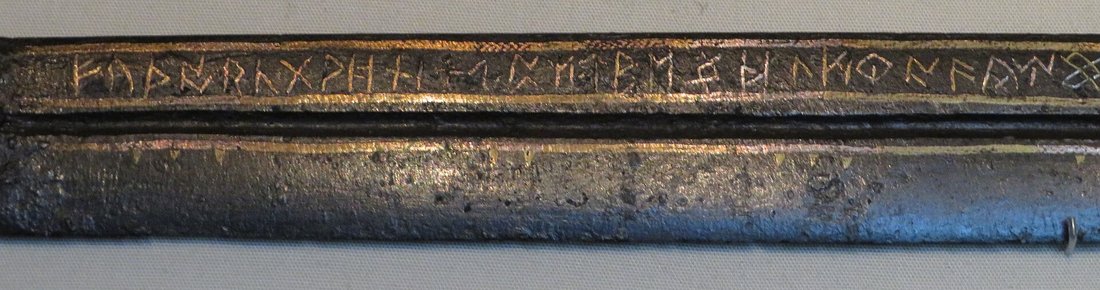
The most famous inscribed weapon find is also the most splendid: the Seax of Beagnoth, a single-edged Anglo-Saxon short sword (seax), recovered from the Thames mud in 1857 and now in the British Museum. On one side of the blade stands the only known complete row of the 28-character Anglo-Saxon futhorc – the English runic alphabet. Beside it, a single name: Beagnoth, the owner or the smith.
Two things reward a second look. First, the technique: the signs are no hasty scratchwork, but skilfully inlaid into the iron from copper, brass and silver wire – a genuine feat of metalwork. Second, an endearing flaw: the order of the runes differs from the sequence recorded elsewhere, and individual signs are oddly formed. The British Museum suspects that the craftsman was not fully at home with runes, or struggled to set them into the hard iron. Anyone who has ever set letters into metal knows the problem. Even the master of Beagnoth slipped – and that is exactly what makes the piece human.
A stubborn error must be cleared away here. The famous Viking swords with blade inscriptions – the roughly 170 blades of the +VLFBERH+T mark or the +INGELRII group – carry no runes. They are Latin capital letters, inlaid into the middle of the blade with iron or steel wire. They come from Frankish workshops in the Rhineland and were the quality mark of their day. Runes and Latin blade-names are two different worlds, easily confused because both are "mysterious signs on a blade".
Genuine runes on the blade itself are in fact rare in the Viking Age; where runes appear, it is rather on the grip, the chape or the scabbard. The Ulfberht story – forgeries, metallurgy and all – we have told separately: see our piece on the Ulfberht sword and the broad overview of the Viking sword.
For us as a workshop, the making is at least as interesting as the content. Broadly, there were three ways letters and runes reached a weapon. First, inlay (tauschierung): a fine groove is cut into the surface, into which soft wire of silver, brass or contrasting iron is hammered – this is how the Seax of Beagnoth and the VLFBERHT blades were made. Second, stamping or punching: a ready-made die is struck into the still-hot or the cold metal, ideal for recurring marks such as wagnijo. Third, plain carving into wooden shafts, bone grips or softer fittings.
Each of these techniques is an ancestor of what laser engraving achieves today: setting a sign permanently and legibly into a hard material. Only the tool differs – the demand that the line sit cleanly and the name endure is two thousand years old. Tellingly, the costliest pieces carry the most elaborate lettering: prestige weapons got inlaid precious-metal wire, everyday gear a briskly struck mark. The effort of the writing was a status marker in itself – whoever could afford an inlaid inscription showed it. More on the typology and classification of Norse weapons can be found in our weapon lore, and on blade classification in our piece on the Petersen typology.
And the magic? It lives above all in the poetry. The most famous testimony is a stanza of the Poetic Edda, in which the valkyrie Sigrdrífa advises the hero Sigurth which runes he should know. The "victory-runes" belong expressly on the sword:
Sigrúnar þú skalt kunna, / ef þú vilt sigr hafa, / ok rísta á hjalti hjörs, / sumar á véttrimum, / sumar á valböstum, / ok nefna tysvar Tý.
"Winning-runes learn, if thou longest to win, / and the runes on thy sword-hilt write; / some on the furrow, and some on the flat, / and twice shalt thou call on Tyr."Sigrdrífumál 6 (Poetic Edda); Old Norse text after the Codex Regius, translation: Henry Adams Bellows 1923
"Twice shalt thou call on Tyr" means: carve the Tyr rune – named for the war-god Týr – twice. It is a wonderfully concrete instruction. Only: it is poetry.
The Sigrdrífumál stands in the Codex Regius, a manuscript of the 13th century, drawing on a time when the old heathenry was long gone. It describes an ideal, not an excavation report. Not a single surviving sword can be linked with certainty to precisely these "victory-runes on the hilt". The poem tells us what runic warcraft was imagined to be – not that every warrior treated his blade this way. Keeping evidence and interpretation cleanly apart is the whole task here: the spears of Vimose and Øvre Stabu are evidence; Sigrdrífa's advice is literature.
Taken together, the two still make a coherent picture. People really did name and mark their weapons – and they told each other stories that the right signs might bring victory. The honest handling of runes means honouring both levels and passing off neither as the other.
For us, a fine circle closes here. The earliest weapon inscriptions were, soberly seen, engravings: they named an object or a person, set permanently into the material. That is still the heart of every good personalised engraving – a name, a date, a sign that stays. You need no invented magical effect to make it worthy; the history carries enough on its own.
So anyone having runes engraved should know one thing, and we tell our customers plainly: rendering a name in runes is a spelling convention, not a secret magic alphabet. Runes are letters with sound values, no more – wonderfully old, wonderfully beautiful, but no wish-machine. And the "blank rune" doing the rounds online, or zodiac-style rune systems, are modern inventions (the blank rune, for instance, goes back to Ralph Blum in 1982) and have nothing to do with historical weapon inscriptions. What matters is the same as in Vimose eighteen centuries ago: a sign that sits cleanly and honestly says whose it is.
And honestly, the thing needs no promise of magic at all. A spear called "the tester". A shield on which a craftsman recorded, eighteen centuries ago, "Nithijo made it". A short sword whose owner had his whole alphabet set into the blade, letter by letter, small mistake and all. That is no incantation – those are people who gave their most important possession a name. Anyone wearing a runic engraving today continues the same old gesture: not to summon powers, but to say who they are and what is theirs. That is reason enough, and a good one.
What is secure: The oldest datable runes come from weapon-sacrifice bogs (Vimose comb harja, c. 150–160 AD; lances marked wagnijo). The Øvre Stabu lancehead bears raunijaʀ ("the tester") – a name of the weapon. The silver shield fitting from Illerup Ådal shows, with niþijo tawide ("Nithijo made it"), the oldest known complete runic sentence. The Seax of Beagnoth (10th c., Thames, British Museum) carries the only complete 28-character futhorc plus the name Beagnoth, inlaid in copper, brass and silver wire. The inscriptions +VLFBERH+T and +INGELRII on blades are Latin letters, not runic work.
Myth-check: Weapon runes are mostly names and maker's marks, not battle-spells. raunijaʀ names the weapon, not the owner. VLFBERHT and INGELRII are Latin – calling them "Viking runes" confuses two scripts. The "victory-runes on the hilt" of the Sigrdrífumál are poetry from a 13th-century manuscript, no proof of common practice. And the "blank rune" as well as horoscope-style rune systems are modern inventions (Ralph Blum, 1982) with no connection to historical weapon inscriptions.
Rune consecration · Runes: origin & history · The Viking Sword · Illerup Ådal · Weapon Lore.
All Runes & Writing articles →
A single rune, cleanly lasered into slate or wood, is a strong motif: minimal, ancient, full of meaning. The only …
Read more →Leifr Eiríksson, Guðrún Ósvífrsdóttir, Ragnar Loðbrók: names from the North sound like little stories – and that is …
Read more →England, the year 1073 – seven years after the Norman Conquest. In the margin of a Christian manuscript someone carves …
Read more →When we say "Odin" and the Vikings said "Óðinn", the Saxons "Wodan" and the south "Wuotan", we are not hearing three …
Read more →