Where do the runes come from, how old are they, and how did 24 characters become first 16 and elsewhere more than 30? This detailed treatise follows the runic script from its Mediterranean roots to the end of the Middle Ages – through all three great runic rows, grounded in the runological literature and with an honest separation of secure evidence from mere interpretation.
There is no such thing as „the" runes – there are three historical main rows that developed apart over roughly a thousand years. Their number of characters is no accident but reflects language change and writing practice. Before we examine each in turn, here are the rows at a glance:
| Row | Characters | Time & place | Distinctive feature |
|---|---|---|---|
| Elder Futhark | 24 | c. 150–800 AD, the entire Germanic area | The original form, arranged in three ættir of eight runes each; fits Proto-Germanic almost exactly. |
| Younger Futhark | 16 | c. 800–1100, Scandinavia (Viking Age) | Reduced – although the number of sounds increased; long-branch and short-twig runes, later „dotted" runes for clarity. |
| Anglo-Saxon Futhorc | up to ~33 | c. 400–1100, England & Frisia | Expanded to represent new sounds of Old English and Old Frisian. |
All three go back to the same root and share the fixed order of the futhark. Their history begins with a question still not conclusively answered: where did the idea come from to capture Germanic speech in characters of its own?
Runes are the letters with which the Germanic-speaking peoples wrote from the early second century AD well into the Middle Ages. The name itself is telling: the Gothic word rūna means „secret" or „confidential counsel", and the Old High German verb rūnēn means „to whisper". Related forms occur in several Germanic and Celtic languages. Whether this sense originally referred to the characters themselves, or was only later attached to them, is not conclusively settled in scholarship. What is clear is that „rune" meant more from the outset than merely „letter" – the word carries a note of knowledge not open to everyone. It does not follow from this, however, that the script was primarily magical; the overwhelming majority of surviving inscriptions are entirely practical in nature.
The Germanic writing system is named after its first six characters, the Futhark: f – u – þ (a th-sound) – a – r – k. This naming after the opening signs is itself a piece of evidence, for the order of the runes was not arbitrary but remarkably stable across the centuries. It is known, among other sources, from so-called futhark inscriptions on which the entire row of characters was carved out as a kind of alphabet mnemonic. This fixed order, which departs from that of the Latin alphabet, is one of the strongest arguments that the runes formed an independently organised system rather than a loose collection of signs.
Runes are a full alphabetic script: in principle one character stands for one sound, just as in the Latin or Greek alphabet. The Elder Futhark comprises 24 such characters and covers the sound system of the early Germanic language stage fairly precisely. Runes thus differ clearly from purely pictographic or syllabic scripts. Alongside this phonetic use there was, however, a second and rarer usage: the so-called ideographic rune. Here a single rune stands not for its sound value but for its name. Each rune bore a traditional name – the f-rune, for instance, was called *fehu („cattle, wealth"), the o-rune *ōþila („inherited land"), the d-rune *dagaz („day"). Where such a rune stands in isolation or as an abbreviation, the reader could supply the whole word. This ideographic use is attested, but it remained the exception; at its core the runic script is a phonetic one.
Runes were written – more precisely, carved or incised – on durable materials: on metal (brooches, weapons, amulets), on bone and antler, on wood, and on stone. Wood in particular shaped the form of the characters. Anyone cutting across the grain works against the fibre; horizontal lines splinter easily and run out into the wood. For this reason runes consist almost exclusively of vertical staves and slanting branch-lines, while true horizontals are absent. This technical constraint explains the characteristic angular appearance of the runes and suggests that wood was an important, if poorly preserved, writing medium from the start.
What is attested: the stable character row of the Elder Futhark with 24 signs, the traditional rune names, the normal phonetic use, and the occasional ideographic use. The derivation of the word „rune" from a root meaning „secret" is linguistically secure – but what cultural role follows from this for the earliest writing practice is a matter of interpretation. (Düwel, Runenkunde 2008; Barnes, Runes: A Handbook 2012)
Where the runes came from is one of the oldest and still unresolved questions of runology. There is agreement only on the broad framework: the Elder Futhark arose around the turn of the era – that is, in the last century BC or the first century AD – through contact between the Germanic peoples and a Mediterranean alphabetic script. That the runes were „invented" wholly independently is considered unlikely: too many runes resemble the letters of the ancient Mediterranean alphabets in form and phonetic principle, and the basic principle „one sign, one sound" is hard to conceive without a model. What is disputed, however, is which script supplied that model. Three main hypotheses stand opposed to one another.
The North Italic (Alpine) hypothesis derives the runes from the alphabets of northern Italy – Etruscan-influenced scripts such as those of Lugano, Sondrio or Magrè, in use in the Alps and their foreland in the first century BC. In its favour is that several rune forms find good counterparts there, and that these alphabets could geographically serve as a bridge between the ancient world and the Germanic north. It was long the preferred solution in older scholarship. Against it stands the fact that the North Italic alphabets were beginning to die out precisely in the decisive period, and that the routes of transmission into the Germanic area can hardly be traced concretely.
The Latin hypothesis sees the model in the script of the Roman imperial period. It can point to the intensive contacts along the Rhine and Danube frontiers: trade, military service and diplomacy brought many Germanic people into contact with Latin writing, and some rune forms correspond quite closely to Latin letters (r, f or b, for example). Against the pure Latin hypothesis is that certain runes are difficult to explain from Latin models, and that the rune names do not follow the Latin system of letter naming but a distinct principle in which each letter is named after a meaningful word.
The Greek hypothesis, finally, points to Greek alphabet variants that may have reached the Germanic area through trade – for example along the great river routes to the Black Sea. Here too individual signs can be compared, yet the historical routes of mediation remain even more speculative than in the other two hypotheses. In practice the arguments overlap heavily, because the ancient Mediterranean alphabets are related to one another: Etruscan, Latin and the Greek variants ultimately go back to a common root. Many rune forms therefore have several possible models at once, which makes an unambiguous assignment difficult.
A recurring argument is the letter-naming principle mentioned above: neither the Latin nor the Greek alphabet names its letters after meaningful words, whereas the runic row does. Some scholars read this as a sign of a deliberate, independent reworking of the borrowed system – possibly by a single person or a single workshop that adapted the foreign alphabet to the Germanic language and writing practice. This idea of a „monogenesis", a single point of origin, is attractive because the earliest runic record is astonishingly uniform across wide distances. It cannot, however, be proven; a gradual process at a contact zone is equally conceivable.
Caution is warranted against overly confident derivations. Comprehensive studies – notably by Bengt Odenstedt (1990) and Michael Barnes (2012) – agree that none of the three hypotheses can be proven conclusively. There is no consensus on the model for the runes, and equally no secure answer to the question of whether a single „inventor" stood at the beginning. Serious accounts name the competing possibilities and their limits – anyone presenting a single, definitive origin story steps beyond what the evidence allows.
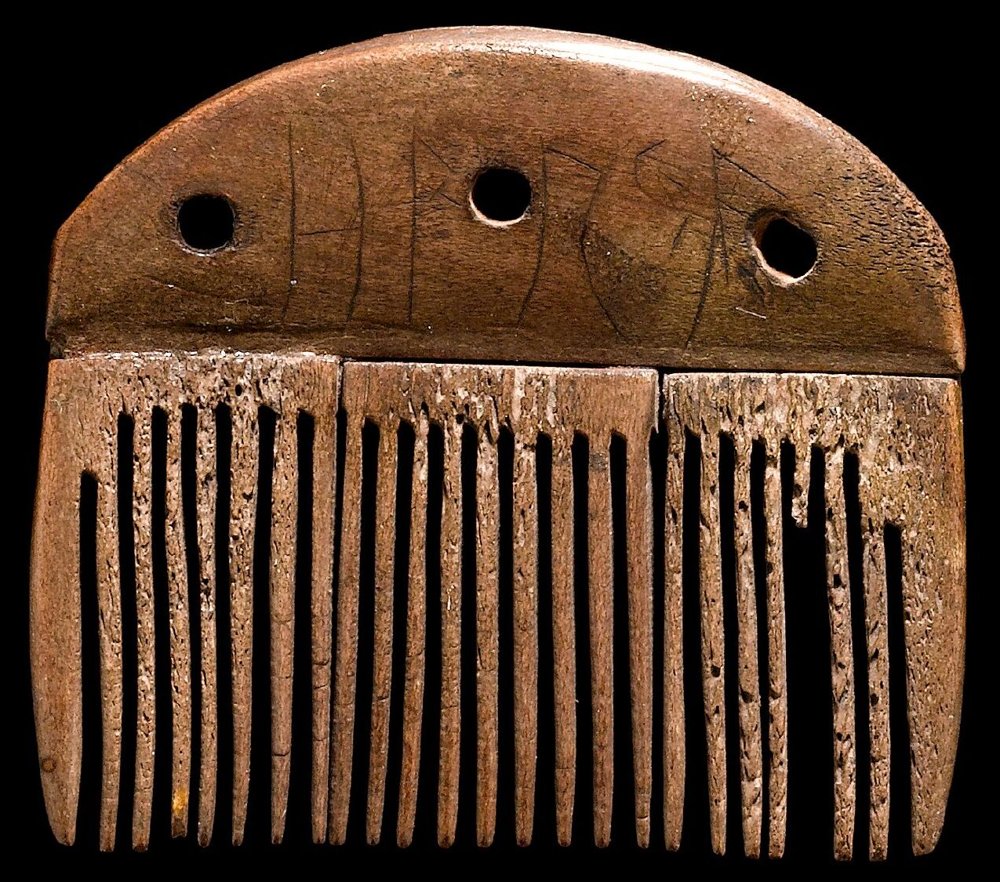
How old the runic script is can only be read from the surviving finds – and these reveal a considerable depth in time. Among the oldest securely legible runic witnesses is the comb from Vimose on the Danish island of Funen, dated to around AD 160. It bears the inscription harja, probably a personal or class name. It is notable that an everyday object is already inscribed here: the writing served entirely practical ends, scarcely ritual ones.
Older still may be the Meldorf brooch from Dithmarschen, around AD 50. Its few characters, however, are disputed: it remains undecided to this day whether they are early runes or Latin letters. The brooch is thus a textbook case of how blurred the boundary was at the beginning – precisely because runes and Latin script are close to the same Mediterranean roots.
A special case is the Negau helm B. Its inscription, which can be interpreted as Germanic and is often read as teiwa (related to the god-name Tiwaz), dates from the period before the turn of the era – but it is written not in runes but in a North Italic (Venetic) alphabet. The helm therefore attests Germanic language in Mediterranean script; it is not a runic monument in the strict sense, but it is a pointer to exactly the contact zone from which the runes are likely to have emerged.
The classical runic period becomes tangible through several famous monuments. The Einang stone in Norway bears the inscription runo faihido – „I painted (or: coloured) the rune". The word faihido shows that runes could be applied not only by carving but also in colour, and that the carvers explicitly named what they were doing. The golden horns of Gallehus (around AD 400) carry one of the finest early inscriptions of all, a complete Germanic alliterative long-line:
ek hlewagastiz holtijaz horna tawidoInscription of the golden horns of Gallehus, c. AD 400 (public domain)
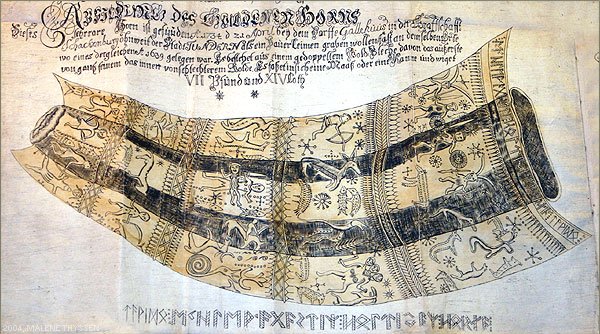
Rendered roughly: „I, Hlewagast, son (or: of the lineage) of Holt, made the horn." The alliteration on h shows that the runic script could already record poetically shaped language – a sign of a mature culture of writing and speech. (The horns themselves were stolen and melted down in 1802; drawings and reconstructions survive.)
The most recent and most spectacular addition to this picture is the Svingerud stone, also called the Hole stone or Holesteinen, after the grave field at Hole in Norway where it was found. First presented in 2023 by the Museum of Cultural History in Oslo and published in detail in 2025 in the journal Antiquity (Zimmermann et al.), the associated graves date, by radiocarbon analysis, to the span of roughly 50 BC to AD 275. This makes the Svingerud stone, by the current state of knowledge, the oldest datable runestone in the world. The scholarly publication assigns the fragments – the stone was found in around 200 pieces distributed across several graves – to an early and apparently still experimental phase of the runestone tradition: alongside legible characters there are incisions whose meaning remains unclear, and indications of several episodes of inscription.
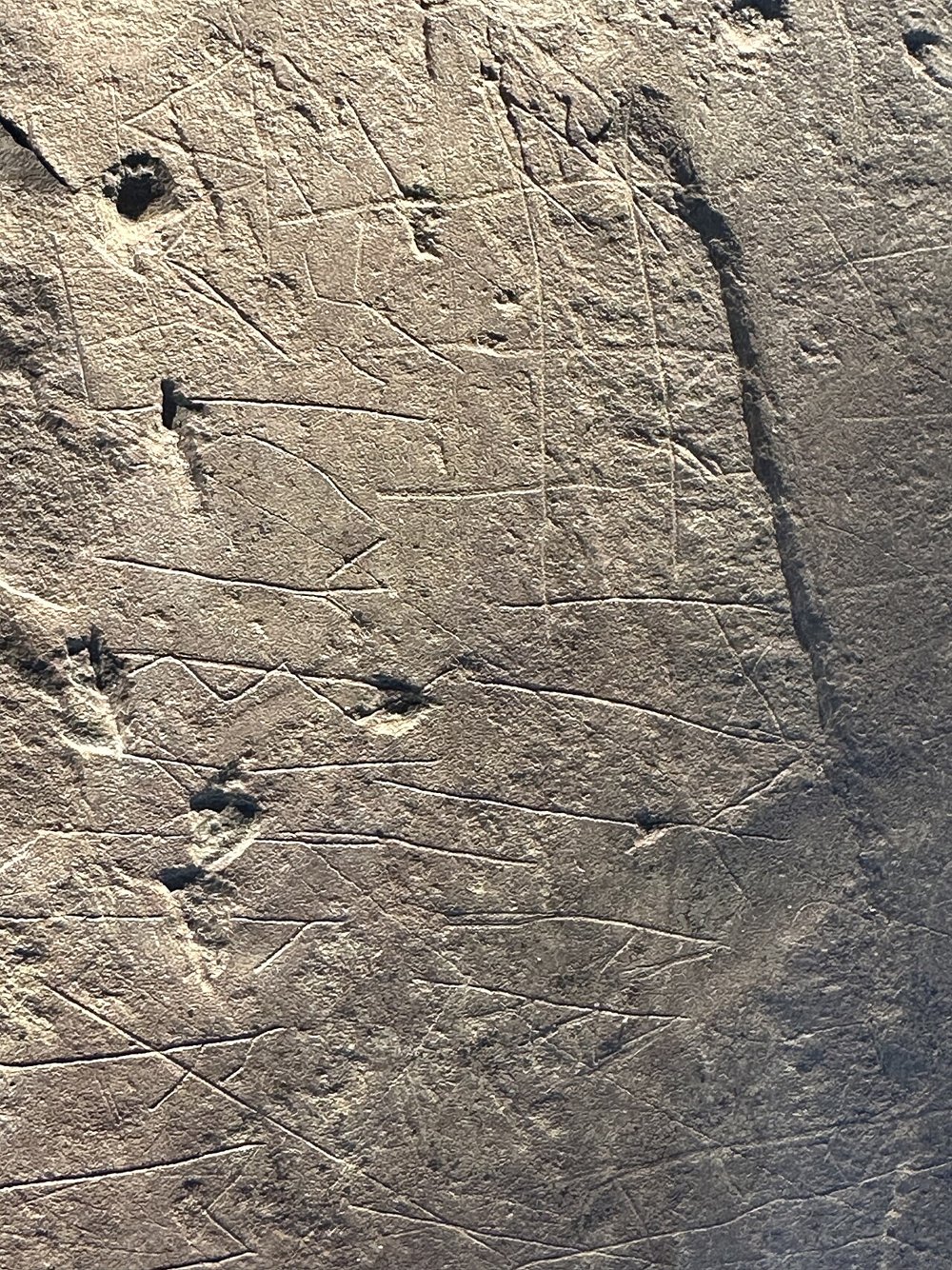
Cleanly separated: what is attested is the early depth in time of the runic script (Vimose c. 160, Gallehus c. 400) as well as the radiocarbon-dated grave context of the Svingerud stone (50 BC–AD 275), which makes it the oldest datable runestone. What remains conjectured or disputed is the interpretation of the Meldorf characters (runes or Latin?), the precise reading of some incisions on the Svingerud stone, and – within the wide radiocarbon span – the exact year of the stone's making. The dating concerns the grave context, not a single calendar year of the inscription. (Antiquity 2025, Zimmermann et al.; Looijenga 2003; Düwel 2008)
At the beginning of the recorded history of Germanic writing stands the Elder Futhark, the oldest and at the same time most uniform runic row. Like the word „alphabet", derived from alpha and beta, it takes its name from the sound values of its first six characters: f, u, þ, a, r, k. It comprises 24 runes and remained in use for the remarkably long span of roughly six and a half centuries. The earliest securely datable witnesses come from the 2nd century AD – such as the Meldorf fibula or the comb from the Vimose bog with its inscription harja – while the latest fall around 700, when the reduced successor row was already gaining ground in the North.
Its geographic reach is striking. The Elder Futhark was no regional phenomenon but the shared script of nearly the entire Germanic-speaking world: finds are spread across Scandinavia, the Central European continent as far as the Black Sea, and – sparsely, and already in altered form – as far as England, where the expanded Anglo-Saxon Futhorc developed out of it. The script was mostly carried by portable objects: weapons and weapon fittings, brooches, combs, pendants, more rarely stones. The inscriptions themselves are predominantly short, often a single word, a name, or a brief owner or maker formula. Long, continuous texts are scarcely to be found in this period.
A characteristic ordering principle of this row is its division into three groups of eight runes each. In the Old Norse scholarly tradition such groups are called ættir (singular ætt, „family, group of eight"). This threefold division is not a modern classification scheme but can already be documented for the time of the Elder Futhark itself.
Evidence: The Vadstena bracteate from Östergötland (Sweden, c. 500 AD) bears the complete Elder Futhark, and its 24 characters are clearly separated into three groups of eight by division marks. A second gold bracteate from Grumpan confirms the same arrangement. The division of the Elder Futhark into eights is thus secured epigraphically – that is, by the inscriptions themselves.
The names Freyr's ætt (f, u, þ, a, r, k, g, w), Hagal's ætt (h, n, i, j, the ï/z zone, p, ʀ, s) and Týr's ætt (t, b, e, m, l, ŋ, d, o) are current – each named after the first rune of the group. Here, however, caution is called for.
Caution with the ætt names: That the Futhark was arranged in three groups of eight is documented for the older row. The names „Freyr's ætt", „Hagal's ætt" and „Týr's ætt", however, come from the younger, medieval Icelandic tradition and refer originally to the Younger Futhark. Applying them to the Elder Futhark is a later attribution. Designations such as „Heimdall's ætt" are wholly modern and attested in no early source.
Linguistically, the Elder Futhark reflects the stage of Proto-Germanic or Common Germanic – and does so with astonishing precision. Its 24 characters correspond closely to the sound inventory of this reconstructed language; as a rule each rune had a fixed sound value. This explains why runologists describe the Elder Futhark as an exceptionally well-fitting writing system: it has dedicated characters for sounds that later Germanic languages had long lost or shifted, such as the voiced z-like final sound (for which the later row uses the sign ʀ) or the ï-sound associated with Eihwaz. Script and language fitted one another like key and lock.
Unusually for so old a writing system, no rune poem for the Elder Futhark survives. The names of its characters – Fehu „cattle, wealth", Uruz „aurochs", Þurisaz „giant/thorn", Ansuz „god/Æsir", and so on – are therefore not directly attested but reconstructed. Scholarship derives them from two directions: from the considerably younger rune poems (the Anglo-Saxon, Norwegian and Icelandic poems, all written down only centuries later) and from the transmitted letter-names of the Gothic alphabet. These names are thus well-grounded reconstructions, not literally transmitted labels from the period itself – a distinction that serious accounts make explicit.
The practice tangible in this period – short, clearly legible name and maker formulas such as that on the golden horn of Gallehus (ek hlewagastiz holtijaz horna tawido) – shows the script first of all as a tool of communication. Whether runes also served a magical practice beyond this is an old debate. Formula words such as alu or laukaʀ on certain objects are often interpreted in that way, yet the great majority of attested inscriptions simply name owners or makers. The notion of the rune as a mysterious magical sign is considerably younger than the script itself; the early evidence speaks first for practical use as writing (cf. Barnes 2012; Düwel 2008).
Between the 6th and early 8th centuries, North Germanic underwent a profound sound change that linguists call the „syncope period". During this transitional phase the sound of the language shifted so drastically that the runic row emerged at its end in a fundamentally different shape from the one it had had at the start. Three developments interlock here.
First, the syncope that gives the period its name: unstressed syllables, still fully pronounced in Proto-Norse, weakened or fell away entirely. An older *gastiz („guest") became younger gestr; *horna became horn. Words grew shorter and the word stress stood out more sharply. Second, umlaut: a vowel in the following syllable „coloured" the stressed vowel before it, producing new vowel qualities such as the umlauted y or ø, which had not previously existed as independent sounds. Third, breaking, in which a simple vowel split into a diphthong depending on its phonetic surroundings (for example e becoming ja or jo).
The result was paradoxical. All these processes increased the number of meaning-distinguishing sounds, the phonemes, of the language. One would therefore have expected a script meant to represent this language to require more characters. In fact the exact opposite happened: precisely at this time the runic alphabet was reduced from 24 to 16 characters. The Younger Futhark that emerged from this upheaval had eight fewer signs than its predecessor – even though the language had grown phonetically richer. Transitional forms of this reduction can be traced in inscriptions of the 7th century.
Evidence: Between the fully developed Elder Futhark and the finished Younger Futhark stand inscriptions with mixed forms and a still-fluctuating set of characters, such as the southern Scandinavian stones of the transitional period (the Blekinge group and others, 6th/7th century). They show that the reduction was not a sudden break but a process spanning several generations.
The immediate consequence of this contraction was a high ambiguity of the signs. Since 16 runes now had to carry a larger and partly newly arisen sound inventory, a single character stood for several different sounds. The same rune could, depending on the word, represent voiced and voiceless k/g, t and d, b and p; a single vowel sign covered several vowel qualities. This was read from context – much as a practised reader today recognises a word even when its vowels are only hinted at. For the writers of the Viking Age this imprecision evidently posed no serious obstacle.
Why a culture simplified its script precisely when its language was growing more complex is one of the great open questions of runology. Two approaches are chiefly discussed. One appeals to writing economy: fewer and simpler characters to carve make writing easier, and the resulting ambiguity could be offset by context, especially as there was no fixed orthographic norm. The other sees rather a deliberate break with tradition or a new, supra-regionally shared understanding of writing at work.
Interpretation, not established cause: Both explanations are attempts at interpretation, not proven facts. Why the Younger Futhark managed with fewer characters despite a growing number of sounds has still not been conclusively clarified. Serious accounts name the reduction as an established finding but its cause as an open research question (cf. Barnes 2012; Spurkland 2005).
Out of the transitional phase emerged the runic row commonly associated with „the Vikings": the Younger Futhark with its 16 characters. It is the script of the Viking Age in the narrower sense, accompanying the entire span from about 800 to 1100. In this row runic writing reached at once its widest distribution and its highest density of monuments.
The Younger Futhark existed in two main variants that differ above all in stroke form. The long-branch runes – often called „Danish" or „normal" runes – are the more fully executed, readily legible form. Opposite them stand the short-twig runes, also called „Swedish-Norwegian" or, after the famous Rök stone, „Rök runes": in these the side-strokes and secondary staves are strongly shortened or reduced to the main stave, which makes carving easier. Both variants render the same sound inventory; they are not separate alphabets but two ways of writing the same row, which also occur side by side and mixed.
| Feature | Long-branch runes | Short-twig runes |
|---|---|---|
| Common designation | „Danish" / „normal" runes | „Swedish-Norwegian" / „Rök" runes |
| Stroke form | fully executed side and secondary staves | shortened, simplified secondary staves |
| Number of characters | 16 | 16 |
| Typical use | representative runestones, formal inscriptions | quicker, everyday carvings |
| Sound inventory | identical | identical |
Alongside these two main forms there was a third, extremely reduced variant: the stavlösa rúnir or Hälsinge runes, often called „staveless runes". In these even the vertical main stave is omitted, so that only the characteristic side elements remain – a kind of shorthand known above all from the Swedish province of Hälsingland and capable of being extraordinarily difficult to decipher.
The ambiguity that arose in the upheaval did not remain unresolved forever. From the High Middle Ages onward the stungnar rúnir came into use – „pricked" or dotted runes. Here a small dot (a „prick") in or beside a rune marked a particular sound variant and thus distinguished, for instance, k from g or i from e. From 16 basic characters a more finely differentiated system could once again be won. These dotted runes are a post-Viking-Age development; they belong to the medieval period and accompany the gradual transition to the Latin script.
The Viking Age brought a veritable runestone „boom". After comparatively few stones had been raised in the preceding centuries, a wealth of memorial stones arose, above all in the 11th century in Scandinavia. Their focus lies clearly in Sweden, and there in turn in the province of Uppland.
Evidence: Uppland has the highest density of runestones in the world – over 1,300, most of them erected toward the end of the Viking Age in the 11th century. Across all of Scandinavia the total runs to several thousand. Many of these stones already arose in a Christian setting and bear, alongside the memorial formula, a cross or an intercessory prayer – runic writing was thus by no means bound to paganism.
The typical inscription on such a stone follows a fixed formula: a commissioner had the stone raised in memory of a deceased relative, often supplemented by the person's deeds or the name of the rune-master. These are above all personal, familial and legal testimonies – remembrance of the dead, evidence of inheritance claims, professions of the new faith.
King Haraldr had these monuments made in memory of Gorm, his father, and in memory of Þyrvé, his mother – that Haraldr who won for himself all of Denmark and Norway and made the Danes Christian.Rendered from the large Jelling stone (Denmark, c. 965), Younger runes
The distribution of the Younger Futhark extended far beyond the Scandinavian heartland. With the voyages of the Viking Age the script reached the colonies and the edges of the known world: on the British Isles numerous carvings are found, among them the famous walls of the Maeshowe burial mound on Orkney, which Norse travellers covered with runic graffiti in the 12th century. In the East, the runestone of Berezan at the mouth of the Dnieper attests to its reach as far as the Black Sea; in the far northwest, finds from Greenland (such as the stone of Kingittorsuaq) document the script at the margin of the settled world.
Because the runestones of the Viking Age usually bear no year, scholarship has sought ways to place them in time nonetheless. A particularly robust method comes from Anne-Sofie Gräslund: a stylistic chronology that dates not the runes themselves but the ornamental design of the stones – above all the form of the runic band and of the serpent or animal heads into which it terminates. At the beginning stands the type RAK (c. 990–1010): the runic band ends straight, without an animal head. Next comes the type Fp (c. 1010–1050), in which the serpent head is shown from above, in „bird's-eye view". The types Pr1 to Pr5 finally show the head in profile and can be finely graded through the development from the Ringerike style (Pr1–Pr2, c. 1010–1050) to the Urnes style (Pr3–Pr5, c. 1045–1130). In this way an undated stone can be placed remarkably precisely on the basis of its ornamental style alone.
With the Younger Futhark, its variants and its rich stone tradition, runic writing reached its peak as a living script of everyday life and remembrance – before it gradually yielded to the Latin alphabet over the course of the Middle Ages, while holding on for a long time yet in peripheral areas such as the medieval Bryggen carvings and the late Dalecarlian runes (cf. Barnes 2012; Düwel 2008; Spurkland 2005; Gräslund on stylistic chronology; Page).
When Germanic groups — Angles, Saxons, Jutes and Frisians — crossed to Britain in the fifth century, they brought the Elder Futhark and its 24 characters with them. The sound changes of Old English and closely related Old Frisian, however, produced new vowels and diphthongs for which no inherited rune existed. The script was therefore extended step by step: from the 24 continental signs grew, over time, as many as around 33 runes, capable of rendering the finer sound distinctions of the insular languages. Because England and the Frisian coastal region largely shared these innovations, scholars also speak of an „Anglo-Frisian" runic tradition.
The name „Futhorc" itself documents this change. In the older system the first six runes give the sound sequence f-u-þ-a-r-k („Futhark"). In Old English the a-sound of the fourth rune (Proto-Germanic *ansuz) shifted towards an o, so that the mnemonic sequence now reads f-u-þ-o-r-c — hence „Futhorc". Characteristic new creations include āc („oak", for long a), æsc („ash", for the æ-sound) as well as ȳr and ēar; they filled the gaps that the inherited inventory left for English pronunciation. The exact number of signs varied by region and period — the Northumbrian variant knows the most additional runes.
The futhorc was in use for centuries before it gradually gave way to the Latin alphabet. Its most important witnesses are at the same time among the finest objects of early medieval art. The Franks Casket (also the Auzon Casket), a box of whale bone from the north of England around 700, bears long runic inscriptions that comment on biblical, Roman and Germanic legendary scenes. The Ruthwell Cross in Dumfriesshire, Scotland, a stone high cross, combines runes with verses closely related to the Old English poem „The Dream of the Rood". The Seax of Beagnoth, a single-edged short sword recovered from the Thames (now in the British Museum), carries one of the few complete futhorc rows, inlaid beside a personal name. From the Frisian region come early small finds such as the comb of Toornwerd, showing that the insular Germanic runic tradition spanned both shores of the North Sea.
Established fact: the Franks Casket, the Ruthwell Cross and the Seax of Beagnoth are surviving original objects with legible futhorc inscriptions; the expansion of the sign inventory to as many as around 33 runes is attested by inscriptions and manuscripts. What often remains open is the precise interpretation of individual passages — for instance on the Franks Casket, whose combined picture-and-text programme is debated to this day.
What individual runes „meant" — that is, which names and images were associated with them — we know above all from three medieval rune poems. They are, however, considerably younger than the runes themselves and marked by Christianity. Each poem assigns the runes a name in the order of their row and explains it in a few lines — a kind of rhymed mnemonic catalogue by which the signs and their names could be memorised.
The Old English rune poem is the most detailed. It survives in a manuscript of around the year 1000 (Cotton Otho B.x), partly destroyed in the 1731 fire of the Cotton library at Ashburnham House; the text is today known chiefly through an earlier printed transcript. Briefer, and referring to the younger 16-rune futhark, are the Norwegian and Icelandic rune poems (13th–15th century). To these is added the Abecedarium Nordmannicum of the ninth century (Codex Sangallensis 878), the only continental listing of the younger row with its names.
| Source | Language / row | Dating | Scope |
|---|---|---|---|
| Old English rune poem | Old English, futhorc | manuscript c. 1000 | most detailed source |
| Norwegian rune poem | Old Norse, younger futhark | 13th century | brief, two lines each |
| Icelandic rune poem | Old Icelandic, younger futhark | 15th century | brief, with kennings |
| Abecedarium Nordmannicum | continental, younger futhark | 9th century | name list only |
Honesty is required here: these poems are our main source for the rune names, but they are late and tendentious witnesses. The same rune can carry quite different images in different poems. Thus the fourth rune (a or o) stands in the Old English poem for ōs in the sense of „mouth" — with a learned nod to Latin os — whereas in the Icelandic poem it stands for „god/Áss", explicitly linked to Odin. From such names, therefore, one can reconstruct neither a uniform, ancient „system of meanings" nor a reliable picture of a pre-Christian cult; they show, rather, how medieval scholars interpreted the signs each in the terms of their own age.
„Feoh byþ frofur fira gehwylcum; / sceal ðeah manna gehwylc miclun hyt dælan / gif he wile for drihtne domes hleotan." — Wealth is a comfort to every man; yet each must give it away freely if he wishes to gain honour in the sight of the Lord.Old English rune poem, feoh stanza (public-domain original text); rendering: Glanz & Gravur, cf. Bruce Dickins, Runic and Heroic Poems, 1915
Anyone who surveys the surviving runic inscriptions as a whole encounters above all practical matters. The overwhelming majority give names, record ownership, formulate memorial phrases of the type „X raised this stone for Y", or note everyday and commercial affairs. An outstanding witness to this are the runic sticks of Bryggen in Bergen (Norway, 12th–14th century): several hundred inscribed pieces of wood bearing trade notes, ownership marks, short messages, prayers, practice alphabets and also coarse remarks. They show runic writing as the living, everyday script of a trading town — written by merchants and craftsmen, not as the secret knowledge of a priestly caste.
The British runologist R. I. Page repeatedly warned against „magical" over-interpretation — against the tendency to see an incantation in every inscription. His sober principle: first read what actually stands there before reading hidden meanings into it.
This does not deny ritual use, however. There are genuine formula words whose sense remains obscure and which can hardly be explained as mere communication: the frequent alu, the laukaʀ („leek", perhaps as an emblem of growth or protection), or an isolated repeated þ. And there are outright curses: the stones of Björketorp and Stentoften in Blekinge (southern Sweden, around the 7th century) threaten misfortune and treacherous death upon anyone who destroys the monument. Such inscriptions prove that runes were also used for consecration, protection and malediction.
Even the much-admired bind runes — two or more characters sharing a common vertical stave — are as a rule simply a saving of space or an aesthetic abbreviation, not encoded magic. The scholarly conclusion is balanced: a ritual-magical use of the runes did indeed exist, but it stood beside the everyday script, not in its place.
Beware the blanket formula „runes are a magic alphabet". It reverses the relationship: by far the greatest part of the inscriptions is profane. The modern notion that every rune is a secret sign with a fixed magical effect stems from esoteric literature of the 19th and 20th centuries, not from the historical sources.
With Christianisation the Latin alphabet prevailed throughout northern Europe — carried by church, administration and book culture. The runes did not vanish overnight, but they were pushed out of the centre of literate life. In England the futhorc died out around the 11th century; in Scandinavia runic writing remained alive considerably longer.
Remarkable is its regional survival. In the high and late Middle Ages the so-called medieval runes emerged, used alongside the Latin script in ecclesiastical settings and in daily life — the Bryggen sticks are a prime example. In the Swedish province of Dalarna, and especially in Älvdalen, the Dalrunes (Dalecarlian runes) persisted as a local script into the 19th century, and in isolated use even into the early 20th century. And in Latin manuscripts runes appear as „runica manuscripta" — scholarly notes, alphabet lists and glosses with which medieval scribes recorded and passed on the old sign system.
From the 17th century onward the runes were rediscovered and studied scientifically by scholars; in the 19th century a romantic-national idealisation set in as well, overlaying the sober picture of the script.
Context and warning: in the 20th century individual runes — above all Sowilō (the „Sig rune") and Othala (the „Odal rune") — were misused as political symbols by the völkisch movement and under National Socialism. This appropriation is a modern ideological construction and has nothing to do with the historical meaning and actual use of the runic script.
Runology, the scholarly study of the runes, works with a clear methodological toolkit. Inscriptions are first transliterated, that is, transferred sign by sign into Latin letters; this transliteration is conventionally rendered in bold type. Reconstructed or uncertain sounds are placed in brackets or marked with special characters — for example ʀ for a fricative that arose from z. In this way it remains recognisable at all times what stands on the object and what is the researcher's interpretation.
The direction of reading matters and by no means always runs from left to right: there are right-running and left-running inscriptions, and in so-called boustrophedon the direction alternates from line to line, like ploughing a field. Only the correct determination of the reading direction — together with word dividers, context and language stage — makes a text legible.
So that individual finds do not remain isolated, scholarship collects them in large corpus editions. For the North the database Rundata (Samnordisk runtextdatabas) is the central tool; to it are added ongoing projects such as RuneS and the Reallexikon der Germanischen Altertumskunde (RGA). Fundamental introductions are provided by R. I. Page (An Introduction to English Runes, 1999), Michael Barnes (Runes: A Handbook, 2012) and Klaus Düwel (Runenkunde, 2008). In this way every interpretation remains verifiable — every statement about a rune can be traced back to its material basis in the find record. Herein lies the difference between serious runology and free interpretation: not in a claim to secret knowledge, but in verifiability.
This treatise lays the foundation; the individual characters are presented in detail in our rune lexicon with all 24 runes of the Elder Futhark, and for further reading the bilingual reading pages and the large Rune Handbook are available as a free PDF in our library.
Runes & their meaning · The Rúnatal – the spell-songs of the Hávamál · Rune magic – alu, laukaʀ and the formula words · Ogham · The Rök Stone.
All Runes & Writing articles →
Before the runes became oracle stones in a pouch, they were simply the first alphabet of the North – for names, trade …
Read more →Some runic inscriptions form no smooth sentence, but only single, recurring words: alu, laukaʀ, laþu. They stand on …
Read more →Some runestones move us across a thousand years. The Skarpåker stone in Södermanland is one: a father casts his grief …
Read more →A Danish stone from the early 9th century carries two riddles at once: a symbol of three interlocking drinking-horns …
Read more →