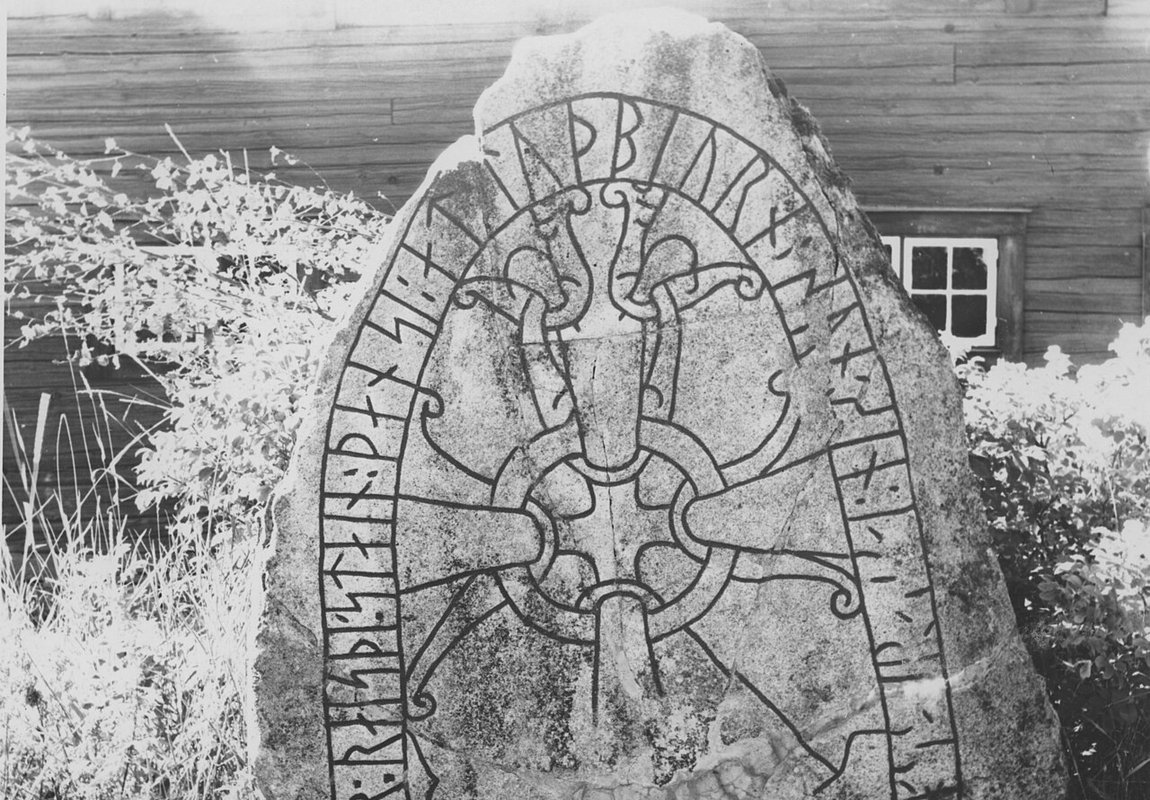
Some runestones move us across a thousand years. The Skarpåker stone in Södermanland is one: a father casts his grief into an image of the end of the world.
There are runestones that move us across a thousand years because in them a human being becomes tangible. The Skarpåker stone in Södermanland is one. It is no monument to a fallen warrior or a rich lord, but the witness of a father grieving for his child – and finding, for that grief, words that still take one’s breath away today.
The inscription begins as plainly and as heavily as a thousand others: Gunnarr set this stone for Lýðbjörn, his son. A father who outlives his son – the reversal of the natural order, a loss that in all times and all cultures counts among the heaviest. But then Gunnarr adds a line that breaks out of the frame of all the usual memorial formulas.
„Earth shall be riven and heaven above." — Skarpåker stone (Sö 154), iarð skal rifna ok upphiminn
These words in artful alliteration allude to Ragnarök, the end of the world, when, according to the Völuspá, earth and heaven burst and all sinks into fire and flood. But for the grieving father it is no distant, mythic cosmic event. It is the most exact description of what has happened within him. With the death of his child the world has broken – his world, the order in which a father dies before his son and not the other way round.
Rarely has a runic text shown so clearly that the great cosmic myth of doom could also be the language of the most personal loss. The world-fire of Ragnarök becomes here the emblem of one broken heart. Gunnarr needed to invent no new image; he reached for the mightiest image his culture knew, because only that could do justice to his grief.
Remarkably, the alliterative line itself is old and formulaic. Similar phrases are known from Eddic poetry, and an astonishingly close parallel is found even in the Old High German Wessobrunn Prayer, a Christian creation-text from southern Germany, which likewise speaks of a time when „earth was not, nor heaven above". The same age-old poetic formula of the non-being and passing of the world evidently lived across language borders – in the North as in the Germanic south.
Whether Gunnarr consciously quoted Ragnarök or reached for a common poetic formula cannot be decided for certain. For the effect it makes no difference. He took an inherited, heavy line and joined it to the concrete name of his dead son – and so made, out of a formula, something deeply his own.
The Skarpåker stone reminds us that the people of the Viking Age were, in their innermost being, not so foreign to us. They loved their children, they grieved, and they sought words that could withstand the unbearable. That a father, more than nine hundred years ago, had his grief carved into stone so that it would remain, is something we understand deeply. Today too people wish to hold fast a name, a memory, a feeling that defies time.
That, at heart, is also what an engraving is about: giving a person, a moment, a remembrance permanence. The Skarpåker stone is perhaps the most moving engraving of the North – and a silent proof that carved words really can carry across a thousand years.
Ragnarök · Runes · Burial & Remembrance · What comes after.
Skarpåker stone (Sö 154), Rundata. Rudolf Simek, Dictionary of Northern Mythology; Völuspá (Poetic Edda). Image credit (title): Skarpåker stone (Sö 154), historical photograph, public domain (Wikimedia Commons).
All Runes & Writing articles →
A Danish stone from the early 9th century carries two riddles at once: a symbol of three interlocking drinking-horns …
Read more →A runestone from Jutland reveals how closely the North was interwoven with the southern shore of the Baltic – through a …
Read more →The passage from the heathen to the Christian North did not happen overnight – and sometimes both worlds stand on one …
Read more →A single rune, cleanly lasered into slate or wood, is a strong motif: minimal, ancient, full of meaning. The only …
Read more →