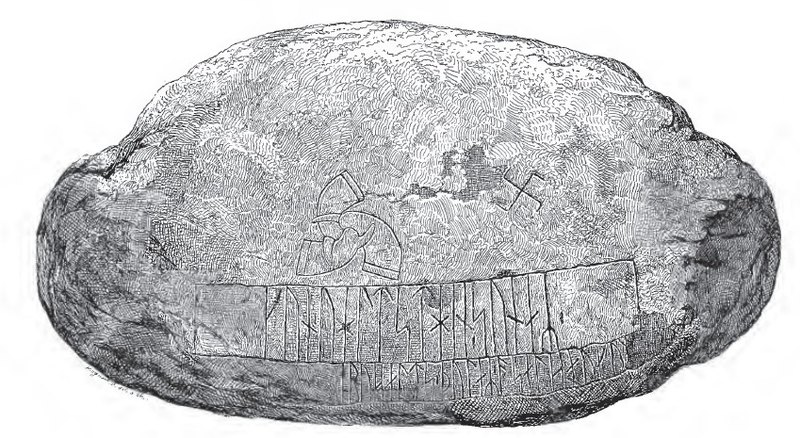
The Snoldelev Stone (DR 248) is one of Denmark's earliest runestones, found on Zealand and now kept at the National Museum of Denmark in Copenhagen. Its inscription reads, roughly, “Gunnvaldr's stone, son of Hróaldr, þulr at Salhaugar”. Next to it are three signs: a wheel cross, a swastika used as an ancient sun symbol, and a triskele made of three interlocking drinking horns. Here is what the stone actually says, what a þulr may have been, why the runes look so old-fashioned, and where Salhaugar was.
Picture a grey lump of granite, barely as tall as a child, on a low rise in eastern Zealand. No dragon ribbons, no crucifix, no king. Just one line of runes running straight across an ancient circle-and-cross, and beside it a swastika and three drinking horns hooked into each other like the fingers of two men sealing an oath. A name, a place – and a title you will hardly ever meet on a runestone.
The Snoldelev Stone is small, but it punches far above its weight. It is among the oldest runestones in Denmark, it preserves the oldest written form of a Danish place-name that can be securely tied to a village that still exists, and it names an office we otherwise know almost only from Eddic poetry: the þulr.
Let us start with the solid ground. In the scholarly numbering the stone is DR 248. “DR” stands for Danmarks Runeindskrifter, the great corpus edited by Lis Jacobsen and Erik Moltke in 1941–42, whose numbers are still used for Danish runic inscriptions today. The stone is granite and about 1.25 metres tall. Farmers found it in the 1770s on stony ground between the villages of Snoldelev and Salløv, south of Roskilde. Sources disagree on the exact year – dates between 1770 and 1780 are given – so we will not pretend to know it.
The stone attracted learned attention early on. In 1812 the journal Antiqvariske Annaler published a long study of “the Snoldelev runestone”. Today the original stands in the National Museum of Denmark in Copenhagen. A replica was put up at the open-air centre Sagnlandet Lejre and unveiled there at midsummer, a gift from the centre's friends' association.
The surroundings matter too. Excavations in the 1980s near the find spot uncovered a Viking Age cemetery, including a richly furnished woman's grave from the early part of the period. So the stone very probably did not stand in an empty field but on a burial ground – the place where a community kept its memory.
Runologists transliterate the runes like this (following the Scandinavian runic text database Rundata; capital letters mark special rune forms, brackets a rune that has been restored):
kunuAlts stAin sunaR ruHalts þulaR o salhauku(m)Transliteration after Rundata, DR 248
Normalised into Old Danish this gives roughly Gunnwalds stæin, sunaR Hroalds, þulaR a Salhøgum. Word for word: “Gunnvaldr's stone, son of Hróaldr, þulr at (the) Salhaugar.” Three bits of identity, a place, a title.
That brevity has an awkward consequence. Grammar alone does not tell us who the þulr was. The word forms allow both readings: “Gunnvaldr's stone, son of Hróaldr the þulr” (so the father held the office), or “Gunnvaldr's stone – Gunnvaldr, Hróaldr's son, þulr at Salhaugar” (so the son did). Most translations attach the title to Gunnvaldr, since the stone is his. But Danish specialists such as the runologist Lisbeth Imer of the National Museum stress that the inscription simply does not settle it. Anyone who tells you that Gunnvaldr was “the priest of Salløv” is saying more than the stone does.
A second detail: the last rune has flaked away. What survives is salhauku; an m is restored to give the dative plural Salhøgum, “at the Sal-mounds”. That fits the preceding preposition á (“at, on”) neatly and is widely accepted – but it is a restoration, not a reading.
If you know the runes of the famous Jelling stones, Snoldelev will make you pause. Some signs look familiar, others odd. That is because the stone belongs to a period of transition. In the seventh and eighth centuries the 24-letter Elder Futhark was being reshaped into the 16-letter Younger Futhark. Snoldelev already uses the younger system but keeps a few older shapes.
The most striking one is the rune for a. On the stone it looks like a vertical stave with crossed branches (ᚼ) – exactly the shape that stands for h in the later “long-branch” Younger Futhark. That is why transliterations print it as a capital A. The same a-form appears on the Björketorp stone in Blekinge, another inscription from the transitional period.
Other features show how lean the new alphabet was:
Finally, the little preposition á is written with the o-rune. On the usual explanation, at this early stage that rune still stood for a nasalised a-sound – one more sign of the inscription's age.
This is worth a closer look, because books and websites give different dates. Older surveys and much of the English-language literature place the stone in the ninth century, the early Viking Age. More recent Danish work pushes it back a little. The Name Research section at the University of Copenhagen dates it to around 700–800, and Lisbeth Imer speaks of the eighth century, the very end of the Iron Age.
The reason for the earlier date: the rune forms match those on a famous find from Ribe, an inscribed fragment of human skull that probably served as an amulet and belongs archaeologically to around 725–750. Put honestly: the Snoldelev Stone was carved in the eighth or early ninth century, with current Danish opinion leaning towards the eighth. Either way it is much older than the Glavendrup and Tryggevælde stones or the Jelling stones of the tenth century, and it belongs to the same early league as the Rök stone in Sweden.
What sets this stone apart among Denmark's early runestones is its imagery. And here it gets interesting, because the signs may not all be the same age.
The wheel cross. Beneath the line of runes lies a circle with a cross inside it, a so-called wheel cross. The runes partly run over it. Specialists draw the obvious conclusion: the wheel came first, and the rune carver reused a stone that had already been worked. Lisbeth Imer interprets the wheel cross as a religious sign of the Bronze Age – the era that also produced the Trundholm sun chariot and countless sun discs pecked into rock. If she is right, the stone had been a marker for well over a thousand years before Gunnvaldr's name was added.
The swastika. Next to it is a swastika, in Danish hagekors. For people of the Iron Age and Viking Age it meant something very different from what it means to us: it was an ancient and widespread symbol of good fortune and the sun, a turning wheel found on gold bracteates, weapons, brooches and vessels, from India to Scandinavia. On the Snoldelev Stone it belongs to that pre-Christian tradition, set between a sun wheel and drinking horns.
The horn triskele. The third sign is the famous one: three drinking horns whose tips interlock so that a three-armed, rotating figure appears – a triskele. Strictly speaking we cannot be completely certain they are drinking horns, but the wide mouth and curved tip make it very likely. The motif belongs to the family of Viking Age “threefold” signs such as the triquetra and the valknut. A similar horn design is often cited from the Lillbjärs picture stone on Gotland, which also shows a valknut; whether the two signs belong together in meaning is unknown.
In the North, drinking horns were never just tableware. They sat at the heart of hall culture: the shared feast, the vow sworn over a full horn, the memorial toast for the dead. The sagas tell of oaths and toasts at the sumbl, the formal drinking ritual, and the golden horns of Gallehus from the early fifth century show how lavishly such vessels could be decorated. Lisbeth Imer points out that offering a drink was part of the moral code of the Iron Age and Viking Age – hospitality as duty, not as a nice extra. What was poured was often mead.
What exactly the three horns on the stone stand for, nobody knows. Two ideas dominate, alongside the simple reading as a general good-luck sign like the swastika.
First, the hall and feast reading: the horns stand for the drinking ritual itself, for fellowship, guest-right and oath – a good fit for a place called “Sal-mounds”, named after halls.
Second, the mead of poetry. According to Snorri Sturluson (Skáldskaparmál, thirteenth century), the mead of poetry, brewed from the blood of the wise Kvasir, was kept in three vessels – the kettle Óðrerir and the vats Boðn and Són – until Odin won it by trickery from Gunnlöð. Three horns, three vessels, and next to them a man whose title is about reciting knowledge: the link is tempting. It is, however, a modern interpretation that projects a thirteenth-century text onto an eighth-century image.
Now for the real puzzle. The word þulr (pronounced roughly “thoolr”, on the stone still in its archaic form þulaR) is well known in Old Norse – but almost only from poetry. It belongs with the verb þylja, “to murmur, to recite solemnly”, and with the noun þula, a versified list. Such þulur survive in manuscripts of Snorri's Edda: long, metrical catalogues of names for gods, giants, swords, ships and horses – study material for poets, built like an oral dictionary. The Eddic poem Rígsþula carries the word in its title.
So by its very word, a þulr is someone who recites. What he recited, and in what setting, is the big question. Old Norse dictionaries usually give “speaker, sage, wise man”; the Rundata database translates the word on Snoldelev as “reciter”. The Danish encyclopedia lex.dk suggests the office may have combined secular and religious functions.
The Eddic evidence is thin but powerful. In Hávamál, the great collection of wisdom put into Odin's mouth, stanza 111 opens like this:
It is time to chant from the chanter's stool; By the wells of Urth I was, I saw and was silent, I saw and thought, And heard the speech of Hor.Hávamál 111, translated by Henry Adams Bellows, 1923
The original says Mál er at þylja þular stóli á – “it is time to recite on the þulr's seat”. The þulr has a fixed place, a seat to speak from, and the poem sets it near the Well of Urðr, where fate is shaped. Whether this reflects a real institution we cannot say, but a speaker's seat is a mark of rank.
Twice Hávamál mentions a fimbulþulr, a “mighty þulr”, who coloured the runes that the gods created (stanzas 80 and 142 in the Old Norse numbering). This great speaker is usually identified with Odin, the god who won the runes and gathers knowledge. And stanza 134 warns: at hárum þul hlæ þú aldregi – never laugh at a grey-haired þulr. Bellows renders it: “Scorn not ever the gray-haired singer, Oft do the old speak good.”
Giants know the word too. In Vafþrúðnismál, the deadly contest of knowledge between Odin and the giant Vafþrúðnir, stanza 9 uses the phrase inn gamli þulr, “the old þulr”, for the giant, master of lore in his own hall. And in Fáfnismál (stanza 34) the birds advise Sigurd to send inn hára þul, the grey-haired þulr, to Hel – meaning Reginn the smith, Sigurd's scheming foster-father. The picture is consistent: the þulr is old, clever, eloquent – and not always harmless.
The word is not only Norse. Old English has the cognate þyle, and it turns up in a prominent place. In Beowulf, Unferth, who sits at the feet of the Danish king Hrothgar, bears this title. It is he who confronts young Beowulf with a mocking speech about a lost swimming contest. Was he doing his job – testing the guest, challenging boasts – or simply a jealous courtier? Scholars have argued about it for a long time; Norman E. Eliason's 1963 article on the þyle and the scop in Beowulf is a classic contribution.
In Old English glosses, þyle also translates Latin words for orators and performers, so its range runs from serious speaker to entertainer. This matters for Snoldelev because Beowulf is set at the court of Danish kings on Zealand, at the hall of Heorot, which many scholars connect with Lejre – less than 20 kilometres from the find spot. We should not make more of it than a striking echo, though: Beowulf is an English poem, and its own date is disputed.
So what was Gunnvaldr – or his father Hróaldr? Scholarship offers several answers, which do not exclude one another.
Cult speaker or priest. Because the Eddic þulr appears alongside runes, the well of fate and Odin, some see him as a religious functionary who recited formulas, prayers or myths at sacrificial feasts. “Cult speaker” is therefore a common translation in the history-of-religions literature. The historian of religions Olof Sundqvist has discussed the word in connection with Odin's winning of the runes in Hávamál and treated the þulr as a bearer of sacred knowledge. For the bigger picture, see our article on Germanic priests and seeresses.
Poet and keeper of knowledge. Others stress the link with the þulur and with recitation in general. The þulr would then be a kind of court poet or scholar who carried genealogies, mnemonic verse and stories in his head. Lisbeth Imer puts it this way: a þulr was probably responsible for remembering the society's laws, rules, myths and legends and reciting them when needed. In a world almost without writing, that was no side job.
Law speaker. A third reading follows from that: the þulr as a forerunner of the later lawspeaker, who recited the law from memory at the assembly. This interpretation is the least directly attested, however – it follows from the logic of an oral society, not from any source that shows a þulr at the thing.
What all these theories share: a þulr was someone whose power lay in the word. Whether that word was sacred, legal, poetic or all three at once, the stone does not say – and the people of Salhaugar might not even have understood the question.
It helps to set Snoldelev beside other Danish stones that name offices. On Funen, in the ninth and tenth centuries, the title goði appears several times. The Helnæs stone names a certain Hróulfr as goði of the “Nærir”, and on the great Glavendrup stone Ragnhildr honours her husband Alli as goði of the Sǫlvar and a retainer. Judging by later Icelandic conditions, a goði was a chieftain with religious and legal duties.
The þulr of Snoldelev is older than these goði stones, and his title is a striking exception among Danish runic inscriptions. It shows that early Viking Age Denmark had named offices of word and knowledge alongside warriors and lords – and that people were proud enough of them to carve them in stone.
That leaves the place. Salhaugar combines salr, “hall”, with haugr, “mound, burial mound”. The inscription gives the dative form Salhøgum, “at the Sal-mounds”. The place lives on in today's village of Salløv, just a few kilometres from the find spot. As the Name Research section at the University of Copenhagen points out, Salløv does not, despite appearances, contain the common ending -lev; its second element is -høj, “mound”. That makes the Snoldelev Stone the oldest written record of a Danish place-name that can be securely linked to a place existing today.
What the “hall” refers to remains open. Suggestions range from a great hall, a cult site, a magnate's residence or a temporary dwelling to a booth or a cattle shed. Lisbeth Imer reads the name as “the mounds with the halls” and thinks of complexes like those at Lejre, the nearby seat of power with its great halls. No halls have been found at Salløv so far. The Copenhagen name researchers offer, explicitly as speculation, a very different idea: perhaps the burial mounds themselves were imagined as halls – lodgings for the dead on their journey.
For more on Lejre and its halls, read our piece on the Lejre silver figure. The neighbouring village of Snoldelev, by the same source, combines the otherwise unknown personal name Snāldi with the old ending -lev, typical of names formed roughly between 300 and 800.
The stone also stands at the start of a tradition. The great Danish memorial stones of the tenth century almost always follow the formula “X raised this stone in memory of Y”. Snoldelev does not yet know that formula. It simply says whose stone it is – an older, terser way of fixing memory.
In our workshop we think of the Snoldelev Stone as something like an ancestor. Some 1,200 years ago someone chose a stone that already had a story and added a new one: a name, a lineage, an office, three signs. That is what we do with slate, wood and glass – just with more patient tools. If you would like a sign or a name of your own in stone, have a look at our custom engraving; and if you want the runes to be right, it pays to know the quirks of early inscriptions first.
Perhaps that is the finest lesson of this little stone: it does not give everything away. It tells us there was a þulr, but not what he said. It shows three horns, but not who drank from them.
What does the Snoldelev Stone say? The inscription reads roughly “Gunnvaldr's stone, son of Hróaldr, þulr at Salhaugar”. The grammar leaves open whether Gunnvaldr or his father Hróaldr was the þulr.
What is a þulr in Old Norse? The word is related to þylja, “to recite”. A þulr was a speaker or sage; scholars discuss a cult speaker, a poet, a keeper of law and lore, or a spokesman at a lord's hall.
Why is there a swastika on the Snoldelev Stone? In the Iron Age and Viking Age the swastika was a widespread sun and good-luck symbol. On the stone it appears alongside an older wheel cross and a triskele of three drinking horns.
What do the three drinking horns mean? Nobody knows for sure. They are read as a sign of feast, oath and hall fellowship, or as an allusion to the mead of poetry kept in three vessels; a link to Odin is not attested.
Where is the Snoldelev Stone today? In the National Museum of Denmark in Copenhagen. A replica stands at the open-air centre Sagnlandet Lejre.
How old is the Snoldelev Stone? It dates from the eighth or early ninth century. Recent Danish research, based on the rune forms, leans towards the eighth century.
For courage. For remembrance. For legends that live on.
Runes · The Valknut · Mead & Drinking-Horn · Odin.
All Runes & Writing articles →
A runestone from Jutland reveals how closely the North was interwoven with the southern shore of the Baltic – through a …
Read more →The passage from the heathen to the Christian North did not happen overnight – and sometimes both worlds stand on one …
Read more →A single rune, cleanly lasered into slate or wood, is a strong motif: minimal, ancient, full of meaning. The only …
Read more →Leifr Eiríksson, Guðrún Ósvífrsdóttir, Ragnar Loðbrók: names from the North sound like little stories – and that is …
Read more →