The valknut is a symbol of three interlocking triangles found on picture stones from Gotland, in the Oseberg ship burial and on an Anglo-Saxon gold ring – usually in scenes that seem to deal with death, sacrifice and Odin. What it meant to people in the eighth and ninth centuries, nobody wrote down, and even its name is modern. Here is what has actually been found, what Snorri adds, which interpretations scholars hold, and how to tell a good valknut for engraving, jewellery or a tattoo.
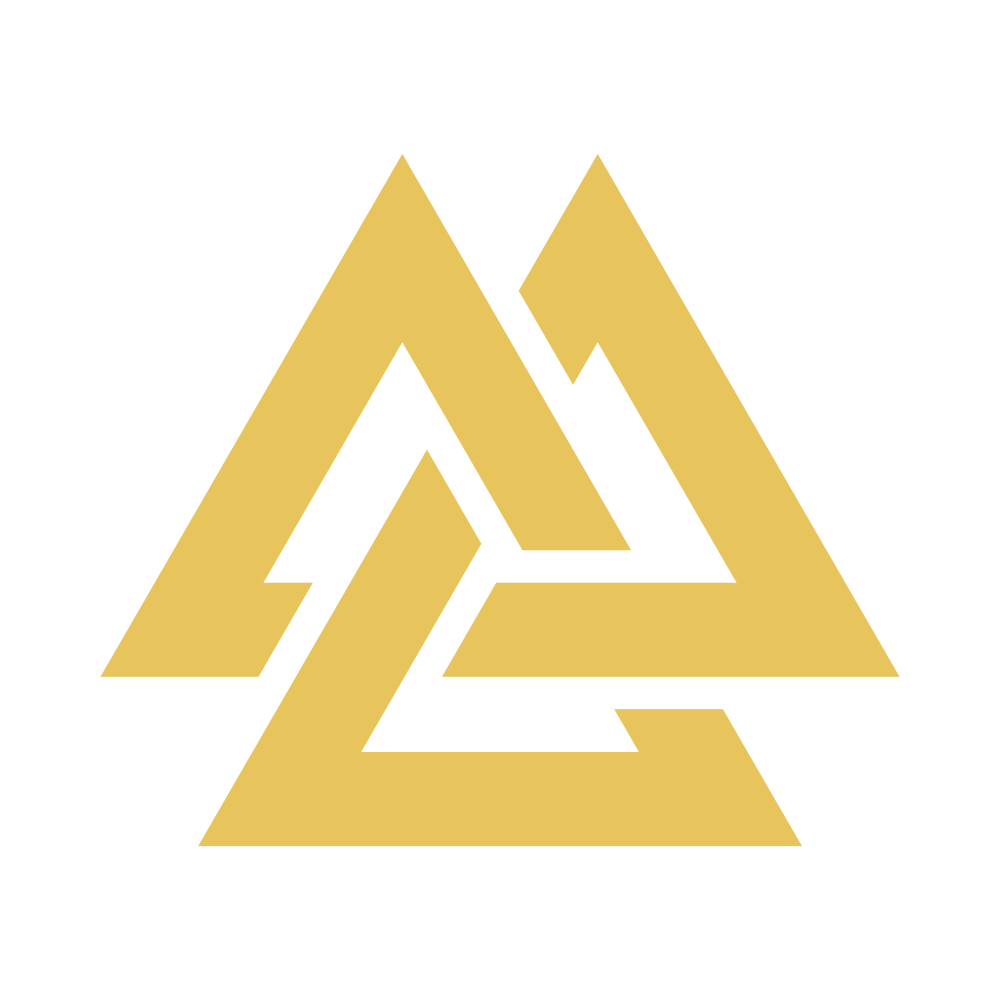
Three triangles, woven into one figure. Nine points facing outwards. You have seen it on pendants, on forearms, on drinking horns at medieval fairs and tucked into company logos. Few "Viking symbols" are as widespread. And few are explained with such confidence, given how stubbornly the sources keep quiet about it.
That silence is exactly what makes the valknut fascinating to us. It is not one of the early-modern magical staves like the Vegvísir and the Ægishjálmr, which first turn up in Icelandic manuscripts centuries after the Viking Age. The valknut is genuinely old: cut into stone, carved into wood, engraved into gold. But it does not speak. No runestone names it. No saga explains it. What survives are pictures, and the company those pictures keep.
So we will work the way we work in the workshop: check the material first, then draw. First the finds, then the one medieval text that might be relevant, then the interpretations, clearly sorted into what is attested and what is inferred. And at the end, practical advice if you want a valknut on slate, wood or glass.
Let us start with the least comfortable fact. The word valknut does not come from the Viking Age. It is a modern Scandinavian term, usually understood in present-day Norwegian as "knot of the slain". Its first element is the same as in Valhalla and Valkyrie: Old Norse valr means the dead of a battlefield, taken together. You will sometimes see an "Old Norse" form valknútr, but it does not occur in any medieval source. It is a back-formation from the modern word.
Curiously, Norwegian valknute also names something quite different: a looped polygon with a loop at each corner, the sort of figure that appears in the coat of arms of Lødingen municipality and, earlier, on seals of the late sixteenth and early seventeenth centuries. Whether the word first meant the slain and drifted to knot patterns, or the other way round, we could not establish from the sources we checked. What is certain is that pairing this name with the picture-stone symbol is a modern move.
German speakers also call it the Wotansknoten, "Wotan's knot", and English speakers sometimes say "Odin's knot" or "heart of Hrungnir". These are modern labels too. The people of Gotland would have called the god Óðinn, and whatever they called the sign, it has not come down to us.
If you want to see the valknut at its source, head for northern Gotland. Two of the key monuments come from the parish of Lärbro: the stones from Tängelgårda and those from Stora Hammars. Both belong to the Gotlandic picture stones, tall limestone slabs carved in low relief, with stacked panels that tell stories from top to bottom. Following Sune Lindqvist's typology, these large mushroom-shaped stones are classed as type C/D and today generally dated to the eighth to tenth centuries. Proposals for individual stones vary widely, and our two are no exception.
Tängelgårda I was found in the 1860s, together with three other stones, at Fånggården near the Tängelgårda farm, reused in a stone setting that probably enclosed a grave. It is now in the Swedish History Museum (Statens historiska museum) in Stockholm. A large sailing ship fills the bottom panel. Above it comes a procession: men carrying swords pointed downwards, a horse that some link with Sleipnir, and a rider greeted by men holding up rings. In this scene, near the rider and between the horse's legs, the valknut appears – more than once.
One detail matters for anyone who wants to draw it: on Tängelgårda I the valknut is formed from a single continuous line. More on that under the variants below.
How to read the scene is already a matter of interpretation. Many see the arrival of a dead man in Valhalla; others a homage to a lord, or to Odin himself. The rings may be oath rings or a lord's gifts to his retinue. What the stone does show is that the valknut is not a filler ornament stuck in a corner. It sits in the middle of the action, close to the rider.
Even more striking is Stora Hammars I, also from Lärbro. The stone is divided into six panels, read from top to bottom. Together with other stones from the same farm it now stands in the open-air Bungemuseet near Fårösund in the north of Gotland – outdoors, protected only against winter frost, and badly weathered as a result. Its date wobbles in the literature between about 700 (Lindqvist) and the tenth century, with other proposals around 790 to 840.
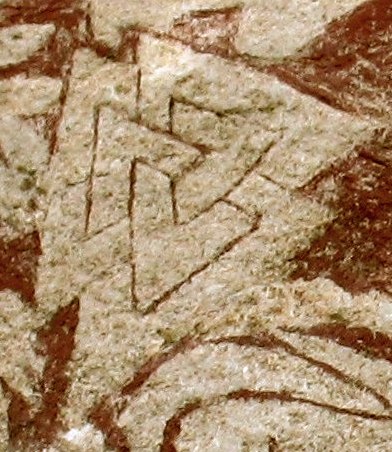
The third panel from the top is the one that has kept scholars busy for more than a century. Beneath two intertwined trees stands a man with a shield and a noose around his neck. A bird of prey flies towards him. Below: the three interlocked triangles, and next to them a kind of altar with two men. To the right, four warriors raise their swords. Another panel shows a ship full of armed men, and at the very bottom a great sailing ship again.
Anyone who knows the Eddic poems thinks at once of Odin, who in the Hávamál hangs himself for nine nights on the windy tree. Others recall King Víkarr in Gautreks saga, whom Starkaðr hangs in a mock sacrifice that turns into a real offering to Odin. Whether the carver at Stora Hammars had one of these stories in mind, a different one, or an actual ritual practice, remains open. What is clear is that hanging, bird, warriors and valknut share a very small patch of stone.
Gotland is the heartland, but not the only find spot. The second great witness comes from Norway: the Oseberg ship burial on the Oslofjord, dated by tree rings to 834. There a carved bedpost bears the valknut in its form of three closed triangles. Hilda Ellis Davidson also pointed to the sign in the fragments of the woven tapestry from the same grave, which shows, among other things, a procession of wagons and riders. A bedpost in the grave of two women is a very different context from a memorial stone covered in warriors, and that is precisely what makes it so telling.
The third classic piece is in the British Museum in London: the so-called River Nene ring. It is an Anglo-Saxon gold finger ring with niello inlay, dated to the eighth or ninth century and 2.7 centimetres across. It was found by someone spearing eels in the River Nene at Peterborough, under the Great Northern Railway viaduct, and the museum bought it in 1855. One of its two applied bezels carries three incised interlaced triangles. The museum describes them in exactly those plain words and offers no interpretation.
Beyond these, there are smaller witnesses: signs on coins, jewellery and further picture stones. Ellis Davidson also mentions Anglo-Saxon cremation urns from East Anglia on which similar signs appear beside wolves and ravens. The fullest collection so far is Tom Hellers' 2012 study Valknútr. Das Dreiecksymbol der Wikingerzeit, published in Vienna, which distinguishes five variants of the symbol.
Browse valknut designs online and you will notice they are not all built the same way. That is not sloppy graphic design; it reflects the old finds. There are two basic forms.
The unicursal form. The whole knot can be drawn with one line without lifting the pen. Mathematically it is a trefoil knot, a close relative of the triquetra, only with sharp corners instead of arcs. This is the valknut of Tängelgårda I.
The tricursal or Borromean form. Three closed triangles interlock so that the whole holds together even though no two of them are directly linked. Remove any one triangle and the other two fall apart. Mathematicians know the principle as the Borromean rings, named after the coat of arms of the Italian Borromeo family. This is the valknut of Stora Hammars I, the Oseberg bedpost and the Nene ring.
Today you will also meet a third version in which the triangles simply hang together like chain links. That one is new. As far as we know it does not occur among the early finds.
Whether people at the time meant anything by the difference, we cannot say. The Borromean principle – three that only hold together as one – invites modern reflections on connection and kinship. As a present-day reading that is perfectly fair. As a statement about the eighth century it is speculation.
Old Norse literature never mentions a valknut. It does, however, contain one passage that has long been linked to it. It comes from Snorri Sturluson, in the Skáldskaparmál, the handbook of poetic language in his Edda, written around 1220. Snorri is telling the story of Thor's duel with the stone giant Hrungnir, and before the fight he describes the giant:
"Hrungnir had the heart which is notorious, of hard stone and spiked with three corners, even as the written character is since formed, which men call Hrungnir's Heart."Snorri Sturluson, Skáldskaparmál, ch. 17, translated by Arthur G. Brodeur, 1916 (public domain)
The Old Norse word behind Brodeur's "written character" is ristubragð, literally something like "carved sign" – a mark you cut rather than write. Hrungnir's head and shield are made of stone as well, while his clay giant Mökkurkálfi has to make do with a mare's heart, which fails him the moment Thor appears.
A three-cornered sign, carved, with its own name: it sounds temptingly like our valknut, and some scholars do regard hrungnishjarta as the only old name for the symbol that has survived. Three points call for caution, though:
We still love the passage. It shows that in Snorri's day people knew a carved three-cornered sign with a name of its own – a precious scrap of thirteenth-century everyday knowledge, whether or not it was the valknut or a distant cousin.
Now for the question you probably typed into a search bar. The honest answer first: nobody knows for sure. Everything that follows is interpretation – well argued, but inferred from the setting of the images. Here are the three most important readings.
Reading 1: the sign of Odin. On Tängelgårda I the valknut sits beside the rider; on Stora Hammars I beside a hanged man, a bird of prey and warriors. Hanging, spear, bird, warriors: all familiar from what the sources tell about Odin, god of the hanged and lord of the slain, who gathers the dead warriors in Valhalla. That is why most scholars connect the valknut with Odin. Rudolf Simek puts it cautiously: because it appears on picture stones with Odin and among the Oseberg grave goods, the sign may be linked to religious ideas surrounding death.
Reading 2: death and passage. Almost every find context has to do with death. The picture stones are memorials, often associated with graves, and their ships and riders are frequently read as journeys to the otherworld. Oseberg is a grave. The East Anglian urns are graves. Hence a reading of the valknut as a sign of passage from life into death, perhaps a mark for a dead person who belongs to a god. One variant ties it to the Valkyries, who in the tradition choose the slain.
Reading 3: binding and loosing. The best-known single theory comes from the British historian of religion Hilda Ellis Davidson. In Gods and Myths of Northern Europe (1964) she proposed that the sign stood for Odin's power to bind and to unbind. She meant a binding of the mind: Odin could paralyse warriors' limbs in battle and send panic, and he could equally release fear through battle-fury, intoxication and inspiration.
The sources offer some hooks for this idea, though no direct evidence for the valknut itself. One of the Valkyries in the list in Grímnismál is called Herfjǫturr, "army-fetter". In the first of the Merseburg Charms, divine women fasten bonds and loosen them. And in the Hávamál Odin boasts of a spell that makes fetters spring from the limbs. Binding really does belong to Odin's sphere. Whether the valknut depicts it remains a clever but unproven guess.
With a symbol this popular, meanings multiply faster than evidence. A few claims keep turning up on product pages, in tattoo catalogues and in videos. Here are the commonest, briefly checked:
A symbol does not become poorer when you strip off the invented stories. Three interlocking triangles beside a hanged man, cut into limestone more than a thousand years ago: that is strong enough on its own.
Today the valknut is among the best-known Norse signs of all. You will find it on pendants, rings and belt buckles, as a tattoo anywhere from wrist to shoulder blade, on drinking horns, shields and T-shirts. Many people who follow modern Norse religion use it as a religious symbol – more on that in our article on Ásatrú today. For others it is a sign of remembrance for someone they have lost, which quietly echoes the grave finds.
Business has noticed it too. The Swedish forestry and paper group SCA uses a single-line, triquetra-like form in its logo, and the German Football Association has used a mark reminiscent of the unicursal form for its national team since 1991. Whether the designers were thinking of Gotland is anyone's guess.
If you are planning a valknut as jewellery or a tattoo, a few conscious choices pay off. First: which form? The Borromean one is better known, the unicursal one more elegant and rarer – both are historically attested. Second: on its own or in a scene? On the picture stones the valknut never stands alone, so a design with a ship, rider or bird often feels closer to the originals than the bare sign. Third: what meaning do you want to give it? You are free to read it personally; it just helps to know which part is your own reading. For more ideas, see our guide to authentic Viking motifs for engraving and tattoos.
The valknut looks simple. Engraving it shows you it is not. A knot lives on the viewer seeing which strand runs over and which under. Leave out those small breaks and the interlace turns into a tangle of lines. Here is what we have learned:
Draw the over and under clearly. Every crossing needs a visible gap in the lower strand. Count the crossings in your design and check at each one that over and under alternate properly. In the Borromean valknut each triangle lies over one neighbour and under the other; get that wrong and the knot falls apart in the viewer's mind.
Line weight and size. For a clean laser engraving, lines should not be thinner than roughly 0.2 to 0.3 millimetres, and the gaps at the crossings need breathing room too. A valknut drawn with double lines – bands rather than single strokes – looks refined but needs size. On a small pendant a single bold strand usually reads better.
The right material. On natural slate the engraving shows light on a dark ground, which comes surprisingly close to the look of a carved picture stone. On wood the knot burns in warm and dark; on glass it becomes a frosted, translucent sign, especially lovely on a candle holder. Our material comparison helps you choose for the occasion.
Proportions. The triangles on the picture stones are not always perfectly equilateral; they were cut by hand. For an engraving, exact equilateral triangles look calmer. If you prefer a more historical feel, pick a template after a particular stone, such as Stora Hammars I, and keep its slight irregularity on purpose.
Combinations. The valknut pairs well with a name in runes, a date or a short line from the Hávamál. Give the symbol enough space so that it does not drown in the lettering. On a memorial plaque it can look deeply dignified – fittingly, since its oldest traces are on memorial stones.
With us, every valknut is drawn, not pulled from a clip-art library, and we will tell you openly which form goes back to which find.
What does the valknut symbol mean? Its meaning was never written down. Because it appears on Gotland picture stones beside scenes of death, sacrifice and warriors, most scholars link it with Odin and the slain; other readings see a sign of passage or, following Hilda Ellis Davidson, Odin's power to bind and loosen.
Is the valknut a real Viking symbol? Yes, the image is genuinely old: it appears on picture stones from Gotland, in the Oseberg burial of 834 and on an Anglo-Saxon gold ring of the eighth or ninth century. The name "valknut", however, is modern.
What is the difference between the valknut and the triquetra? The triquetra is made of three arcs, the valknut of three triangles with nine points in total. The unicursal valknut is mathematically the same knot as the triquetra, just drawn with corners.
Why is the valknut called the heart of Hrungnir? Snorri Sturluson describes the giant Hrungnir's three-cornered stone heart and says a carved sign of that name was made after it. Whether he meant the valknut is uncertain.
Where can I see an original valknut? Tängelgårda I is in the Swedish History Museum in Stockholm, Stora Hammars I at the Bungemuseet on Gotland, and the Nene ring in the British Museum in London. The Oseberg finds belong to the Museum of Cultural History of the University of Oslo.
Is it okay to get a valknut tattoo? Of course. It is a historical sign that many people wear today as a mark of remembrance, faith or art. It is worth choosing the form deliberately and knowing which meanings are attested and which are modern.
For courage. For remembrance. For legends that live on.
Principle: one symbol can be old and another modern – both may be beautiful and meaningful. We only care about naming the difference honestly.
