The genuine Viking motifs for engraving and tattoos are Thor's hammer, the triangle knot now called the valknut, the triquetra, picture-stone ships, ravens, wolves, serpents, the Great Beast of Jelling, the six animal styles from Oseberg to Urnes, and runes of the Younger Futhark. The Vegvísir and the Ægishjálmur staves come from early modern Icelandic books of magic. Here you get find sites and dates, an overview table and the practical part: spelling names in runes, material, size and legibility.
A tattoo stays with you for life, a slate plaque for decades. So ask one plain question first: did anyone in the Viking Age actually make, see or wear this design? Or did someone invent it in the nineteenth century, in the 1990s, or last Tuesday for a web shop?
Both can be beautiful. The trouble starts when you pay for an "ancient Viking symbol" and receive an Icelandic magical stave from 1860, or when your name appears in runes that no Viking could have read. This guide sorts strictly: what is backed by finds from the Viking Age (roughly 790 to 1066), what comes from later manuscripts, and what is a modern creation. Then comes the practical part we need in our workshop every week: writing runes correctly, choosing material, size and legibility. For a broader introduction to the symbols themselves, see Viking symbols and their meaning.
If one sign belongs to the Viking Age beyond any doubt, it is Thor's hammer. Small hammer pendants in silver, bronze, iron and occasionally amber are known mainly from the tenth and early eleventh centuries, concentrated in Denmark, southern Sweden and southern Norway. Beyond a few dozen carefully made pendants, there are simple iron "hammer rings" from central Sweden and Åland and a growing number of detector finds.
The silver pendant from Erikstorp in Östergötland has a stylised head with staring eyes. The gold hoard from Hiddensee carries pendants that scholars still debate: hammer or cross? And the soapstone mould from Trendgården in northern Jutland let one craftsman cast crosses and hammers side by side. In 2014 a lovely find turned up on Lolland: the bronze pendant from Købelev carries a runic inscription read as hmar is, "this is a hammer".
For an engraving or a tattoo, that means you can base your hammer on a specific find, with a site and a date to go with it. More in Thor's hammer Mjölnir – from axe to hammer.
Three interlocking triangles: the sign we now call the "valknut" really is old. It appears on two Gotland picture stones from Lärbro. On Stora Hammars I it sits in a scene often read as a sacrifice at a gallows; on Tängelgårda I it hovers above riders and warriors. Both stones are usually dated to the eighth century. A similar figure is carved on a bedpost from the Oseberg burial in Norway (buried in 834), and outside Scandinavia there is the Anglo-Saxon gold ring from the River Nene.
So the motif is attested. What is not attested is the name or a fixed meaning. Valknut is a modern Scandinavian coinage, roughly "knot of the slain".
The finds are covered in detail in Valknut, Vegvísir & Ægishjálmur – real or invented?, and the stones themselves in The picture stones of Gotland.
The triquetra, a knot of three pointed arcs, is no fantasy sign. It turns up on Scandinavian stones and metalwork, and in the tenth century it appears on coins struck for the Norse kings of York, for instance under Anlaf (Óláfr) Sihtricsson. It is also a motif of Irish and Anglo-Saxon manuscript art and later a Christian Trinity emblem.
Related but distinct is the sign on the Danish Snoldelev stone from the ninth century: three interlocking drinking horns. More background in The triquetra: the knot of three and its meaning.
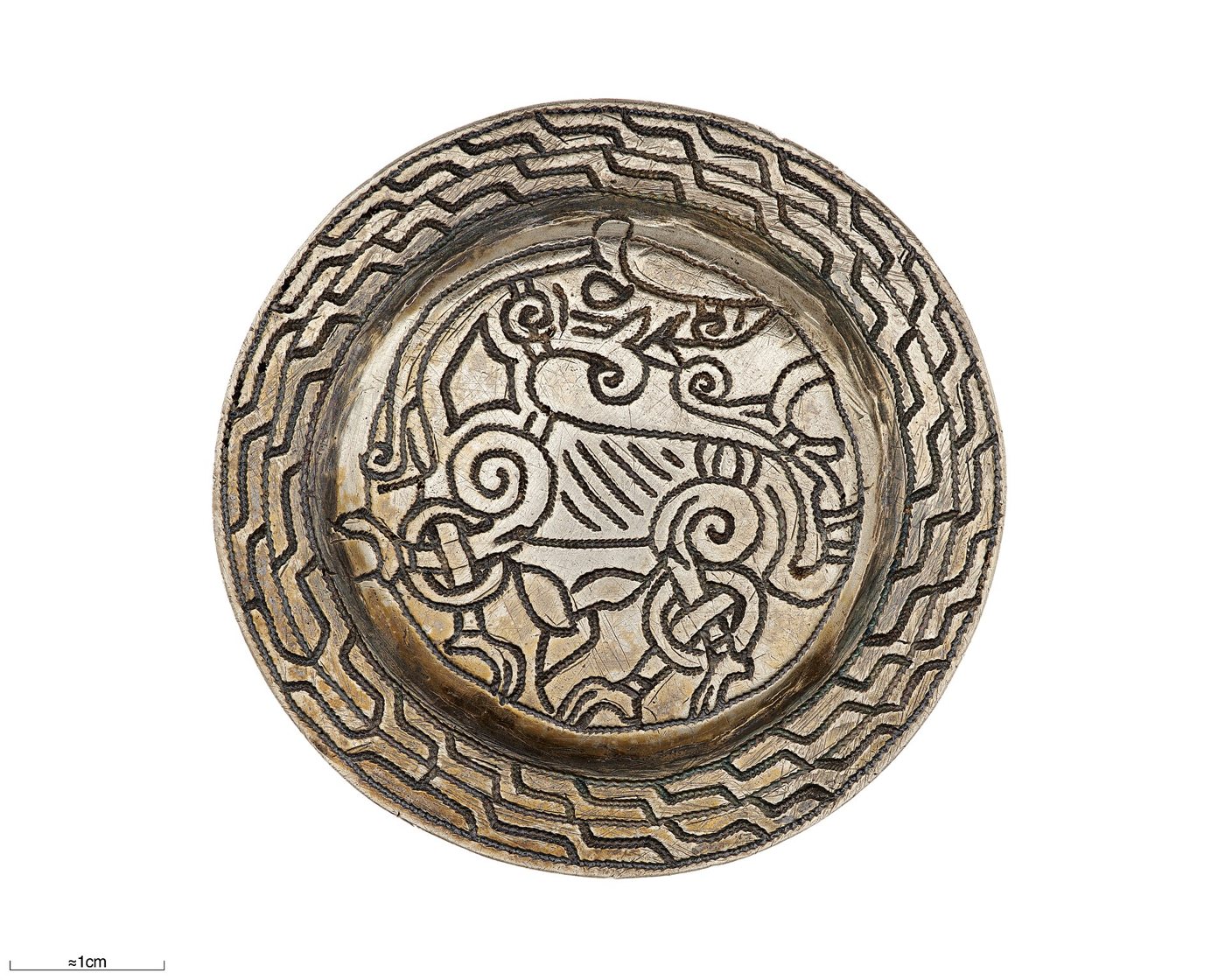
Viking-Age craftsmen left behind an entire visual language: interlaced beasts, ribbons, tendrils and gripping animals. Scholars distinguish six main styles named after sites; dates overlap and vary by author:
Why does this matter for engraving and tattoo work? Because every piece has a real reference point. You can say "this follows the Mammen axe" or "this is after the Urnes portal". A good introduction is The art styles of the Viking Age: Oseberg to Urnes, and the showpiece of the final style is described in The Urnes portal.
One caveat: a free composition "in the style of" is modern work. Legitimate, just not a copy of a find.
The larger of the two Jelling stones, raised by Harald Bluetooth sometime between the 960s and 980s for his parents Gorm and Thyra, has three faces. One carries the inscription, one Christ in foliage, and one the so-called Great Beast: a four-legged, maned creature wrapped in the coils of a snake. People often call it the "Jelling lion", although nobody knows whether a lion was meant. It is a key work of the Mammen style.
As a motif, the Great Beast is a gift: royal, securely dated and strong in silhouette. It works best on larger areas, an upper arm, a shoulder blade or a slate plaque from about A4 upward.
From the eighth into the tenth century, many Gotland picture stones show large sailing ships with curved hulls, a sail reinforced with a lattice of strips and a crew suggested by a row of small heads. Ships also feature beyond Gotland, for instance on the Swedish Sparlösa stone and the Tullstorp stone in Scania.
A ship after a picture stone is an excellent motif: genuine, full of story, and simple enough to work small.
Odin's ravens Huginn ("thought") and Muninn ("memory") are named in the Poetic Edda, in Grímnismál, written down in the thirteenth century. Images are older. On the pressed foil plates of the helmets from Vendel and Valsgärde (sixth–seventh centuries, pre-Viking), mounted warriors ride with two birds flying around their heads. The little silver figure from Lejre in Denmark, dated to the first half of the tenth century, shows a figure on a throne whose backrest ends in two bird heads. There are many bird-shaped brooches as well, and in the tenth century a raven appears on coins of the Norse king Anlaf Guthfrithsson at York.
Wolves are just as present, for example on the Torslunda plates from Öland with their wolf-warrior, and on Thorwald's Cross on the Isle of Man, where a figure with a bird on his shoulder, usually read as Odin, is swallowed by a wolf. The popular design of two ravens inside a circle of runes, on the other hand, is a modern assembly. More in Huginn and Muninn: Odin's ravens of thought and memory.
Snakes are everywhere in the late Viking Age, above all as rune bands: on hundreds of eleventh-century Swedish rune stones, the inscription runs inside a serpent's body. On the Altuna stone in Uppland (eleventh century), Thor sits in a boat, fishing with an ox head, hammer raised, his foot punching through the hull; the Danish Hørdum stone is similar. And at Gosforth in Cumbria stands a stone cross from the first half of the tenth century on which scenes of Ragnarök appear on a Christian monument; inside the church lies a further stone with Thor's fishing trip.
For engraving, rune-stone serpent bands make a natural frame for an inscription, just as the carvers used them.
The World Tree is central to the Eddas, but there is no unambiguous Viking-Age image of Yggdrasil. Some read a tree on the Överhogdal tapestries from northern Sweden as the World Tree, but that remains an interpretation. The round tree designs with knotted roots and a rune ring sold everywhere are modern; if you want a tree, have it drawn in a genuine style, say with Urnes loops for roots.
Runes are the trickiest motif because they are text, and a misspelled name can be read by anyone who knows runes.
Start with the row. The Elder Futhark of 24 characters was in use from roughly the second to the eighth century. During the Viking Age, Scandinavians wrote the Younger Futhark with only 16 characters, in long-branch and short-twig variants. The Rök stone around 800 and the Jelling stones are written in younger runes. So if you want a specifically "Viking" design with runes, the Younger Futhark is your row. The differences are explained in Elder and Younger Futhark compared, the basics in Runes – an honest introduction.
Runes are not a cipher for the Latin alphabet but a phonetic script. You write what you hear, not how it is spelled. This is transliteration, and it differs by row.
Take Thomas. The "Th" is a single sound, not T plus H. In the Elder Futhark it becomes ᚦᛟᛗᚨᛋ (þ-o-m-a-s). The Younger Futhark has no separate O, so you use the U rune: ᚦᚢᛘᛅᛋ (þ-u-m-a-s). A second example: Sven. The Younger Futhark has neither V nor E; the V is written with the U rune, the E with the I rune: ᛋᚢᛁᚾ. Real rune stones spell the name Sveinn exactly so: suin. In the Elder Futhark it would be ᛋᚹᛖᚾ.
If you want a single rune rather than a name, Which rune should I have engraved? will help. Double consonants were usually written only once in younger runes, so Anna becomes ᛅᚾᛅ. For sounds like English "ch" or "sh" there is no dedicated rune; you have to choose a phonetic solution deliberately. Our rune name generator and rune translator help with a first draft, and before any engraving we check the name again by hand.
The templates that land on our workbench show the same pitfalls again and again:
The Vegvísir, the eight-armed "way-finder", is first recorded in the so-called Huld manuscript, compiled by Geir Vigfússon at Akureyri in Iceland in 1860. "Viking compass" is a marketing label.
The Ægishjálmur, the "helm of awe", is a little older, but only as a word. In the Poetic Edda, in Fáfnismál, the dragon Fáfnir boasts that he wore the helm of awe against all people. No sign is described. The well-known radiating figures with trident tips come from Icelandic books of magic from the early modern period, roughly the seventeenth to nineteenth centuries.
Also modern are the "rune circles" in which the futhark runs around a central symbol, the Web of Wyrd with its grid of all 24 runes, a creation of the late twentieth century, and most of the "Celtic" knots now associated with the North. Many of these go back to the construction methods the Scottish artist George Bain published in 1951 in his book on Celtic art, which became the basis for countless new designs. The full story is told in Vegvísir & Ægishjálmr – the famous "Viking symbols" that aren't.
| Motif | Attested since | Example find | Suitability for engraving/tattoo |
|---|---|---|---|
| Thor's hammer | Viking Age, mainly 10th c. | Erikstorp, Købelev (with runes), Trendgården mould | excellent; clear silhouette, works small |
| Valknut (modern name) | 8th c. | Stora Hammars I and Tängelgårda I, Gotland | excellent; geometric, scales well |
| Triquetra | pre-Viking and Viking Age, not only Norse | coins of the Norse kings of York, 10th c. | good; simple line |
| Animal styles | c. 770–1130 | Oseberg, Borre, Jelling cup, Mammen axe, Urnes portal | outstanding; needs space |
| Great Beast | 960s–980s | Larger Jelling stone | very good from medium size |
| Ship | 8th–10th c. (picture stones) | Gotland picture stones, Sparlösa | very good; simple lines |
| Ravens/wolves | Vendel period to Viking Age | Vendel/Valsgärde helmet plates, Lejre figure, Torslunda | good; redraw from a model |
| Midgard Serpent | 10th–11th c. | Altuna stone, Hørdum, Gosforth | good as frame or band |
| Younger runes | from 8th c. | Rök stone, Jelling stones | excellent if correctly transliterated |
| Yggdrasil image | no clear evidence | Överhogdal (reading disputed) | possible as a modern design |
| Vegvísir | 1860 | Huld manuscript, Iceland | attractive, but not Viking Age |
| Ægishjálmur (sign) | early modern | Icelandic books of magic | attractive, but not Viking Age |
| Web of Wyrd | late 20th c. | modern esoteric literature | modern |
A motif is only as good as its execution, and that depends on the surface. Natural slate is layered. The laser removes the dark surface and exposes paler layers beneath, producing that typical velvety contrast. Very fine hairlines can chip or vanish into the texture; bold lines and filled areas look superb. Examples are in our slate engraving range.
Crystal glass is the most forgiving with fine detail: the engraving appears as matte white within clear glass and stays crisp. Wood darkens under the laser, but grain and growth rings absorb energy differently, so fine lines look different in latewood than in earlywood.
Skin is a living material. Tattooed lines spread a little over the years, and gaps close up. A delicate Urnes band that thrills you today can become a grey smudge in twenty years if it was drawn too small. Runes on skin need enough size that close strokes, as in Elder Futhark ᛗ or ᛞ, do not run together.
Around 922, Ibn Faḍlān described Rus on the Volga as covered "from fingernail to neck" with trees and figures; whether he meant tattoos or paint is debated. More in Were the Vikings tattooed?.
Three rules of thumb have served us well. First: the more detailed the style, the more space it needs. An Oseberg gripping beast lives from its many small paws; a Thor's hammer lives from its outline. Second: runes have to be readable. Below about half a centimetre in character height, things get tight on slate; glass allows a little less, and on wood it depends on the grain. Third: one motif per surface. Hammer plus valknut plus Vegvísir plus raven is a sample catalogue, not a Viking design.
If you are unsure, send us your idea through our custom engraving page. We will tell you openly whether a motif works at your size, which find it comes from and whether the runes are right, even if you order elsewhere.
For genuine Viking-Age motifs, the honest answer is often that we only partly know. A hammer pendant surely had a protective, religious function. What a Mammen beast "meant", if it meant anything specific at all, is open.
For many people today, Thor's hammer is not decoration but a religious sign. Iceland's Ásatrúarfélagið was founded in 1972 and has been officially recognised since 1973; in Scandinavia, Germany and elsewhere there are communities that honour the old gods, often with a markedly source-critical approach.
Anyone may wear it, but it deserves not to be made ridiculous: no hammer as a party gag, no runes as fantasy gibberish. More on present-day practice: Asatru today – organised, source-critical, alive.
Which Viking symbols are actually authentic? Well attested are Thor's hammer, the triangle knot now called the valknut, the triquetra, the six animal styles, the Great Beast of Jelling, ships, ravens, wolves, serpents and the Younger Futhark. The Vegvísir, the Ægishjálmur stave and the Web of Wyrd are far younger.
Is the Vegvísir a Viking symbol? No. It is first recorded in an Icelandic manuscript of 1860, the Huld manuscript. Fine to wear, just as an Icelandic magical stave.
What runes did the Vikings use? The Younger Futhark with 16 characters. The 24-character Elder Futhark had already fallen out of use by the Viking Age.
How do I write my name correctly in runes? By sound rather than spelling, and in a single rune row. Have the result checked by someone who reads runes before it goes onto skin or stone.
Which Viking motif works for a small tattoo? Clear silhouettes such as Thor's hammer, the valknut or a ship after a picture stone. Animal styles need room so the lines stay legible over the years.
Can I have a Viking motif engraved on slate? Yes. Slate suits runes, hammers and picture-stone motifs especially well. We welcome templates and ideas through our custom engraving service.
For courage. For remembrance. For legends that live on.

Viking Symbols & their meaning – genuine or invented? · Norse symbols: real or invented? · Viking-age art styles · Which rune to engrave? · Viking tattoos · Thor's Hammer.
A clean Norse animal ornament is neither an accident nor generic "Viking scribble". Behind it stand six clearly …
Read more →The triquetra (Latin "triangle", also called the trinity knot) consists of three equal, interlaced arcs. It can be …
Read more →The troll cross (Swedish trollkors) is an amulet bent from a single piece of iron, usually in the shape of a round bow …
Read more →Slender animals and serpents winding around one another in endless, elegant loops, as fine as if drawn with a pen: this …
Read more →
.jpg)