Nobody can say for certain whether the Vikings had tattoos: not a single scrap of tattooed Viking Age skin survives from Scandinavia, and the only written source is the Arab envoy Ibn Fadlan, who in 921/922 saw the Rus on the Volga covered in dark green designs “from the tips of their toes to their necks”. Whether that was ink under the skin or paint on top of it is still debated. We follow the trail, show which body modification is actually proven, and check how old the most popular Viking tattoo designs really are.
Walk through any Viking festival and you will see them: forearms covered in runes, a valknut between the shoulder blades, a vegvísir on the back of a hand, knotwork crawling up the neck. Viking tattoos are among the most requested designs in tattoo studios from Hamburg to Minneapolis. Yet the obvious question is hardly ever asked: did the Vikings themselves actually have tattoos?
The honest answer is less satisfying than any flash sheet. It is: maybe. We have one eyewitness, one word that translators have argued about for a century, and not a single find that confirms or refutes it. What we do have is something far less often mentioned: men who filed grooves into their teeth. This article is about all of it – what we know, what we suspect, and what was invented later.
If you want to know what a Viking sword looked like, you dig one up. If you want to understand their houses, you follow the postholes. But skin is the most perishable material a human body has. It survives the centuries only in exceptional conditions: permafrost, bone-dry desert air, or the acidic, oxygen-poor environment of a peat bog.
From Viking Age Scandinavia – roughly 793 to 1066 – no body with preserved skin showing a tattoo is known. The dead were cremated or buried in ordinary earth graves, where after a few decades only bone remains. The famous bog bodies of northern Europe, which may spring to mind now, mostly date to the pre-Roman Iron Age and the Roman period, many centuries before the Vikings, and they offer no tattoos that could be attributed to the Norse.
None of this means there were no tattoos. It simply means archaeology has nothing to say on the matter. Missing skin is not evidence of absence. But it is not evidence of presence either. Anyone who tells you that “the Vikings were demonstrably tattooed” is claiming more than anyone knows.
What we have is a text – and it does not come from the North but from Baghdad. In 921 the Abbasid caliph al-Muqtadir sent an embassy to the ruler of the Volga Bulghars, and its secretary was a man named Ahmad ibn Fadlan. In 921/922 he met the Rus on the banks of the Volga – traders from the North who moved furs and slaves along the great rivers of Eastern Europe. Most scholars see them as people of Scandinavian origin who mixed with other groups. We tell his whole journey in our article on Ibn Fadlan and the Rus.
Ibn Fadlan was no admirer. He found the Rus filthy, described their drinking and their sacrifices with open disgust, and recorded their ship funeral in such detail that it remains one of the most quoted sources of the entire Viking Age. Precisely because he had no reason to flatter anyone, historians take him seriously. On the men’s bodies he writes (our own rendering, based on the scholarly translation by James E. Montgomery):
“Never have I seen bodies more perfect than theirs – they are tall as palm trees, fair and ruddy. […] From the tips of his toes to his neck, every man is covered in dark green: lines, pictures and the like.”Ibn Fadlan, Risāla, c. 922 – our own rendering, following J. E. Montgomery’s translation
In the same breath he lists their equipment: every man carries an axe, a sword and a knife, and the swords are of the Frankish kind, broad-bladed and ridged. Those details can be checked against finds – and they hold up. The Frankish blades Ibn Fadlan describes are known from hundreds of graves. That suggests he looked closely. It does not automatically make his sentence about skin correct, but it makes it far more credible than a traveller’s tall tale.
One point gets lost in almost every online article. Ibn Fadlan is describing the Rus on the Volga, in 922, as a travelling trading party far to the east. Whether farmers in Jutland, fishermen in northern Norway or settlers in Iceland wore similar designs, he does not say and could not know. Even if we read his sentence as tattooing, it is evidence for one group in one place – not for “the Vikings” as a whole.
This is where it gets technical, and where everything is decided. Ibn Fadlan uses no unambiguous word for “tattoo”. He says the men were “greened” – an expression from the Arabic root for the colour green. That tells us nothing about technique. It could mean pigment pricked into the skin, paint applied to it, cuts rubbed with colour, or simply staining.
The colour itself is less clear-cut than it sounds. Arabic “green” covered a range reaching into dark, bluish and near-black tones. That is an argument for tattooing: soot-black ink pricked into pale skin really does take on a blue-green sheen with time.
Then comes the second word. The designs, Ibn Fadlan says, were šajar – literally “trees” – pictures and the like. Many popular texts render this as “trees and figures”, and suddenly Yggdrasil appears on a Viking chest. Montgomery, however, translates the word as “lines”. He bases this on the usage of the traveller Ibn Jubayr, who in the late twelfth century used the same word for dark-green mosaic patterns on a church in Palermo. The meaning would then be branching lines and ornament – which would fit Norse animal interlace remarkably well, but remains an interpretation.
The tattoo reading goes back above all to the orientalist Ahmed Zeki Validi Togan, who published the text with a German translation in Leipzig in 1939. Many later translators followed him. Montgomery himself notes that such a practice is otherwise unattested for the Vikings. That is the heart of the problem: Ibn Fadlan saw the result, not the needle. Whether the Rus repainted their patterns before every trading season or carried them for life, we do not know.
Sometimes you get closer to a source by asking what other witnesses leave out. The Byzantine historian Leo the Deacon describes the Rus prince Sviatoslav, who in 971, after a lost campaign, met Emperor John Tzimiskes to negotiate. His portrait is strikingly precise: medium height, powerfully built, blue eyes, head shaved except for a single lock, a gold earring set with two pearls and a red stone, a plain white garment. Not a word about markings on the skin.
That does not refute Ibn Fadlan – Leo saw the prince fully clothed. But it shows how thin the ice is. The Andalusian traveller Ibrāhīm ibn Yaʿqūb, who visited Hedeby on the Schlei around the middle of the tenth century, says nothing about tattoos either. He mentions something else, which we will come to in a moment.
So, Ibrāhīm ibn Yaʿqūb. His notes on the “very large town at the far end of the world ocean” survive only in excerpts quoted by later writers, among them the thirteenth-century scholar al-Qazwīnī. There we read that the inhabitants have an artificial make-up for the eyes; when they apply it, it never comes off, and their beauty increases – in men and women alike. More in our article on Ibrāhīm ibn Yaʿqūb in Hedeby.
Whether this was a kohl-like eyeliner of the kind common in the Arab world or something else, the brief text does not say. What is certain is this: a tenth-century eyewitness saw men and women with painted eyes in one of the most important trading towns of the North. That fits everything else we know about Viking grooming – combs in almost every grave, tweezers, ear spoons. How well-groomed they really were is the subject of What did Vikings look like?
Now for the part that deserves more attention than any fantasy tattoo. For a study published in 2005 in the American Journal of Physical Anthropology, the Swedish osteologist Caroline Arcini examined 557 skeletons dating from roughly 800 to 1050. In 24 men she found deep horizontal grooves in the upper front teeth – neatly and deliberately filed, often in pairs or threes side by side. Later research has raised the number considerably.
A particularly large number of these men lie on Gotland. At Kopparsvik near Visby alone – the island’s largest Viking Age cemetery, with more than 330 excavated burials – over three dozen men with filed teeth have been identified. Further cases come from Birka, Sigtuna, Öland and southern Sweden, among other places.
And then there is Dorset. In 2009, during road construction on Ridgeway Hill near Weymouth, archaeologists found a pit containing 54 beheaded men. Radiocarbon dates place them between about 970 and 1025, and isotope analysis of the teeth points to a Scandinavian origin for the men tested. One of them had filed grooves into his upper central incisors. Here was a man carrying exactly the mark known from Gotland – and he ended up in a mass grave on the south coast of England.
What did the grooves mean? For a long time they were read as a warrior’s badge. In 2024, Matthias S. Toplak of the Viking Museum Haithabu and Lukas Kerk of the University of Münster proposed a different idea in Current Swedish Archaeology. Most men with filed teeth on Gotland were buried without weapons or any obvious warrior identity, many of them at trading places. The authors suggest an initiation mark for a closed community of merchants, perhaps a forerunner of later guilds. The grooves were barely visible beneath lip and beard – you had to show them on purpose. A sign of recognition, then, not everyday decoration.
So if you are looking for a genuine, documented Viking body modification, you will not find it on the skin but in the mouth. Less photogenic, admittedly. But true.
In the fifth book of his Gallic War, Julius Caesar writes that all Britons stain themselves with vitrum, which produces a blue colour, so as to look more terrifying in battle. Whether vitrum means woad, as it is usually translated, is disputed. Experiments also suggest that woad makes a very poor tattoo pigment: it is caustic and tends to leave scar tissue rather than blue lines. Caesar is most likely describing paint – and he is talking about Britons in the first century BC.
The Greek historian Herodian reports in the third century that the inhabitants of northern Britain wore images of animals on their bodies in place of clothing. The name of the Picts – Latin Picti, “the painted ones” – first appears in a Roman panegyric of AD 297. Whether it referred to real body art or was simply a Roman catch-all for raiders north of the Wall is an open question.
The most intriguing clue comes from England. In 786 two papal legates, George of Ostia and Theophylact, travelled through the Anglo-Saxon kingdoms on behalf of Pope Hadrian I and held synods in Northumbria and Mercia. In their report to the pope they condemn various pagan customs. One passage is generally understood as aimed at skin markings: God created man beautiful, but the pagans, at the devil’s prompting, have covered him with hideous scars. The follow-up is remarkable: anyone who endured this “staining” for the sake of God would be rewarded for it; only those who did it out of pagan superstition gained nothing.
That is not a blanket ban on tattoos but a verdict on the motive behind them. It concerns Anglo-Saxons at the end of the eighth century – the very decade in which Vikings raided Lindisfarne in 793 – not the Norse themselves. What it does show is that permanent skin markings seem to have existed in the Germanic-speaking North Sea world around 786 and that churchmen linked them with paganism. That pagan Scandinavians knew something similar is not proven, but it is easy to imagine.
When tattooed mummies suddenly turn up in articles about Viking tattoos, check the dates. Two finds are cited again and again – both magnificent, neither of them anything to do with Vikings.
Ötzi, the man from the glacier ice of the Ötztal Alps, lived about 5,300 years ago, in the Copper Age. Using multispectral photography, researchers at the Eurac institute in Bolzano mapped 61 tattoos on his body: short parallel lines and two crosses, mostly on the lower back and legs, made with carbon – soot, in other words. He is one of the oldest tattooed humans we know.
The Pazyryk culture of the Siberian Altai left frozen burials containing bodies with extensive tattoos. A chieftain from barrow 2, excavated by Sergei Rudenko in 1947, bears deer with sweeping antlers, rams, griffin-like creatures and a fish across his arms, chest and legs. The tombs are now mostly dated to the fourth to third centuries BC.
These finds prove that humans have tattooed for millennia, and even that animal ornament appeared on skin. They do not show what a Norwegian wore around 900. More than a thousand years and thousands of kilometres of steppe separate Pazyryk from the Vikings. Citing them as “proof of Viking tattoos” is comparing apples with Siberian pears.
Which leaves the question most people are really asking: which design is “authentic”? Here is an honest assessment of the classics. It cannot tell you whether a Viking wore that exact sign on his skin – nobody knows. It tells you whether the sign itself dates from the Viking Age. In more depth: Viking symbols and their meaning.
Vegvísir. The eight-armed “wayfinder” is probably the most tattooed “Viking symbol” of all – and by far the youngest. Its earliest known appearance is in the Icelandic Huld manuscript, compiled in 1860. Before that it is unattested. The same goes for the Ægishjálmur, the “helm of awe”: the word appears in the Edda, but the symbol as drawn today comes from early modern Icelandic grimoires. More in Vegvísir and Ægishjálmur. Icelandic folk magic is fascinating and genuine – just some 800 years after the Vikings.
Valknut. Three interlocked triangles really do appear on Viking Age and earlier objects, such as the Gotland picture stones Stora Hammars I and Tängelgårda and a bedpost from the Oseberg ship. The name “valknut”, however, is modern, and what the sign meant is unknown. We untangle it in The Valknut.
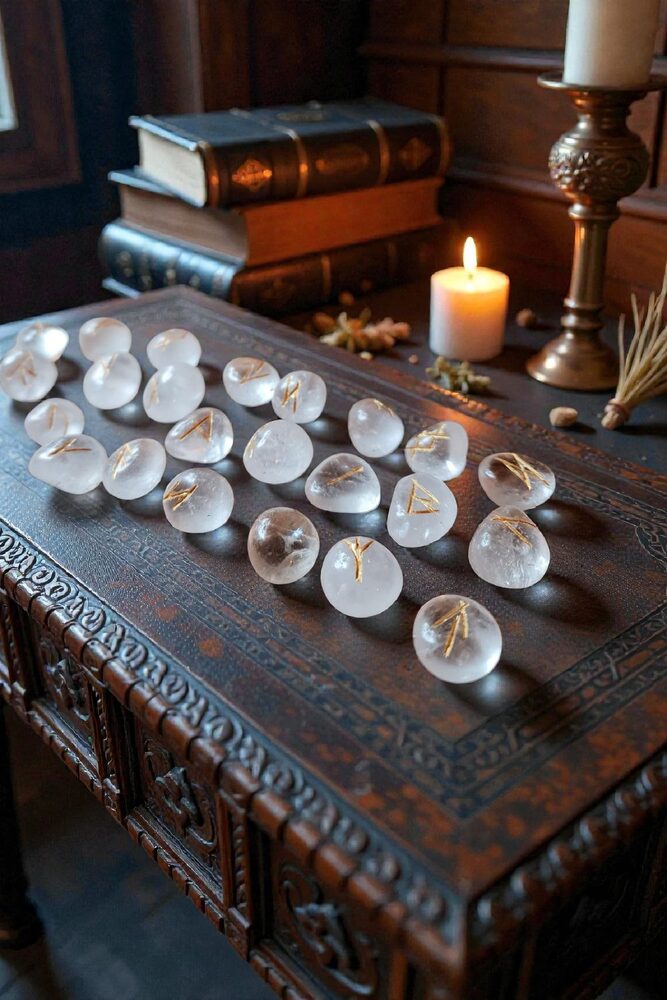
Runes. The Younger Futhark, with its 16 characters, was the script of the Viking Age, attested on thousands of runestones. A rune tattoo is therefore historically well grounded – as long as you use the right alphabet. Many tattoo templates mix the Elder Futhark (24 characters, in use until about 750) with modern esoteric meanings. A clean starting point: Runes – an honest introduction.
Yggdrasil. The world tree is a genuine myth from the Edda, but we know of no unambiguous Viking Age depiction. The typical tattoo design – round crown, symmetrical roots, often with a knotwork frame – is a modern creation. Wearing Yggdrasil means wearing real mythology in modern form. Background: Yggdrasil – the tree that holds the worlds.
Animal styles. This is where it gets truly historical. Norse animal ornament is attested on hundreds of objects and can be divided into styles with find sites and dates. Anyone who takes Ibn Fadlan’s “lines” seriously and wonders what such designs might have looked like ends up here. For an overview see The art styles of the Viking Age; which designs work best on skin and in engraving is covered in Authentic Viking designs for engraving and tattoos.
Want a Norse design that is more than catalogue filler? Work like a good conservator: from the find to the drawing, never the other way round.
Pick a real style as your model. The Mammen style is named after a magnificent silver-inlaid axe from a grave at Mammen in Jutland; the timber of the burial chamber was felled in the winter of 970/971. Its hallmarks are a powerful beast with a spiral at the hip and lush tendril ornament – bold, legible, ideal for an upper arm or calf. The Urnes style, named after the carved planks of the stave church at Urnes in Norway (c. 1070), is the opposite: slender, elongated animals and snakes biting one another in wide, elegant loops. It looks almost calligraphic and suits long surfaces such as the forearm or back. Read more in The Urnes portal.
Spell your runes properly. Viking Age rune carvers wrote by sound, not letter by letter. If you want your name in runes, have it transcribed rather than swapped character for character. A great many tattoos online use signs from the wrong alphabet or simply contain mistakes.
Ask for the source. A serious studio design should be able to tell you which find a motif is based on. If the answer is “ancient Celtic-Norse” with no place or century, be careful. And if you would rather hold it in your hands than wear it under your skin: these are exactly the styles we engrave on slate, wood and glass in our workshop in Alsdorf near Aachen – and you can learn to draw them in Drawing Norse animal ornament.
The series Vikings has shaped the modern image enormously: shaved scalps covered in ornament, dark-rimmed eyes, war paint. It is striking costume design, but no attempt at reconstruction. The dark eyes at least have a slender anchor in Ibrāhīm ibn Yaʿqūb’s note on the eye make-up of Hedeby; the scalp tattoos have none. What else the show invents is covered in our “Vikings” series fact check.
The best twist of all: the Vikings did not leave us their visual language on skin but on stone, wood and metal. It is still there to see – at Jelling, at Urnes, on Gotland. Draw from it, and you need no invented sigils. You have the original.
For courage. For remembrance. For legends that live on.
Did Vikings have tattoos? Possibly, but it is not proven. The only source is Ibn Fadlan, who in 921/922 described dark-green designs on the bodies of the Rus; whether these were tattoos or paint is debated, and no tattooed skin survives.
What did Ibn Fadlan write about Rus tattoos? He wrote that each man was covered from the tips of his toes to his neck in dark green “trees” or “lines”, pictures and the like. He does not say how they were made.
Is there archaeological evidence of Viking tattoos? No. No skin survives from Viking Age Scandinavia on which tattoos could be checked. What is proven is a different body modification: grooves filed into the front teeth.
Is the vegvísir a real Viking symbol? No. The vegvísir is first attested in an Icelandic manuscript of 1860 and belongs to Iceland’s early modern magical tradition, around 800 years after the Viking Age.
Which Viking tattoo designs are historically accurate? The best attested are runes of the Younger Futhark and the animal styles – Borre, Jelling, Mammen, Ringerike and Urnes. The valknut is genuinely old as a sign, but its name and meaning are modern.
Did Vikings have face tattoos? There is no evidence for it. Ibn Fadlan describes designs only up to the neck; face tattoos come from TV series and fantasy art.
Ibn Fadlan & the Rus · The Valknut · Vegvísir & Ægishjálmr · Runes & their meaning · Berserkers.
All Everyday Life & Craft articles →
Most Vikings were not raiders but farmers, traders and craftspeople. A look inside the long house where their lives …
Read more →An entire heroic epic on a single teak panel: rider, ship and figures. Our Atli motif stands in an ancient Norse …
Read more →A stone that is warm rather than cold, light as wood, honey-gold in the light – and sometimes carrying within it an …
Read more →When we think of Vikings, we often see grey-brown figures in undyed wool. That is a mistake. Whoever could afford it …
Read more →