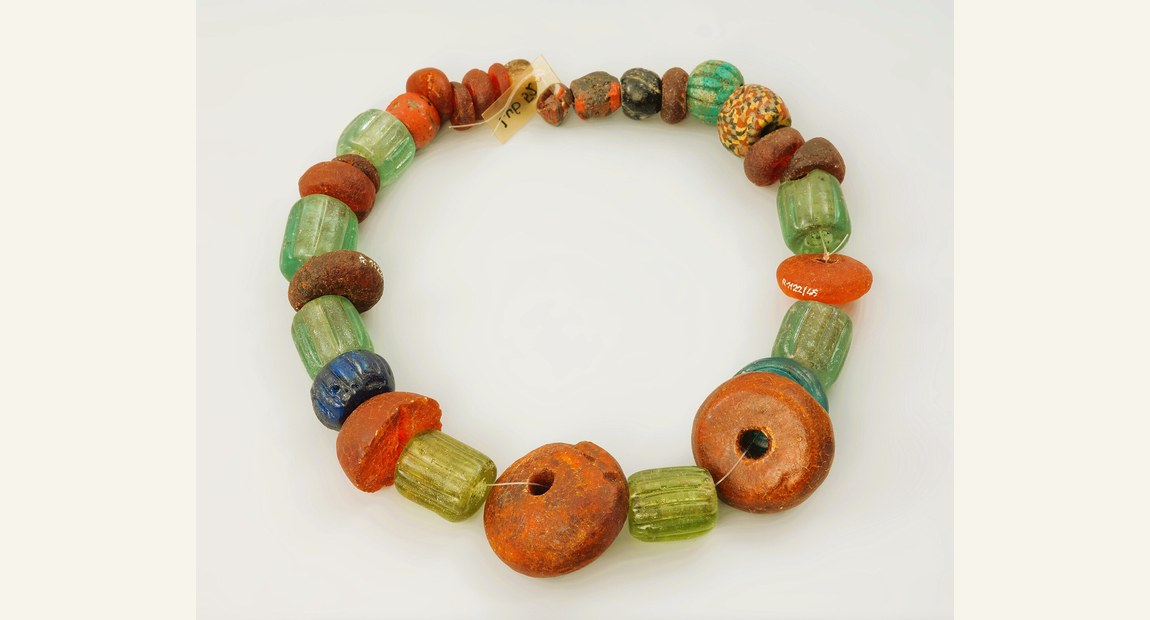
Amber is not a stone at all but fossilised tree resin – tens of millions of years old, carried by ice and sea to the shores of the Baltic and Jutland. There it became the most coveted raw material the North possessed: Stone Age hunters carved animals from it, early farmers sank thousands of beads in bogs, Bronze Age exchange carried it to Mycenae, Rome paid absurd prices, and in Viking towns from Ribe to Dublin craftsmen turned the warm gold into beads, gaming pieces and Thor's hammers. Here is what the evidence actually shows – and what merely sounds good.
Pick up a piece of amber and your hand tells you at once that something is off. It is warm. It is light, almost like wood. Rub it on a wool jumper and it lifts scraps of paper. Hold it to the sun and the light turns honey-yellow, sometimes nearly red. Small wonder that people have seen something special in this material for more than ten thousand years.
The sober answer to the question of what amber is: fossil resin. Tens of millions of years ago, vast coniferous forests grew where the Baltic Sea lies today. Their trees bled resin to seal wounds, just as a spruce does now. Some of that resin ended up in the soil, was washed away by rivers, buried in sediment and slowly hardened. The Danish reference encyclopaedia Lex dates the formation of Baltic amber roughly to between 57 and 35 million years ago. Figures vary with author and method, but everyone agrees we are talking about many tens of millions of years.
Which trees produced the resin is still not fully settled. For a long time scholars spoke of an "amber pine" (Pinus succinifera); more recent work also points to relatives of the Japanese umbrella pine. What is certain is that they were conifers and that the forest was enormous. Mineralogists call Baltic amber succinite, after the Latin sucinum that Pliny already used. Its density is only slightly above that of water (about 1.06 to 1.08 g/cm³), and its hardness is around 2 to 2.5 on the Mohs scale – soft enough to carve with a knife and polish with sand.
And then there are the famous inclusions: midges, ants, spiders and bits of plants that stuck in the liquid resin and have rested there ever since. For palaeontologists they are a window into a vanished forest.
The original amber forests are long gone. Their resin now lies mostly in a sediment layer that miners call "blue earth". The best-known source is the Sambian peninsula near today's Kaliningrad, where amber has been mined on an industrial scale since the nineteenth century. Long before that, Baltic storms threw it onto the beaches.
For Scandinavia two other forces matter: ice and waves. Ice-age glaciers pushed amber-bearing sediments west and north, and the sea keeps working the lumps free. That is why amber also turns up on Danish shores, especially in the seaweed after autumn and winter storms along the west coast of Jutland. Big pieces are rare, though – Lex calls even a 5 × 5 cm piece a very rare find on Danish coasts.
For regions without an amber coast – central Europe, the Mediterranean, later Ireland and England – it was an import. That gap between those who had it and those who wanted it is where trade began.
The words themselves tell a story. German Bernstein comes from Middle Low German bernen, "to burn": it is the "burning stone", because it catches fire and gives off a resinous, spicy smell. Swedish bärnsten carries the same idea. In Old Norse the material was called raf, which survives as Danish and Norwegian rav. English "amber" has a different, Arabic-derived history and originally referred to ambergris.
The Greeks called amber ēlektron. Ancient writers already noticed that it attracts light objects when rubbed, and when the English physician William Gilbert studied the effect around 1600 he coined a term from the Greek word that eventually gave us electricity.
And the Germanic peoples? A Roman wrote their word down for us: glaesum. It is related to English "glass" and seems originally to have meant something shining and translucent. Pliny reports that in the days of Germanicus the Romans named a North Sea island "Glaesaria" – Amber Island – which the locals called Austeravia. Which island that was cannot be determined with certainty.
The oldest amber objects in the North are not beads but little animals. Mesolithic hunter-gatherers carved elks, bears and other creatures from amber, often incised with zigzag or dot patterns. A small bear washed up on the beach of Fanø in 1991; other figures come from bogs such as Egemarke and Fogense Enge. In December 2015 an amber hunter spotted a roughly seven-centimetre animal – probably an elk, possibly a horse – in the seaweed at Næsby beach near Slagelse at night. Archaeologist Peter Vang Petersen considers it possibly the oldest work of art found in Denmark. Amber cannot be radiocarbon-dated, so its age rests on comparison with finds such as the late-glacial elk figure from Weitsche in north-eastern Lower Saxony.
Many of these figures have a loop or a "frame" between their legs. They were worn – on a strap, a belt, perhaps round the neck. Whether as hunting magic, protective charm or simple ornament, we do not know. Calling them "amulets" is an interpretation, not a finding.
With the first farmers of the Neolithic the scale changed. The people of the Funnel Beaker culture – named after their typical pots – collected and worked amber in vast quantities, especially in northern and central Jutland. According to the National Museum of Denmark, the great amber deposits date to around 3800–3300 BC. And they really are great. In the bog at Læsten near Randers, more than 4,000 beads weighing some 8.5 kg together came to light in 1837. At Mollerup in northern Jutland, farmers of the fourth millennium BC sank 12,849 amber beads in a wetland – many of them brand new, still showing traces of manufacture.
Anyone who sinks 12,849 beads in a bog is not simply discarding jewellery. They are giving something back – to whatever powers people believed in then. We do not know their names. But the act of placing precious things in water runs through Nordic prehistory all the way to the great weapon offerings of the Iron Age.
In the Bronze Age the treasure of the coast became a commodity of European rank. The North had a problem: bronze requires copper and tin, and Scandinavia had practically neither. What it did have was amber. Many researchers see this imbalance as one engine of Bronze Age exchange – amber, and probably furs and other goods, went south; metal came north.
It is well established that Baltic amber travelled far south. Amber beads were found in the shaft graves and tholos tombs of Mycenae, and in the eastern Mediterranean amber circulated as a prestige gift among rulers. That it really came from the Baltic is no romantic guess. In the 1960s the American chemist Curt W. Beck developed a way of distinguishing Baltic succinite from other fossil resins using infrared spectroscopy, and many Mediterranean finds proved to be Baltic.
Do not picture the "Amber Road" as a paved highway. The term covers a bundle of routes over rivers, passes and trading places that shifted over the millennia, with amber changing hands many times along the way.
The amber trade becomes very tangible in the Roman imperial period. Pliny the Elder devotes a long passage of his Natural History (book 37) to it. He tells how under Nero a Roman knight was sent to the coast of Germania to obtain amber for gladiatorial games. From Carnuntum on the Danube it was some 600 miles. He brought back so much that the nets protecting the spectators were studded with amber; the largest piece weighed thirteen Roman pounds.
Pliny also preserves a much older note: the Greek navigator Pytheas of Massalia (4th century BC) had spoken of an island called Abalus where amber washed ashore in spring and where the inhabitants used it as fuel. And Pliny marvels at the prices, writing in the 1855 translation by Bostock and Riley:
"…a very diminutive human effigy, made of amber, has been known to sell at a higher price than living men even…"Pliny the Elder, Natural History 37.12 (trans. Bostock & Riley, 1855, public domain)
The most famous passage, though, comes from Tacitus. In his Germania (ch. 45, around AD 98) he describes the Aestii on the eastern sea, probably ancestors of Baltic-speaking peoples:
"Sed et mare scrutantur, ac soli omnium sucinum, quod ipsi glaesum vocant, inter vada atque in ipso litore legunt." – They also search the sea, and alone of all peoples gather amber, which they themselves call glaesum, among the shallows and on the very shore.Tacitus, Germania 45 (Latin text public domain, our own translation)
Tacitus adds, with an audible shake of the head, that the Aestii themselves had no use for it: it was gathered raw, passed on unworked, and they accepted the price with astonishment. He also explains, correctly, that amber is a tree sap – after all, you can see creeping and flying insects inside it. For a Roman around AD 100 that is a remarkably accurate observation. We tell more about this people in our article on the Aestii and the gold of the Baltic.
The centres of Roman amber carving lay in the south, notably at Aquileia on the Adriatic, where the northern raw material became little flasks, figurines and rings for the elite. In the North itself amber remained above all a bead material. Necklaces of the Wielbark culture in present-day Poland, often associated with the Goths, show the mix of local amber and imported glass that shaped northern jewellery for centuries.
Jump to the eighth century. On the west coast of Jutland, a few kilometres from the sea, Ribe emerges – Scandinavia's oldest trading town. Bead makers, comb makers, bronze casters worked here – and amber polishers. On the excavated areas of the market site archaeologists have recovered several kilos of amber, mostly raw lumps and half-finished beads. Ribe VikingeCenter reads this as a sign that amber was a major commodity of the town. Charred pieces suggest that it was also burned, as incense or for varnish. Where Ribe's amber came from is easy to guess: the beaches all around. Read more about the early town and its first coins in Ribe – the oldest town in the North.
At Hedeby (Haithabu) on the Schlei the picture is a little different. Archaeologist Ingrid Ulbricht analysed the amber finds: most raw nodules were small, under five grams, and waste turned up almost everywhere on the site without a clear workshop concentration. She concluded that amber carving at Hedeby was more of a widespread sideline than a specialist trade. More on the town between two seas in Hedeby – the gateway between the seas.
Things look different at Kaupang in Vestfold, where 161 pieces of unworked amber were recorded, along with bead blanks bearing small guide marks for drilling – here there may have been dedicated workshops (more on Kaupang and Vestfold). Similar bead blanks with drilling marks are known from Paviken on Gotland. In York, Viking Jórvík, tenth-century amber was worked side by side with iron and copper alloy.
The half-finished pieces also reveal the method: choose a nodule with a helpful shape, remove the weathered crust, rough it out with knife or file, scratch a guide mark, drill – often from both sides until the channels met – then grind and polish. Occasionally a simple lathe was used. Every blank that cracked along the way ended up in the rubbish, and is now pure gold for archaeologists. As engravers we know the approach well: look first at what the material wants, then set the design.
At the mouth of the Oder lay Wolin, one of the great harbours of the southern Baltic, where Slavs, Scandinavians and traders from far afield met. Excavations have revealed amber workshops there, and at several southern Baltic sites – Wolin, Kołobrzeg, Groß Strömkendorf – amber and antler waste occur in the same layers. Perhaps the same craftsmen worked both materials. Raw material was close at hand, since the Pomeranian coast also yields amber. The full story of the town and its legend is in Wolin & Jomsborg: the metropolis at the mouth of the Oder.
And then there is Dublin, founded by Vikings in the ninth century at the far end of the Norse world. Ireland has no amber coast – yet excavators in Fishamble Street found a considerable amount of amber, including many fragments and roughouts of beads and pendants. Here the distribution points to fixed, organised workshops where only certain people worked amber. The raw material must have been imported, most likely from the Baltic region.
The commonest product was the bead. In Scandinavian women's graves, amber beads often hang between the oval brooches, mixed with glass, carnelian and rock crystal. How such necklaces were put together, and how jewellery worked as wealth and gift, is the subject of Viking jewellery: worn, given – and hacked. To meet amber's colourful neighbours, read on about the Viking bead maker.
Alongside beads, craftsmen made pendants of many shapes, finger rings, spindle whorls and gaming pieces. Ribe VikingeCenter explicitly lists dice and playing pieces among typical products. A hnefatafl board with warmly glowing amber pieces must have been a real status statement – more on the game in Hnefatafl – Viking chess.
And then the Thor's hammers. Most small hammer pendants of the Viking Age are silver, bronze or iron, but some are amber. Archaeologist Jörn Staecker, who catalogued the hammer pendants systematically, treats them as a type of their own and places them in the tenth century, although many pieces cannot be closely dated. According to summaries of his catalogue there are about fifteen, most from Denmark, a few from Scania, Sweden and Gotland. What the hammer pendants mean overall is covered in depth in Thor's hammer Mjölnir.
No text tells us whether amber was "magical" to the Vikings themselves. For Rome, Pliny reports that amber was hung on infants as an amulet and lists a whole range of supposed healing powers. That similar ideas existed in the North is plausible but not attested. It was certainly also worn simply because it was beautiful.
The Viking Age is also the age of the great eastern routes along the Dnieper and Volga, which carried Arab silver north. Amber played a part on these roads, but a more modest one than you might expect. It reached Rus settlements as jewellery and raw material, and for the high Middle Ages amber workshops are known archaeologically from places such as Novgorod and Kyiv, producing beads and small crosses among other things.
What is missing from the written sources is telling. Ibn Fadlan, who visited the Rus on the Volga in 922, reports that the men bought green beads for their women at outrageous prices. He says nothing about amber. The great east-west trade revolved around silver, furs, slaves, silk and glass beads. Amber was more a commodity of the Baltic world itself and of the routes west. The bigger picture of these routes is in The Rus: Vikings in the East and Viking trade.
On countless websites and jewellery cards you will read that amber is "the tears of Freyja". It sounds Norse, beautiful and ancient. Let us look at the sources.
In Gylfaginning (c. 1220), Snorri Sturluson tells how Freyja's husband Óðr went away on long journeys; in Brodeur's 1916 translation, "Freyja weeps for him, and her tears are red gold." In Skáldskaparmál he accordingly lists "Freyja's tears" as a poetic circumlocution (kenning) for gold, along with the rain, hail or drops of Freyja's eyes. Gold – not amber. No Old Norse text is known that equates Freyja's tears with raf. The link to amber is a modern transfer, probably inspired by the colour and by the Greek legend in which Phaethon's sisters weep for their fallen brother and their tears harden into amber – a story Pliny already dismissed as invented.
The same goes for Brísingamen, Freyja's famous necklace. The sources do not say what it was made of. In the eddic Þrymskviða it is simply Freyja's necklace; Snorri has Loki steal it and Heimdallr fight for it; a late tale, Sörla þáttr, makes it the work of four dwarfs and speaks of gold. That it was an amber necklace is a modern hypothesis – tempting, because amber necklaces really do occur in women's graves, but backed by no text. We go through the evidence in Brísingamen – Freyja's necklace between Edda, skaldic verse and Viking grave and in our portrait of Freyja.
Because amber is so desirable, it has long been imitated – with plastic, glass, pressed amber powder or young resin known as copal. A few simple checks help with a first assessment:
Only laboratory methods such as infrared spectroscopy give certainty – the same technique Curt Beck once used to trace Baltic amber to Mycenae. For valuable pieces an expert opinion is worth it.
Alongside golden amber, by the way, the Vikings liked its dark counterpart: black jet, which also charges up when rubbed and is similarly light. Find out more in Jet – the black gemstone of the Vikings.
For ten thousand years people in the North picked up the same material, worked it, wore it, offered it and sold it – the hunter on the Stone Age beach, the farmer at the Mollerup bog, the Aestii who puzzled Tacitus, the polisher in Ribe. Perhaps that is amber's real magic: not Freyja's tears, but the fact that it holds time still. A midge. A drop of resin. And the traces of every hand that has touched it since.
What exactly is amber? Amber is fossilised tree resin, not a mineral. Baltic amber (succinite) comes from coniferous forests that grew in the Baltic region many tens of millions of years ago.
Where can you find amber in Denmark and on the Baltic? Mostly along the tideline after autumn and winter storms; in Denmark especially on the west coast of Jutland. The largest deposits are on the Sambian peninsula near Kaliningrad, where amber is also mined.
Did the Vikings wear amber? Yes. Amber beads, pendants, gaming pieces and even a number of amber Thor's hammer pendants are known, and amber was worked at Ribe, Hedeby, Kaupang, Wolin, York and Dublin.
Is amber Freyja's tears? Not according to the Old Norse sources. Snorri writes that Freyja weeps red gold, and "Freyja's tears" is a kenning for gold. Equating them with amber is modern.
What does glaesum mean? According to Tacitus (Germania 45), it was the Aestii's word for amber. It is related to English "glass".
How can I tell if amber is real? Real amber is warm, light and floats in saturated salt water. It can only be identified with certainty in a lab, for example by infrared spectroscopy.
For courage. For remembrance. For legends that live on.
Jet – the black gemstone · Carnelian – the Vikings' red beads · Hacksilver – silver as currency · Viking jewellery · Norse gifts for women.
All Everyday Life & Craft articles →
When we think of Vikings, we often see grey-brown figures in undyed wool. That is a mistake. Whoever could afford it …
Read more →They ran the farm, could inherit and divorce – and yet the truth about the Viking woman is more nuanced than modern …
Read more →A stone that burns like coal, charges electrically when rubbed like amber, and polishes to a deep black shine: jet is …
Read more →How do you pay when there is no money of your own? The Vikings had a simple answer: with silver, weighed on the scales …
Read more →