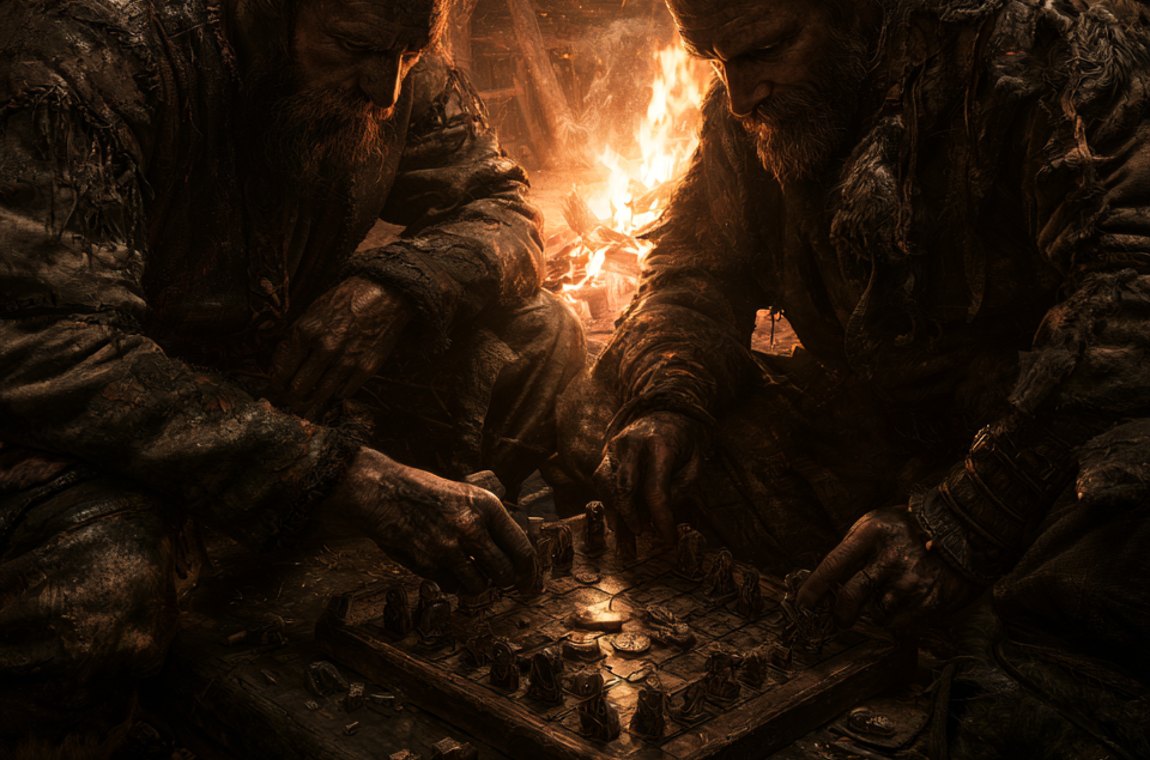
Hnefatafl is the great board game of the Viking Age: a king and a handful of defenders start in the middle of the board and must break out, while an attacking force twice their size tries to trap him. The game is attested by boards, by playing pieces of glass, bone and amber, and by sagas and riddles. Its exact rules, however, are lost and have to be reconstructed – mainly from an account Carl Linnaeus wrote in 1732. Want to try it first? Play hnefatafl online now on our site.
A chamber grave on the island of Björkö in Lake Mälaren, sometime around the middle of the tenth century. The dead person lies with sword, axe, spear, arrows and two horses. And in the lap, packed in a pouch: gaming pieces, dice and a king. Modern researchers read the set as the mark of someone who understood strategy. No other grave good speaks quite so quietly about thinking.
The game was called tafl, and in its best-known form hnefatafl. It is not chess, and it is not merels. It is something that feels oddly foreign today: an unequal fight in which the two sides want completely different things. And if you ask where our modern rules come from, the trail does not end with a Viking at all, but with a Swedish botanist travelling through Lapland in the 1730s.
Old Norse tafl means "board" or "board game". It was borrowed from Latin tabula, the same word that gave English "table" – which is why medieval English writers spoke of "tables" for board games. At first tafl was a catch-all. Later the Norse distinguished skáktafl (chess), kvátrutafl (a dice game in the backgammon family), halatafl (a fox-and-geese type game) and hnefatafl. Once chess arrived in the north, the old game needed a name of its own.
The element hnefi literally means "fist". In the sources, though, it names the central piece, the king. The Hervarar saga is explicit: the darker pieces defend the hnefi. Why "fist" of all things is unclear – perhaps the king was simply the chunkiest piece on the board. "King's table" is the usual English gloss and catches the sense, but it is not a literal translation. Some manuscripts spell it hnettafl.
The basics take a minute. Every piece moves in a straight line, any distance, like a rook in chess. You capture an enemy piece by sandwiching it between two of yours. The king sits in the centre with his bodyguard; the attackers wait along the edges, roughly twice as many. The king wants to reach the edge or a corner, the attackers want to hem him in. Simple and merciless. You can test it straight away in our online hnefatafl game – against the computer, no sign-up needed.
Hnefatafl was never a single game with a fixed rulebook. It was a family, and wherever Scandinavians settled or traded, relatives turn up with different board sizes and names. One caveat for the overview below: the piece counts are mostly inferred from board size and analogy. Only for tablut and tawlbwrdd do they come from written descriptions.
| Variant | Region | Board | Set-up | Evidence |
|---|---|---|---|---|
| Brandubh | Ireland | 7 × 7 | king + 4 vs 8 | name in Irish literature, boards like Ballinderry; rules reconstructed |
| Ard Rí | Scotland | 7 × 7 | king + 8 vs 16 | modern reconstruction, "High King" |
| Tablut | Lapland (Sámi) | 9 × 9 | king + 8 vs 16 | Linnaeus' diary, 1732 |
| Hnefatafl | Scandinavia | 11 × 11 or 13 × 13 | today usually king + 12 vs 24 | finds and sagas, no written rules |
| Tawlbwrdd | Wales | 11 × 11 | king + 12 vs 24 | manuscript of Robert ap Ifan, 1587 |
| Alea evangelii | England/Ireland | 19 × 19 points | probably king + 24 vs 48 | Corpus Christi College Oxford MS 122 |
Brandubh is the small Irish form. The name is usually taken to mean "black raven". It appears in medieval Irish literature, where kings and heroes play it, but those texts never explain how. Linking it to the small 7×7 boards from Ireland and Orkney is plausible, not proven. The famous Irish game fidchell is sometimes equated with tafl as well; whether it really belonged to the family is disputed.
Tawlbwrdd (Welsh, "table board") is a lucky break for researchers, because here we have an actual description. In 1587 Robert ap Ifan noted, in a manuscript now in the National Library of Wales, that the game was played on an 11 × 11 board with a king and twelve men against twenty-four. Plenty of detail is missing, but it is a real written witness.
The Alea evangelii, the "Gospel game", is the odd one out. A manuscript at Corpus Christi College, Oxford (MS 122), usually dated to the eleventh century and written in an Irish hand, shows a huge board played on the intersections of a grid, much like a go board. The accompanying text claims the game was invented at the court of the English king Æthelstan (924–939) and carried to Ireland by Dub Innse, bishop of Bangor. The pieces are mapped onto the Eusebian canon tables of the Gospels, and the central piece stands for the unity of the Trinity. A secular siege game given a pious makeover – and proof of how familiar tafl must have been in Anglo-Saxon and Irish circles.
Rules rot faster than wood. What survives are the objects themselves, and there are surprisingly many.
Gokstad, Norway: The famous ship burial on the Oslofjord, raised around 900, contained a two-sided wooden board. One face carries a merels pattern, the other a grid that the games historian H. J. R. Murray reconstructed as 13 × 13 squares. The board is broken, so that size is an inference. A single horn gaming piece was found with it. For the grave and the ship itself, see our article on the Gokstad ship.
Ballinderry, Ireland: The finest surviving tafl board comes from a crannóg – an artificial island settlement – in County Westmeath, excavated in 1932. It is made of yew, has 49 peg holes in a 7×7 grid, and the centre and corner holes are marked off with arcs. A frame with projecting heads, probably handles, and interlace panels in the Scandinavian Borre style decorate it. The crannóg was occupied from the late ninth to the eleventh century. The National Museum of Ireland, where the board is on display, considers Dublin its most likely place of manufacture. Pegged pieces have one obvious advantage: they stay put when the board wobbles. How Scandinavians lived in Dublin is the subject of our article on the Ostmen of Dublin.
Birka, Sweden: The graves of the trading town on Lake Mälaren are a treasure chest of gaming pieces. Grave 750 held glass pieces in two colours, dark green and pale blue-green, a dark king, and the fittings of a board that has itself decayed. Other Birka graves produced sets of amber, bone and elk antler, each with a distinguished king piece. And then there is chamber grave Bj 581 from the opening of this article, whose occupant was identified as a woman by DNA analysis in 2017. Its gaming kit – pieces, antler dice and the iron fittings of a board – was one reason the researchers argued for a military leadership role. That reading is debated; more in our article on the Birka warrior woman. For the town itself, read Birka – the silver town on Lake Mälaren.
More finds: A boat grave at Skamby in Sweden produced a set of amber pieces with one larger piece. Small boards with a marked centre are known from Buckquoy on Orkney, medieval 13×13 boards from Bergen. Lindisfarne yielded a blue glass piece with white droplets in 2019, from a trench dated to the eighth or ninth century. And the National Museum of Denmark recently presented a walrus-ivory figure barely three centimetres tall, which archaeologist Peter Pentz interprets as the king of a tafl set; it had been found west of Oslo as long ago as 1798.
Material tells you status. Ordinary people played with pieces of bone or wood, perhaps with pebbles on a grid scratched into a board. The well-off owned glass pieces, often from the same workshops that made beads, as our article on the bead maker shows. At the top end were sets of amber, walrus ivory or antler with finely carved kings.
Few topics attract such generous attributions as hnefatafl. Three cases deserve a closer look.
The Lewis chessmen are the most famous gaming pieces of the north. Found in 1831 on the Hebridean island of Lewis and carved mostly from walrus ivory, they date to the twelfth century, probably between 1150 and 1200. They are often sold as "Viking game pieces" or even as a hnefatafl set. They are clearly chess, though: kings, queens, bishops, knights, warders as rooks, and pawns – 78 pieces in the original hoard. Alongside them were 14 flat discs for a game of the backgammon family. The hoard captures precisely the moment when chess was winning.
The Ockelbo runestone in Gästrikland shows two men holding drinking horns, seated over a board whose centre and corners appear to be marked. It is usually dated to the late eleventh century and counts as a picture of a tafl game. The catch: the original stone was destroyed in a church fire in 1904. What stands today is a reconstruction based on older drawings. The motif is not in doubt, but fine details such as the board markings should be treated with care.
The Vimose gaming board from Funen is often called the oldest tafl board in popular writing. It comes from a great weapon deposit of the Roman Iron Age, centuries before the Vikings. The National Museum of Denmark, however, cautiously reads it differently: one side may have served a game like the Roman ludus latrunculorum, the other a backgammon-like game. The finds include pieces of amber, bone and Roman glass, and dice. Germanic warriors clearly knew Roman board games early on. That tafl grew out of them is a reasonable guess, not a proven fact.
The written sources almost all date from the twelfth to fourteenth centuries. For the rules they offer little, for the game's meaning a great deal.
The key passage comes from Hervarar saga ok Heiðreks. Odin, disguised as Gestumblindi, challenges King Heiðrekr to a riddle contest – a motif that recalls the wisdom duel in Vafþrúðnismál. Two riddles concern tafl. In the first, Gestumblindi asks about brides who fight around their weaponless lord; the darker ones shield him every day, the fairer ones attack. Heiðrekr solves it at once:
"That is hnefatafl: the darker ones defend the hnefi, and the white ones attack."Hervarar saga ok Heiðreks, Gestumblindi's riddles, our own translation from the Old Norse
Two details here are pure gold. First, the king is vápnlauss, "weaponless" – a hint that in this version he could not take part in captures himself. Second, the colours: defenders dark, attackers light. Friðþjófs saga, by contrast, makes the defenders red and the attackers white. A second riddle describes a beast with eight horns and no head, followed by many; the answer is "the húnn in hnefatafl". What the húnn was is disputed: the king, a playing piece, or a die? On that question hangs whether hnefatafl was sometimes played with dice.
Orkneyinga saga preserves a verse by Earl Rögnvaldr Kali Kolsson, who ruled Orkney in the twelfth century. He lists nine accomplishments, and the board game comes first: Tafl emk ǫrr at efla – roughly, "I am keen and skilled at tafl". Runes, books, smithing, skiing, archery, rowing, harp playing and poetry follow. Note the order: the board game ranks ahead of the weapon skills. Tafl was part of a ruler's education. Meet the rulers of the islands in our article on the Earls of Orkney.
The Edda knows the game too. In Völuspá the gods of the golden age teflðu í túni, "played tafl in the courtyard", and after the end of the world the Æsir find the golden gaming pieces, gullnar tǫflur, again in the grass. Older translations sometimes hide this. Henry Adams Bellows rendered the line in 1923 as follows:
"In their dwellings at peace they played at tables, / Of gold no lack did the gods then know."Völuspá, stanza 8, translated by Henry Adams Bellows (1923, public domain)
"Tables" is exactly right – the English word for board games. The German translator Karl Simrock, on the other hand, turned the tafl into dice in 1851 and the golden pieces into golden "balls", a sign of how unsure nineteenth-century scholars were about what tafl meant. The image itself is powerful: at the beginning and the end of the world, the gods sit at a board game. Leisure as the sign of an intact order.
In the sagas of Icelanders people play tafl in passing all the time. None of these scenes works as a rulebook. Legal texts, which people sometimes ask about, do not help much either: we could not reliably verify a law passage that explicitly regulates hnefatafl.
No Viking wrote down the rules of hnefatafl. The only detailed first-hand description of a tafl game in actual play comes from Carl Linnaeus, later the father of botanical classification. In 1732 the young naturalist travelled through Lapland and kept a diary, the Lachesis Lapponica. In it, with a sketch, he describes a Sámi game called tablut.
According to Linnaeus, tablut was played on an embroidered reindeer hide with 9 × 9 squares. The king stood on the central "castle", surrounded by eight "Swedes" in a cross. Facing them were sixteen "Muscovites", in groups of four at the middle of each edge. The Swedes won if the king reached any edge square, the Muscovites if they captured him. The names betray the era: the Great Northern War against Russia had ended barely eleven years earlier.
This very source was misread for a long time. James Edward Smith published an English translation of the diary in 1811; the Latin-Swedish passage on the game was translated by the merchant Carl Troilius, who made mistakes. The most consequential: that the king had to be surrounded on all four sides. In the original, two attackers usually suffice; only on or next to the castle are three or four needed. Newer translations, such as John Ashton's (2007), corrected this. Many twentieth-century rule sets sold as "authentic Viking rules" therefore rest on a faulty translation of an eighteenth-century account of a Sámi game.
Because the gaps are large, several rule sets have become established. The most widespread are the Fetlar rules, named after the Shetland island where tournaments were held from the 2000s, and the Copenhagen rules built on them, now the tournament standard. Both are played on 11 × 11: the king and twelve defenders against twenty-four attackers. The differences between all versions revolve around a handful of questions.
Is the king armed? An armed king may help capture, sandwiching an enemy together with a defender. An unarmed king cannot. The Hervarar riddle points to an unarmed king; Linnaeus is not conclusive. The Copenhagen rules arm him.
How is the king captured? In Linnaeus' tablut two attackers normally suffice, as with any other piece. Under Fetlar and Copenhagen rules the king must be surrounded on four sides, or on three if the fourth is the throne. A "strong" king is very hard to catch and gives the defenders a huge boost.
Edge or corner? If the king may escape to any edge square, the defenders win almost every game on larger boards. So most modern versions require him to reach one of the four corners. The corners and the central throne are "castle" squares only the king may enter, and they count as hostile when a piece is pinned against them. Whether the marked corners at Ballinderry meant exactly this, we do not know – but they suggest the corners mattered. Copenhagen adds extras such as a "shield wall" capture along the edge; for the real formation, see our article on the shield wall.
Is it fair when thirteen face twenty-four? That depends entirely on the rules, and the tafl community has argued about it for decades.
On small boards with edge escape the king can hardly lose. Ard Rí, for instance, is considered solved: with correct play the defenders always win. Conversely, tablut with the corrected Linnaeus rules has been found in modern analyses to favour the attackers slightly. In Copenhagen tournaments, players therefore swap sides. The game designer R. Wayne Schmittberger even proposed a bidding system to balance play.
For the Viking Age that leaves one honest conclusion: we do not know whether the game was balanced then. Perhaps the stronger player deliberately took the weaker side; perhaps a die decided things. All we know is that people played it for centuries – something about it clearly worked.
You learn the rules in minutes and the game over years. Still, a few principles help immediately, especially when you try our hnefatafl online.
As the attacker: Don't chase the king – build a ring. The greatest danger is an open line to a corner, so occupy the squares diagonally in front of the corners first. A diagonal chain of pieces is almost impossible to break, since none of its pieces can be sandwiched. Patience wins: every piece you lose is a hole in the net.
As the defender: Tempo is everything. In the opening moves the attackers are still scattered, so open lines quickly and threaten two corners at once. A fork that gives the king two escape routes can only be blocked once. Sacrifice defenders if it clears a line. And do not let the king squat in the middle: a walled-in king is a lost king.
For both sides: Corners and throne act as enemies, so never park a piece next to one where an opponent can pin it from the other side. And switch sides often: once you have played both attacker and defender, you understand the game twice over.
Gaming pieces in warrior graves, Rögnvaldr's list of skills, the gods at play in Völuspá – all of it shows that tafl belonged to an elite's image of itself. At the same time it whiled away long winter evenings in the longhouse. The finds range from luxury sets to simple pieces and scratched grids, so it was not only the powerful who played. For a wider look at leisure and competition, read our article on glíma and knattleikr.
The end came gradually. Chess reached the north in the eleventh and twelfth centuries along with Christianity and trade. It carried prestige and it was balanced. The Bergen boards show that hnefatafl was still played into the late Middle Ages, but in the end it survived only on the margins – in Wales into the sixteenth century, in Lapland into the eighteenth – and then as a reconstruction, with us.
We are a family engraving workshop in Alsdorf near Aachen, and a tafl board is a labour of love for us. The grid is perfect for laser engraving: crisp lines, marked castle squares, perhaps a Borre-style interlace border like Ballinderry's or a runic inscription with the players' names. On slate the board looks dark and weighty, almost like an excavated find; on wood it feels warm and homely. We compare the materials in Slate, wood or glass?. If you would like your own 11×11 or 13×13 board, get in touch via our custom engraving page – and get some practice online first.
What is hnefatafl? An asymmetric board game of the Viking Age: a king tries to escape from the centre of the board while an attacking force twice the size tries to trap him. It is attested by archaeological finds and saga literature.
What are the rules of hnefatafl? All pieces move in straight lines like a rook, and you capture by sandwiching an enemy between two of your pieces. The king usually wins by reaching a corner, the attackers by surrounding him. The original rules are lost; modern sets such as the Copenhagen rules are reconstructions.
Is hnefatafl Viking chess? "Viking chess" is a modern nickname. Hnefatafl is not related to chess, which displaced it in the north from the twelfth century.
What is the difference between tablut and hnefatafl? Tablut is the Sámi variant on a 9 × 9 board that Carl Linnaeus described in 1732. Hnefatafl was played on larger boards of 11 × 11 or 13 × 13; its rules are reconstructed from tablut.
What does the word hnefatafl mean? Tafl means board or board game; hnefi literally means fist but refers to the king piece. It is usually rendered as "king's table".
Can I play hnefatafl online? Yes – you can play hnefatafl for free in your browser on our site, no account needed.
For courage. For remembrance. For legends that live on.
The Mästermyr tool chest · Viking clothing & fashion · Viking names & their meaning · Viking jewellery.
All Everyday Life & Craft articles →
In the darkest time of the year the Norsemen celebrated Jól. Some customs of this winter feast live on in our Christmas …
Read more →When archaeologists open a Viking-age grave, one find is almost always there: a comb. The comb was the most personal …
Read more →Among silver and glass, glowing red beads keep appearing in the rich women's graves of the Viking Age: carnelian. The …
Read more →How did people heal in a world without a pharmacy? With herbs, with knowledge – and with a charm to go with it. An Old …
Read more →