Chamber grave Bj 581 at Birka held a woman, buried with a sword, an axe, two spears, 25 arrows, two shields, two horses and a gaming set. A genome study proved her sex in 2017, after the grave had spent roughly 140 years as the textbook example of a male elite warrior. Whether she actually fought, let alone commanded, is an interpretation rather than a measurement. Here is what is secure, what the critics objected to, how the researchers answered in 2019 and which questions are still open.
Some finds sit quietly in textbooks for decades until someone asks one new question. Chamber grave Bj 581 is one of them. From the day it was opened in 1878 it stood for the Viking warrior par excellence: a full weapon kit, two horses, a gaming board, a spot right beside the fortress. Nobody asked whether a man lay there. The weapons seemed to settle it.
In 2017 the answer came back from the lab: the person in this grave had two X chromosomes and no Y. Biologically, a woman. Since then Bj 581 has become one of the most argued-over burials of the entire Viking Age – hailed as proof of shield-maidens, dismissed as a lab blunder, reinterpreted in every direction imaginable.
We think the real story beats any headline. It is not only about a woman in the tenth century. It is about how archaeology works, how assumptions harden into facts, and how to be honest about what cannot be known. So let us take it step by step.
Birka lies on the island of Björkö in Lake Mälaren, west of modern Stockholm. From the eighth century it grew into one of Scandinavia's key trading places, a hub linking the Baltic, Russia and the routes reaching all the way to the Caliphate. Towards the end of the tenth century it faded. Today, together with neighbouring Hovgården, it is a UNESCO World Heritage Site.
Around the town lie cemeteries with some 3,000 visible mounds and graves. About 1,100 of them have been excavated, most in the nineteenth century. Above the settlement rises a hillfort, the Borg, and below it a large building was uncovered in 1998 that researchers call the "Garrison". It produced fragments of weapons and armour: remains of at least nine spears, three swords, two axes, two fighting knives, more than 50 arrows and pieces of armour. Armed men – and perhaps women – evidently lived and trained here.
Bj 581 sits right at this spot. The grave lies on a raised terrace outside the northern gate of the hillfort, beside the road that led from the fortress down into town. It is the westernmost grave on Birka, marked by a large boulder. Whoever was buried here was meant to be seen by everyone coming down from the fort or climbing up to it.
The grave was excavated by the Swedish naturalist and archaeologist Hjalmar Stolpe (1841–1905). He worked on Björkö from 1871 for many seasons and uncovered hundreds of burials. For his day he was unusually meticulous: he kept field diaries, drew plans and had the finds labelled. That care matters later in this story.
Bj 581 impressed him at once. In his 1879 report to the Royal Academy he called it, in essence, perhaps the most remarkable of all the graves on this field. His field notes simply assumed a man – because of the weapons, and because jewellery and weaving tools were missing. That was not a measurement. It was the expectation of his time.
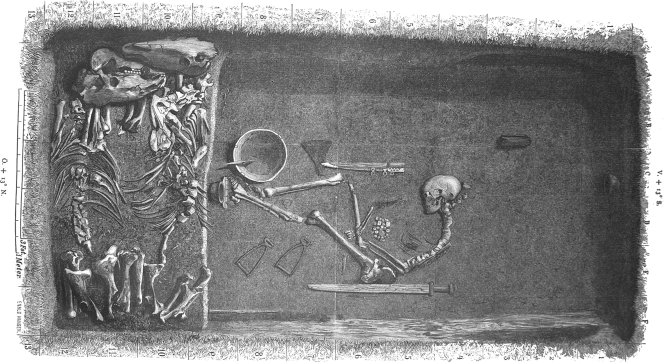
Stolpe drew the grave plan on site in 1878. It was published in 1889 as an engraving by Evald Hansen, and it was redrawn once more for Holger Arbman's great catalogue of the Birka graves (Birka I, plates 1940, text 1943). These later versions differ in details – and that, too, became part of the dispute.
Bj 581 is a chamber grave: a timber-lined room dug into the ground, in which the dead person lay as if in a small house. According to the literature the chamber measured roughly 3.45 by 1.75 metres. The body was probably placed sitting upright, perhaps on a chair or bench, and later slumped. Seated burials occur at Birka in some of the richest graves.
Following Arbman and the 2019 re-publication, the grave held:
The grave is dated by a quarter-fragment of an Arab silver dirham struck under the Samanid ruler Naṣr ibn Aḥmad during the reign of the caliph al-Muqtadir; Price et al. place the striking between 913 and 933. A coin only gives an earliest possible date. Combined with the typology of the other objects, it points to the mid-tenth century.
The weapons are not miniatures or toys but fully functional kit. That sets Bj 581 apart from some other graves where weapons look more symbolic. Of the roughly 1,100 excavated graves on Birka, only 75 contain any offensive weapon at all, and only two hold a full weapon set. Bj 581 is one of those two, and it also ranks among the twenty or so richest graves on the island.
For twentieth-century scholarship, Bj 581 was the go-to example. Anyone wanting to show how a mounted elite warrior of the Viking Age was equipped reached for this grave. Arbman published it in 1943, Anne-Sofie Gräslund discussed it in her 1980 volume on Birka's burial customs, and studies of Birka's martial culture – such as Charlotte Hedenstierna-Jonson's 2006 doctoral thesis The Birka Warrior – treated it as a fixed point. Drawings in books and exhibitions showed a bearded horseman.
What is striking is how that reading took root. Nobody had ever tested the sex. The assumption came from Stolpe's notebook and was handed down from one generation of scholars to the next. Price and his colleagues therefore speak, in 2019, of a chain of cumulative assumptions: each researcher built on what the previous one had taken for granted.
There was a quiet warning, though. As early as 1980, Gräslund argued in general terms that weapon-rich graves are more likely to show a person's social rank than a career as a fighter. That point remains one of the strongest objections to any hasty reading – whether the grave holds a man or a woman.
The first crack in the picture came not from genetics but from osteology, the study of bones. In 1975 the osteologist Berit Vilkans inventoried the skeletal remains in the Birka boxes. She recorded the Bj 581 skeleton as female. But because it seemed uncertain whether the bones really belonged to the grave – she noted, for example, a third thigh bone and slightly different age estimates – nobody followed it up.
It was Anna Kjellström of Stockholm University who re-examined the bones as part of a larger study of the Mälaren Valley population. She presented her results at a conference in 2014 and published them in 2016. Her findings: a wide greater sciatic notch on the pelvis, a distinct preauricular sulcus, a jaw without a projecting chin, and slender, gracile long bones. All of this points to a woman. She put the age at over 30. She found no injuries and no pathological changes.
Pelvic sexing in adults is fairly reliable, but not infallible. And the old question remained: did these bones truly come from this grave? That is where genetics came in.
In September 2017 the American Journal of Physical Anthropology published "A female Viking warrior confirmed by genomics". The lead author was Charlotte Hedenstierna-Jonson; among the ten authors were Anna Kjellström, the archaeologist Neil Price and the geneticists Mattias Jakobsson and Anders Götherström.
The team extracted DNA from two different skeletal elements: a left canine tooth and a left upper arm bone. The result was clear. The share of sequences mapping to the Y chromosome was practically nil, far below the threshold for classifying an individual as female. Both samples also produced the same mitochondrial lineage (haplogroup T). That matters: the tooth and the arm almost certainly come from the same person.
The team added strontium isotope analysis on three molars. Strontium from soil and water is laid down in tooth enamel during childhood and hints at where someone grew up. The values fell outside the estimated local range, suggesting the woman did not grow up at Birka and may have moved during childhood. The authors themselves stress that this is not conclusive. Genetically she was closest to present-day people from the British Isles, Iceland, Denmark and Norway, and within Sweden to people in the south and centre. How carefully such comparisons need to be read is explained in our piece on DNA tests and Viking ancestry.
The paper's title, however, overreached. Genetics confirmed biological sex – not occupation. That gap between "female" and "warrior" instantly became the heart of the debate.
Within days the press had turned the find into a global story: "The real shield-maiden", "Lagertha was real". Specialists were far more cautious, and part of the criticism was fair. The main objections:
The wrong skeleton? The historian Fedir Androshchuk and others pointed out that some Birka graves had been disturbed, that the different versions of the grave plan disagree, and that Vilkans' notes might indicate a second body. As far back as 1989 Greta Arwidsson had considered a double burial. The Swedish archaeologist Martin Rundkvist argued that the possibility of mixed-up bones deserved more thorough treatment.
Weapons do not make a warrior. Judith Jesch, professor of Viking studies at Nottingham, questioned whether grave goods show what a person did in life at all. Weapons can express rank, family property or a role played at the funeral. She also criticised the 2017 paper for arguing its interpretation too briefly.
A gaming board as a sign of command? The researchers had read the gaming set as a pointer to tactical thinking and leadership. Jesch found that link unconvincing. The archaeologist Leszek Gardeła noted that gaming pieces occur in graves of men and women alike. A board game is, first of all, a board game – what lies behind hnefatafl and other Norse games we explain elsewhere.
The eastern element. The clothing and cap point to the steppe and the East. Jesch remarked that this side of the grave was given short shrift in reading it as a "Viking" warrior.
In February 2019 Neil Price, Charlotte Hedenstierna-Jonson and colleagues followed up in the journal Antiquity with "Viking warrior women? Reassessing Birka chamber grave Bj.581". The question mark in the title already signals a more careful tone. The paper works through the objections one by one, with a detailed supplement on the documentary record.
On whether the bones belong to the grave, the authors offer three lines of evidence. First, every single bone in the analysed skeleton is individually labelled "Bj.581" in ink – as are the horse bones and most of the objects. Second, they compared the skeleton element by element with Stolpe's original 1878 drawing: all major bones are present, only the skull and some small foot bones are missing, which is common in old excavations, and no labelled bone is absent from the drawing. Third, they compared it with other graves from which the skeleton might in theory have come, and excluded them.
On the supposed double burial, they report that the extra thigh bone in Vilkans' inventory is labelled "Bj.854", so it belongs to a different grave and was evidently misfiled. The supposed human ribs turned out to be horse bones. The differing age estimates can be explained by dental wear linked to diet, and the DNA from tooth and arm comes from one person. Stolpe's 1879 report describes only one body. Their conclusion: they have the right individual, and she was buried alone.
On interpretation, the authors list a whole range of alternatives themselves: the woman could have been a farmer, a merchant, a craftworker or a poet and been given objects that were not hers; a warrior identity might have been conferred on her only at the funeral; she might have taken on a male social role; other gender identities are conceivable too, although the authors call modern terms such as "transgender" problematic when applied to the past. Weighing it all, they hold to the reading they consider most straightforward: the grave of a woman who lived as a professional warrior and was buried as one. They stress explicitly that a single grave cannot carry sweeping conclusions about an entire society.
Jesch responded on her blog: the new paper was better argued than the 2017 one, but often made too much of slim evidence. She still found the link between gaming board and command unconvincing, and pointed out that the supplement's own wording – something that appears to be an iron-framed gaming board – shows how shaky that point is.
Let us sort it soberly. Secure: Bj 581 held a woman over 30, buried alone, in a chamber at one of Birka's most prominent spots, with a full weapon kit, two horses, a gaming set and eastern-style clothing, around the middle of the tenth century. The link between the bones and the grave is very well founded after the 2019 evidence; a residual doubt about a 140-year-old museum collection can never be fully excluded, and some critics still rate it higher than the authors do.
Open is everything concerning this woman's life. Did she fight? Her skeleton shows no healed injuries. That does not rule it out – many warriors leave no marks on bone, and the skull is missing – but it provides no evidence either. Did she command? That rests on the gaming set and the location by the Garrison, which is to say on interpretation. And what the burial meant to those who arranged it, we simply do not know.
That distinction is exactly what makes the case so instructive. The old view – weapons equal man equal warrior – was just as much an interpretation as the new one. Nobody had ever tested it. The real gain from Bj 581 is therefore less the headline than the method: determine biological sex independently first, then interpret the grave goods, and lay both openly side by side.
Bj 581 is the most famous grave of a woman with weapons, but not the only one. In 2021 Leszek Gardeła gathered the material from across Scandinavia and beyond in his book Women and Weapons in the Viking World. His finding: there is a modest number of such graves, often with just a single weapon such as an axe or a spear, frequently alongside typically female jewellery. A kit like the one in Bj 581 is the great exception.
Gardeła warns against declaring all these women warriors wholesale. An axe can be a tool, a spear a status marker, a weapon in a woman's grave even a hint of magic or ritual. Some finds recall the staffs of the seeresses we describe in our article on the völva. The picture is varied, and that is what makes it interesting.
Why did Bj 581 hit so hard? Because it seemed to confirm a figure everyone knows: the shield-maiden, Old Norse skjaldmær. It is worth looking at the texts, precisely to see what they can and cannot tell us.
The richest source is the Danish historian Saxo Grammaticus, who wrote his Latin Gesta Danorum around 1200. In Book Seven he says, in essence, that there were once women among the Danes who dressed like men and devoted their lives to arms; the tale of the sea-raider Alfhild belongs here. In Book Eight, at the great battle of Brávellir, he names warrior women such as Hetha, Visna and Vebiorg. In Book Nine Lagertha appears, fighting at Ragnar's side.
From a source-critical angle this means: Saxo was writing some 250 years after Bj 581, as a learned cleric, with a gaze shaped by classical models such as the Amazons. His shield-maidens are literary figures in a distant past that he himself knew only from songs and stories. They show that the motif was familiar in the High Middle Ages – not that such women existed in this form in the tenth century.
The same goes for the Icelandic sagas and heroic poems. In Hervarar saga, Hervör takes the sword Tyrfing from her father's grave mound and sets out as a Viking; in the Völsung legend Brynhild is a warrior who will marry only a hero. These are legendary sagas and heroic poetry, written down in the thirteenth century and later, full of wonders and sorcery. The more realistic Sagas of Icelanders, by contrast, hardly know fighting women. There, women shape events with words, counsel and goading rather than blades.
And then there are the valkyries: supernatural women who decide death in battle and carry the fallen to Odin. They are myth, not soldiers. But they show that the image of armed women was deeply rooted in Norse imagery – on picture stones, in small pendants of female figures with shield and sword, and in poetry.
Some want to see a heroine in Bj 581, others an overblown campaign. What we really have is a woman buried more than a thousand years ago at the edge of a trading town – with everything that expressed power and rank in her world: weapons, horses, silk, silver, a game. Someone equipped her that way, deliberately and at great expense, and laid her in a spot that everyone had to pass. Her community wanted her remembered like this. That much we know for certain.
Whether she threw spears and gave orders, her grave does not fully reveal. The most honest position is the one the researchers themselves take: the warrior reading is well argued, but it is not the only possible one. And that is a finding too: the Viking Age was more varied than a century of textbooks told us. To learn more about women's lives in the North, read our piece on women in the Viking Age, and to see Birka's burial customs in a wider frame, continue with death and the afterlife in the North.
Was the Birka warrior really a woman? Yes. Osteology and the 2017 genome analysis agree that the person in Bj 581 was biologically female, and the DNA from tooth and upper arm comes from the same individual.
Is it proven that she was a warrior? No, that is an interpretation. The full weapon set, the horses and the location by the Garrison suggest a warrior to the excavators, while other researchers see a status burial or a symbolic role as equally possible.
When did the woman in grave Bj 581 live? She was buried around the mid-tenth century and was over 30 when she died. An Arab coin from the early tenth century gives the earliest possible date.
Could the bones have been mixed up? That was a central objection. According to Price et al. (2019), every bone is labelled "Bj.581" and matches Stolpe's grave plan; an extra thigh bone comes from another grave, and a double burial is not supported.
What was the gaming board in the grave? Excavators found 28 gaming pieces with dice and remains of a probably iron-framed board. Which game was played is not certain, and whether it signals a leadership role is disputed.
Were shield-maidens real? In the sagas and in Saxo they are literary figures from a later age. Archaeology knows a small number of women's graves with weapons, Bj 581 being the best known – but that is no evidence of an army of shield-maidens.
For courage. For remembrance. For legends that live on.
Valkyries · Women of the Viking Age · The Shield Wall · Hedeby.
All History & Finds articles →
Sometimes history is found not with the spade but with the computer. For a long time four of Harald Bluetooth's famous …
Read more →„So did they wear horned helmets or not?" The honest answer is a double no and yes: the Vikings did not. But the North …
Read more →Sometimes a war is won not with the sword but with the purse. In 991 the English ealdorman Byrhtnoth faced a Viking …
Read more →In 723 an Anglo-Saxon missionary stood axe in hand before the holiest tree of the Hessians – the oak sacred to the …
Read more →