They carried the keys to the farm, inherited land, divorced their husbands and commissioned runestones. And yet most of them could not speak for themselves in court. The women of the Viking Age fit no cliché – neither the quiet housewife nor the axe-wielding warrior.
Anyone writing about women in the North between 800 and 1100 runs into a basic problem: almost everything we can read about this period was written down by men, and mostly centuries later. Even so, a surprisingly clear picture emerges. Graves, runestones, law codes, sagas and the reports of foreign travellers often disagree in the details. On the main lines, though, they agree: women in the North held a position that stands out in the Europe of their time. Equal in today's sense they were not.
This article works through the subject step by step – from marriage, work and inheritance to the seeresses, the richest graves and the question of whether there were women warriors. Where the evidence gets thin, we say so.
Four groups of sources carry our knowledge of Viking women, and each has its own bias.
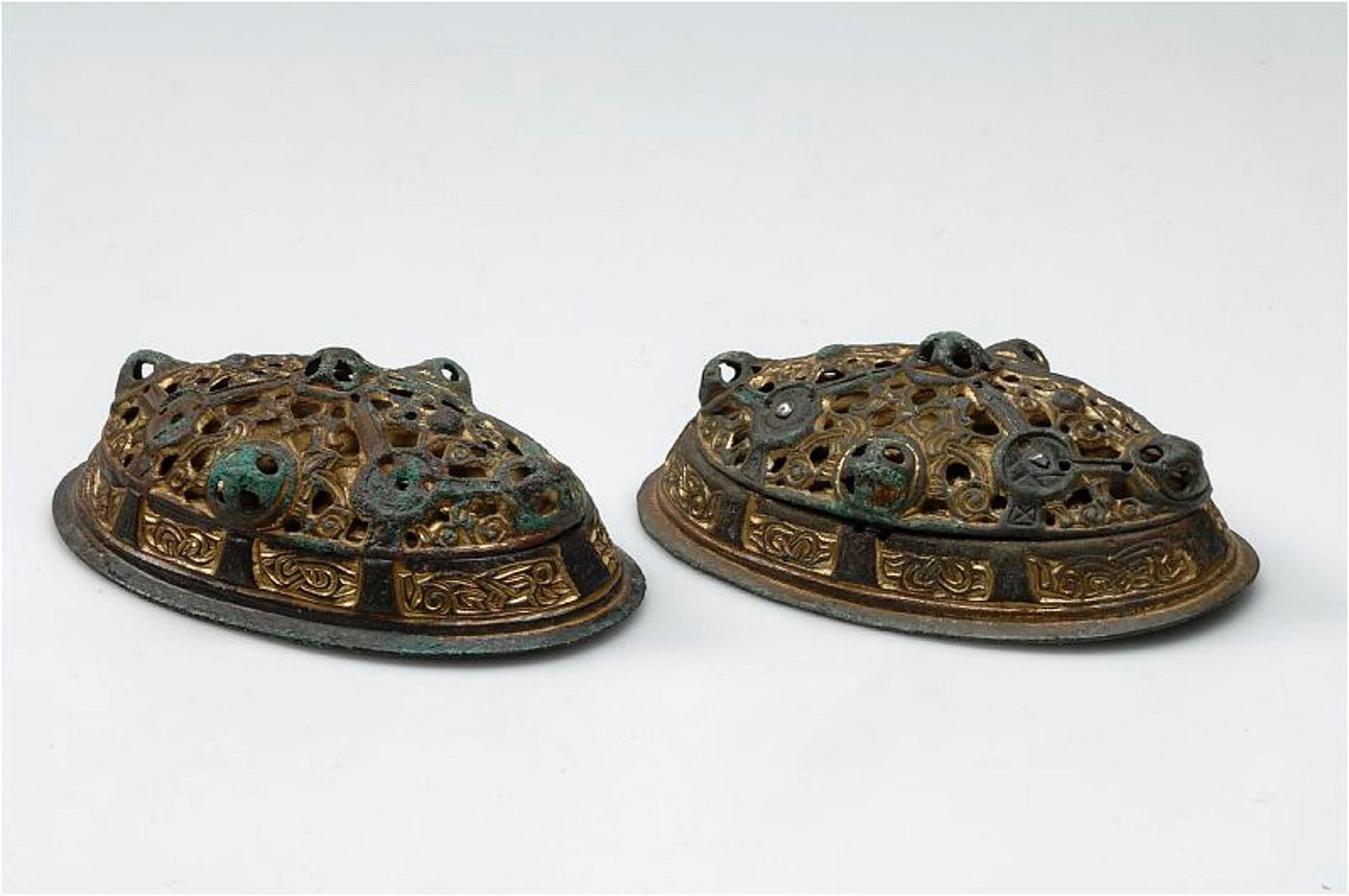
Archaeology is the only source from the period itself. Women's graves are usually recognised by their jewellery: the paired oval brooches (often called "tortoise brooches" because of their shape) that held up the strap dress at the shoulders, bead necklaces, spindle whorls, loom weights, shears and keys. In recent years bone analysis, isotope studies and DNA have been added. They have overturned some old identifications, in both directions.
Runestones, mainly from Sweden and Denmark and mostly from the 10th and 11th centuries, are contemporary inscriptions. Women appear on them as the dead, but also as the people who commissioned them. Many stones record inheritance without saying so outright: whoever raised the stone was often also the heir.
The law codes, such as the Icelandic Grágás ("Grey Goose") or the Norwegian laws of the Gulaþing and Frostaþing, were only written down in the 12th and 13th centuries, after the conversion to Christianity. They preserve older rules, but we never know exactly which provision is old and which has been reshaped by the Church.
The sagas, finally, are magnificent literature of the 13th and 14th centuries. Their women – Guðrún Ósvífrsdóttir, Hallgerðr, Bergþóra, Auðr – are unforgettable. As historical records, however, they are of limited use. They show how Icelandic authors of the High Middle Ages imagined their ancestors. Added to this are outside reports, such as that of the Arab envoy Ibn Faḍlān, who observed the Rus on the Volga around 922, and chroniclers from England, the Frankish realm and Byzantium.
Lay the four groups side by side and you reach solid conclusions. Read only one and you quickly end up with a caricature.
In the North a marriage was first of all an agreement between two kin groups. Romance played little part in the negotiations. What mattered were property, alliances and standing. The groom or his family paid the mundr, the bride price. The bride's family gave her the heimanfylgja, the dowry. On the morning after the wedding came the morgingjöf, the husband's morning gift.
One detail is easy to miss and crucial: these assets did not simply disappear into a common pot. They remained assigned to the woman. If the marriage broke up or the husband died, she could reclaim them. A married woman therefore had her own financial cushion, and her family had a reason to keep an eye on her wellbeing.
The bride was not always asked, especially at a first marriage. The laws place the betrothal in the hands of the father or the nearest male relative. Widows, by contrast, had far more say under Icelandic and Norwegian law, and in the sagas widowed women get their way again and again. The literature is full of women who reject an unloved suitor or let a husband feel their contempt. Whether this mirrors the reality of the Viking Age or the tastes of later storytellers cannot be said with certainty.
Besides marriage there was concubinage. A frilla lived with a man without bride price and dowry having been agreed. Kings and chieftains in particular kept other partners besides their wives. The children of such unions could inherit but were in a weaker legal position. For the women themselves this status was less secure than that of a wife.
Few points surprise modern readers as much as this one. In the pagan North a marriage could be dissolved, and by either side. In the sagas a formal declaration before witnesses is enough, often repeated in two places: at the marriage bed and at the door of the house. That settled it. Afterwards the arguments were mainly about money – about mundr and dowry.
A famous episode comes from Laxdæla saga. Guðrún Ósvífrsdóttir wants to be rid of her first husband Þorvaldr. On the advice of Þórðr Ingunnarson she sews him a shirt with such a wide neckline that it can count as women's clothing – and declares herself divorced. A little later Þórðr in turn leaves his own wife Auðr on the grounds that she wears men's breeches. The story is more anecdote than legal source. But it shows that the storytellers considered a quick divorce something normal.
In Njáls saga Unnr leaves her husband Hrútr because the marriage cannot be consummated, and her father then demands the return of her property. Again money is at the centre, not the question of whether a woman may leave at all.
With the Church this changed. Canon law knew no divorce in the pagan sense, only separation under narrow conditions. The later law codes show this transition. That also means: easy divorce belongs to the pre-Christian period and the first generation after it, not to the whole Middle Ages.
Inside the farm, the farmer's wife – the húsfreyja – was in charge. She managed the stores, assigned work to the servants and saw to dairying, clothing and the sick. On a large farm this was no small office but the running of an operation with dozens of people and animals that had to survive a long winter.
The sign of this position was the keys. Numerous women's graves of the Viking Age contain keys at the belt or on a chain hanging from a brooch. Some fit chests and caskets; others are so small or so ornate that they are better read as badges. How naturally keys belonged to a woman is shown by the Edda: when Thor dresses up as Freyja in the poem Þrymskviða to win back his stolen hammer, the gods let keys jingle at his belt. Without them the disguise would not have been complete.
This power had a clear limit. It ended at the farm gate. Outside – at the thing, in alliances with neighbours, on voyages – the man usually spoke. But when he was away for months – trading, at war or for good – everything rested with her. Many women therefore ran a farm alone for long stretches, not as an exception but as part of ordinary life.
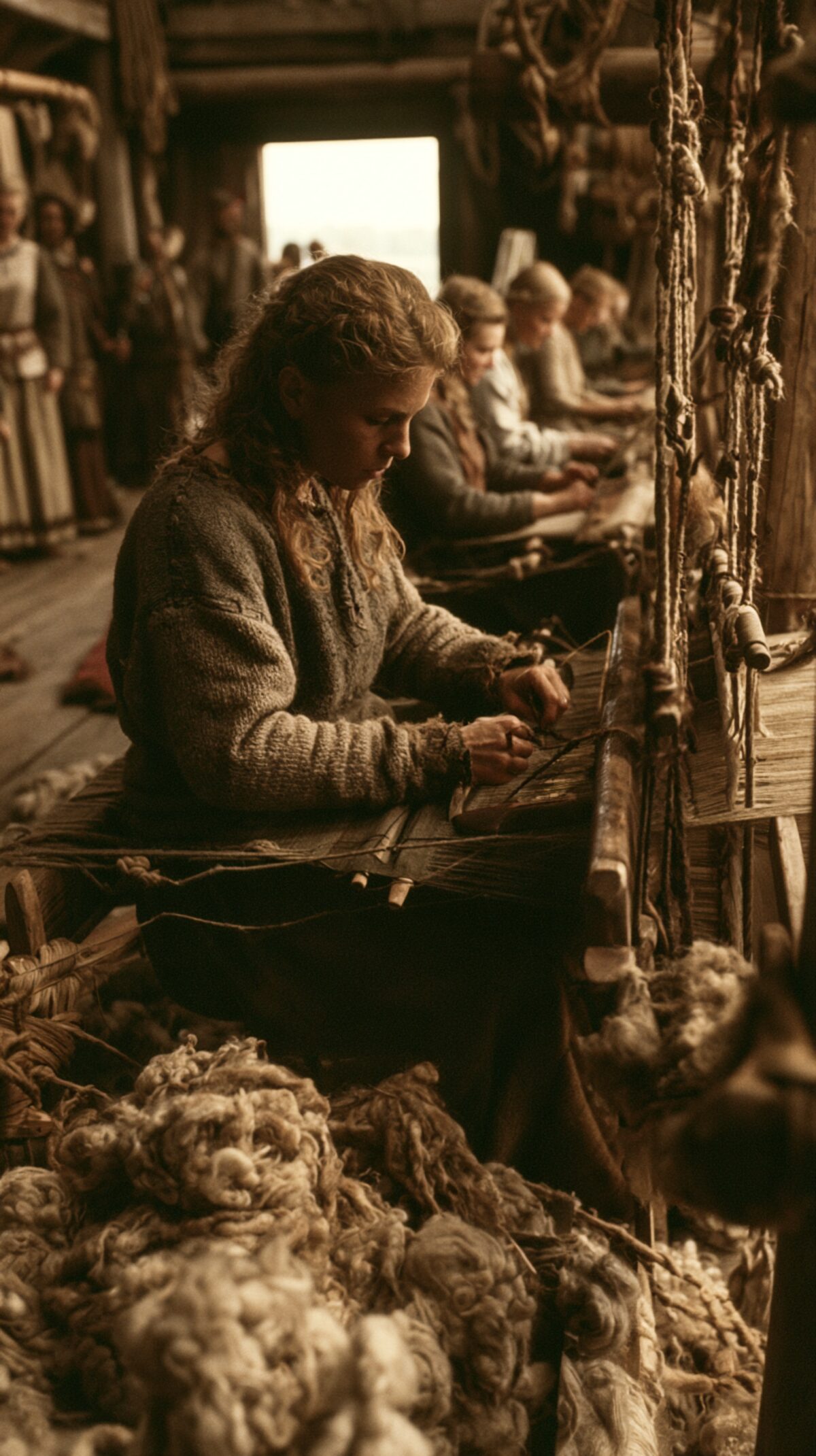
A large share of women's work was textile work, and economically it was anything but a sideline. Wool had to be shorn, plucked, sorted, spun, woven, fulled and dyed. Spindle whorls of stone, clay or bone are among the most common finds of all. On the upright warp-weighted loom women produced the cloth for clothing, blankets, sacks and tents – and for sails.
A sail for a large longship needed many square metres of dense woollen cloth. Reconstruction projects in recent decades have shown how much work went into it: depending on the estimate, a single large sail took years of labour, not weeks. The exact figures vary widely because they depend on assumptions about wool quality and working speed. The direction, though, is clear. Without the work of many women no fleet would have sailed.
In Iceland woollen cloth, vaðmál, even became a kind of currency. Dues and prices were reckoned in ells of this cloth. Whoever wove was literally producing money. Fine work such as tablet weaving for borders and embroidery in wool and silk thread was also women's work. The narrow tapestries from the Oseberg grave are the most famous example.
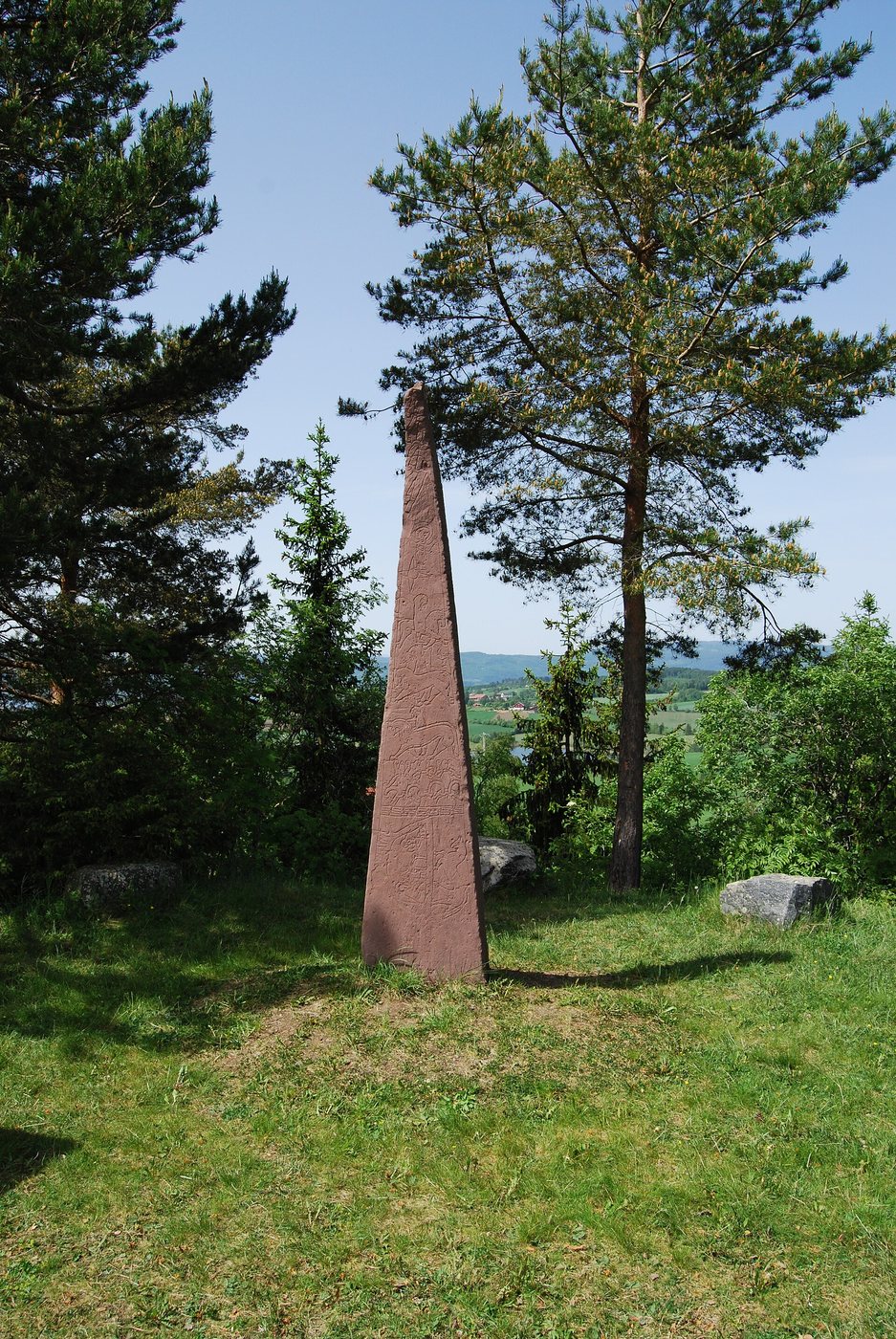
How highly such skill was valued is shown by a runestone from Norway. The Dynna stone from Hadeland, raised around 1040–1050, says that Gunnvǫr, daughter of Þryðríkr, had a bridge built in memory of her daughter Ástríðr. And further: she was the handiest maiden in Hadeland. Her needlework is probably meant. The praise a mother had carved in stone for her daughter was not for beauty but for skill.
Alongside this came the rest of the farm work: milking, churning butter, making cheese and skyr, smoking and drying meat and fish, brewing ale, baking bread, gathering herbs. Raising children came on top. It sounds like what we call "housework". In a world without shops it was the basis for a farm surviving the winter.
Were women also active in trade? The answer is a cautious yes. In some women's graves, for instance at Birka on Lake Mälaren and at Kaupang on the Oslofjord, folding scales and weights were found of the kind needed to weigh silver. Whether these women traded themselves, managed a household's wealth or whether the scales were a status symbol cannot be decided from a single grave. That women handled silver is beyond question.
A foreigner left a remarkable observation on this. Ibn Faḍlān, envoy of the Caliph of Baghdad, saw Rus merchants on the Volga around 922 – men who came from Scandinavia or had Scandinavian roots. He describes the women wearing boxes of iron, silver, copper or gold on their breasts, according to their husbands' wealth, and rings around their necks. Each ring, he says, stood for a certain sum the husband owned. Whether this interpretation is right, or whether Ibn Faḍlān was told something he did not understand, is open. What is certain: a family's wealth was visible on the bodies of its women.
More on how silver, scales and hacksilver shaped trade can be found in our article on Viking trade; the envoy's report is covered in detail in the article on Ibn Faḍlān.
One principle runs through the Norse laws: sons came before daughters. If there were sons, daughters inherited less land or none. If there were none, daughters, widows and mothers could certainly inherit, including land. This distinguishes the North from, for example, the Frankish Lex Salica, which excluded women from so-called Salic land.
No law code shows how this worked in practice as vividly as a stone. On the Hillersjö stone in Uppland (U 29), raised in the late 11th century, the rune-carver Þorbjǫrn Skald inscribed a whole family history. It begins with the command "Interpret!". Then: Geirmundr married Geirlaug when she was young. They had a son; Geirmundr drowned, and later the son died too. Geirlaug married Guðríkr; of their children only the daughter Inga survived. Inga married Ragnfastr of Snottsta; when he and their son died, Inga inherited the farm. She married again and died childless – and so in the end Geirlaug, the mother, inherited from her daughter.
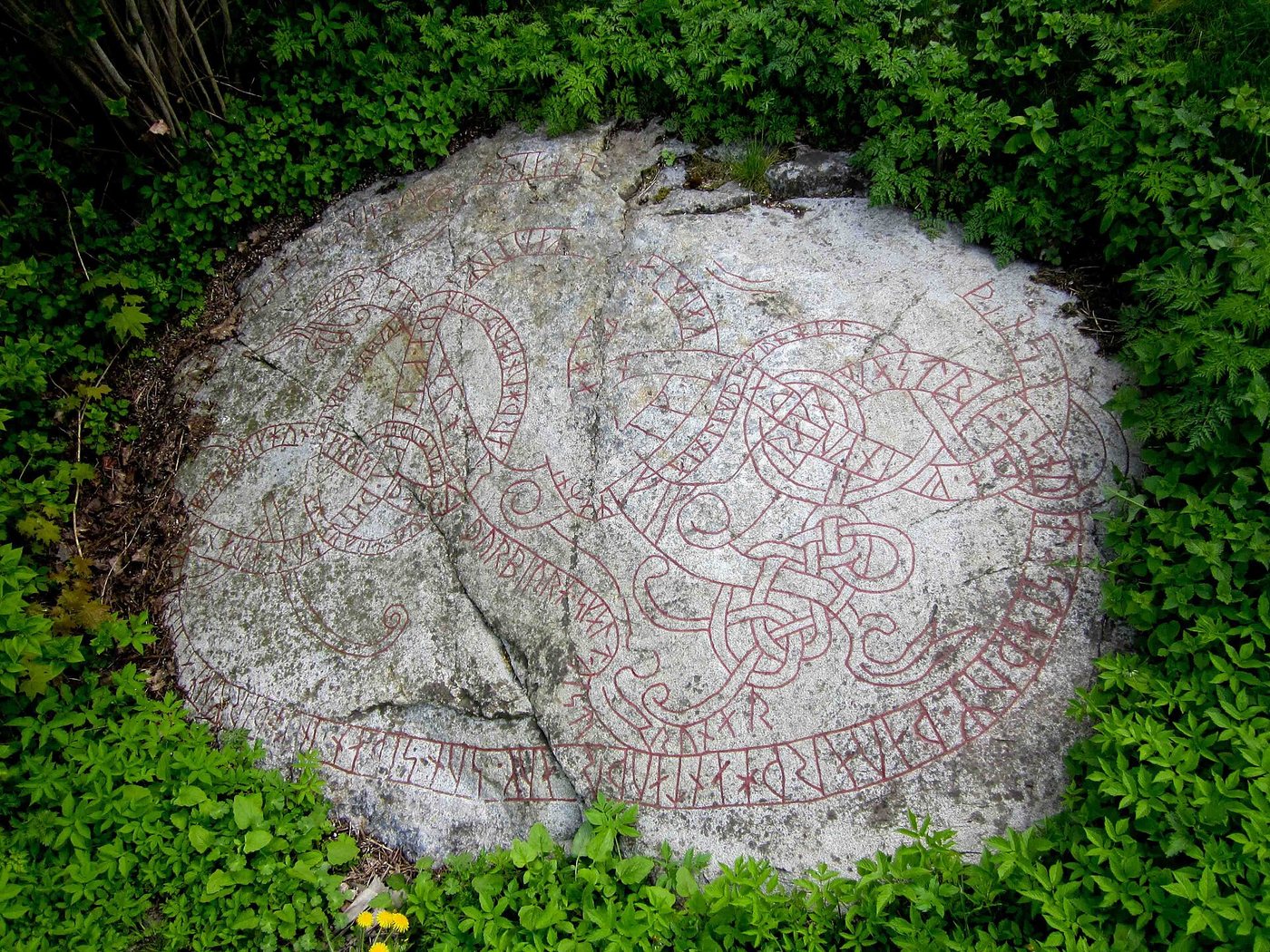
This inscription is more than a grave notice. It is a public piece of evidence: anyone passing by could read why this property now belonged to a woman. Inga herself had several stones raised for her husband Ragnfastr, some of which survive. In them she names herself as heir.
Women appear on runestones remarkably often as the ones who commissioned them – alone or together with sons and brothers. The Swedish historian Birgit Sawyer has shown how closely these stones are tied to questions of inheritance. With Christianity a new form was added: women had bridges and roads built "for the soul" of someone who had died, like Gunnvǫr on the Dynna stone. Such bridge-building counted as a pious work.
Two famous stones from Denmark go back to the same woman: Ragnhildr had the Glavendrup stone raised for Alli, usually interpreted as her first husband, and the Tryggevælde stone for her husband Gunnulfr. Both inscriptions threaten anyone who destroys the stone with a curse. More in the article on Glavendrup and Tryggevælde.
Here the picture becomes more sober. The assemblies where law was spoken, disputes settled and politics made were at their core a matter for free men. In Iceland a woman could not be a goði – hold a chieftaincy with a seat at the Althing – and she did not sit as a judge. Grágás requires the person leading a manslaughter case to be a freeborn heir at least sixteen winters old, and Eyrbyggja saga states plainly that a woman or a boy under sixteen could never prosecute such a case. Women had to have a male relative represent them.
In Norway the line ran somewhat differently, which shows that "the Viking woman" was not a single figure. Under the older Gulaþing law a widow could attend the assembly with the same rights and duties as her late husband. If a married man was killed, it was his widow, not his male relatives, who had to summon the thing. The Frostaþing law expected a woman who owned a farm to appear in person when called; only with good reason could she send a man instead.
Norwegian law even had its own word for a woman at the head of her kin: baugrýgr, roughly "ring lady". It meant an unmarried woman who had inherited the position of head of the family and was entitled to receive and pay compensation in rings – until she married. The scholar Else Mundal concluded that women's participation in public life was more a question of practicality than of principle: where there was no man, the woman stepped in.
The bottom line: women had rights, property and influence, but no equal access to public power. Anyone speaking today of an "egalitarian Viking society" skips this part. Anyone claiming women had no rights skips the other.
Most women of the Viking Age have remained nameless. A few, however, step out of the dark – sometimes through a stone, sometimes through a chronicle, sometimes only through a saga.
Thyra is the first woman in Danish history we can grasp with certainty. King Gorm had a stone raised for her at Jelling and calls her tanmarkaR but, "Denmark's adornment" or "Denmark's strengthening" – the meaning is disputed. Her son Harald Bluetooth names her again on the great Jelling stone. What she herself did, we do not know. The later legends that she built the Danevirke date from the High Middle Ages. More in the article on Thyra Danebod.
Auðr the Deep-Minded (Auðr djúpúðga) is one of the great figures of the Icelandic settlement. According to Landnámabók and Laxdæla saga she lost her husband and son in the British Isles, had a ship built, sailed with her household via Orkney and the Faroes to Iceland, took land at Breiðafjörður, shared it out among her people and freed slaves. How much of this is legend cannot be said exactly. That 13th-century Icelanders gave a woman this founding role says a great deal. Her story is told in the article on Auðr the Deep-Minded.
Guðríðr Þorbjarnardóttir may be the most widely travelled woman of the Middle Ages. According to the two Vinland sagas she lived in Iceland and Greenland, sailed to North America, gave birth to a son named Snorri there and later went on pilgrimage to Rome. The details differ between Grænlendinga saga and Eiríks saga rauða. That women sailed to Vinland is supported by an inconspicuous find: at L'Anse aux Meadows in Newfoundland a soapstone spindle whorl came to light. So spinning went on there too.
Freydís Eiríksdóttir, daughter of Erik the Red, is the dark counterpart. The sagas show her once as a fearless woman who, heavily pregnant, picks up a fallen man's sword, strikes it against her bared breast and so drives the attackers off, and once as the instigator of a massacre of her own companions. Both say more about the storytellers than about the historical person. More in the article on Freydís.
Olga of Kyiv ruled the realm of the Rus in the 10th century for her under-age son Sviatoslav. Her name is a Slavic form of Norse Helga. The Primary Chronicle describes her revenge on the Drevlians, who had killed her husband Igor, in gruesome details that sound more like legend than report. Her visit to Constantinople, recorded by the Byzantine emperor Constantine VII himself, and her baptism are secure.
Other famous names stand on shaky ground. Gunnhildr, wife of Eric Bloodaxe, appears in the sagas as a power-hungry sorceress – an image Norwegian historians probably pinned on a political opponent. Sigrid the Haughty is reported so contradictorily that some scholars doubt she existed as a single person at all. And Lagertha is known only from Saxo Grammaticus, who wrote around 1200.
In one area women outranked men: dealing with the hidden. The völva, the seeress, was a respected and feared figure. She travelled from farm to farm, was hosted and consulted on how the winter would turn out, how a marriage would end, whether misfortune threatened. Her art was called seiðr, a form of magic and prophecy regarded as female. Men who practised it laid themselves open to the charge of unmanliness – even Odin has to put up with this mockery from Loki in the Edda.
The most detailed description is in Eiríks saga rauða. During a famine in Greenland the seeress Þorbjǫrg, called "the little völva", is brought to a farm. The saga describes her clothing in detail: a blue cloak set with stones, a hood of black lambskin lined with white catskin, catskin gloves, a staff with a brass knob, a pouch of charms. She is seated on a raised seat, a young woman sings the necessary songs, and the seeress foretells the end of the hardship. The saga is two hundred years younger than the events. And yet several details have found their counterparts in graves.
The best-known example lies at the ring fortress of Fyrkat in northern Jutland. A woman was buried there in a wagon body, in costly clothing with gold thread. She wore silver toe rings, otherwise unknown in Scandinavia. In a small pouch lay seeds of henbane, a poisonous, intoxicating plant. There was also a metal staff with bronze fittings, a box with owl pellets and small bones, and a silver amulet in the shape of a chair. The National Museum of Denmark cautiously interprets her as a possible seeress. The chair recalls the raised seat of the völva, the staff the staffs of the sagas. The interpretation cannot be proven, but it is well founded. More in the article on henbane and the Fyrkat grave.
Iron staffs of this kind are now known from a whole series of women's graves, in Scandinavia as well as in the settlement areas to the east. The archaeologist Neil Price interpreted them as magic staffs in his book The Viking Way. The young woman who sings the songs for Þorbjǫrg in the saga, incidentally, is Guðríðr – the same woman who later sailed to Vinland.
Women also had their place in cult. The goddesses Frigg and Freyja barely ranked below the gods, and Freyja was considered the teacher of seiðr. Female guardian spirits, the dísir, received their own sacrifices. Whether women also led the great blóts is poorly documented. In household rites they probably played a central role. For more on the seeress, see the articles on the völva and on seiðr.
A look at the graves turns a common assumption upside down: the most splendid grave of the entire Viking Age belongs not to a king but to two women.
In the autumn of 834 – this precisely do the tree rings of the timbers in the burial chamber date it – two women were laid to rest in a magnificent ship at Oseberg on the Oslofjord. The elder was around eighty and suffered from severe arthritis. The younger was long estimated at 25 to 30; newer examination of the teeth points to about 50 to 55. They were given the only completely preserved wagon of the Viking Age, four decorated sledges, beds, chests, kitchen equipment, weaving tools, silk from the East and the narrow tapestries showing processions of people and wagons. No precious metal was found, because the grave was robbed early on.
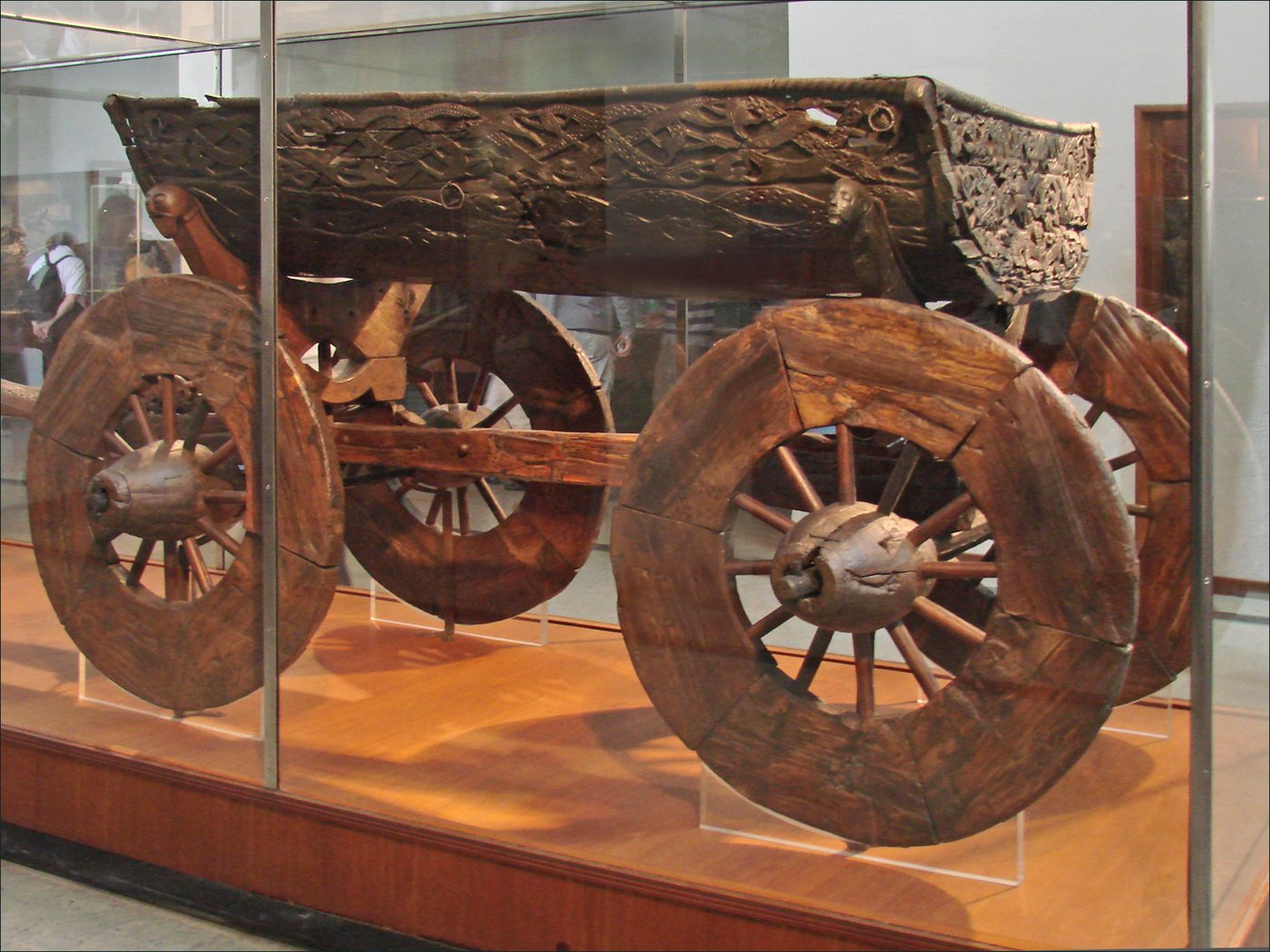
Who the two were, no one knows. The old guess that the elder was Queen Åsa, grandmother of Harald Fairhair, cannot be proven. Others see in her a priestess or seeress. An early DNA analysis that attributed ancestry from the Black Sea region to the younger woman could not be confirmed by later studies. Only one thing is certain: a society that went to such lengths for two women did not see them as minor figures. More in the article on the Oseberg ship.
Away from the princely graves, too, burials show how women were seen. Rich women's graves contain horses, wagons, bronze bowls, glass beads in large numbers, sometimes silver from the Caliphate. Burial custom clearly distinguished between men and women, but not according to the scheme "important" and "unimportant". It distinguished according to roles.
This is the question almost everyone asks today, and it deserves an honest answer in two parts.
The first part is a find. In 1878 Hjalmar Stolpe excavated chamber grave Bj 581 at Birka. In it lay a person buried around the middle of the 10th century with a sword, an axe, two spears, a seax, 25 arrowheads, two shields, two bridled horses and a gaming board with pieces and dice. For over a century it was considered the model of a warrior's grave. In 2017 a study led by Charlotte Hedenstierna-Jonson showed that the person buried there was genetically female. In 2019 Neil Price's team followed with a fuller interpretation in the journal Antiquity, deliberately putting a question mark in the title: "Viking warrior women?"
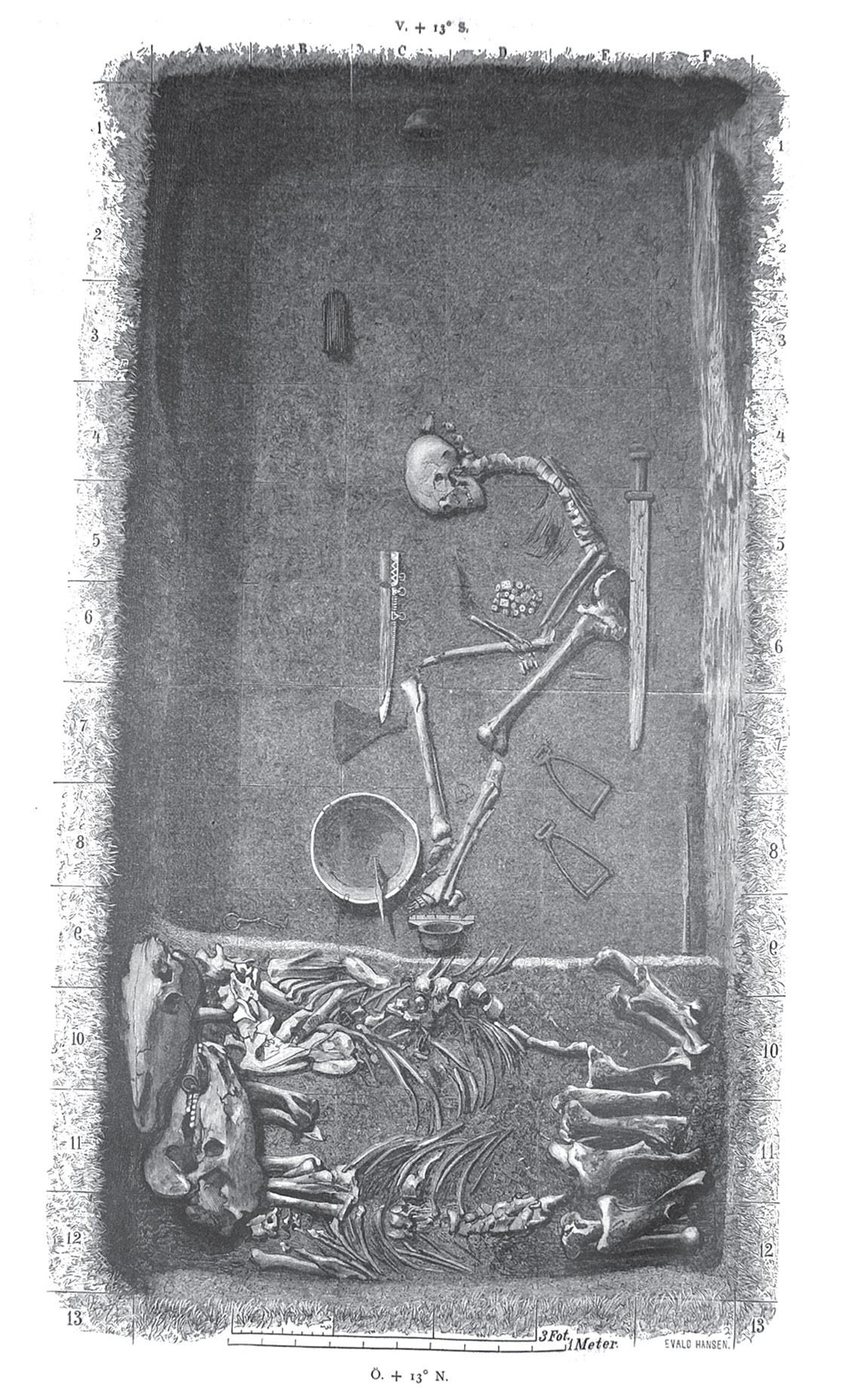
The second part is the debate about it. Critics such as the British Viking scholar Judith Jesch consider the reading as a high-ranking warrior to go further than the evidence allows. Weapons in a grave do not automatically mean that someone fought; they can express rank, family or an ideal. Men, too, were buried with weapons they never used. On the other hand: would anyone ever have doubted a man with the same equipment? That is the strongest argument of the supporters. The case is traced in detail in the article on Bj 581.
As for the written sources, things get thin. Around 1200 Saxo Grammaticus tells of shieldmaidens such as Lagertha and Hetha who supposedly led whole armies – in a work full of legend. The Icelandic sagas know armed women almost only in exceptional situations or in heroic poetry, such as Hervör, who asks her dead father for his sword. The Byzantine historian John Skylitzes reports that after a battle of the Rus against Byzantium in 971, armed women were found among the fallen. That is one of the few near-contemporary notices – but it, too, is a single sentence.
The result is a graded picture. That individual women fought is possible and in some cases likely. For a warrior-woman culture with many shieldmaidens, as TV series show it, there is no solid evidence. The shieldmaiden is first of all a literary figure whose power came precisely from being unusual. More in the articles on the shieldmaiden and on the Valkyries.
Everything said so far applies to free women, mostly from well-off families. But a considerable share of the women in the North were unfree. Slave women, Old Norse ambáttir, worked at the quern, in the byre, at the loom. They had no rights over their own bodies, and the sources make no secret of the fact that they were sexually exploited.
Many of them came from the raids, especially from Ireland and Scotland. Genetics has supplied a remarkable trace here: a study led by Agnar Helgason concluded in 2001 that the maternal ancestry of present-day Icelanders – measured by mitochondrial DNA – goes back about 60 per cent to the British Isles, while the paternal ancestry is about 80 per cent Scandinavian. That does not mean all these women were slaves; some came as wives from mixed families in the Viking settlements of Ireland and Scotland. But it shows how many women spent their lives far from their mothers' homeland.
The harshest view of this reality comes from Ibn Faḍlān. He describes the funeral of a Rus chieftain on the Volga at which a slave woman was killed and burned with him. Whether the report can be trusted in every detail is disputed; as an eyewitness account it still carries great weight. Some Scandinavian graves also contain two people, one of whom was evidently sacrificed. The history of Viking women is not only a history of strong mistresses of the house. More in the article on slavery among the Vikings.
For a long time Viking expeditions were considered a purely male affair. That is true of most raids. It is not true of the settlement of new lands. Whoever founded farms in England, Ireland, Orkney, the Faroes, Iceland or Greenland brought families along. In England archaeologists have found women's graves with Scandinavian jewellery, and studies of burials in the Danelaw suggest that considerably more Scandinavian women came across the North Sea than was long thought.
The chronicles confirm this indirectly. For the year 893 the Anglo-Saxon Chronicle reports that the Danish army had put its women, its ships and its property in safety in East Anglia before moving on. An army with families in its train is no longer a raiding party but a migration.
In Iceland and Greenland, finally, women were indispensable. Without them no clothing, no dairying, no next generation. That a woman, Auðr, is among the best-known settlers and another, Guðríðr, among the best-known voyagers to America is no accident of the record.
Women were often among the early Christians in the North. Many runestones with crosses and prayer formulas were raised by women, and the bridge stones are a typical sign of this new piety. Some scholars suspect that Christianity offered women a space of their own, for example through care for the souls of the dead. This cannot be proven for every region.
Legally the new religion brought both. It banned the exposure of newborns, which probably affected girls in particular, and demanded the bride's consent to marriage. At the same time it restricted divorce and bound women more firmly to marriage and home. Whether women's position improved or worsened overall is still disputed among scholars today. The answer probably depends on which woman you ask: the widow with her own farm, the young bride or the slave woman.
"Viking women were equal to men." No. They had property, inheritance rights and the right to divorce, but no equal access to the thing, the courts and rule. Compared with other parts of Europe their position was strong; measured by today's standards it was not.
"Women had no say." Just as wrong. Inside the farm they ran things, and as widows, heiresses and patrons of runestones they appeared in public.
"There were many shieldmaidens." The evidence is lacking. What is secure is one disputed weapon grave of a woman and a handful of brief written notes; the rest is legend and television.
"The sagas show how it was." They show how 13th-century Icelanders imagined the past. Many details match finds, many do not. Every saga scene is first of all a story.
"Oval brooches were Viking jewellery for everyone." The paired brooches are typical of free, mostly well-off women in Scandinavia and the settlement areas. Wearing them displayed origin and status. More on dress in the articles on Viking clothing and Viking jewellery.
Women among the Germanic peoples · Bj 581 – the warrior of Birka · The shieldmaiden · The völva · The Oseberg ship · Thyra Danebod · Auðr the Deep-Minded · Viking weaving · Law & the thing · Childhood among the Vikings.
All Everyday Life & Craft articles →
A stone that burns like coal, charges electrically when rubbed like amber, and polishes to a deep black shine: jet is …
Read more →How do you pay when there is no money of your own? The Vikings had a simple answer: with silver, weighed on the scales …
Read more →Long before chess came to the North, people sat on the long winter evening over a different board: Hnefatafl, the …
Read more →In the darkest time of the year the Norsemen celebrated Jól. Some customs of this winter feast live on in our Christmas …
Read more →