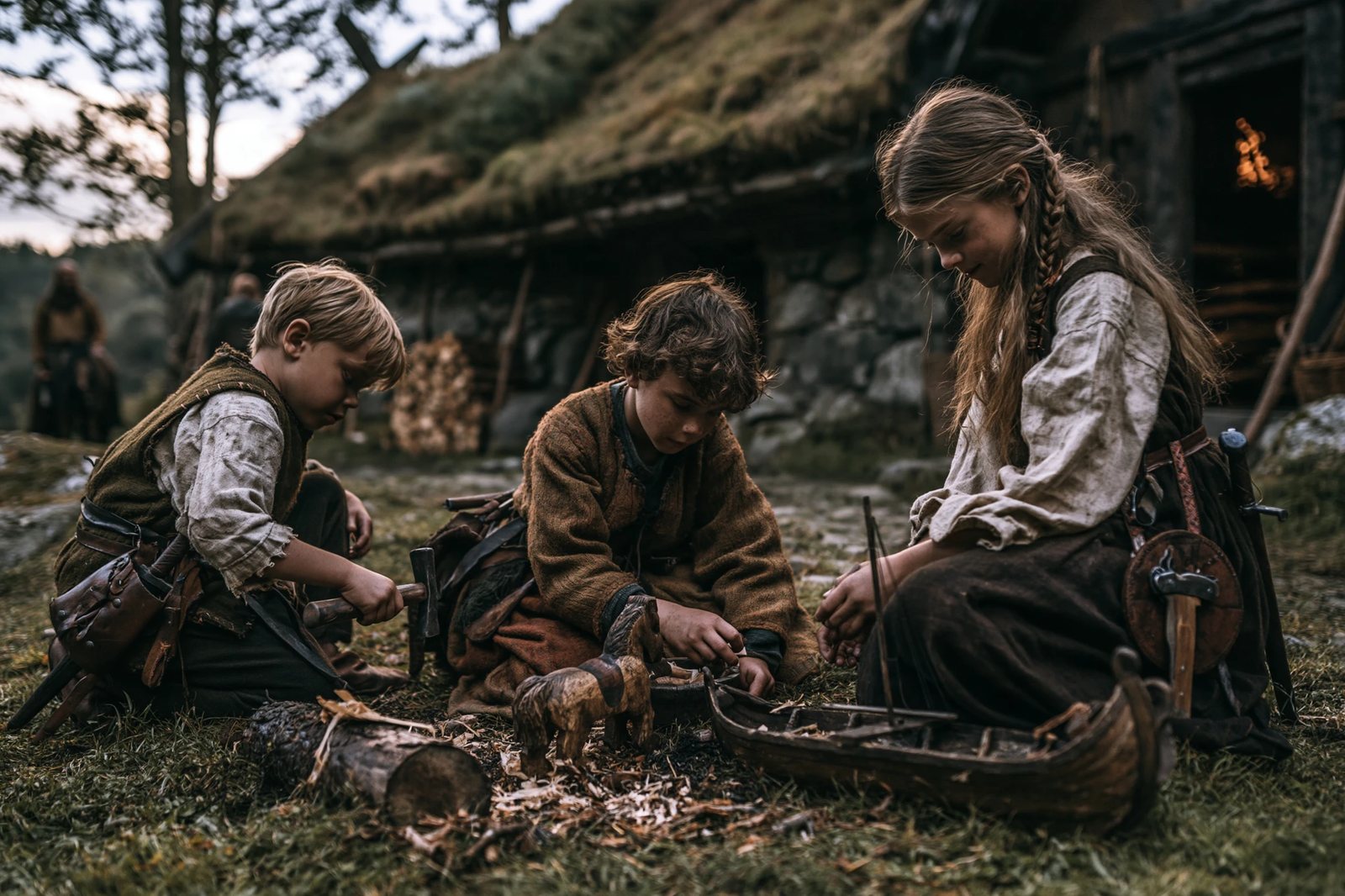
No child of the Viking Age was born a "little Viking". It was born, sprinkled with water, named — and usually grew up as a farm child on a homestead by the fjord, the coast or inland. What we know of that childhood comes from graves, sagas and law texts, and much of it is gentler, harder and more sober than today's Viking cult would have you believe. Let us take an honest look at those first years in the North.
Birth took place at home, among women. Experienced helpers — the sagas simply speak of women who knew what they were doing — attended the mother, likely spoke protective verses and did what they could. On the exact procedure the sources are largely silent; we know more about what came afterwards than about the hour itself. What is certain: birth was life-threatening, for mother and child alike, and the first day of life often decided everything that followed.
For a newborn was not yet automatically a full member of the family. Only when the head of the household — or, in his absence, the responsible person — accepted the child, lifted it up and granted it a place in the home, did it become part of the kin. This act carried legal weight, and it is the key to understanding both the tenderness and the harshness of this world.
The most important early rite was called ausa vatni — "to sprinkle with water". The child was wetted with water and given a name. Importantly: this is not a Christian import. The custom is attested for the pagan period too, and the sagas describe it as a matter of course. With the naming, the child was officially accepted; to expose a child that had once been named and blessed with water was afterwards regarded as a grave crime.
Names were not chosen at random. Children were often named after deceased relatives — it was believed that with the name, something of the ancestor's luck, character or protective power passed on as well. Names with divine references (Thor-, Frey-) or with martial and virtuous elements were popular. A name-gift, the nafnfestr ("name-fastening"), often went with it — whoever gave a child its name bound the gift to it. You can learn more about the system of given names, bynames and patronymics in our article on Viking names and their meaning.
In an agrarian society with no welfare system, children were the future: labour, heirs, continuers of the kin and — not least — those who kept the memory of the dead alive. This double meaning, practical and honouring at once, echoes in the wisdom poetry:
A son is better, though late he be born, / after his father is gone. / Guide-stones stand but rarely by the road, / unless kinsman set them for kin.Hávamál 72, after the translation by Henry Adams Bellows 1923 (public domain)
The verse is coldly calculated and yet deeply human: whoever has descendants will not be forgotten. Children were thus far more than mouths to feed — they were the bridge between the generations. That explains why accepting a child was such a weighty act.
The everyday life of the vast majority of children unfolded on the farm, not on a longship. From an early age they were drawn into work: the little ones herded goats, sheep and geese, gathered firewood and berries, helped in the house. Older children learned what their sex and station demanded of them — girls at spindle and loom, in dairying and food storage, boys with livestock, fieldwork, fishing and craft. A child learned by watching and imitating; work and play were not separate worlds.
How hard or how sheltered these years were depended greatly on station. The child of a wealthy family had prospects different from those of a bondsman's child. Anyone wanting to know more about the framework of this life — living in the longhouse, food, craft — will find it in our overview of everyday Viking life.
One of the most formative institutions was fosterage, Old Norse fóstr. Children — sons above all — were often raised not by their own parents alone, but given for years to another family. The foster-father (fóstri) and foster-mother (fóstra) raised the child, taught it skills and took on responsibility.
This had a deep social purpose: fosterage bound two kin-groups together. Whoever raised another's child was often regarded as the lesser party — there was honour in entrusting your child to a respected friend, and honour in taking on the responsibility. Foster-siblings sometimes stood closer to one another than blood siblings, and the bond between ward and foster-father could last a lifetime. Such relationships were the glue of a society that functioned, without a state, above all through personal alliances.
Children have always played, and the Viking Age is no exception. From excavations we know of small wooden swords and boats, carved animal figures and little horses, balls and spinning tops. Especially widespread were gaming pieces of bone — astragali, the ankle bones of sheep and cattle, used as throwing and dexterity games, much like later knucklebones.
Some toys were learning tools at the same time. A carved ship taught, in passing, the shapes of real boats; small tools drilled the movements one would need as an adult. And of course there were board games: Hnefatafl, the Norse "king's game", was popular with young and old and trained strategic thinking. You can try your own hand at it in our interactive Hnefatafl.
There were no schools in the modern sense. Knowledge was passed on orally and practically. Children memorised sagas, ancestral lines, legal formulas and poems — memory was the library of this society. Whoever knew many verses and stories counted as educated. The runes were passed on too, though not universally: rune-knowledge was useful, but not a school subject for every child.
Practical abilities took priority: running a household, mastering a craft, handling animals and boats. Weapons training for boys of free families usually began in early adolescence — at about twelve one was increasingly regarded as capable of acting and could, in some matters, be treated like an adult. But there is no question of a drilled corps of child warriors.
The sagas show children not merely as extras. There are scenes of deep affection — parents grieving dead children, fathers proud of their offspring's wit, foster-fathers going to their deaths for their wards. Egill Skallagrímsson, the rough skald, composed a shattering lament for his drowned sons. Such testimonies refute the cliché that hard times produced hard, unfeeling parents.
What is established: The naming rite ausa vatni — sprinkling with water and giving a name — is attested for the pagan period and was legally decisive for the acceptance of a child. Fosterage (fóstr) is broadly attested in the sagas and bound families together. Children's toys — wooden swords and boats, carved animals, astragali, gaming pieces — are well documented archaeologically. The high rate of child mortality can be read from cemeteries. And child exposure (barnaútburðr) was legally permitted before Christianisation — the Íslendingabók lists it among the concessions that initially remained in force when Christianity was adopted around the year 1000.
As much as children were valued — many did not reach adulthood. Disease, infection, hunger in bad years and the dangers of birth and infancy took a heavy toll. This is mirrored in the cemeteries: a considerable share of burials are children, and many people died before their eighth year. Those who survived childhood had good prospects of a longer life — but that first bottleneck was narrow.
Remarkably, archaeologists only began to recognise children's graves systematically once they assessed grave size alongside grave goods. Small burials were long overlooked; only the closer look made visible how present children — and their early deaths — were in this world.
A subject one should neither hush up nor sensationalise: before Christianisation it was legally permitted to expose a newborn child — the barnaútburðr. The timing was decisive: as long as the child had not yet been blessed with water, named and accepted, the decision lay with the head of the household. Once the child had been taken in, this option was regarded as forfeited.
When Christianity was adopted in Iceland around the year 1000, according to the Íslendingabók a few old customs remained permitted for a transitional period — among them child exposure and the eating of horsemeat — before they too were banned. This shows two things. The custom was real and legally anchored. And at the same time, the sources tell us nothing reliable about its extent. How often children were actually exposed, whether it was the exception in emergencies or occurred more frequently, simply cannot be quantified. We therefore treat the subject soberly — as the law of another time, not as a horror story.
Where popular culture exaggerates: The image of the Viking-Age child lying in the cradle practically holding an axe, drilled into a warrior from infancy, is heavily overdrawn. The overwhelming majority of children grew up as farm children whose everyday life was shaped by livestock, field, loom and craft — not by combat training. Weapons practice existed, but it mainly concerned boys of free families and began only in adolescence. Secondly: "Viking" was never a children's job title. The word originally denotes an activity — going on a voyage to trade or raid — that applied at most to a portion of adult men. A child was a child, not a "mini-Viking". And thirdly: child exposure was permitted, but its actual extent is unknown — sweeping claims in either direction are not serious.
In the end, Viking-Age childhood appears as a path from newborn to full member of the kin: born, named, accepted, raised — often in two families at once — playing and working, learning by listening and imitating. It was a childhood without romantic glorification, but also without the cold harshness sometimes ascribed to it. Children were future and remembrance at once, and the kin was the net that carried them. If you want to delve deeper into this net of kinship, fosterage and honour, you will find more in our article on kin and family.
Viking names & their meaning · Everyday Viking life · Viking women.
All Everyday Life & Craft articles →
Coarse brown sacking, a shaggy fur collar, and of course the obligatory horned helmet – that is the Viking of film and …
Read more →No animal stood closer to the people of the North than the horse. It carried them over fells and fords, pulled their …
Read more →