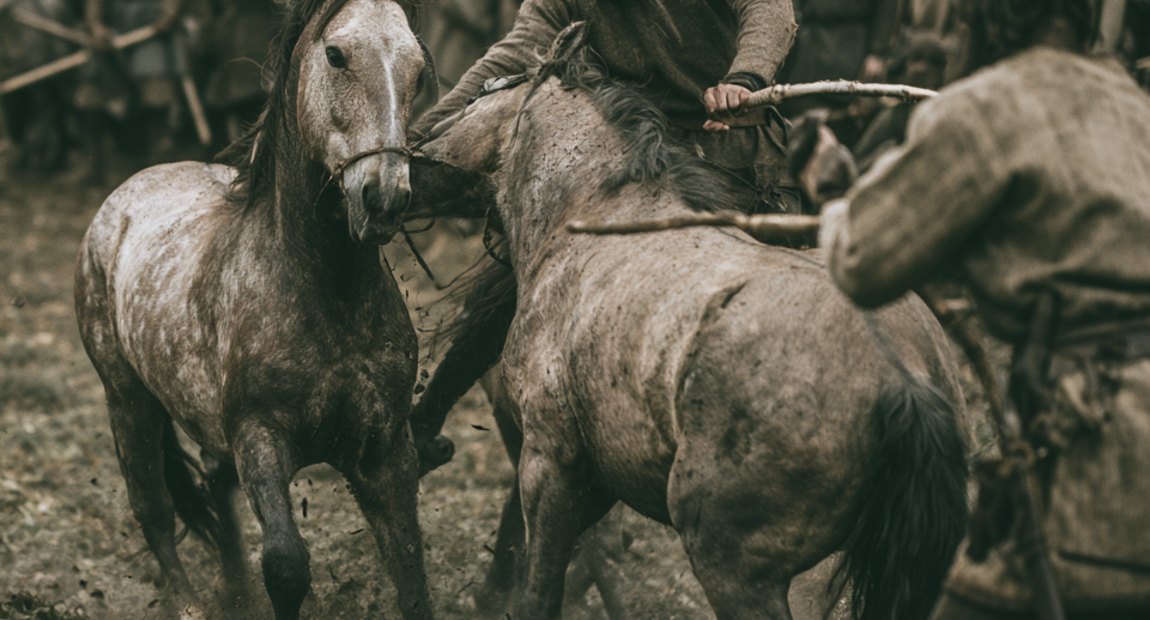
No animal stood closer to the people of the North than the horse. It carried them over fells and fords, pulled their plough, decided their wealth and even followed them into the grave. At the same time it was a sacred beast, whose flesh was eaten in the presence of the gods and whose eight-legged version was ridden by Odin himself. Let us look closely: what the finds show, what the sagas tell, and where the lovely legends end.
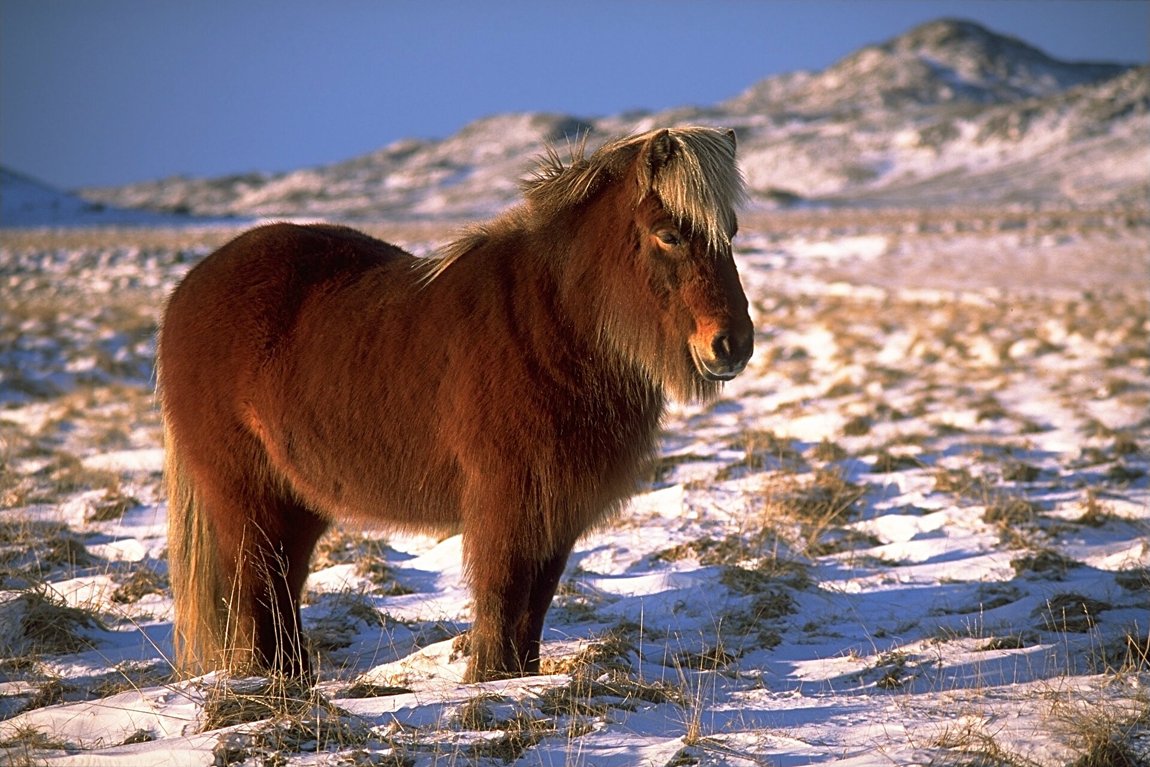
Anyone who pictures the Viking horse as a tall war-charger is mistaken. The horses of the Viking Age were small, usually between 1.25 and 1.45 metres at the withers, powerfully built, thick-coated and astonishingly enduring. They had to make do with sparse fodder, winter outdoors, and still carry heavy loads across trackless country. Exactly this type survives today in the Icelandic horse: robust, sure-footed, good-natured and far stronger than its size suggests.
These horses were not ornaments but working animals and status symbols at once. In a world without roads or wheeled traffic in the modern sense, a good horse was the difference between a day's march and a laborious trek on foot. No wonder a mount was among the most valuable possessions of a free man or woman.
The real distinction of many northern horses is their extra gait. Besides walk, trot and canter, Icelandic horses master the toelt, a smooth, clean four-beat gait in which one foot always stays on the ground. It is so free of jolting that you can carry a full glass without spilling a drop. For long rides across rough terrain this was an invaluable advantage.
This ability sits in a single gene, the so-called gait-keeper gene DMRT3. And here it gets interesting: the responsible mutation did not arise in Scandinavia. According to genetic studies it most likely appeared in medieval England, around York, near the year 850. From there it was the Vikings of all people who spread gaited horses further, because they prized the comfortable gait and deliberately passed on and traded such animals. Via Iceland and the trade routes the gene reached the whole world; a large share of today's gaited horse breeds carry it.
The Icelandic horse is today genetically remarkably isolated, and there is a very concrete historical reason. Around the year 982 the Icelandic Althing decided on an import ban for horses. Since then no foreign horse has entered the island, and the rule holds in essence to this day: an Icelandic horse that has once left the island may never return. So the stock remained largely sealed off for over a thousand years and preserved an old type.
Myth check: Even so, the Icelandic horse is not an unchanged Viking breed that one could regard like a living photograph. Over a thousand years of breeding, selection through harsh winters and human preferences have shaped it. What is true: it descends from the horses of the settlement age and, thanks to the import ban, has remained unusually pure and isolated genetically. That is remarkable enough without turning it into an untouched original.
In everyday life the horse was an all-purpose animal. People rode it to the thing, to the neighbouring farm and up to the highland pastures. They loaded it with goods, hay and household gear, for a pack horse could travel paths where no cart could go. And they harnessed it to harrow and light plough where the ground allowed. In Iceland and Norway, where routes were often only narrow tracks through bog and scree, the sure-footed little horse was simply the only sensible means of overland transport.
It is notable that the Vikings fought mainly on foot or from ships. The horse brought the warrior to the battlefield, but true mounted cavalry was far less developed in the North than, say, among the Franks. The horse was a means of travel, a beast of burden and an object of prestige, more rarely a war machine.
A fine, fast horse was a mark of rank. Chieftains and wealthy farmers adorned their animals with elaborate harness: gilded fittings, artfully decorated bridles and girth mounts belonged to the outfit of a man of importance. Such showpieces often bear the typical animal ornament of the Viking Age, for instance in the Mammen style, with interlaced gripping beasts and plant tendrils.
Evidence: The Danish rider's grave at Fregerslev near Skanderborg, dated around 950, contained one of the richest sets of harness from the Nordic Viking Age: hundreds of gilded silver fittings from bridle and strap-work, richly decorated. It shows how much a mount could express its owner's standing, and that horse and equipment were placed in the grave with the dead.
Rider graves with a horse are scattered across the whole Viking world, from Denmark through Sweden to the British Isles. Often one or more horses were sacrificed and buried with the deceased, complete with harness, sometimes saddle and stirrups. In some graves horse and rider lay together, as if they were to travel on as one.
What these graves meant precisely is not always clear. They show wealth and rank, belief in a journey to the beyond, and the close bond between human and animal. But one must be careful with grand interpretations.
A chapter of its own is the horse fight, Old Norse hestavig. Two stallions were set against each other, often near mares in heat to inflame their fighting spirit. The owners urged the animals on with long staves. Such fights were a popular sport, a social event with spectators, wagers and much sense of honour. And because honour was at stake, in the sagas they all too often ended in quarrels among the people.
Then Thorgeir's stallion ran at Gudmund's. The horses bit each other for a long time without needing to be parted, and that was great sport for the people.Paraphrased after a horse-fight scene of the Icelandic sagas (Njals saga / Reykdaela saga)
The horse fight is one of the best proofs that the horse was not merely a working animal but part of social life, with all the pride and quarrelsomeness that went with it.
In the heathen cult the horse played a large role. At the blot, the sacrificial feast, animals were slaughtered, their blood sprinkled on the altar and those present, and the meat eaten together while people drank toasts to the gods. The horse was an especially prized sacrificial animal. Arab and Christian reporters mention horse sacrifice, and archaeologically sacrificed horses are attested many times over.
Some animals counted as specially consecrated. In Hrafnkels saga the Freyr-priest Hrafnkell keeps a stallion named Freyfaxi, dedicated to the god Freyr; whoever rides him without leave shall die. Similarly the Völsa thattr touches on a macabre household cult around a preserved horse member. Such stories show that the horse was not only food and transport but, in people's imagination, reached into the sphere of the gods.
Because the horse was so closely bound to heathen sacrifice, eating horsemeat became a marker. To the Christian church it counted as a heathen abomination to be stamped out. Whoever ate horsemeat thereby declared himself, at least in the eyes of the missionaries, for the old faith.
When Iceland accepted Christianity at the Althing around the year 1000, the transition was therefore a compromise. To keep the peace, concessions were first made to the old customs: secret sacrifice, the exposure of children and precisely the eating of horsemeat were tolerated for a while. Only later were these exceptions abolished.
Evidence: Ari the Wise reports in the Islendingabok that when Christianity was adopted around 1000, three old practices were at first still permitted, among them expressly the eating of horsemeat. This shows how deeply rooted the custom was and how cautiously the conversion was negotiated.
Myth check: One often reads that the Vikings avoided horsemeat as unhealthy or unclean. That has the logic backwards. For the heathen Northerners horsemeat was a highly prized festive food, precisely because it was tied to sacrifice. The ban came from outside, from the Christian church, which fought the practice as a heathen ritual. The unease about horsemeat still widespread in many countries today is thus a legacy of Christianisation, not of the Vikings.
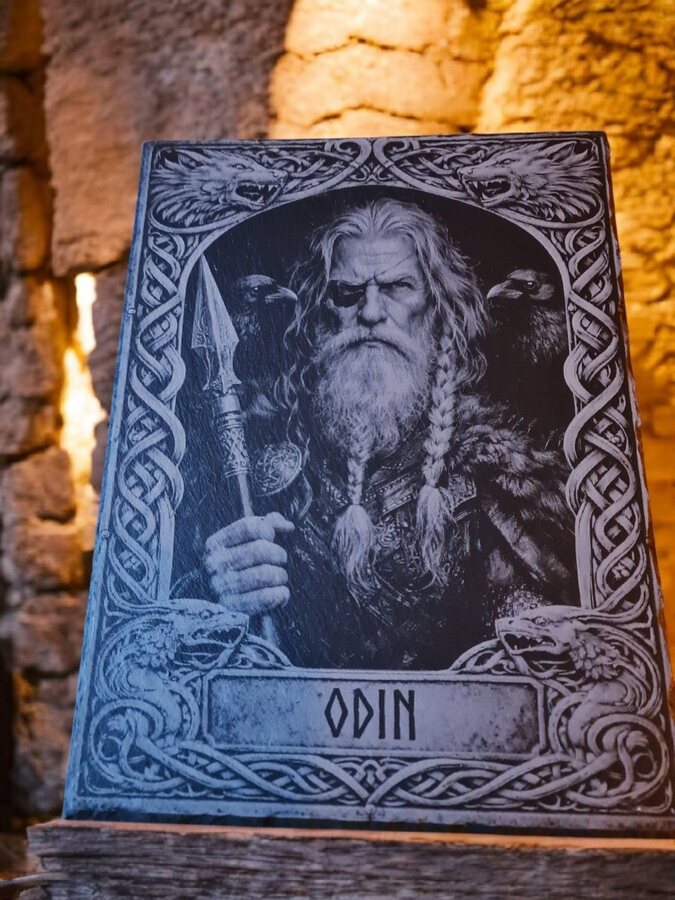
In mythology the horse attains its highest dignity. Odin's mount Sleipnir is the best of all horses, grey and eight-legged, able to carry him over land, sea and into the world of the dead. He is the offspring of Loki, who turned himself into a mare to outwit the builder of the gods' stronghold and so became the mother of the wondrous foal. On Sleipnir Odin rides to Hel to ask after the fate of his son Baldr.
Sleipnir is the name of the steed that belongs to Odin's son; the best it is of all horses.Paraphrased after the Poetic Edda, Grimnismal, in the manner of Karl Simrock's rendering
Other gods ride too. The Aesir cross the bridge Bifröst daily to their court, and the sun is drawn across the sky by the steeds Arvakr and Alsvidr. So the cosmos mirrors what held in daily life: without horses no one gets anywhere, not even the gods.
The Viking horse was travelling companion, beast of burden, status symbol, sporting hero, sacrificial animal and gift to the gods all at once. It carried the farmer to the thing and the dead into the beyond. It decided who counted as rich, and it stood at the centre of cult and the quarrel over conversion. Its legacy rides on today: in the tough, friendly Icelandic horse with its smooth toelt, and in the tales of a grey steed with eight legs that knew no boundary, not even the one between the worlds.
Sacred horses · Sleipnir – Odin's steed · Everyday Viking life · Viking Farming · Viking navigation.
All Everyday Life & Craft articles →
The Vikings had no police, no prisons and no king who could enforce his will everywhere – and yet they built a …
Read more →Viking jewellery was rarely just decoration. A pair of brooches held the dress, an arm-ring was status symbol and …
Read more →Barely an image of the „real Viking“ reaches us today without dark runic and knotwork tattoos. But how do we actually …
Read more →No calendar page, no clock, no numbered day of the year — and yet the people of the North knew exactly when to sow, to …
Read more →