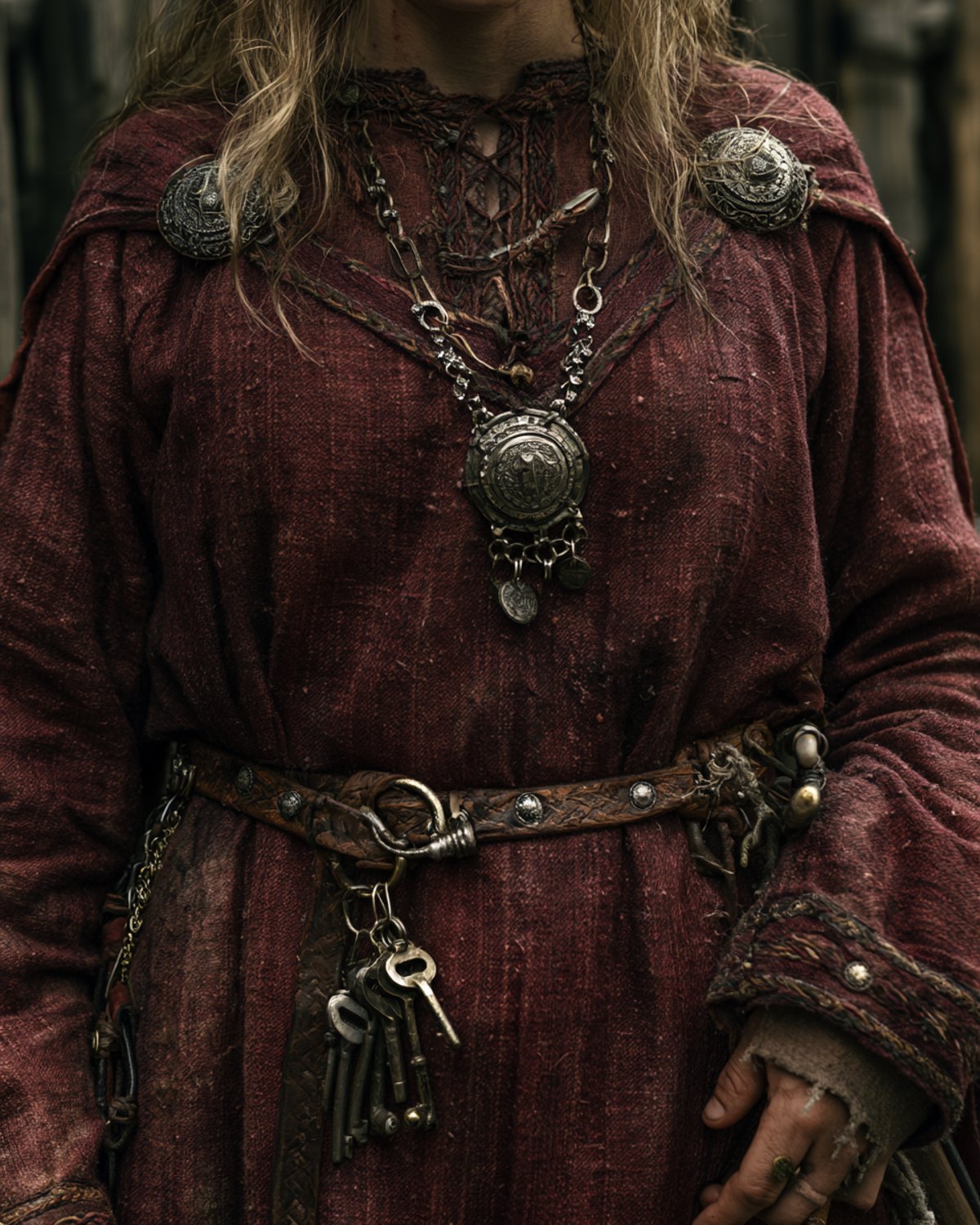
Viking jewelry was dress fastener, savings account and statement of faith all at once: paired oval brooches held up women's strap dresses, silver arm and neck rings stored wealth that could be hacked into pieces and weighed out, and pendants showed whether someone trusted Thor, Christ – or, to be safe, both. Add beads of glass, carnelian and rock crystal that travelled thousands of kilometres from the Middle East. Here is what the finds actually prove, how the pieces were made, and which modern "Viking jewelry" has little to do with the Viking Age.
Picture a market day in Hedeby around 950. A woman buying cloth slides a twisted silver ring off her arm, and the merchant produces his folding balance. A piece is cut off, weighed, trimmed again. That scene captures the idea that changes how you look at every ornament of the period: for most of the Viking Age (roughly 793 to 1066) Scandinavia had no general coin economy. Value lay in the metal itself – in weight and purity, not in a stamped image.
Archaeologists call this a bullion economy: silver counts by the gram, whether it arrives as a coin, an ingot, a ring or a broken brooch. A heavy ring was therefore ornament, status symbol and portable wealth in one. That double nature runs through almost everything we now call "Viking jewelry".
Alongside the silver economy stood a second world: jewelry that was part of dress. Brooches – dress pins that work like oversized safety pins – were a necessity, because clothing was pinned, not buttoned. What the garments themselves looked like is covered in our article on Viking clothing. Here we follow the metal that held them together.
No find says "a woman in Scandinavian dress was buried here" as reliably as a pair of oval brooches, sometimes nicknamed "tortoise brooches". They sat in pairs below the collarbones and fastened the shoulder straps of the apron-like strap dress worn over a long shift. Between them hung strings of beads, and often small chains carrying a knife, scissors, a needle case or keys.
These brooches were mass products in the best sense. In his standard study Ovala spännbucklor (1985) the Swedish archaeologist Ingmar Jansson counted more than 3,600 known examples from Scandinavia and the Norse settlement areas – roughly 1,500 each from Norway and Sweden, around 170 from Denmark, 160 to 170 from what is now Russia, about 75 from the British Isles and 35 from Iceland. Many more have turned up since; for Denmark Judith Jesch (2015) gives a figure close to 400.
The classification goes back to the Norwegian Jan Petersen, who ordered the forms in Vikingetidens smykker in 1928. Two types dominate the material: P 37 is everywhere in the ninth century, while P 51 appears around 900 and rules the tenth. A good replica of a P 51 brooch therefore has hundreds of originals in real graves behind it. Towards the end of the tenth century oval brooches drop out of fashion, a shift that coincides with Christianisation and new styles of dress.
Technically they grew more elaborate over time. Early pieces from around 700 are thin, plain shells. In the second half of the ninth century double-shelled brooches take over: a solid inner shell with an openwork, richly decorated outer shell on top, often set with raised bosses. Almost all are copper alloy, some gilded or silvered to look like precious metal. A genuine silver pair is known from Hedeby – a rare exception.
One regional exception is worth knowing: on Gotland, women wore their own brooch forms instead of oval brooches, above all the so-called animal-head brooches and box brooches. There was never one single "Viking costume".
While two oval brooches held the straps, a third brooch often closed a cloak or overgarment at the chest.
Trefoil brooches have three lobes like a clover leaf and a backstory we love. Their models are Carolingian fittings: three-armed strap distributors from Frankish sword belts. Such pieces reached the North as loot, gifts or trade goods. There someone soldered a pin to the back, and part of a Frankish warrior's kit became a woman's dress fastener. Scandinavian workshops then adopted the shape and filled it more and more with their own animal and plant ornament. The form is Frankish; the use is Norse.
Equal-armed brooches are elongated pieces with two matching ends, found throughout Scandinavia from the ninth to the eleventh century, often lying between the two oval brooches in graves. Disc brooches are round fasteners, frequently small and worn at the throat; the finest are silver or gold with filigree, like the disc brooch in the Hiddensee gold treasure.
The idea that Viking jewelry was a women's affair is a stubborn misconception. Men fastened their cloaks with large brooches, and here contact with Ireland and Scotland shows clearly. The ring brooch – usually an open (penannular) or closed ring with a long, movable pin – comes from the Irish and British tradition and was taken up eagerly in the Viking West. The tenth century produced impressive silver examples, among them the so-called thistle brooches with ball-shaped, often brambled terminals and very long pins that stuck out well beyond the shoulder.
A common interpretation holds that men pinned the cloak on the right shoulder to keep the sword arm free. That fits some graves but is not a rule every burial confirms. What is certain: a heavy silver brooch was a statement – and, when it came to it, bullion like everything else.
Rings may be the most honest objects of the age, because they openly admit to several jobs. In poetry the good lord is a giver of rings; skalds call him by poetic circumlocutions (kennings) such as "ring-breaker", because he broke rings and shared them out among his followers. Whoever gave rings bound warriors to himself. Whoever received them wore their loyalty on their arm for all to see.
The Hávamál, the wisdom poem of the Poetic Edda, puts the core of this gift culture into stanza 41. In our own rendering:
"With weapons and garments friends should gladden each other; that shows plainest on oneself. Those who give and give back stay friends the longest."Hávamál 41, our own translation from Old Norse
At the same time the ring on your arm was a reserve. Many arm rings in hoards are simple twisted or plaited silver rods with their ends hammered together – easy to make, and just as easy to cut up again. Some researchers believe that certain ring types were deliberately made to weight units. For Ireland and Norse Scotland a unit of around 24 grams, a kind of "ounce", is discussed, but whether all rings were really standardised is not settled. Better understood is so-called ring-money: plain, band-shaped silver rings made in Scandinavian Scotland from the mid-tenth to the mid-eleventh century, which also turn up in Ireland (John Sheehan 2016).
Neck rings twisted from several silver or gold rods were the heaviest and most conspicuous form. An eyewitness adds a remarkable note: the Arab envoy Ibn Faḍlān, who met the Rus on the Volga in 921–922, reports that their women wore neck rings of gold and silver, one for every 10,000 dirhams their husband owned – and that some had many. Whether that is literally true we can't say; the idea of jewelry as public proof of wealth fits the finds. Ibn Faḍlān also mentions containers of iron, silver, copper or gold on the women's breasts, often read as a description of oval brooches.
Where silver counted by weight, you didn't need change – you made it. Hacksilver is the name for cut-up fragments of rings, ingots, brooches and coins found in many hoards. Many pieces also carry small nicks, known as test cuts: someone sliced into the metal to check whether real silver lay beneath the surface or merely silver-plated copper. We tell the full story in our article on hacksilver.
Paying required tools. Graves and settlements yield folding bronze balances, often kept in their own case, together with weights. From the late ninth century standardised weight forms spread across the North: spherical weights flattened on two sides and small many-faced cubo-octahedral weights, both modelled on weights from the Islamic world. Much of the silver itself came from there too, in the form of Arabic dirhams that flowed north along the river routes of Eastern Europe.
So a ring could be a lord's gift on Monday and vanish as hacksilver into three merchants' pouches by Wednesday. Only when royal coinages gained ground around the year 1000 did weighed silver gradually lose its role.
Hoards – valuables deliberately hidden – are our best windows into this world.
The Spillings Hoard (Gotland). On 16 July 1999 the largest known silver treasure of the Viking Age was recovered at the Spillings farm in Othem parish, north-eastern Gotland. According to the Swedish History Museum in Stockholm it consisted of two silver deposits of just over 25 and around 41 kilograms plus a third deposit of bronze; altogether the find weighs about 76 kilograms. The two silver deposits held more than 14,000 coins, mostly Arabic dirhams, and roughly 500 arm rings. The latest coin identified so far dates from 870. The treasure lay beneath the floor of a building. We tell the story of the find in our article on the Spillings Hoard.
The Cuerdale Hoard (England). On 15 May 1840 workmen on the bank of the Ribble near Preston in Lancashire struck a lead chest. According to the British Museum it held around 40 kilograms of silver: some 7,000 coins and over 1,300 further pieces of silver, including whole rings, ingots and hacksilver – more than 8,600 objects in total. The coins date its burial to around 903–905. Cuerdale is regarded as the largest Viking silver hoard from the British Isles, and it shows coins from England, Francia and the Islamic world side by side with chopped rings from Ireland and Scandinavia.
The Hiddensee gold (Germany). Between 1872 and 1874, after storm tides, sixteen gold pieces weighing 596.2 grams in total were found bit by bit on the beach near Neuendorf on the Baltic island of Hiddensee: a plaited neck ring, a disc brooch, six large and four smaller pendants and four spacer links. The ensemble dates to the tenth century; the original is in the Stralsund Museum. You will often read that it came from the circle of King Harald Bluetooth. That is a guess based on style and richness, not evidence. The shape of the pendants, somewhere between cross, bird and hammer, is read in different ways. More treasures are gathered in our overview of the great silver hoards.
The strings between the oval brooches tell of a remarkably wide world. Glass beads are the most common, and many were made in the North. In Ribe bead makers were already melting coloured glass in the eighth century, partly recycled from broken vessels and mosaic tesserae from the south, and winding it around iron rods. Our article on the bead maker shows how.
From the late eighth and especially the ninth century, beads appear that clearly came from far away: red-orange carnelian beads, often faceted, and clear rock crystal beads. Their origins are sought in the Middle East and India; carnelian from Gujarat in western India was traded for centuries, and through the Abbasid caliphate and the river routes of the Rus such beads reached the Baltic. The Swedish archaeologist Johan Callmer ordered Scandinavia's bead finds by period in a 1977 study that is still fundamental, tracing the influx of oriental beads. Birka in particular has yielded many carnelian beads. Read more in our article on carnelian.
A colourful string showed how far a family's connections reached – and it was an investment: Ibn Faḍlān writes that the Rus readily paid a dirham for a green glass bead. Small wonder that necklaces turn up in myth too. Freyja's famous necklace is the most splendid example, and we follow it between Edda, skaldic verse and grave finds in our article on Brísingamen.
Among Viking Age pendants, Thor's hammer is the best-known motif. Small hammers of iron, bronze, silver or amber are known from Scandinavia, the Baltic and the western settlements; most date from the tenth century. What they meant, where they were found and why they are not a modern invention is covered in depth in our article on Thor's hammer Mjölnir.
One object sums up the period of transition with dry precision: a soapstone mould from Trendgården in Jutland, now in the National Museum of Denmark in Copenhagen. It has cavities for crosses and for a Thor's hammer. The same craftsman cast both. Two clienteles, or people hedging their bets in uncertain times? The mould only tells us that both were in demand.
On the Christian side stand cross pendants and small crucifixes. From Birka comes a silver crucifix decorated with filigree and granulation, dating from the tenth century. In 2016 a metal detectorist near Aunslev on Funen found a gold crucifix only about 4 centimetres long and weighing 13 grams, worked from gold wire and tiny gold balls and dated to the first half of the tenth century. It ranks among the oldest images of Christ in Denmark and is stylistically close to the Birka piece. Note the point: the technique is exactly that of pagan display jewelry. The goldsmiths changed the motif, not the toolkit.
If you want to date Viking jewelry, look at the ornament. Viking Age art is divided into stylistic phases named after find sites. The styles overlap, and the dates are approximations. A fuller account with examples is in our article on Viking Age art styles.
That gives you a useful test: if a piece promises "Viking style" but shows a Celtic knot band from the Book of Kells, something is off. Genuine models can be tied to a style, often even to a specific find.
Most jewelry was cast. For oval brooches, an existing brooch or a model was pressed into clay to form a two-part mould, which was dried and fired; bronze was poured in, and the mould was then broken to release the casting. Because existing brooches could simply be copied, copies of copies appeared, and the same type was produced in places far apart. That is why Jansson, despite the close similarity of many pieces, does not assume a single "factory". There were also reusable soapstone moulds, such as the one from Trendgården.
Workshops reveal themselves through their waste: crucible sherds, broken moulds, ingots, casting sprues. In Ribe, the early trading place on Denmark's North Sea coast, excavators have recovered large amounts of such debris from the eighth and ninth centuries. A study from Aarhus University (Orfanou and colleagues, 2021) analysed more than 1,100 samples of crucibles and moulds and showed that alloys became more standardised in the ninth century: high-zinc brass was preferred for brooches, probably for its golden colour, while leaded alloys, which cast more easily, went into practical items such as keys. In Hedeby on the Schlei, the great trading town in today's Schleswig-Holstein, casting debris, models and ingots are plentiful too. Learn more about the town in our article on Hedeby.
Display pieces demanded more. In filigree, fine twisted or beaded wires are laid into scrolls and loops and soldered onto a base plate. In granulation, the goldsmith sets tiny metal balls, often less than a millimetre across, onto the surface and solders them in place – work that needs a steady hand and long practice. The Aunslev crucifix, the Hiddensee gold and many disc brooches show both. Niello, finally, is a black compound of metal sulphides melted into engraved lines to set dark patterns against bright silver. More in our article on Viking goldsmithing.
Search for "Viking jewelry" today and you quickly find finger rings engraved with rows of runes, Vegvísir pendants and stainless-steel bangles with wolf heads. Much of that has little to do with the Viking Age.
A real find from Birka is more surprising than any invention: a ninth-century woman's grave held a silver ring set with a stone of coloured glass bearing an inscription in Arabic Kufic script, read as "for Allah" or "Allah".
Other symbols fare similarly. The Vegvísir and the Ægishjálmr as a "Viking compass" come from early modern Icelandic magical manuscripts, not from the Viking Age; the full story is in our article on Vegvísir and Ægishjálmr. Bracelets with two dragon heads, on the other hand, do have genuine models: open arm rings with animal-head terminals are well attested, especially around the Baltic and on Gotland. And the popular "Viking wolf head"? Plausible as an animal-head terminal; as a realistic wolf's head in stainless steel, a modern interpretation.
We engrave with a laser on slate, wood and glass in Alsdorf, not in silver. The questions are the same, though: where does the motif come from, which style, which original?
The animal styles are ideal for engraving because they are conceived as surface patterns. A gripping beast in Borre style, a ribbon animal in Jelling style or a figure-of-eight loop from the Urnes style work astonishingly well as line art on dark slate. The outline of a trefoil brooch or the plaited pattern of a neck ring make fine motifs too. If you'd like something like that, our custom engraving page is the way to reach us.
Viking jewelry never split beauty from usefulness: it held the dress, sealed friendships and, when needed, paid the bill.
What did Viking jewelry mean? It was dress fastener, status symbol, store of wealth and religious sign at once. Silver rings served as money by weight, brooches held clothing together, and pendants such as Thor's hammers or crosses showed faith and belonging.
Did Viking men wear jewelry? Yes. Men wore large ring brooches on their cloaks, arm and finger rings, decorated belt fittings and pendants. Oval brooches, by contrast, almost always belong to women's dress.
How can I tell authentic Viking jewelry? Genuine pieces come from archaeological finds and can be assigned to a type, a style such as Borre or Urnes, and usually a region. Good replicas name their model, for example "oval brooch type P 51" or a specific hoard.
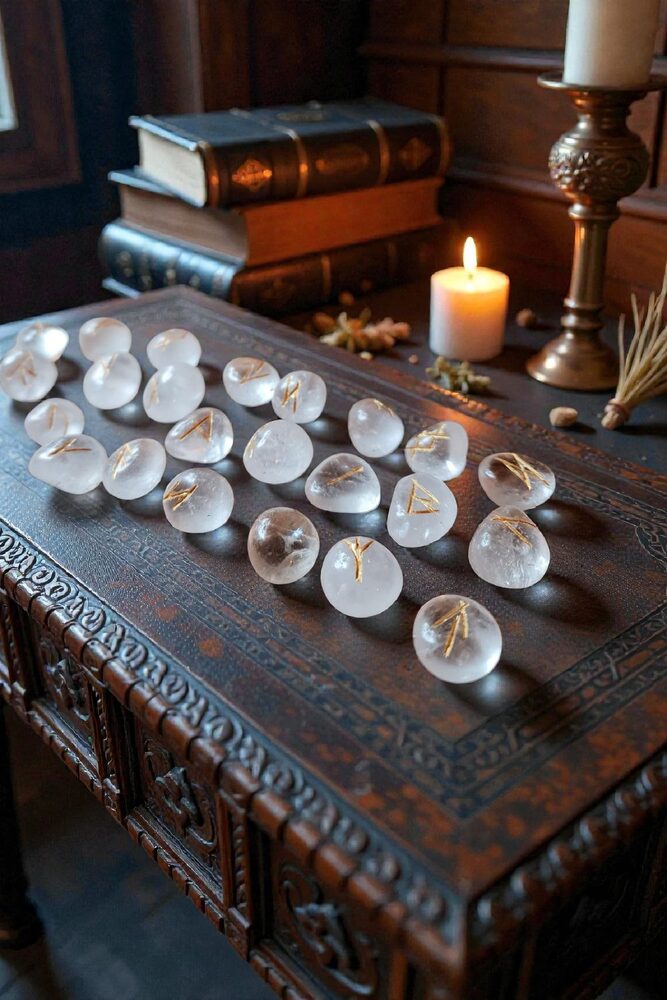
Did Vikings wear rune rings? Finger rings with runic inscriptions are barely attested from Viking Age Scandinavia. The known runic rings of the early Middle Ages are Anglo-Saxon; rings with a full futhark are modern designs.
What is the largest Viking treasure ever found? The Spillings Hoard from Gotland, found in 1999: around 66 kilograms of silver in two deposits with more than 14,000 coins and about 500 arm rings, plus a bronze deposit.
Where did Viking beads come from? Many glass beads were made in Scandinavia itself, for example in Ribe. Carnelian and rock crystal beads came along the eastern trade routes from the Middle East and India.
For courage. For remembrance. For legends that live on.
The treasures of the gods · The silver hoards · Thor's Hammer · The Valknut · Hedeby.
All Everyday Life & Craft articles →
Barely an image of the „real Viking“ reaches us today without dark runic and knotwork tattoos. But how do we actually …
Read more →Most Vikings were not raiders but farmers, traders and craftspeople. A look inside the long house where their lives …
Read more →An entire heroic epic on a single teak panel: rider, ship and figures. Our Atli motif stands in an ancient Norse …
Read more →A stone that is warm rather than cold, light as wood, honey-gold in the light – and sometimes carrying within it an …
Read more →