A ring is a closed circle – no beginning, no end. No wonder the people of the North laid their most binding promises upon a ring. On the altar of the sanctuary lay the oath ring, reddened with sacrificial blood, and whoever placed a hand on it and swore bound themselves before gods and men. A look at a custom between saga text and real find.
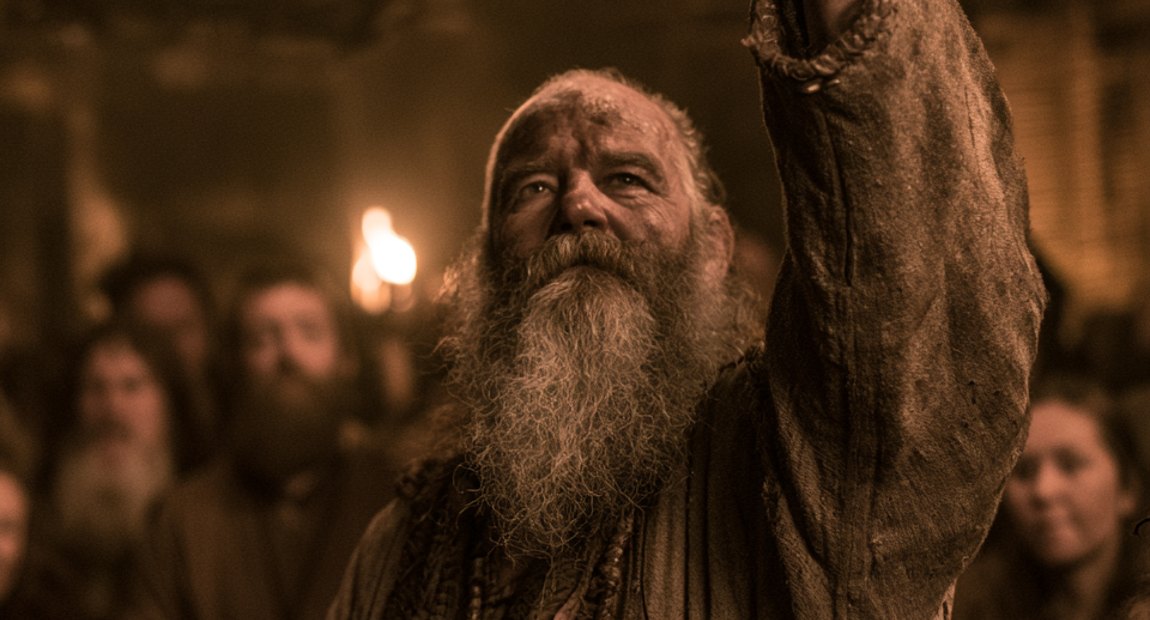
It is described most fully in the Icelandic Eyrbyggja saga. In Thorolf's temple, it says, a heavy arm-ring lay on the altar; on it everyone was to swear their oaths, and the goði, the priest-chieftain, wore it on his arm at all assemblies. Before any legal act the ring was dipped in the blood of the sacrificial animal. The oath on the reddened ring was the most solemn one known.
The oldest Icelandic law, preserved in the Landnámabók, also knows the formula. Whoever swore in court called on the gods of law and fertility:
“… so help me Freyr and Njörðr and the almighty As, that I conduct this case as is right.” Oath formula after the Landnámabók / Ulfljót's law (public domain)
One might take this for later saga embellishment – were there not an independent, very early witness. The Anglo-Saxon Chronicle reports for the year 876 that the Danish army swore King Alfred a peace on the “holy ring,” which it had never before done for any nation. Here a hostile, near-contemporary source confirms precisely the custom the sagas describe only centuries later: the oath on the holy ring.
And then there are the finds. At Lilla Ullevi near Bro in Sweden a cult site was excavated in 2007: a stone platform around which lay more than 65 small iron rings – amulet rings, laid down at a holy place. Such iron rings, often with miniature Thor's hammers attached, are also known from the cemeteries of the Mälaren valley, where they lay on cremation urns. The closed ring was clearly more than jewellery: a sign of binding, of protection, of the sacred.
The ring carries its meaning in its form. It is whole, undivided, lasting – as an oath is meant to last. At the same time, in the North the ring was a store of value and a means of payment: people wore their silver as arm and neck rings and broke off a piece when needed. To give a ring, or to swear on one, meant to stake something valuable and whole. Our wedding rings still carry this thought: a circle as the image of a promise without end.
Behind it lies a culture in which the spoken word weighed heavier than any seal. Whoever swore pledged their honour; a broken oath made one an outlaw. The consecrated ring gave this word a body, something to touch. That is exactly what we do when we engrave a name, a saying, a date into stone or wood: we give a promise permanence. Whoever wishes to go deeper into these feasts and oaths will find it in our piece on Blót & Sumbel.
The oath on a holy ring is independently attested: the Anglo-Saxon Chronicle records for 876 the Danish army's oath on the “holy ring.” Archaeologically tangible are iron rings at cult sites – more than 65 small iron rings around a stone platform at Lilla Ullevi (Uppland, ~600–800), plus iron amulet rings with Thor's hammers on urns in the Mälaren valley. The detailed picture of the altar ring (swearing on it, reddening it with sacrificial blood, the goði wearing it) comes from Eyrbyggja saga; the oath formula “… hjálpi mér svá Freyr ok Njörðr ok hinn almáttki áss” from the Landnámabók / Ulfljót's law.
The colourful temple scene with the blood-reddened altar ring comes chiefly from Eyrbyggja saga, written down only in the 13th century and thus long after the heathen age – caution is due here. The custom itself, however, of swearing on a holy ring, is independently supported by the near-contemporary Anglo-Saxon Chronicle (876) and by real iron-ring finds. Core genuine, embellishment partly literary.
How do heathens celebrate today? · Runes & their meaning · Thor's Hammer · Guldgubber – the tiny gold gods · The Germanic feasts.
All Festivals & Belief articles →
The old Norse people did not think of a person as a sealed self inside a skin. A life involved more powers than that: a …
Read more →A word that tastes of cold air and carved staffs: Gandreið. The “magic ride” carries us to the dark frontier of Norse …
Read more →For our ancestors death was no taboo but a passage accompanied with care. They closed the dead one's eyes, made him …
Read more →The Germanic year knew no spring – only summer and winter. And its feasts followed the rhythm of field and war. Snorri …
Read more →