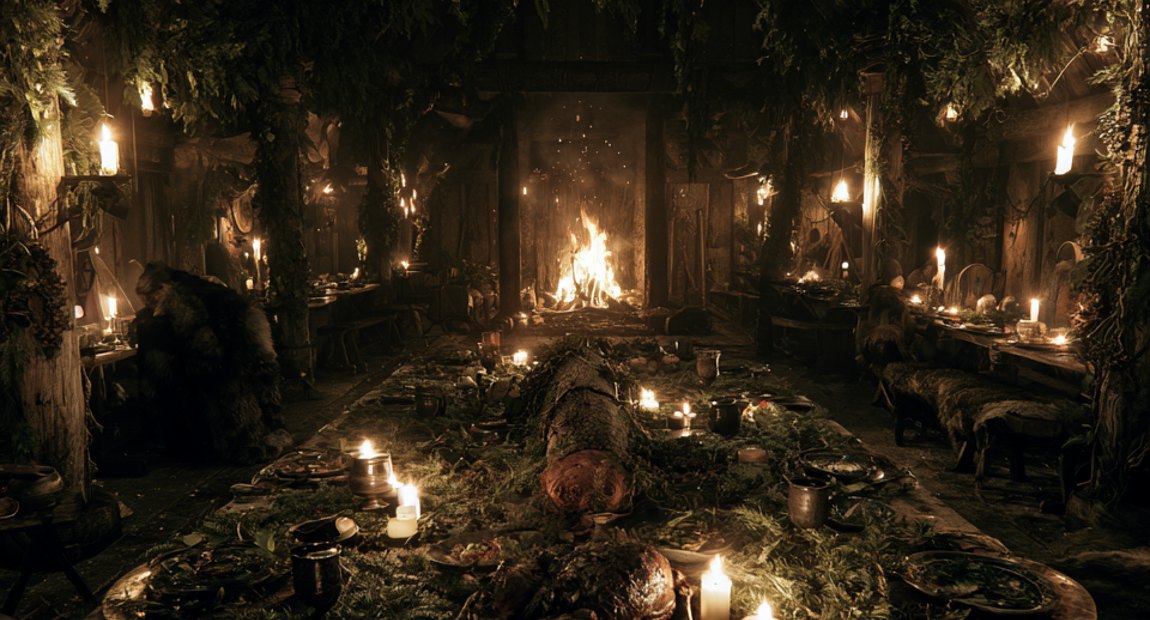
A fire in the open, a drinking horn passed from hand to hand, a few words to gods and ancestors, and at the end a draught of mead poured into the earth: this is what lived heathenry looks like today. Not a museum, not a costume party, but a real feast celebrated by people across the German-speaking world. Its two most important forms are called Blót and Sumbel. What lies behind them – and what of it is old, what is new?
The Old Norse word blót belongs to the verb blóta: to honour a deity with a gift. A Blót is thus neither a prayer nor a sermon, but an act of offering – a giving and receiving. Modern heathens understand the gift not as a sacrifice one suffers, but as an act of sharing and gratitude. One shares one's own well-being with the higher powers and asks in return for a good, peaceful year.
It is usually held outdoors: by a fire, under a tree, by a river or on a hill. The main occasions are the feasts of the year's cycle, but also life's transitions – a naming for a child, a wedding, a farewell. A Blót always marks a threshold: the end of one time and the beginning of another.
Even though every group has its own signature, a Blót usually follows a clear three-step shape. It begins with the opening: often a frith is proclaimed – all quarrels are to rest for the duration of the feast. Then the gods, the ancestors and the spirits of the land are called and invited to take part.
Next comes the offering: the central act. A gift goes to the powers – usually a poured offering (mead, ale, apple juice), sometimes food. Then comes the heart of it, the Sumbel. At the close stands the ending: the offering is poured out. In the Eldaring e.V., one of the largest German-speaking heathen communities, a beautiful formula has become customary for this.
“From the gods to the earth to us, from us to the earth to the gods.” closing words at a Blót, modern ritual practice of the Eldaring e.V.
The Sumbel is the sociable, spoken heart of the feast. A filled drinking horn travels round the circle from hand to hand. Whoever holds it speaks: a toast to a god, a remembrance of an ancestor, a promise, a thanks, sometimes simply a good wish. Then one drinks, passes the horn on, and the next person takes a turn.
The Sumbel often runs in several rounds: one for the gods, one for the ancestors and heroes, one for free words. The word here is no small matter – in heathen understanding, what is spoken aloud carries weight. An oath at the horn is a serious thing. That is exactly what still makes the Sumbel so powerful: it is the moment in which a community becomes audible.
Much of this has a real historical core. The term Blót, the poured offering, the shared drinking to the gods, the plea for ár ok friðr – “good year and frith” – all of this is found in the Old Norse sources. Other things are deliberately new: the exact order, the texts, the formulas. Modern heathens make no secret of this. They celebrate within the tradition, but with their own creativity – and honestly separate what is attested from what is reconstruction.
If you would like a taste yourself without joining a society: our Blót calendar shows the nine great feasts of the year with dates and customs, and in the Germanic lunar calendar you can see how the old feasts were once reckoned by the moon.
The basic terms are attested in Old Norse: blóta (“to honour by offering”) and the formula til árs ok friðar (“for good year and frith”) appear, among other places, in Snorri's Heimskringla. The Hákonar saga góða describes a Blót with shared drinking, toasting Óðinn, Njörðr and Freyr; the Ynglinga saga (ch. 8) names three great Blóts a year. The shared, ritualised drinking (the later Sumbel) is likewise tangible in the poetry and sagas. The modern order described here – opening with frith, offering, Sumbel, pouring out – is the documented practice of present-day communities such as the Eldaring e.V.
One should not confuse a Blót of today with a Viking-age ritual. The written sources are mostly late, Scandinavian and partly from Christian hands – they give us fragments, not a script. No one knows how an offering feast in the 9th century unfolded in every detail. The modern Blót is therefore an honest revival: it ties into attested forms but fills the gaps with present-day shaping. Whoever knows this celebrates no less genuinely – only more honestly.
The Germanic feasts · Þorrablót – the winter feast · The solstice festivals · Seiðr – the magic.
All Festivals & Belief articles →
A life has its great thresholds: the arrival of a child, the coming-together of two people, the farewell to a loved …
Read more →There are cosier Christmas figures than a house-sized cat that prowls through the winter night to check who did not …
Read more →Before a Viking ship glided toward home, the crew took the carved dragon-heads down from the prow. Not out of modesty …
Read more →Between the years lies a time that ticks differently: the Rauhnächte, the Twelve Nights around the winter solstice. The …
Read more →