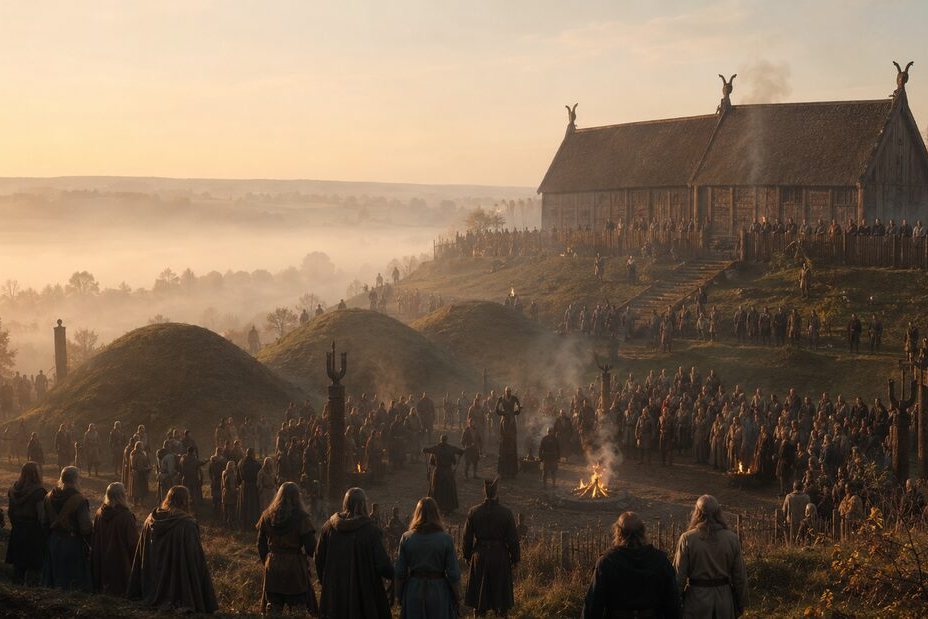
When people picture a Viking sacrifice, they quickly imagine a dark temple full of idols. The reality was more down to earth – and all the more interesting for it: people sacrificed at stone heaps under the open sky, in great royal halls, in sacred groves and at springs. A true "temple" in the sense of a church is barely traceable in the archaeology of the North. Let us take an honest look at where the old Norse really honoured their gods.
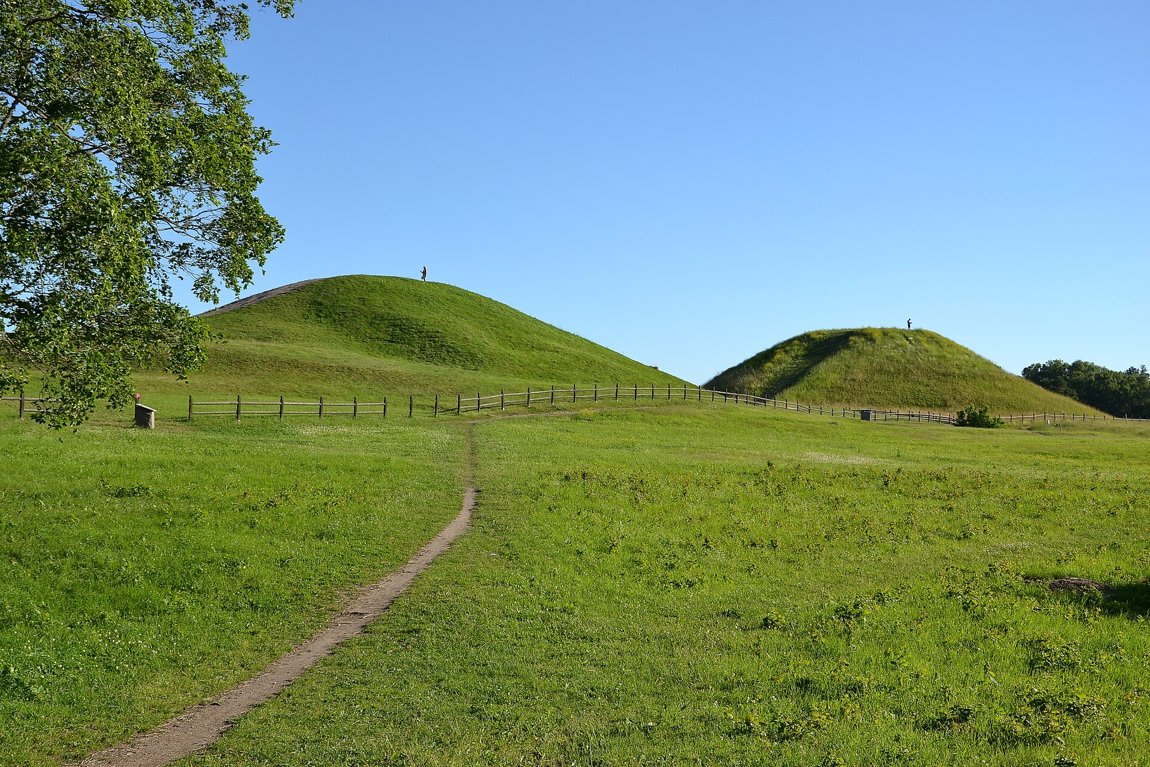
The Old Norse sources know two main terms for cult places, and they do not mean the same thing. The hörgr was originally a stone altar or a heaped-up cairn of stones under the open sky – a place of offering in the landscape, often on rises or at striking spots. The hof, by contrast, denotes a building, as a rule a large hall in which cultic acts took place alongside everyday life. Both words appear already in the Poetic Edda: the Völuspá says the gods raised "altars and halls" (hörg ok hof) as they ordered the world in primordial time. The idea is old, then – but it does not describe a single type of building, rather a range of places.
The coexistence matters: one person sacrificed outdoors at the stone, another indoors in the hall, and many did both depending on the occasion. There was no central house of worship, no priestly caste with its own temple building. Cult was embedded in the life of farms and kindreds – and that is exactly what makes it hard for archaeology to identify clearly.
For decades scholars searched for the "Viking temple" – and did not find it, at least not as a free-standing sacred building on the model of a church. What they found instead were large multi-purpose halls of the elite. In these royal and chieftain halls people ate, drank, gave judgement, made politics – and sacrificed. Cult was the leader's business: whoever owned the hall also led the sacrificial feast. Religion and rulership could not be separated.
This fits the written sources. When the sagas speak of a hof, they usually mean such a hall space, not a closed-off sacred building. Some Icelandic sagas do describe a smaller partitioned room within the hof, in which idols stood on a stallr (a kind of altar bench) – yet these accounts date from the 13th century, that is from Christian times, and bear the stamp of their authors. They should not be read unquestioned as a floor plan.
The best-known Icelandic site carries the word itself in its name: Hofstaðir ("Hof-place") in the Mývatn region. Excavations uncovered a very large hall of the 10th and early 11th centuries. On its own it would look like an especially large farmstead. The difference lies in the finds: at and within the building lay the skulls of at least around two dozen cattle, many with the marks of a deliberate blow – the animals were apparently killed publicly and dramatically, and the skulls afterwards displayed, probably on the outside of the hall, where they weathered over time.
Hofstaðir thus shows in model form what a cult site in the North could look like: an inhabited, used hall that at certain times of the year became the stage for great sacrificial feasts, drawing people from far and wide. No golden temple, but a place of community in which meat, blood and feasting stood at the centre.
There are exceptions, however, and the most important lies in Scania (southern Sweden): Uppåkra, for many centuries one of the most significant central places of Scandinavia. There a small, unusually robustly built structure was excavated that was rebuilt again and again on the same spot over a remarkably long period – a sign of deliberate continuity. Inside were found the remains of an elaborate beaker and bowl of precious metal, together with a dense concentration of deposited objects, among them over a hundred gold foils (guldgubber) and weapon parts. This house really does look like a purpose-built cult structure, not a dwelling hall.
Uppåkra is so valuable precisely because it proves the rule by being the exception: such free-standing cult houses did exist, but they were rare and tied to outstanding centres of power. The normal case remained the multi-purpose hall.
Other great central places belong here too. At Danish Tissø – the name means "Týr's lake" – lay an extensive royal estate with a mighty hall and a fenced special area; in the adjacent lake weapons were deposited, suggesting ritual offerings. Eastern Danish Gudme ("home of the gods") was for centuries a centre of wealth and cult of supra-regional importance. And at Scanian Järrestad a hall was uncovered around which striking depositions clustered. These places belong closely to our theme but deserve a closer look of their own – here we are chiefly interested in the pattern: power, hall and cult meet again and again at the same site.
In Norway two finds round off the picture. At Ranheim near Trondheim a round structure heaped up from stones and earth came to light – a veritable open-air altar – beside the traces of a small building and a processional structure. At the end the site was deliberately covered over, possibly as the old faith gave way to the new. Ranheim is thus one of the best candidates for an actual hörgr in the archaeological record.
At Mære in Trøndelag, on the other hand, a medieval stone church stands today – and beneath it were found the postholes of an older hall as well as small gold foils, like those known from Uppåkra. This is significant: it supports the widespread observation that churches were in some places built exactly where heathen cult had previously taken place – cult continuity at a sacred site, across the change of faith. One should not overstate this reading, though: not every church stands on a sanctuary, and the connection must be tested case by case.
The fullest account of a sacrificial feast is given by Snorri Sturluson in Hákonar saga góða (Heimskringla), written around 1230 – long after the heathen age and by a Christian hand, which must be kept in mind. The core, however, agrees well with the archaeological evidence from Hofstaðir: animals were slaughtered, their blood caught (the hlaut), and with it the walls of the hall and the participants were sprinkled; the meat was boiled in kettles over the fire and eaten together. The chieftain hallowed the meal, and the drinking cup (the full) went round – Óðin for the king's victory and power, Njörðr and Freyr for a good year and peace. Added to this was the memorial drink (minni) for the departed kin.
It was an old custom that when there was to be a blót all the farmers came to the place where the temple stood, and brought with them the provisions they needed while the feast lasted … all kinds of cattle were slaughtered, and the blood thereof was called hlaut … with it the altars were to be reddened, and likewise the walls of the temple within and without, and the people also were sprinkled; but the flesh was to be boiled for the food of the assembled company.Snorri Sturluson, Hákonar saga góða (Heimskringla); translation after S. Laing, 1844, public domain
A blót, then, was no sinister secret ritual but first of all a communal feast: people gathered from the farms, ate and drank for days, sealed alliances and honoured gods and ancestors in one and the same act. For those who want to dive deeper into the feasts of the year – from the Winter Nights through Yule to Sigrblót – we offer an interactive blót calendar tool that anchors the dates to the solstices and the old reckoning.
Elsewhere, in the Ynglinga saga, Snorri arranges the sacrificial feasts into a simple yearly scheme: one at the start of winter "for a good year", one in mid-winter "for growth", and a third towards summer, the victory sacrifice. This threefold scheme is memorable and often quoted – but one should know that it is Snorri's ordering synthesis from the 13th century. Lived practice was more varied regionally, with household offerings such as the Álfablót and the Dísablót, of which the sources report only in fragments. The pattern is broadly right, but the neat threefold division is more model than measurement.
Not every cult site was a building. The Roman historian Tacitus already reported sacred groves among the Germani (he named the famous grove of the Semnones), and the Norse likewise knew the lundr, the sacred grove. Springs and bogs were places of offering where weapons, jewellery and other valuables were laid down – the weapon lake at Tissø belongs to this series. The hörgr as a stone altar under the open sky joins here. The sacred place needed no roof; it needed meaning, continuity and the assent of the community.
A quiet but reliable witness are the place-names. Scattered across Scandinavia are names with the elements -hof (cult hall), -vé or -vi (sacred place, sanctuary – think of Odense, "Óðin's vé"), -hörg (stone altar) and -lund (sacred grove). Often they appear together with a god's name: Þórslundr, Freysvé, Óðinsvé. Such names preserve the heathen cult in the landscape long after the feasts themselves had vanished. They are an important corrective: they show that cult sites were widespread and distributed across many forms – hall, sanctuary, altar, grove – and not concentrated in a few great temples.
No text has shaped the image of the splendid Viking temple as much as the account by Adam of Bremen from the late 11th century. He describes a temple gleaming entirely with gold in (Old) Uppsala, with the statues of Þórr, Óðin and Freyr, a sacred grove in which every nine years nine males of every kind were sacrificed and their bodies hung up, and feasts lasting nine days. As impressive as that sounds, it must be put in context: Adam was a Christian cleric who was never there himself and wrote at second hand, with the clear intent of portraying heathendom as cruel and idolatrous. His numbers are conspicuously shaped by the symbolic figure nine. Archaeologically, an important hall and cult centre could indeed be demonstrated at Gamla Uppsala – but no golden temple such as Adam describes.
Anyone who wants to understand Viking cult should set aside the church-and-temple image. Sacrifice happened where life happened: in the chieftain's great hall, at a stone altar on the rise, in the sacred grove, at spring and bog. Cult was a matter of the kindred and of rulership, embedded in feast, law and community. It is precisely this down-to-earth, sociable picture that is historically more sound – and more honest – than the golden temple of legend. It shows a religion that was not visited but lived.
Sacred Places of the North · Uppsala · Gudme · Tisso · Germanic Sacrifice & Sanctuaries.
All Festivals & Belief articles →
Scarcely an image is so bound up with the Vikings as the burning ship drifting out to sea with the dead. The ship was …
Read more →