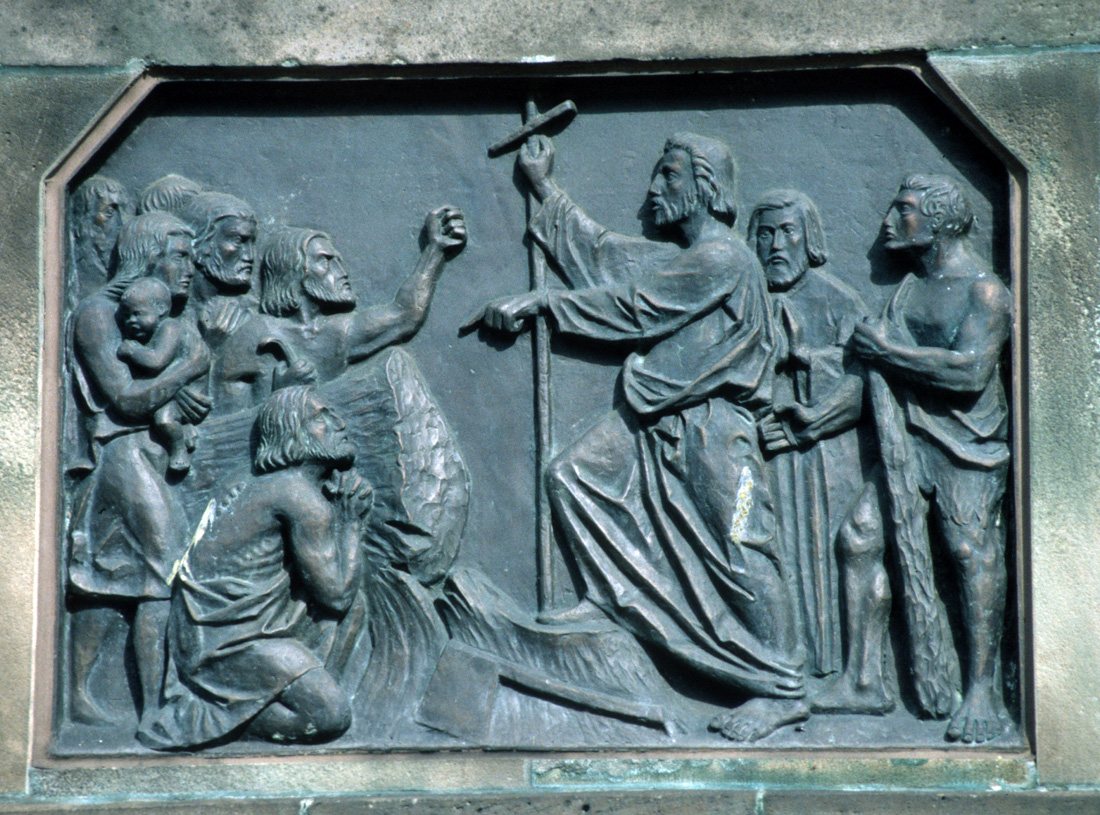
The Germanic peoples were converted to Christianity over roughly 800 years, not in a single moment: the process began with the Goths and Bishop Wulfila in the 4th century and was only completed in Sweden in the 12th. Along the way came the baptism of the Frankish king Clovis, Irish and Anglo-Saxon missionaries such as Willibrord and Boniface, Charlemagne's brutal Saxon wars, Ansgar's journeys to Hedeby and Birka, Harald Bluetooth's runestone at Jelling, Iceland's assembly vote around 1000 and the death of Olaf the Saint at Stiklestad. Sermons played a part. Politics usually played a bigger one, and sometimes the sword decided.
Picture a small mould of soapstone, about the size of your palm. A metalworker in northern Jutland used it in the second half of the 10th century. Cut into its face are several hollows: some for little crosses, and some for Thor's hammers. One craftsman, one mould, one pour of metal. The Trendgården mould now sits in the National Museum of Denmark in Copenhagen, and it tells the story of conversion more honestly than many a saint's life. Changing faith in the North was not a switch being flipped. It was a long dusk.
The first Germanic people to become Christian in large numbers were the Goths. Their key figure was Wulfila (Ulfilas in Greek, c. 311–383). He descended from Christian captives taken from Cappadocia in Asia Minor and around 341 was consecrated "bishop of the Christians in the Gothic land". When the Gothic leader Athanaric persecuted Christians, Wulfila led his flock across the Danube into Roman Moesia.
His lasting achievement was a translation of the Bible into Gothic, for which he devised an alphabet drawn mostly from Greek and Latin letters, with a few borrowed rune shapes. The Gothic Bible is the oldest substantial text in any Germanic language. Its most splendid witness, the Codex Argenteus or "Silver Bible", was written in 6th-century Italy, probably in Ostrogothic Ravenna, and is kept today in Uppsala University Library.
The turning point came in 376. Fleeing the Huns, the Tervingi under Fritigern asked to be admitted to the Roman Empire, and as they crossed the Danube they apparently adopted Christianity in the form favoured by Emperor Valens. That was the so-called Homoian creed, which taught that the Son is "like" (Greek homoios) the Father rather than of the same substance. The victorious imperial church later dismissed this as "Arianism", after the priest Arius. Ostrogoths, Vandals, Burgundians and Lombards followed the same creed, and for generations it separated Germanic rulers from their Catholic Roman subjects. The Visigoths in Spain only became Catholic in 589 under King Reccared; the Lombards followed during the 7th century.
The Franks took another road, and it shaped the history of western and central Europe. The Merovingian king Clovis I was baptised at Reims by Bishop Remigius, and he chose the Catholic creed, not the Homoian one. That put him on the same side as the Gallo-Roman population and its powerful bishops. As politics, it was a masterstroke.
Our main source is Gregory of Tours, writing some eighty years later. He frames the conversion on the model of Constantine: in a battle against the Alamanni that was going badly, Clovis called upon the god of his Christian wife Clotilde and won. At the font, Remigius supposedly told him to bow his neck, to adore what he had burned and to burn what he had adored. More than 3,000 of his warriors are said to have been baptised with him.
The date is disputed. Tradition gives 496, because Gregory places the Alamannic battle in Clovis's fifteenth year. Many historians now prefer a later date, around 498/499 or even 506/508, partly because they read the congratulatory letter of Bishop Avitus of Vienne differently. So "496" deserves a question mark. And the name "Zülpich" (Tolbiac), often attached to that battle, does not actually appear in Gregory's account of it.
From the late 6th century, fresh impulses came from an unexpected direction: the British Isles. In 597 Pope Gregory the Great sent the monk Augustine to Kent, where King Æthelberht accepted baptism. In 601 Gregory sent further instructions, preserved by Bede (Ecclesiastical History I.30): the temples of the English should not be destroyed, only the idols inside them; the buildings should be sprinkled with holy water and given altars. The customary sacrifices of oxen should be turned into feasts in honour of the saints. In short, whoever wants to climb a high mountain does it step by step, not in leaps.
How slow that climb could be is shown by another story in Bede (II.15). King Rædwald of East Anglia, often identified as the man in the Sutton Hoo ship burial, was baptised in Kent, but back home he kept, in the same shrine, one altar for the Christian sacrifice and a small one for offerings to the old gods. An early lesson in hedging your bets.
At the same time, Irish monks were wandering the Continent. Columbanus founded Luxeuil in Burgundy around 590, later moved to Lake Constance and died at Bobbio in Italy in 615; his companion Gallus stayed among the Alamanni, and his hermitage grew into St Gallen. The Irishman Kilian, according to tradition, was killed at Würzburg around 689.
The Anglo-Saxons brought something the Irish often lacked: organisation. Willibrord landed in Frisia in 690, was consecrated archbishop of the Frisians in Rome in 695, based himself at Utrecht and founded the monastery of Echternach in 698. His Life, written by Alcuin, says he even visited a Danish king called Ongendus, got nowhere and took thirty boys back with him to be taught the faith. On the voyage home he reportedly killed animals and baptised people in the sacred spring on the holy island of Fositesland, probably Heligoland – a deliberate breach of taboo.
The most famous Anglo-Saxon missionary was Wynfrith, who took the name Boniface. After a failed first attempt in Frisia in 716, he obtained a papal commission in 719, became a bishop in 722 and worked in Hesse and Thuringia. His biographer Willibald tells how, at Geismar near Fritzlar, Boniface felled a huge oak that the pagans called robur Iovis, "Jupiter's oak" – meaning Donar, the continental Thor. According to Willibald, the tree burst into four parts as if struck by a blast from above; the watching pagans converted, and the timber was used for an oratory dedicated to St Peter. For the dating (usually around 723) and the debate, see our article on the Donar Oak at Geismar.
The context matters. Boniface operated under the protection of the Frankish mayor of the palace Charles Martel and with papal backing. He set up bishoprics such as Würzburg, Erfurt and Büraburg, inspired the founding of Fulda (744, by his pupil Sturm) and reorganised the Frankish church. In 754 he and his companions were killed near Dokkum in Frisia.
Nowhere was conversion as violent as among the Saxons. Charlemagne fought them, on and off, from 772 to 804. In his very first campaign in 772 he took the Eresburg and destroyed the Irminsul, a central Saxon sanctuary.
In 782 rebellious Saxons wiped out a Frankish army in the Süntel hills. Charlemagne's response has gone down in history as the "Massacre of Verden". The Royal Frankish Annals say the Saxons handed over the guilty "to be killed", 4,500 of them, and that it was done. The revised version of the annals adds that all were beheaded on a single day at Verden on the river Aller.
The conquest was backed by law: the Capitulatio de partibus Saxoniae, usually dated to 782 (some suggest up to 785). It threatened death to anyone who burned a church, killed a priest, ate meat in Lent out of contempt for Christianity, cremated a body in the pagan manner or hid to avoid baptism. In 785 the Saxon leader Widukind was baptised at Attigny with Charlemagne as his godfather. Only after further revolts did the milder Capitulare Saxonicum of 797 replace the harshest provisions.
The sharpest criticism came from Charlemagne's own court. In the 790s the Anglo-Saxon scholar Alcuin argued that faith is a matter of free will, not compulsion: you can drive a man to the font, but not into belief. He also urged that missionaries be preachers, not plunderers – a jab at the church tithe that turned many Saxons against Christianity all the more.
We know exactly what a Saxon convert had to say. A manuscript of the late 8th or early 9th century, now in the Vatican Library (Codex Palatinus latinus 577), contains a baptismal vow in Old Saxon with Frankish and Old English colouring. Asked whether he renounces the devil, the candidate replies:
end ec forsacho allum dioboles uuercum and uuordum, Thunaer ende Uuoden ende Saxnote ende allum them unholdum, the hira genotas sint.Old Saxon baptismal vow, Cod. Pal. lat. 577 (8th/9th c.); in English: "and I renounce all the devil's works and words, Thunaer and Woden and Saxnot, and all the fiends who are their companions."
This sentence is a gift to historians. It names three gods the Saxons actually worshipped: Thunaer (Thor), Woden (Odin) and Saxnot, whose name may mean "sword companion" or "companion of the Saxons" and who appears as Seaxnēat in an Anglo-Saxon royal genealogy. For more on these continental forms, see Wodan, Donar & Ziu. Note that the church did not treat the gods as fantasies. It treated them as real powers – demons that had to be renounced by name.
With Saxony absorbed, the Frankish realm bordered on the Danes. The next step was taken by Ansgar (801–865), a monk of Corbie and Corvey. His successor Rimbert wrote his Life soon after his death, full of concrete detail.
In 826 the Danish claimant Harald Klak was baptised at Ingelheim with Emperor Louis the Pious as godfather. Ansgar went north with him, but Harald could not hold power. Around 830 Ansgar travelled on to Birka on Lake Mälaren, the great trading town of the Svear. King Björn allowed him to preach, and the royal reeve Herigar was baptised and built a church. In 831/832 Ansgar became archbishop of Hamburg, responsible for mission across the North. In 845 Danes sacked Hamburg, and he withdrew to Bremen.
Around 850 the Danish king Horik I allowed him to build a church at Hedeby (Latin Sliaswich), and later another at Ribe. On Ansgar's second visit to Birka, around 852, Rimbert says the assembly cast lots to ask the gods whether the mission should be allowed – and the lot fell in its favour. The Christian mission entered the country through a pagan procedure.
Tradition credits the breakthrough in Denmark to Harald Bluetooth, who succeeded his father Gorm around 958. The Saxon monk Widukind of Corvey, writing only a few years later, tells of a cleric named Poppo who carried a red-hot iron before the king without being burned, after which Harald resolved to worship Christ alone. It is a miracle story, but it is close enough in time to take a conversion around 965 seriously.
Harald left the best evidence himself. On the great runestone at Jelling, often called "Denmark's baptismal certificate", he recorded that he raised it for Gorm and Thyra, "that Harald who won for himself all Denmark and Norway and made the Danes Christian". One face carries the oldest image of Christ in Scandinavia, wrapped in foliage; another shows a great beast entwined with a snake. For the details, see our article on the Jelling stones.
What happened next is intriguing. Gorm had been buried as a pagan in a chamber in the north mound, its timbers dated by dendrochronology to 958/959. When it was opened in the 19th century, it held no bones and only a few grave goods. In 1978 archaeologists found the bones of a man beneath the later church, which many interpret as Gorm's remains, moved there. If so, the son brought his pagan father into the Christian order after death – but that reading is not certain.
The strangest conversion of all happened among the Icelanders. Our best source is Ari Þorgilsson, who wrote his Íslendingabók ("Book of the Icelanders") around 1122–1133 and named informants who had known eyewitnesses. Ari dates the event to the year 1000; some historians recalculate it to 999.
The background: the Norwegian king Olaf Tryggvason was leaning on Iceland. He sent the priest Þangbrandr, who preached and killed in about equal measure and failed. Olaf then held the sons of Icelandic chieftains in Norway and threatened to kill them. Two Christian chieftains, Gizurr the White and Hjalti Skeggjason, rode to the Althing. There, pagans and Christians threatened to split into two separate legal communities – on an island without a king, that meant civil war.
Both sides agreed to let the lawspeaker Þorgeirr Ljósvetningagoði decide – a pagan. Ari tells us that Þorgeirr lay down in his booth, spread his cloak over himself and lay there for a day and a night without saying a word. Then he addressed the assembly, saying in effect that if they tore apart the law, they would tear apart the peace. There must be one law and one faith. Everyone was to become Christian and be baptised. But some exceptions remained for the time being: the old law on exposing newborn infants and on eating horse meat, and people could sacrifice in private without penalty; only if witnesses saw it would the lesser outlawry apply. A few years later, Ari says, these exceptions were abolished.
In Norway, conversion was bound up with kingship. Hakon the Good, raised at the English court of Æthelstan, tried around 950; according to Snorri, the farmers of Trøndelag forced him to eat sacrificial meat. Whether it happened like that is uncertain, as Snorri wrote some 250 years later.
Olaf Tryggvason (king c. 995–1000) used force. The sagas tell of forced baptisms, smashed idols and cruel punishments for the unwilling, though these are Christian hero tales written in hindsight. He fell around 1000 in the sea battle of Svolder.
The decisive step came under Olaf Haraldsson, later Olaf the Saint (king 1015–1028). At an assembly on the island of Moster he is said to have introduced a Christian church law with Bishop Grimkell; the date of 1024 is a later tradition. In 1028 he had to flee before Cnut the Great and the chieftains allied with him. Returning, he fell on 29 July 1030 at the Battle of Stiklestad. Notably, there were Christians among his enemies. Stiklestad was a power struggle, not a war of pagans against Christians.
His death made him a saint. As early as 1031 Bishop Grimkell had the body enshrined, miracle stories spread, and his tomb at Nidaros (Trondheim) became the greatest pilgrimage site in the North. In 1152/53 Nidaros became an archbishopric.
The Svear around Lake Mälaren held to the old gods longest. King Olof Skötkonung is regarded as Sweden's first Christian king; his baptism is traditionally placed around 1008 at Husaby in Västergötland, though the date is not secure. He struck coins with crosses at Sigtuna. Yet according to Adam of Bremen, writing around 1075, a great pagan temple still stood at Uppsala with images of Thor, Wodan and Fricco, where large sacrificial feasts were held every nine years. Adam knew Uppsala only from informants, and his account is considered partly exaggerated.
The runestones of the 11th century, especially in Uppland, are strong archaeological evidence for the shift. Very many carry a cross and prayers such as "God help his soul". Some say the dead man died "in white clothes", that is, shortly after baptism. A pagan rival king, Blot-Sweyn, around 1080 appears only in late sagas. Not until 1164 did Sweden get its own archbishopric at Uppsala – some eight centuries after Wulfila.
Syncretism – the blending of elements from different religions – was the normal state of the transition period in the North. We have already met the Trendgården mould with its crosses and hammers. Of the roughly one thousand known Thor's hammer pendants, most date from the 10th century, precisely when the cross was becoming visible in Scandinavia. Many scholars therefore read the hammer partly as an answer to the cross: a statement of identity that competition made necessary.
The Icelandic Book of Settlements mentions a settler named Helgi the Lean. Freely translated, it says he was very mixed in his faith: he believed in Christ, but called on Thor for sea voyages and hard times (our own rendering). It is hard to describe the religious life of the age more honestly. Then there was primsigning, a preliminary blessing with the sign of the cross short of full baptism, which let traders deal with Christians without giving up their old gods.
In the British Isles, stone crosses such as the one at Gosforth in Cumbria show scenes that can be read through Norse myth, for example Víðarr against the wolf; another stone in the same church probably shows Thor fishing for the Midgard Serpent. More in our article on Gosforth and Thorwald's Cross. Whether the carvers meant to honour pagan myth or to present it as a prelude to Christian judgement is an open question. The second is more likely – but the old images clearly still made sense to viewers.
And then there are the weekdays. Tuesday (Tiw), Wednesday (Woden), Thursday (Thunor/Thor) and Friday (Frige) still carry the gods' names. They are not secret resistance, though, but a loan translation of the Roman week that predates the mission. Be more careful with supposedly "ancient Germanic" customs: the Christmas tree, the Easter hare and some midsummer rites were declared pagan survivals only in the 19th century, often in Jacob Grimm's wake. Their documented age is usually much younger.
Power, trade and violence explain a lot. A baptised king gained allies in the church, literate administrators and a seat among Europe's courts; merchants found it easier to deal with baptised partners. One factor is often overlooked, though: the old religion had no church. There were no bishops of the gods, no scripture, no leadership beyond the region. Cult belonged to families and chieftains – flexible, but defenceless once the chieftains changed sides. That we still know Odin, Thor and Freyja at all we owe, paradoxically, to Christian writers: Icelandic scholars of the 12th and 13th centuries, Snorri Sturluson above all, wrote down the myths when no one worshipped those gods any more.
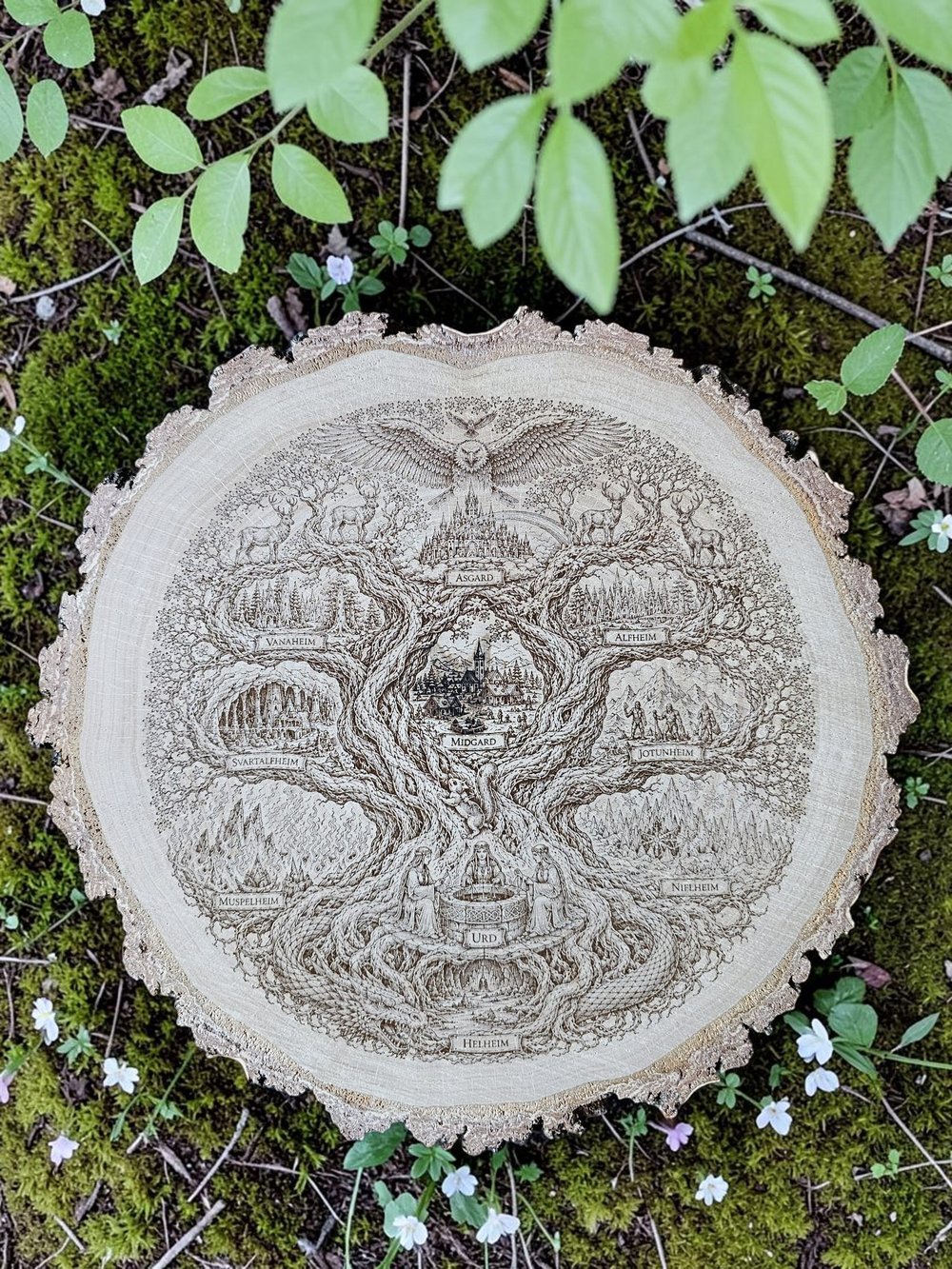
In our workshop in Alsdorf, near Aachen, we meet this double heritage all the time. A Thor's hammer on slate, a world tree for a christening – often both within one family. A thousand years ago someone stood at a bench and cast what people needed. We feel a certain kinship with that person.
When did the Germanic peoples become Christian? Not all at once: the Goths from the 4th century, the Franks around 500, the Alamanni and Bavarians in the 7th–8th centuries, the Saxons by force after 772, Denmark around 965, Iceland around 1000, Norway by about 1030 and Sweden over the 11th and 12th centuries.
Were the Goths Arians? Yes, in the language of the later church. Wulfila and the Goths followed the Homoian creed, which called the Son only "like" the Father; the imperial church labelled that Arianism.
Were 4,500 Saxons really executed at Verden? The figure comes from the Royal Frankish Annals and cannot be checked. Many historians consider it exaggerated, but the mass execution itself is regarded as historical.
Who was the Apostle of the North? Ansgar (801–865), archbishop of Hamburg-Bremen, who preached at Hedeby, Ribe and Birka. Few lasting congregations resulted from his work.
How did Iceland become Christian? By a decision of the Althing around 1000: the pagan lawspeaker Þorgeirr, after a day and a night under his cloak, ruled that everyone should be baptised, while at first allowing private sacrifice to go unpunished.
Did Vikings wear Thor's hammers and crosses at the same time? We know both were made side by side, for example in the Trendgården mould. Whether individuals wore both is rarely provable, but it fits accounts such as the one about Helgi the Lean.
For courage. For remembrance. For legends that live on.
The Irminsul · The Donar oak & Boniface · The Merseburg Charms · Interpretatio Romana · The Germanic feasts.
All Festivals & Belief articles →
They appear almost in passing in the old texts, yet they are everywhere: the disir, female spirits who watch over a …
Read more →Forget the translucent veil-ghost. The draugr of the Old Norse sagas comes back in the flesh – heavy as an ox, darkly …
Read more →In the sagas of the North, no one sleeps harmlessly. A dream there is rarely a mere echo of the day, but a messenger …
Read more →A ring is a closed circle – no beginning, no end. No wonder the people of the North laid their most binding promises …
Read more →