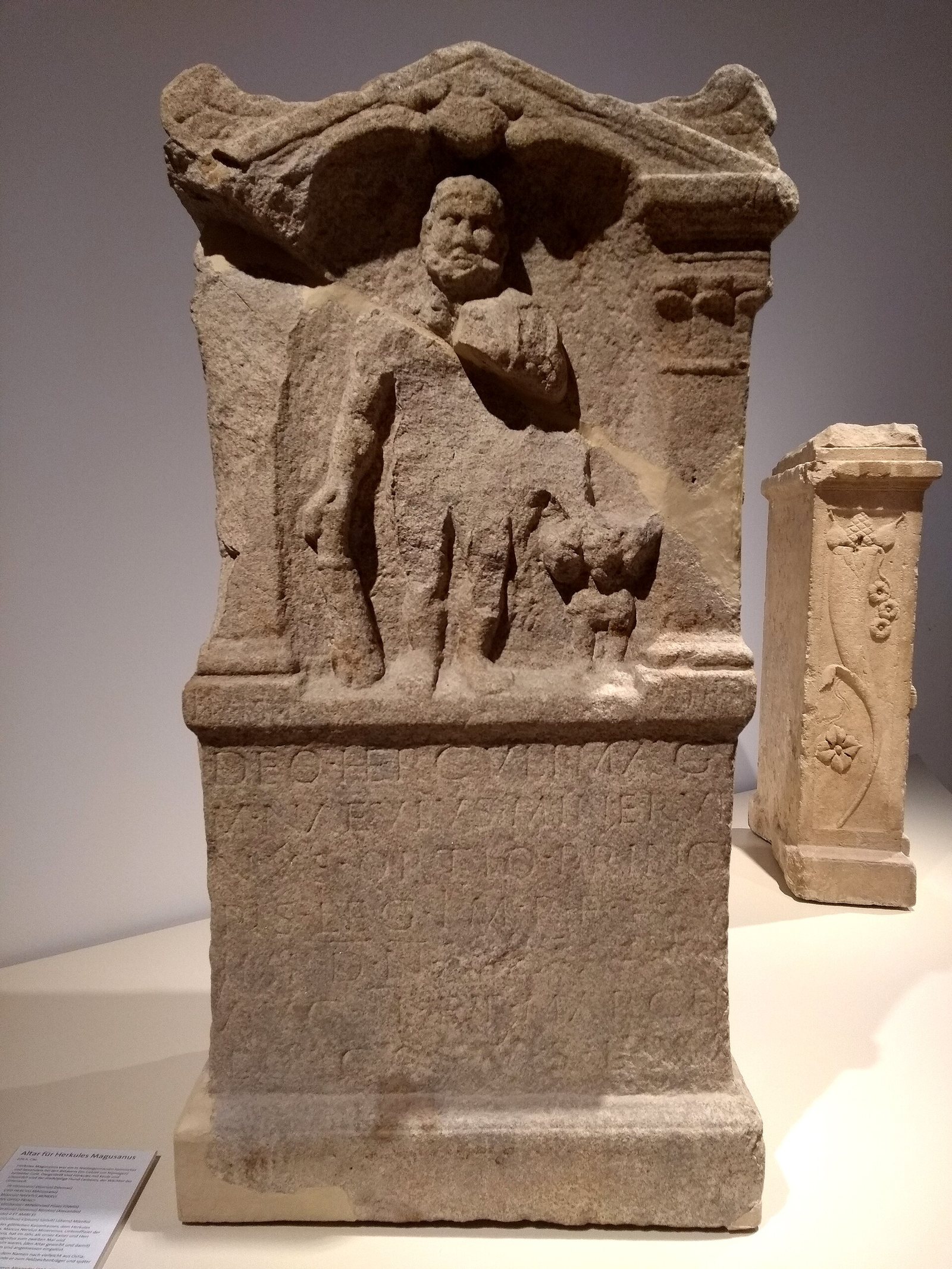
Interpretatio Romana is the Roman habit of calling foreign gods by the names of their own: a Germanic god who looked like Mercury to a Roman simply became Mercury in Roman writing. The term comes from Tacitus, Germania 43. Almost everything we know about the gods of the continental Germanic peoples around the first century reaches us through this filter. The traffic also ran the other way – Germanic speakers translated Roman gods into their own, which is why English still has Wednesday, Thursday and Friday. Here is how it worked, and where it leads us astray.
Picture a Roman officer on the Lower Rhine some time in the first century AD. Across the river, men are making offerings to a god whose name he can barely pronounce. He sees a wanderer, a lord of profit and of the dead. What goes into his report? Not "Woden". He writes "Mercury".
That is how the gods of the early Germanic peoples have come down to us: in Roman costume. The Germanic tribes of the imperial age wrote down no myths, no hymns, no theology. What we know of their gods comes from Greek and Roman authors, from Latin altar inscriptions and – a thousand years later – from the literature of the North. If you want to follow the trail from "Mercury" back to Odin, you have to understand this act of translation. And read it with a sceptical eye.
The phrase scholars now use for the whole phenomenon occurs only once in all of ancient literature. In AD 98 Tacitus published his short ethnography De origine et situ Germanorum, better known as the Germania. In chapter 43 he reaches the Naharnavali, one people within the large Lugian confederation in the east of Germania. They show visitors a grove of ancient sanctity, presided over by a priest dressed like a woman. Then comes the famous sentence:
"But the gods, by Roman interpretation, they call Castor and Pollux. Such is the nature of the deity; its name is Alcis."Tacitus, Germania 43; our own translation of the Latin ("deos interpretatione Romana Castorem Pollucemque memorant; ea vis numini, nomen Alcis")
The sentence is a miniature lesson in method. Tacitus openly labels the equation as Roman, not Naharnavalian. He gives the native name, Alcis, right alongside. And he explains his reasoning: the gods are two brothers, young men, worshipped as a pair – just like the Dioscuri, Castor and Pollux. There are no images, he adds, and no trace of foreign superstition.
Modern religious studies lifted the technical term interpretatio Romana ("Roman interpretation" or "translation") straight from this passage. The classicist Georg Wissowa made it a standard concept with an essay on "Roman gods in barbarian lands" (1916–1919). Since then it has meant any identification of a foreign deity with a Roman one. The mirror image – Germanic speakers equating Roman gods with their own – is called interpretatio Germanica. That is a modern scholarly label, not an ancient one.
Who the Alcis were remains open. Divine twins turn up across Indo-European traditions, from the Greek Dioscuri to the Indian Ashvins. Whether the name is linked to a Germanic word for sanctuary or to the elk has been argued over for more than a century. What is certain is that here, for once, we get the Roman label and the native content in the same sentence.
The key passage for our topic sits a few chapters earlier. In chapter 9 Tacitus sums up Germanic religion as a whole:
"Of the gods they worship Mercury above all, and on certain days they think it right to offer him human victims as well. Hercules and Mars they appease with permitted animals. Part of the Suebi also sacrifices to Isis."Tacitus, Germania 9; our own translation of the public-domain Latin text
Three Roman names, three ranks. Mercury sits at the top and receives human sacrifice – to Roman readers a clear marker of barbarian strangeness, since a decree of the Senate had banned human sacrifice in Rome in 97 BC. Hercules and Mars receive "permitted" animals, offerings any Roman would have recognised.
Since Jacob Grimm, most scholars have read this triad as Woden, Donar (Thunor, later Thor) and Tiwaz (Old High German Ziu, Norse Týr). We introduce all three in our article on Woden, Donar and Ziu. But Tacitus himself gives not a single Germanic name. The identification comes from later evidence: weekday names, early medieval texts and the logic of the gods' attributes.
And then there is Isis. An Egyptian goddess among some of the Suebi? Tacitus is puzzled himself. He could learn little about where the foreign cult came from; only its emblem, "shaped like a Liburnian galley" – a light warship – proved that the worship had been imported. Here you can watch the method at work. Tacitus knew the navigium Isidis, the spring festival in which a ship was launched in honour of Isis. A ship as a cult symbol, therefore Isis. Which Germanic goddess lay behind it, nobody knows. Suggestions include a relative of Nehalennia, the seafarers' goddess of the Scheldt estuary, or a link with Nerthus, whose image travelled around on a wagon. Both remain guesses.
Put Tacitus' sentence next to Caesar and you pause. About 150 years earlier, in the Gallic War (6.17), Caesar had written of the Gauls: Deum maxime Mercurium colunt – "Of the gods they worship Mercury most." Tacitus on the Germans: Deorum maxime Mercurium colunt. Almost word for word.
That does not make Tacitus wrong. But it shows that ancient ethnography ran on formulas. An educated Roman wrote within a literary tradition, not like a fieldworker with a notebook, and the chief god of any barbarian people tended to be a Mercury because that was how such things were written.
Even more revealing is what Caesar says about the Germans themselves. In 6.21 he sets them sharply apart from the Gauls: they have no druids and care little for sacrifice.
"They count among the gods only those they can see and whose help they plainly enjoy – Sol, Vulcan and Luna; of the rest they have not even heard."Caesar, De bello Gallico 6.21; our own translation
Sun, fire and moon – this is interpretatio too, just an unusual kind. Sol and Luna are heavenly bodies, Vulcan stands for fire. Caesar describes a nature religion without personal gods, which fits poorly with Tacitus, who 150 years later knows Mercury, Hercules, Mars and Isis. Most historians now read it chiefly as Caesar's politics: the Gauls are civilised enough to be conquered, the Germans beyond the Rhine are primeval savages – a handy reason to draw the frontier at the river.
Still, the list need not be pure invention. Sun and moon matter in later Germanic and Norse tradition, from Sunna and Sól to Máni, the moon. Whether Caesar had heard something real or was serving up a cliché, we cannot tell.
Roman god-names for Germanic deities also crop up in Tacitus' histories, usually in passing – and that is exactly what makes them useful.
Notice Mars. In the Germania he comes third; among the Tencteri he is "chief of the gods". Either different tribes had different priorities, or the ranking in the Germania is more schematic than it looks. Roman spectacles deliver names, not theology.
Besides the writers there is a second, often underrated body of evidence: votive altars. Germanic men serving in the Roman army or living in the Rhine provinces adopted a Roman custom and set up altars with Latin inscriptions to their gods. And here something interesting happens. Beside the Roman god-name there is often a native epithet. The interpretatio no longer comes from a distant author but from the worshippers themselves.
The best-known case is Mars Thingsus. At Housesteads fort on Hadrian's Wall, in the third century, Germanic soldiers from Twente – the cives Tuihanti, serving in a Frisian cavalry unit – dedicated stones to Mars Thincsus and two goddesses named Beda and Fimmilena. The stone actually reads "Thincsus"; "Thingsus" is a modern normalisation. The epithet belongs to the Germanic word for the assembly, the Thing. A Mars who protects the Thing fits neatly with a Tiwaz who stands for law and oath.
On the Lower Rhine and in the river delta, the Batavians worshipped their chief god as Hercules Magusanus. Some twenty inscriptions are known, plus the sanctuary at Empel near ’s-Hertogenbosch and coins of the breakaway Gallic emperor Postumus. Whether this Hercules was Donar is disputed. Some derive the epithet from a Germanic word for "strength, might", others from Celtic ("old young man"). This god in particular shows how shaky the step from Roman name to native deity can be.
Then there is Mercurius Cimbrianus (also Cimbrius). He is known from seven dedications in Upper Germany from the second and third centuries: three from the Heiligenberg near Heidelberg, two from around Miltenberg on the Main – one dated to AD 191 – and two from the Mainz area. The epithet recalls the Cimbri, the people who terrified Rome alongside the Teutones around 100 BC. A "Mercury of the Cimbri", and so a Woden? That is the usual reading. But it carries several question marks. Why would Cimbri keep a cult of their own in the Odenwald three centuries after their defeat? Descendants or splinter groups there are pure conjecture. And whether "Mercury" means Woden here cannot be read from the terse inscriptions themselves.
In our own corner of the world – the Lower Rhine and the Cologne–Bonn–Aachen area – epithets are especially colourful. Mercury appears as Gebrinius, Cissonius or Arvernus, Mars as Camulus or Lenus. Much of this is Celtic, some Germanic, some both or neither: the region was a cultural borderland. The clearest example is the Matronae. Hundreds of stones show three women in Roman visual language, with provincial Latin inscriptions but epithets such as Aufaniae or Austriahenae that often sound Germanic. Here there is no Roman deity left to equate them with at all. The form is Roman, the content local.
So far we have watched Romans translating Germanic gods. Now the direction flips. At some point in the Roman imperial period, Germanic speakers met the Roman seven-day week, in which every day belonged to a planetary god. And they did what we now call interpretatio Germanica: they swapped the Roman gods for their own.
| Latin | Roman god | Germanic replacement | Today |
|---|---|---|---|
| dies Martis | Mars | Tiwaz (Tiw, Týr) | Tuesday, Swedish tisdag |
| dies Mercurii | Mercury | Woden | Wednesday, Dutch woensdag |
| dies Iovis | Jupiter | Thunor/Donar (Thor) | Thursday, German Donnerstag |
| dies Veneris | Venus | Frija (Frigg) | Friday, German Freitag |
Sunday and Monday are straightforward loan translations of dies Solis and dies Lunae. Saturday kept Saturn in English and Dutch (zaterdag); German went for the "Sabbath day" (Samstag), and the Norse for "washing day" (Old Norse laugardagr). For the full story from Sunday to Saturday, see our long article on the Germanic days of the week, and for the goddess question, Friday: Frigg or Freyja?.
When this happened cannot be pinned down. The planetary week was established in the Roman world by the first century AD at the latest – graffiti at Pompeii already show it. The Germanic names are formed so consistently across West Germanic and Norse that a borrowing in the later imperial period is usually assumed, somewhere between the second and fourth centuries. Closer than that we cannot get.
For our subject the weekday list is pure gold. It is the one source in which Germanic speakers recorded their own equations – not in writing, but in the language itself, across an area from Iceland to the Alps. Mercury = Woden, Mars = Tiwaz, Venus = Frija: this confirms the standard reading of Tacitus' triad.
And then comes the catch. In the weekday, Donar is equated not with Hercules but with Jupiter. Methodologically, that is fascinating. To a Roman observer, a Germanic god with a weapon who fought monsters looked like Hercules with his club. To Germanic speakers he was the thunderer – and the thunderer in the Roman sky was Jupiter. Two translators, two results, depending on which trait each thought mattered most. So a Jupiter altar on the Rhine might be a Donar altar, and so might a Hercules altar – neither is certain.
German "Dienstag" is a disputed extra: it goes back to Middle Low German dingesdach, which some link to the Thing and so to Mars Thingsus, while others think that a stretch. German "Mittwoch", "mid-week", is a church coinage that deliberately pushed Woden's day aside; in Dutch it survived as woensdag, and in English, of course, as Wednesday.
This is the core problem of every interpretatio. When an altar says "Mercury", we do not automatically know what the person who paid for it had in mind.
First: an equation highlights, it does not depict. In Rome, Mercury was god of merchants, travellers, thieves and the dead, whom he guided to the underworld. That suits Woden, the wanderer with hat and staff, the leader of the dead. But Woden's side as war god, as lord of frenzy, poetry and magic, barely registers in "Mercury". Read only the Roman name and you see half a god.
Second: we often do not know who made the equation. Tacitus probably never set foot in Germania. He drew on traders, officers and earlier writers, such as the lost "German Wars" of Pliny the Elder. With inscriptions, the equations come from the dedicators – but they too wrote in a Roman idiom, perhaps with a stonemason who only knew certain gods. The archaeologist Christian Miks points out that in Lower Germany local cult communities probably forged many of these links themselves.
Third: one Germanic god can have several Roman names, and vice versa. Donar is sometimes Hercules, sometimes Jupiter. Behind "Mercury" there may be a Woden, but also a Celtic Lugus, especially on the Rhine, where Gaulish and Germanic cultures blended. Behind "Mars" there may be Tiwaz – or a local protector with no link to him at all.
Fourth: the gap to the Norse sources. More than a thousand years separate Tacitus from Snorri Sturluson. That Woden and Odin, Donar and Thor, Ziu and Týr belong together linguistically is certain: the names go back to the same Proto-Germanic forms. That they shared the same myths is not thereby proven. Fenrir's binding, Thor's fight with the Midgard Serpent and Odin's self-sacrifice on the tree are not attested for the Roman period.
Fifth: was Woden already the highest god around AD 100? Some scholars suspect his cult grew to that rank only later, and that Tacitus is echoing Caesar's Gaulish pattern. It cannot be proven either way.
None of this makes interpretatio worthless. It just means every Roman god-equation is a clue, not an ID card.
The habit of giving Germanic gods Roman names did not die with Rome. Christian writers took it over, and it is they who supply the explicit equations missing from Tacitus.
In his Life of the Irish missionary Columbanus, written around 640, Jonas of Bobbio has the saint come upon Suebi near Bregenz gathered around a great vat of beer meant as an offering to their god "Vodanus", "whom others call Mercury". A century or so later the Lombard historian Paul the Deacon writes that Wodan – called Godan with an added letter – is the one the Romans call Mercury, worshipped as a god by all the peoples of Germania. More on that in our article on the Lombards and Woden's name.
In the eleventh century Adam of Bremen describes the temple at Uppsala with three idols: Thor, Wodan and Fricco. Wodan, says Adam, is carved armed, "as we portray Mars", while Thor with his sceptre seems to resemble Jupiter. Suddenly Woden is Mars rather than Mercury. Adam wrote at second hand, but he shows how fluid these equations were. In England around the year 1000, Abbot Ælfric, in his sermon on the false gods, identifies Jupiter with the one the Danes call Thor and Mercury with the one they call Odin.
These witnesses spell the equations out, but they are themselves learned constructions, built from classical schooling and weekday names.
Interpretatio tells us more than names. To a Roman, foreign gods were not false gods but the same powers under different names. That openness is what allowed Germans, Celts and Romans to stand at the same altar.
It also shows Germanic peoples taking up the offer. The Batavians with their Hercules, the Tuihanti with their Mars, the Ubii with their Matronae, the weekdays from Iceland to Bavaria: everywhere they borrowed Roman forms and filled them with their own content. That is not submission. It is translation in both directions.
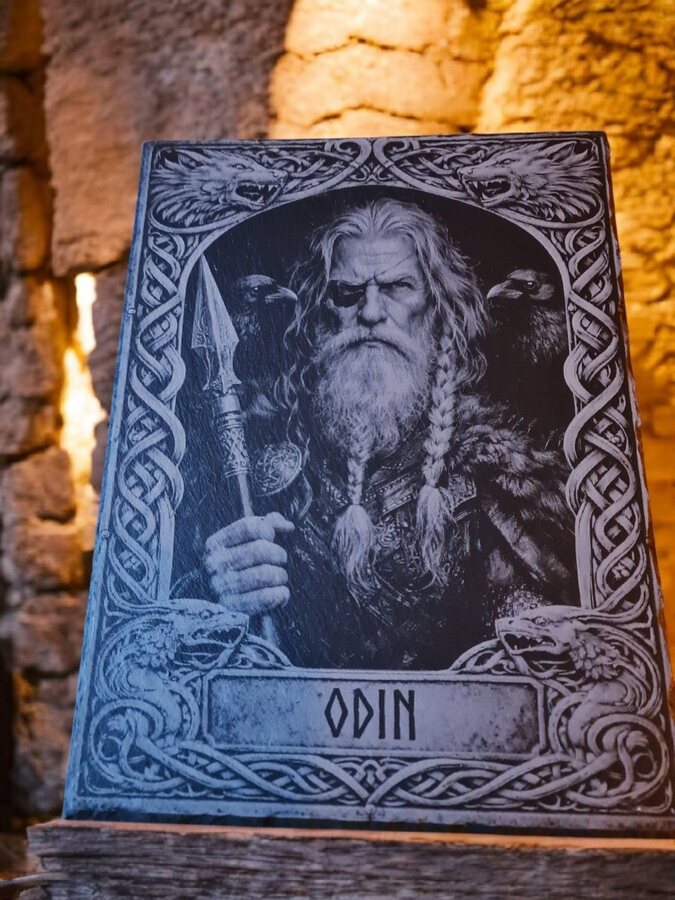
When we engrave a god onto slate in our workshop in Alsdorf, this is what we think about. Not far away, in Aachen, Jülich and along the Lower Rhine, altars to Mercury, Mars and the Matronae once stood. Whoever puts "Woden" or "Donar" on a stone today is continuing a very old tradition – just without the Roman detour. For an overview of the northern gods, take a look at our Norse pantheon.
What does interpretatio Romana mean in simple terms? It means Romans called foreign gods by the name of a similar Roman god. A Germanic god who seemed like Mercury to them was written down as Mercury.
Where does the term interpretatio Romana come from? From a single passage in ancient literature: Tacitus, Germania 43, on the divine brothers Alcis, whom the Romans "by Roman interpretation" called Castor and Pollux. Modern scholarship turned the phrase into a technical term.
Which Germanic gods are behind Mercury, Hercules and Mars? The standard reading is Woden, Donar (Thor) and Tiwaz (Tyr). The main support comes from weekday names and early medieval texts; Tacitus himself gives no Germanic names.
What is interpretatio Germanica? The reverse process: Germanic speakers equating Roman gods with their own. The best example is the weekdays, such as dies Mercurii becoming Woden's day, Wednesday.
Why is Thor sometimes Hercules and sometimes Jupiter? Because different translators stressed different traits. Romans saw a monster-fighting strongman and thought of Hercules; Germanic speakers saw the thunder god and chose Jupiter.
Did Julius Caesar describe the Germanic gods? Only briefly: in Gallic War 6.21 he claims the Germans worshipped only the sun, fire (Vulcan) and the moon. Most historians today see this as a politically coloured stereotype rather than careful observation.
For courage. For remembrance. For legends that live on.
The Matronae · Nerthus – the earth goddess · The grove of the Semnones · The Norse pantheon · The Germanic feasts.
All Gods & Goddesses articles →
Loki fits no box. Now he saves the gods with a trick, now he plunges them into ruin. It is exactly this doubleness that …
Read more →The strongest god has two sons: Magni („the mighty") and Modi („the brave / wrathful"). They are more than minor …
Read more →In the North, the moon is a man. Máni, brother of the sun, steers his heavenly body across the sky night after night …
Read more →Few figures in Norse myth are as puzzling and as important as Mimir. Sometimes he is a being at the well of wisdom …
Read more →