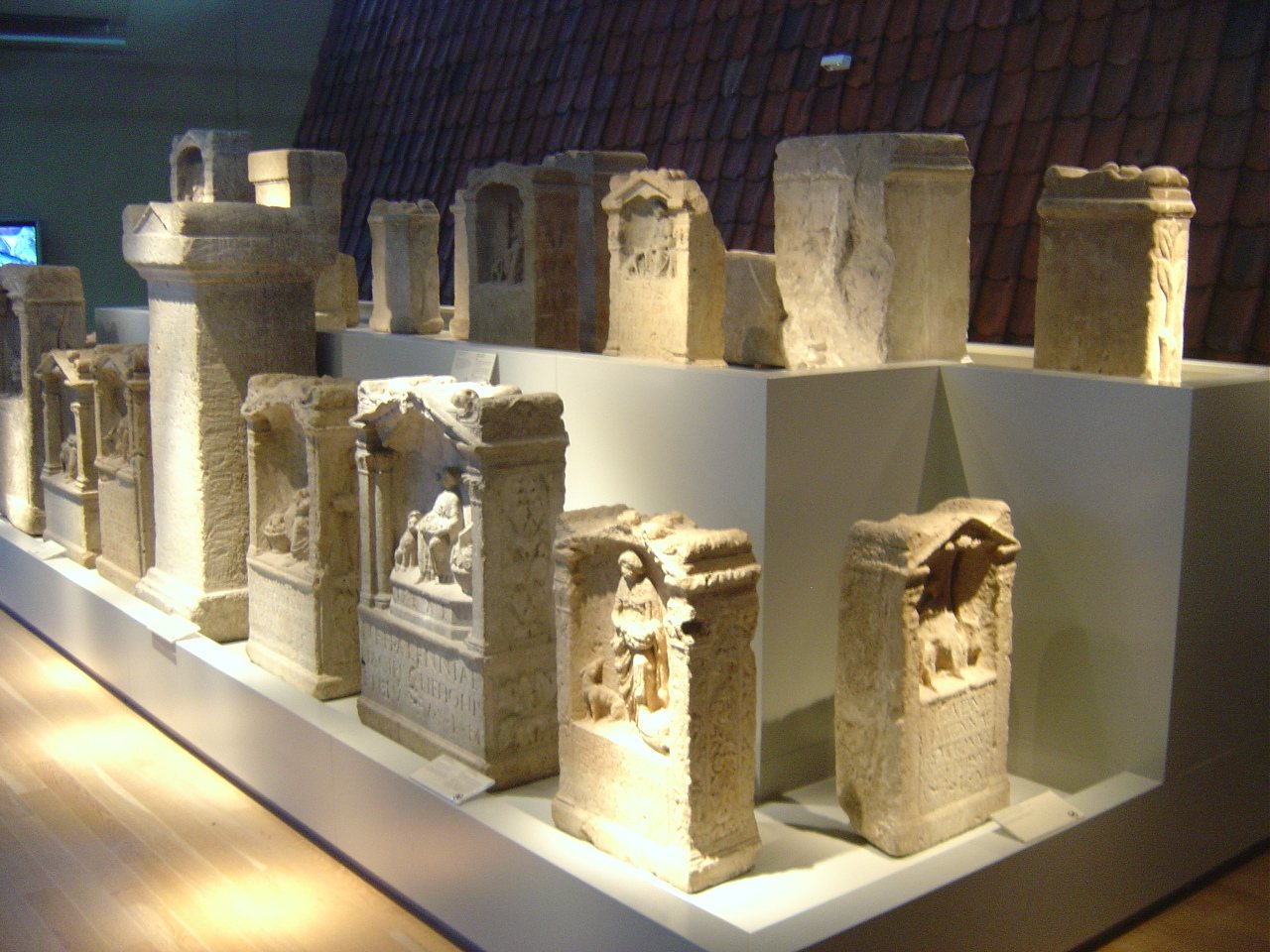
Nehalennia was a goddess of the Scheldt estuary in today's Zeeland, to whom Roman-era merchants vowed altars in return for a safe crossing to Britain and an undamaged cargo. We know her almost entirely from those stones: a temple find on the beach at Domburg in 1647, and hundreds of fragments that fishermen hauled out of the Eastern Scheldt near Colijnsplaat from 1970 onwards. Here is what the altars reveal, who paid for them, and why her name still divides scholars.
On 5 January 1647 a heavy storm battered the island of Walcheren. When it had passed, people from Domburg walked down to the beach. Where the surf had bitten into the dunes they found dressed stone, wall foundations and pieces of statues. Many of the blocks carried Latin inscriptions, and one name kept turning up that nobody recognised: Nehalennia.
That is how the rediscovery of a goddess began, a goddess no ancient author ever mentions. No saga tells her story, no poem, no Edda. Everything we know about Nehalennia is carved on altars set up by Roman merchants, skippers and a handful of soldiers at the mouth of the Scheldt in the second and early third centuries AD. That sounds thin, yet it is remarkably rich: hardly any regional deity of north-western Europe left behind so many inscribed votive stones.
The Zeeuws Museum in Middelburg speaks of "more than twenty" altar stones from the Domburg find, most of them dedicated to Nehalennia. Specialist literature counts around 40 stone monuments, about 30 of them inscribed, along with statue fragments and building material from a temple. The numbers vary because nobody catalogued carefully in the seventeenth century, and some pieces disappeared at once. Among the finds were statues of Victoria, goddess of victory, and of Neptune, god of the sea – an early hint that this place had everything to do with the water.
In the same year the Leiden professor Marcus Zuerius van Boxhorn published a treatise on the mysterious goddess, deriving her name from "Scythian" – a very seventeenth-century idea, when scholars liked to trace Dutch origins to distant steppe peoples. The etymology did not survive, but the puzzle did.
The Domburg stones were taken into the village's Reformed church. There they stood for two centuries, sketched, described and engraved in works such as the "Zelandia Illustrata". Then, in 1848, fire broke out in the church, and most of the votive stones were destroyed or badly damaged.
Only a few pieces came through more or less intact. One of them belongs to the collection of the Zeeuws Genootschap and is on view at the Zeeuws Museum in Middelburg: a limestone altar dedicated by a man called Ingenuinius Ianuarius and dated to roughly AD 150–250. Other survivors are in Brussels. That we still know what the lost stones looked like is thanks to the draughtsmen of the seventeenth and eighteenth centuries, whose sheets now serve archaeologists as a kind of substitute find.
One Domburg stone became famous because it names the trade with Britain outright. A certain Marcus Secundinius Silvanus thanks the goddess ob merces recte conservatas – roughly, "because the goods were kept safe". He calls himself a negotiator cretarius Britannicianus, a dealer in pottery on the British run. You cannot ask much more of an altar than that.
More than three centuries after Domburg, history repeated itself, this time at sea. On 14 April 1970 skipper K. J. Bout from Tholen, fishing in the Eastern Scheldt near Colijnsplaat on Noord-Beveland, pulled up four chunks of stone in his nets. He reported them. Nico Stuart, curator at the Rijksmuseum van Oudheden (National Museum of Antiquities) in Leiden, recognised them as pieces of two Roman altars, and on the inscribed fragments he could read the name Nehalennia.
What followed was one of the most unusual recoveries in Dutch archaeology. Using the fishing boat "Tholen 6 Johanna Cornelia", more than a hundred altars and fragments were brought up in under four weeks, together with roof tiles, tuff blocks and other building material. Further targeted searches followed in 1971 and 1974. In the end Leiden held the remains of far more altars than Domburg had ever produced.
How many exactly? It depends on how you count. The Leiden museum speaks of about 200 altars in total, roughly 80 of them (nearly) complete. The scholarly catalogue by P. Stuart and J. E. Bogaers (2001) lists 83 altars with a figure of the goddess and 111 without. Other overviews count every fragment separately and arrive at more than 300 monuments. They are simply counting different things.
The stones from the Eastern Scheldt owe their condition to the mud. Whatever was buried in the clay stayed crisp; whatever stuck out was worn by currents and gnawed by boring sea creatures. That is why some faces are blurred while inscriptions lower down remain razor-sharp.
A sanctuary needs a place. For Colijnsplaat the altars supply its name themselves. One altar without a figure names a dedicator called Gimio with the phrase Ganuentae consistens – "resident at Ganuenta". It is the only evidence for this place name. Since then Ganuenta has been regarded as the likely name of the settlement by the sanctuary, an identification championed by the Dutch archaeologist J. E. Bogaers. It is not certain, and other locations have been suggested.
The landscape looked nothing like today's. In Roman times the Scheldt reached the sea north of Colijnsplaat, and the sanctuary stood on its bank – at the point where ships left the river and set course for the Thames.
Whether Ganuenta lay in the territory of the Menapii or of the Frisiavones is still debated. What is clear is that merchants from Gaul and Germania met here on the edge of the empire, waited for a fair wind, transshipped cargo and prayed. For a sense of life on this coast, see our articles on the Menapii and the Cananefates.
Now it gets wonderfully concrete. Many Nehalennia altars give not just the dedicator's name but his trade and home town. For Colijnsplaat, the ancient historian Wolfgang Spickermann has counted the professions: three negotiatores allecarii, four negotiatores salarii, one negotiator cretarius, twelve merchants without further detail, plus three nautae (boatmen), one actor navis (a kind of ship's master or manager) and an assistant to a business agent. Soldiers appear on only three stones.
What were these men trading?
Two wine merchants are inferred only indirectly, from the carved decoration of the stones such as wine barrels on the side panels. That is interpretation, not inscription.
One name stands for this whole world: Marcus Exgingius Agricola. On his altar he describes himself as a citizen of Trier (cives Trever on the stone) and a salt merchant at Cologne (negotiator salarius C. C. A. A., short for Colonia Claudia Ara Agrippinensium). A man from Trier, trading salt in Cologne, thanking a coastal goddess at the mouth of the Scheldt: the Roman frontier province in miniature.
Agricola was no exception. Most dedicators came from Cologne; others came from Trier, Nijmegen and Dormagen, from the Rauraci around Augst near Basel, the Sequani around Besançon and the Veliocasses around Rouen. One of them, Quintus Phoebius Hilarius, was a town councillor (decurio) of the Municipium Batavorum, Roman Nijmegen – background in our article on the Batavians.
Notice who is missing. Women and families hardly appear among the dedicators at all. Nehalennia was evidently not a goddess of hearth and childbirth but a goddess for business travellers. Spickermann calls her, pointedly, a "functional goddess" of the Britain traders. Her sanctuaries were more like roadside stations at the edge of the sea than pilgrimage centres.
To understand the altars, you need to know how Roman piety worked. The key idea was the votum, the vow. Before the journey you promised the deity a gift if all went well. If you came home safely and the cargo had neither spoiled nor gone overboard, you paid up. The standard formula at the end of almost every inscription reads v(otum) s(olvit) l(ibens) m(erito): "fulfilled his vow willingly and deservedly".
The Nehalennia stones give two typical reasons. One gives thanks ob merces bene conservatas, for goods kept safe. The other asks pro mercibus bene conservandis, for goods to be kept safe – that is, before sailing. Some dedicators add that they acted at the goddess's command: ex imperio appears five times, ex iussu and ex praecepto once each. Whether a dream or an oracle lay behind it, the stones do not say.
A few altars carry consular dates and can therefore be fixed to the year: AD 188, 193, 223 and 227. Overall, the monuments date from about AD 150 to 250.
One more detail: many altars are so alike in style that scholars suspect a stonemason's workshop on site, supplying both Domburg and Colijnsplaat. Millstones from the find area also point to shared ritual meals. The sanctuary, in other words, was a busy trading post rather than a silent temple. Very similar vow altars are known from the Rhineland – more on that in our article on Germanic sacrifices and sanctuaries.
The imagery on the altars is strikingly consistent. Usually Nehalennia sits on a throne in a small niche between two columns, an aedicula (a little temple-like frame). She wears a long gown with a short shoulder cape over it, clearly visible on many stones.
Her companions and attributes:
The side panels add more figures: Neptune on eleven stones, Hercules on eight, as well as Jupiter, Oceanus and, once, a triad of Matronae.
What do these signs mean? Here interpretation begins. In Roman imagery a basket of fruit stands for fertility and plenty – easily translated, for a merchant, into profit and prosperity. The ship points to seafaring. The dog divides opinion. For some it is simply a guardian of house and goods. Others see a guide of souls and therefore a hint that Nehalennia was also linked with death and passage – hardly a far-fetched worry at sea. Neither reading can be proven.
A notable parallel appears in Tacitus. In his "Germania" (ch. 9, AD 98) he writes that part of the Suebi also sacrifice to Isis, whose cult image is shaped like a liburna, a light warship – proof, Tacitus himself concludes, that the cult came from abroad. This "Isis with the ship" has occasionally been linked with Nehalennia, but Tacitus is talking about the Suebi, not about the people of the Scheldt coast. How Roman writers gave foreign gods Roman names is the subject of our article on interpretatio Romana.
The stones spell her name several ways. Nehalennia is by far the commonest, alongside Nehalenia and Nehalaennia. One altar from Colijnsplaat reads Nechalenia, and on two others the H is carved as a special half-letter. The masons were evidently looking for a way to write a breathy guttural sound that Latin lacked.
What the name means has been argued over for almost four centuries. The main proposals:
Behind the word game lies a bigger question: whose goddess was she? In Roman times the Scheldt estuary was a borderland. To the south lived tribes usually counted as Celtic, to the north and east Germanic-speaking groups, and all had lived under Roman rule for generations. The honest answer is that Nehalennia was a native deity of this coastal zone, whose name is probably older than the altars and whose image was shaped in an entirely Roman style. For background, see our articles on Germanic religion and Celtic religion.
If you live in the Rhineland, as we do, the Nehalennia altars look instantly familiar. The aedicula shape with an enthroned goddess in a columned niche, the dedication formulas, the stepped inscription – all of that is known from the votive stones of the Matronae, found by the hundred between Cologne, Bonn and the Eifel. The earliest dated aedicula altar of this kind comes from Iversheim in the Eifel and belongs to the first half of the second century.
The family resemblance is no accident. Many dedicators at Colijnsplaat came from Cologne, where the Matronae cult flourished. According to Spickermann, Nehalennia is, after the Matronae, the most frequently depicted deity in the province of Lower Germany. And once the Matronae even appear directly on a Nehalennia stone, as a triad on a side panel.
Cologne itself has yielded two votive stones to Nehalennia, found in what is now the district of Deutz. The goddess had followers where her merchants lived. One difference remains: the Matronae always appear as a trio, usually wearing large bonnets, while Nehalennia stands alone with her maritime symbols. For the tribes along the Rhine, see our article on the Germanic peoples of the Rhineland.
After 227 there are no more dated Nehalennia altars. Almost nothing from late antiquity has been found around Colijnsplaat, which suggests the settlement and sanctuary were abandoned around the middle of the third century and later disappeared under the water.
For a long time this was blamed on a great marine flood, the so-called "Dunkirk II transgression". That theory has now been abandoned. More likely, people helped the sea along: on the coast they dug salty peat to extract salt, stripping away the very layer that protected the land. A bitter twist – the salt that made Nehalennia's merchants rich may in the end have sunk her temple. The crises of the third century did the rest.
Whether belief in the goddess died out entirely, we do not know. Some 450 years later, Alcuin's Life of the missionary Willibrord tells how the saint smashed an idol on Walcheren and was attacked with a sword by its guardian. Alcuin does not say whose idol it was. Some scholars think a late survival of the Nehalennia cult may be meant. It is an attractive guess, nothing more.
The coastal trade itself lived on. In the early Middle Ages Frisian merchants took over the routes between the Rhine and Britain, and trading places such as Dorestad flourished just a few days' sailing from the drowned altars. The merchants now prayed to a different god, but the water was the same. More on the coastal peoples of that age in our article on the Frisians.
If you want to meet the goddess in person, there are three good places to go.
Rijksmuseum van Oudheden, Leiden: most of the altars from the Eastern Scheldt are here. The museum counts one Nehalennia altar among its highlights – the stone of the boatman from Besançon, who thanked the goddess for a safe voyage. She rests her foot on the ship's prow, the fruit basket on her thigh, the dog at her side. Seen side by side in the galleries, the altars show how uniform and yet individual they are.
Zeeuws Museum, Middelburg: here you can see one of the few Domburg stones to survive the fire of 1848 – the altar of Ingenuinius Ianuarius from the collection of the Zeeuws Genootschap.
Nehalennia Temple, Colijnsplaat: in the marina at Colijnsplaat, about 500 metres from the original find site, a replica temple has stood since 2005. Its design draws on local finds and on studies of Gallo-Roman and Germanic sanctuaries, using traditional materials and techniques as far as possible. It is a memorial, not an exact reconstruction of the drowned sanctuary. It is looked after by the Stichting Nehalennia; visits are usually by appointment.
A tip from our workshop in Alsdorf, where we spend our days cutting into slate: look at the altars from the side. The narrow faces hide Neptune, Hercules, cornucopias and scrollwork – details that photos usually leave out. Anyone who works stone will come away with deep respect for the masons of Ganuenta.
What is not attested are myths, stories, family ties or festivals of the goddess. We do not know how the locals portrayed her before the Romans arrived, or who looked after the sanctuary. Her name's meaning and the language it belongs to remain open. Anything beyond "protector of merchants and seafarers" is interpretation drawn from images.
That is exactly what makes Nehalennia so honest. She is not a figure embroidered by later poets. She is a goddess as people actually experienced her: a power you trusted before a dangerous crossing, and thanked in stone afterwards, with salt on your boots and an undamaged cargo in the hold. A related figure from a very different source – Tacitus rather than altar stones – is Nerthus, Mother Earth.
Who was Nehalennia? Nehalennia was a regional goddess of the Scheldt estuary in today's Zeeland, the Netherlands. In Roman times merchants and boatmen asked her for a safe crossing to Britain and thanked her with votive altars.
Where were the Nehalennia altars found? First in 1647, after a storm, on the beach at Domburg on Walcheren, then from 1970 in the Eastern Scheldt near Colijnsplaat, where fishermen caught them in their nets. Two more stones come from Cologne-Deutz.
Where can I see the Nehalennia altars? Most are in the Rijksmuseum van Oudheden in Leiden. A Domburg altar is on display at the Zeeuws Museum in Middelburg, and since 2005 Colijnsplaat has had a replica temple.
What does Nehalennia's dog mean? No source tells us. It is usually read as a guardian and protector; some scholars also see it as a guide of souls.
Was Nehalennia Germanic or Celtic? That is disputed. Older theories looked for Germanic roots, while a more recent one reads the name as Celtic, "she who is at the sea". What is certain is that she was a native deity of the coastal region.
What was Ganuenta? Probably the name of the Roman-era settlement by the Colijnsplaat sanctuary. It survives on a single altar, and the site now lies beneath the Eastern Scheldt.
For courage. For remembrance. For legends that live on.
The Matronae · Germanic Religion · Celtic Religion · Interpretatio Romana · Nerthus – the earth goddess.
All Festivals & Belief articles →
Between the years lies a time that ticks differently: the Rauhnächte, the Twelve Nights around the winter solstice. The …
Read more →Emperor Barbarossa sits in the Kyffhäuser, his head propped on the table, his beard grown through the stone slab …
Read more →The summer solstice is the longest day of the year – and was one of the great feasts of pagan Europe. Germanic peoples …
Read more →The Vikings had no capitals, but they had places of power: sites where law was spoken, sacrifice made and the ancestors …
Read more →