"Germanic religion" is strictly speaking no uniform system, but a web of related ideas of many tribes over centuries. Because the Germanic peoples themselves barely wrote, we know it above all from foreign pens: from Caesar and especially from Tacitus' Germania, plus from votive inscriptions, place names, bog finds and – much later and Norse-coloured – from the Edda.
Germanic religion had no holy book, no dogma and no priestly caste like the Celts. It was a cult of the deed: bound to place, kin and the turning year. That makes it so hard to grasp – and so fascinating. Our knowledge rests on three pillars: the ancient authors (above all Tacitus's Germania), the archaeological finds (votive stones, bog offerings, amulets) and the much later Norse Edda, which may only be used cautiously in hindsight. Where these sources chime together, a picture emerges.
At the top stood the gods the Romans labelled with their own names (interpretatio Romana): Mercury = Wodan (god of ecstasy, poetry and the dead), Hercules = Donar (thunder god and protector), Mars = Ziu/Tiwaz (the old sky and law god). To these came mighty goddesses: the earth goddess Nerthus, Frija (namesake of Friday) and the Rhenish Matronae. It was no fixed "pantheon" as with Greeks and Romans, but a shifting world of regional gods and bynames.
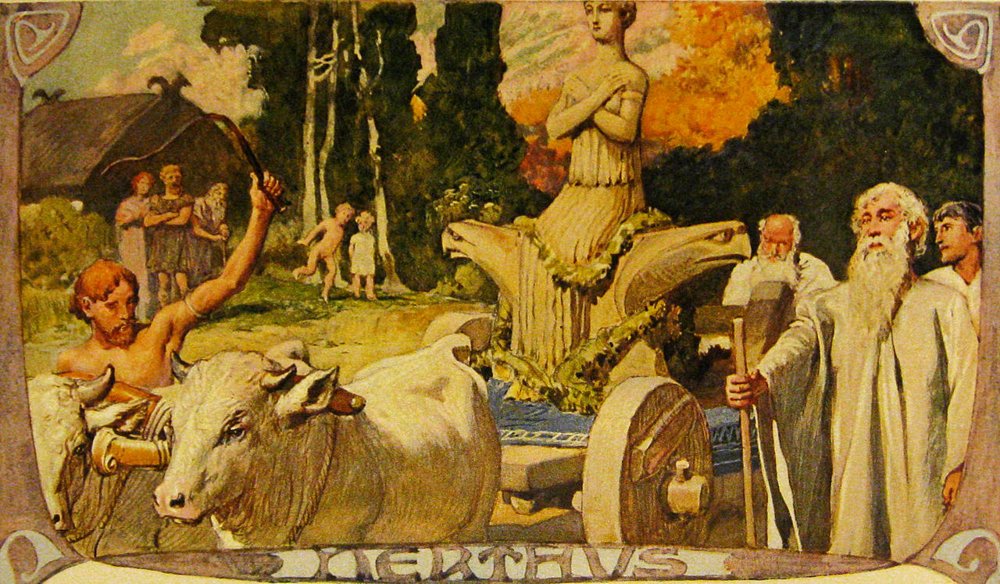
Tacitus hands down perhaps the most important sentence: the Germani thought it unworthy to confine their gods within walls – instead they consecrated woods and groves. The Semnonic grove was a supra-regional sanctuary one might enter only bound. Most striking is the report on the earth goddess Nerthus, whose veiled wagon travelled over the land; as long as she dwelt among people, weapons rested.
Unlike in the distant north, the continental faith is above all tangible. In the Rhineland hundreds of Roman-era votive stones honour Germanic gods under Roman names; Germanic soldiers set up altars to Mars Thingsus on Hadrian's Wall. In the bogs weapons and treasures were sunk (Nydam, Illerup, Ejsbøl); from the same milieu come simple wooden idols (Braak, Broddenbjerg). And in place names like Godesberg near Bonn the belief in the gods lives on to this day – a piece of homeland right on our doorstep.
Sacrifice was made for ár ok friðr – "good year and peace": animals, food, weapons, in exceptional cases probably humans too. The feast was called blót in the north, the year shaped by the cycle of festivals. The future was questioned through oracles – lot-twigs, sacred horses, bird flight – read by priests and seeresses such as the famous Veleda. And over all lay ancestor worship: the dead remained part of the kin.
With Christianisation the gods vanished from the cult – but not from the culture. They survived in the weekdays, in place names, in customs like the Yule nights and the Wild Hunt. The old faith is not dead; it has sunk beneath the surface of our everyday life.
"They consecrate woods and groves, and by the names of gods they call that mystery which they behold in awe alone."Tacitus, Germania 9, after a public-domain translation
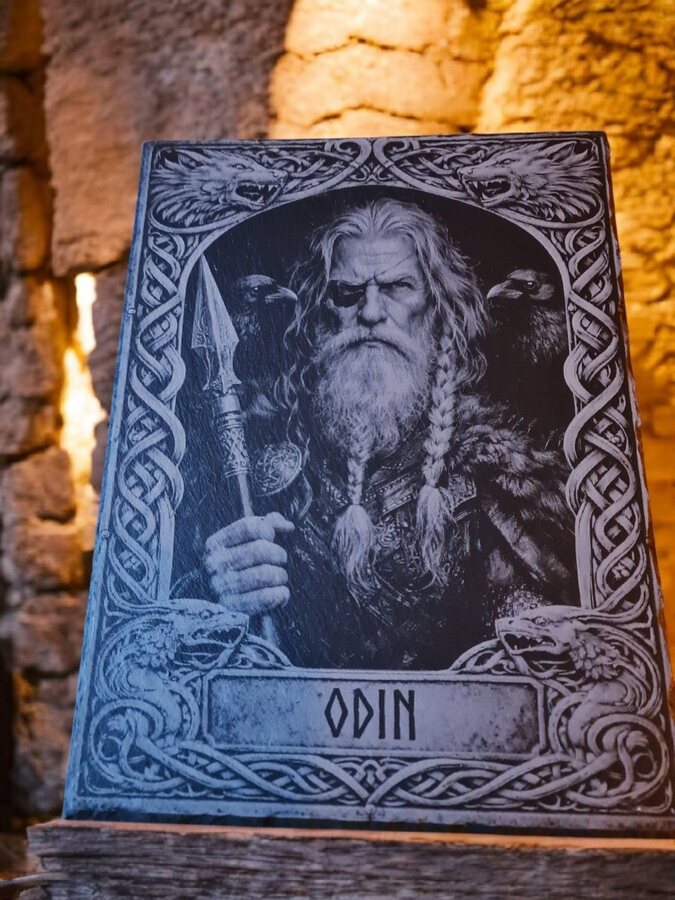
Tiwaz · Wodan, Donar & Ziu · Nerthus – the earth goddess · The grove of the Semnones · The Matronae.
All Festivals & Belief articles →
While elsewhere a round man with a reindeer sleigh rolls in, in Iceland thirteen troll boys come down from the …
Read more →A fire in the open, a drinking horn passed from hand to hand, a few words to gods and ancestors, and at the end a …
Read more →A life has its great thresholds: the arrival of a child, the coming-together of two people, the farewell to a loved …
Read more →