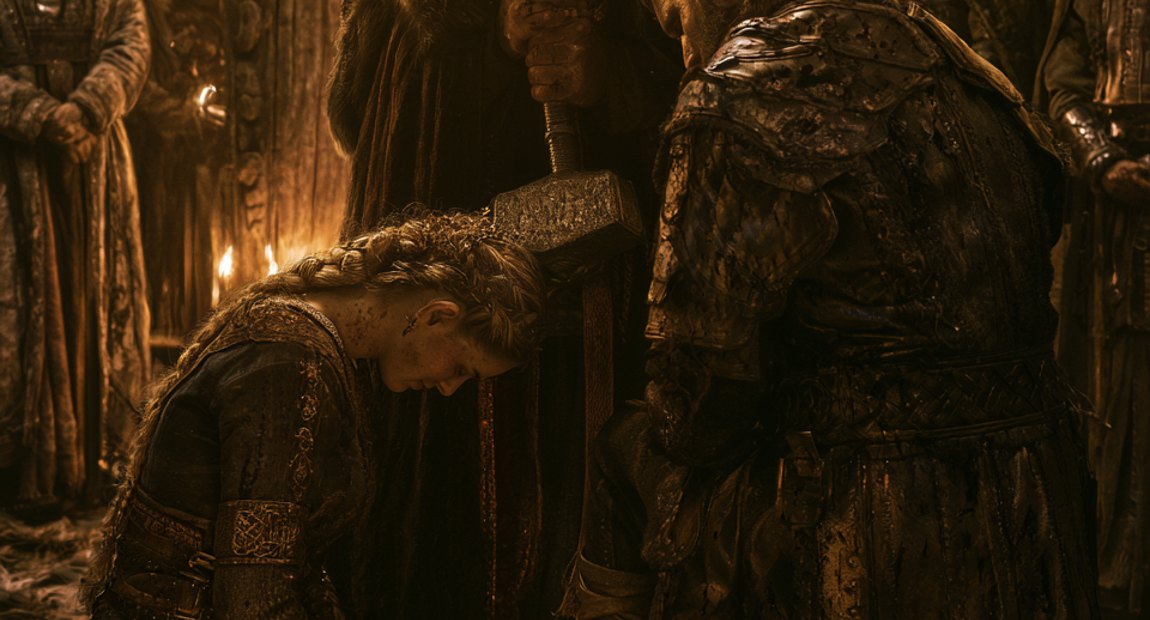
A life has its great thresholds: the arrival of a child, the coming-together of two people, the farewell to a loved one. Heathen thought has a feast for each of these thresholds – for a Blót always marks a passage, the end of one time and the beginning of another. A look at the life-feasts from the cradle to the grave-mound.
Not only the year's cycle has its turnings, but life itself. Heathen communities therefore still mark life's passages with a Blót: the naming of a newborn child, the wedding, the farewell to one who has died. The thought is always the same: one observes the threshold consciously, among those who bear one up, with a word that lasts.
“With weapons and garments friends should gladden each other … Giving and giving back keeps friendship longest.” Hávamál 41/42 (after Bellows 1923, public domain)
At the beginning stands the giving of the name. In the old tradition the child was sprinkled with water – ausa vatni – and received its name, often bound up with a naming-gift (nafnfestr). With the name the little person entered the community of the kindred and became a being of its own with its own path. The water-pouring is expressly attested already for pre-Christian times; the naming-gift made the day tangible – an object that recalls this first step for a whole life.
Marriage was a solemn bond, sealed with a handclasp (handsal) and often with a ring – the old symbol of binding and endlessness. One called on the powers that watched over love and oath; the goddess Vár counted as guardian of the vows between man and woman. A bond meant to hold wants to be named and witnessed – to this day one gives at a wedding a token that bears the names and the date.
And at the end stands the worthy farewell. The ancestors remain part of the community; one honours them, drinks to their memory and sets them a mark – as once the memorial stones by the road. Nearly everything is transient, yet what a person was remains in the memory of their own. Herein lies the meaning of every life-feast: to give the passage a lasting mark.
These three thresholds we accompany with our work. For the wedding an engraved token with names and date, for birth and naming a greeting of welcome, for the farewell a simple, lasting plaque. No loud selling, but what the life-feasts were always about: to give the moment a mark that outlasts it.
The sprinkling of the child with water (ausa vatni), together with naming and naming-gift (nafnfestr), is attested in the Old Norse tradition; the Hávamál alludes to it too. Marriage by handclasp (handsal) and the significance of the ring as a symbol of binding are attested; Vár appears in Snorri as goddess of the oaths between man and woman. That life's passages are marked with a Blót is the documented practice of present-day communities (Eldaring e.V.: naming, wedding, among others).
Today's heathen life-feasts are modern in their concrete form – rituals are worked out by the groups themselves, not read off a transmitted order of service. The water-pouring (ausa vatni), too, is attested, but its exact meaning (pre-Christian rite or Christian-influenced) is disputed. What is attested is the core: naming with a gift, marriage-bond with handclasp and ring, remembrance of the dead. Whoever celebrates so today ties honestly into the old and shapes it anew.
How do heathens celebrate today? · How the Germanic peoples honoured their dead · The old year's cycle up close · Norse wedding & christening gifts · Seiðr – the magic.
All Festivals & Belief articles →
There are cosier Christmas figures than a house-sized cat that prowls through the winter night to check who did not …
Read more →Before a Viking ship glided toward home, the crew took the carved dragon-heads down from the prow. Not out of modesty …
Read more →Between the years lies a time that ticks differently: the Rauhnächte, the Twelve Nights around the winter solstice. The …
Read more →Emperor Barbarossa sits in the Kyffhäuser, his head propped on the table, his beard grown through the stone slab …
Read more →