
Runes fascinate us – and few subjects are so heavily romanticised. Here you get the honest overview: runes were the script of the Germanic peoples, a real alphabet of signs that stood for sounds. Not a secret book of spells, not a hidden code for the initiated. We show you the three great rune rows, where our knowledge comes from, what rune stones actually say – and where modern esotericism starts to invent. This piece is our signpost: from here you can reach every row, the rune lexicon and our tools in detail.
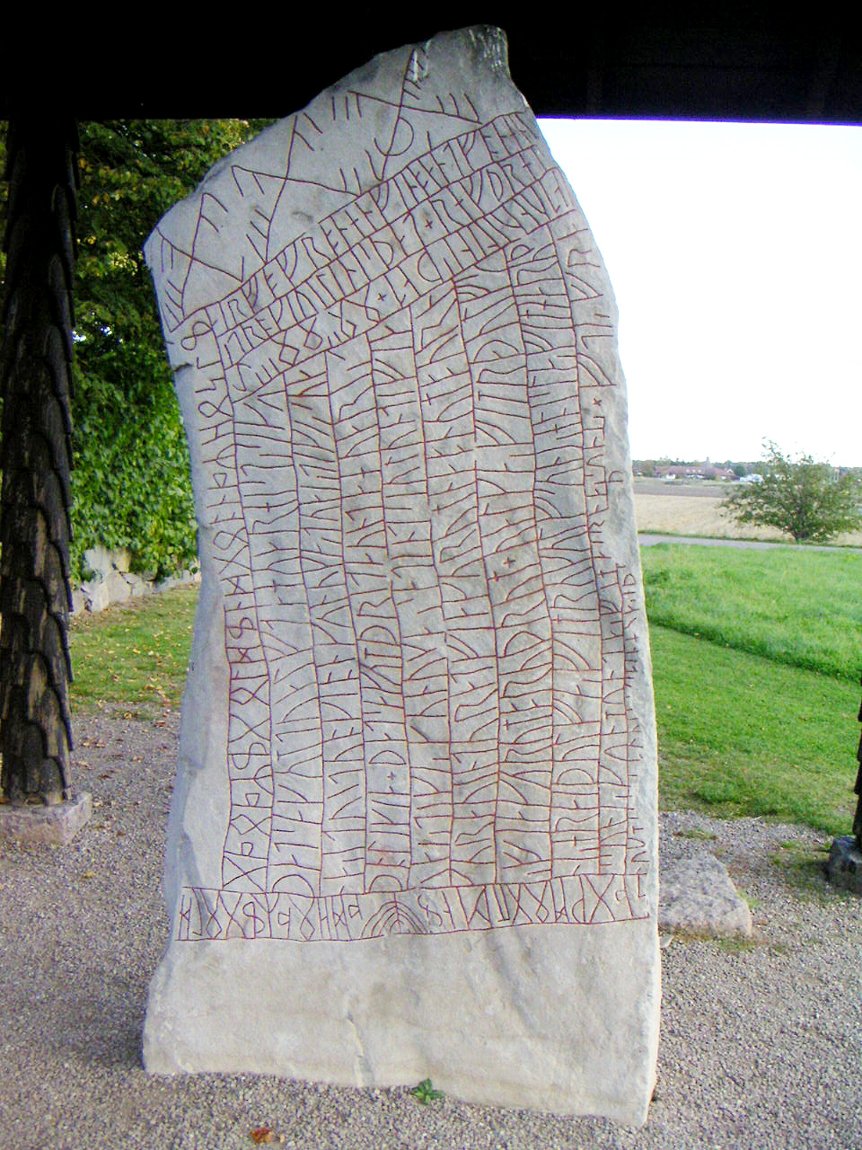
Runes are written characters. More precisely: the letters of the Germanic languages before the Latin alphabet took over. Each rune primarily stood for a sound – just like our "F", "U" or "S" today. Writing a name in runes therefore means transferring it sound by sound, not sign by "secret power". That is no insult, quite the opposite: it makes the runes one of the oldest attested writing traditions of northern Europe, with a history spanning more than a thousand years.
The name of the row already reveals the principle. The older alphabet is called the "Futhark" – after the sound values of its first six runes: f, u, þ, a, r, k. Just as we say "ABC", the northern peoples effectively said "Futhark". Runes were scratched, carved and cut: into wood, bone, metal and stone. Their angular form – almost only vertical and diagonal strokes, hardly any curves – is not mystical design but simply practical: a sign can be cut cleanly across the wood grain without the line splintering.
And yet runes were more than plain letters. Each rune also carried a name, and that name was a meaningful word: Fehu "cattle, wealth", Uruz "aurochs", Thurisaz "giant/thorn", Ansuz "god". These names are why runes feel so vivid – and why they lend themselves so well to engraving. If you want to go through the rows in detail, you will find everything in the rune lexicon.
"The runes" do not exist as a single fixed alphabet. Over the centuries several rows developed, differing in the number of signs, their form and their sound values. Three are the most important – and the decisive ones for engraving.
The Elder Futhark is the oldest row, with 24 runes. It was in use from roughly the 2nd to the 8th century and was the common script of the early Germanic peoples – from Scandinavia to the Rhine. When someone today says "the runes" and pictures the classic 24 signs, they usually mean this row.
The Younger Futhark is the row of the actual Viking Age (from about 800). Surprisingly it grew shorter rather than longer: only 16 runes remained. Several sounds now had to share one sign – a single rune could stand for both "k" and "g", or for "u", "o" and "y". So if you want an authentic Viking motif engraved, you reach for the Younger Futhark, not the Elder.
The Anglo-Saxon Futhorc went the opposite way: in England and Frisia the row grew to around 28 to 33 signs, to capture new sounds of the Old English language. The very name shows the sound shift – "Futhark" became "Futhorc". This alphabet lies behind famous objects such as the Franks Casket and the Ruthwell Cross.
How do we know what the runes were called and what their names meant? Largely from the so-called rune poems. These are short mnemonic verses in which each stanza begins with a rune and explains its name – a kind of rhymed teaching alphabet. An Anglo-Saxon, a Norwegian and an Icelandic rune poem survive.
The Anglo-Saxon version opens with the rune Feoh (Fehu), and the very first verse shows how soberly wise these texts often are:
Wealth is a comfort to all men; yet must every man bestow it freely, if he wish to gain honour in the sight of the Lord.Anglo-Saxon Rune Poem, Feoh stanza, translation after Bruce Dickins, Runic and Heroic Poems, 1915 (public domain)
Such verses are gold for rune lore: they give us the names of the runes and hint at their meaning. Yet the context matters – the rune poems were only written down in the Middle Ages, in some cases centuries after the heyday of the row in question. So they reflect the later tradition, not necessarily the view of the carver of the year 300. Incidentally, no separate rune poem exists for the Elder Futhark; its names are reconstructed by linguists.
The best proof that runes were a working script is the finds themselves. More than six thousand runic inscriptions are known, many on stone but just as many on combs, brooches, weapons, amulets and everyday objects. And their content is often surprisingly ordinary.
On the great rune stones of the Viking Age you rarely find a magic formula, but a memorial text: "X raised this stone in memory of Y, his father/brother/son." They are monuments to the dead, records of ownership, travel notes, statements of pride. The Bryggen finds from Bergen include trade notes, ownership tags, even love greetings and curses between neighbours – the perfectly normal written traffic of a literate society.
There is one recurring formula that is religious: "Þórr vígi" – "May Thor hallow (these runes/this monument)". It calls upon the god Thor for protection and shows that runes and belief did touch. But that is a blessing, not proof of a secret magic alphabet. How deep the religious dimension of the runes went is something we treat in detail in our piece on the rune consecration (Runenweihe).
Now to the trickiest subject. Yes, there are runic inscriptions that were meant to work magically. On amulets and bracteates we find formula words whose sense we no longer know for certain: "alu", "laukaʀ" (leek, a symbol of growth and protection), "laþu", "ehwaz". Some stones carry open curses against anyone who destroys the monument. Runes could indeed be carriers of blessing, protection and ban.
But – and this is the point – this is often turned into a "magic alphabet" that never existed in that form. The runologist R. I. Page repeatedly stressed that the overwhelming majority of inscriptions are profane: names, ownership, remembrance. The magical pieces are the exception, not the rule. And even there it is unclear whether the runes themselves worked the magic, or whether – as with prayers in any script – it was the words that were meant to act, the writing being merely the medium. If you want the documented state of research, you will find it in our scholarly essay on the runes.
Hardly any historical subject is so overgrown with modern invention. Three things everyone should know before engraving or gifting runes.
Why do we stress this so much? Because honest rune lore is the better story. You do not need invented magic – the real runes are fascinating enough: a script with which people 1800 years ago remembered their dead, carried on trade and cut their name into stone for eternity.
This is where rune lore becomes practical. For an engraving you transfer a modern word or name sound by sound into the chosen rune row. Important: you write by sound, not by letter. A "C" becomes k or s depending on pronunciation, and the result differs by row – the same word looks different in the Elder Futhark than in the Younger.
A special form is the bind rune: two or more runes are merged over a shared stave into a single sign. Historically this often saved space or served as an artful signature – a monogram made of runes. For jewellery and engravings bind runes are wonderful, because they condense two initials or a whole name into one elegant symbol.
So that you can try this out without transliterating yourself, we built two tools: the rune translator transfers any text into the three rune rows, and the rune name-giver renders your name cleanly in runes. Both are built honestly: they show you a correct transliteration by convention – and do not claim to grant you a magic word.
This overview is the starting page of your rune journey. From here you can go deeper: if you want to get to know a particular row sign by sign, follow the links to the Elder Futhark, the Younger Futhark or the Anglo-Saxon Futhorc. If you are looking for the meaning of a single rune, the rune lexicon explains every rune in detail.
If you prefer it academic, read the scholarly essay with datings, find contexts and the state of research. And if you want to know how runes and ritual truly related – beyond the kitsch – then the Runenweihe is the right piece.
Our promise always stays the same: we explain runes as they are attested – as a genuine script with a genuine history. What is certain we call certain. What is interpretation we call interpretation. And what is modern invention, we say so too. That way you can choose an engraving that not only looks beautiful, but carries a story that is true.
Runes: origin & history · Rune consecration · The Germanic Languages · Old Norse Terms.
All Runes & Writing articles →
What is a „rune consecration“ – and did it exist at all? This detailed treatise walks through every form: from the …
Read more →Some runic inscriptions form no smooth sentence, but only single, recurring words: alu, laukaʀ, laþu. They stand on …
Read more →Some runestones move us across a thousand years. The Skarpåker stone in Södermanland is one: a father casts his grief …
Read more →A Danish stone from the early 9th century carries two riddles at once: a symbol of three interlocking drinking-horns …
Read more →