
Rune magic is real history, just not the kind most people imagine: finds such as the Ribe skull, the Sigtuna amulet and a love charm from Bergen show that people carved runes to heal, protect and curse. The Edda and the sagas tell vivid stories of Odin's runes, victory runes and Egil's shattering poisoned horn, but they were written down in the thirteenth century. We separate poetry, finds and scholarly debate and show what can honestly be said about magical runes.
A guest at a Norwegian feast cuts his own palm, scratches a few signs into his drinking horn and smears them with blood. A moment later the horn bursts apart and the ale spills into the straw. It was poisoned. That is how Egil's Saga tells it, and that is roughly what most people picture when they hear the words "rune magic": signs that work.
The real picture is richer. Three very different kinds of source talk about magical runes. There are the poems of the Poetic Edda, written down in thirteenth-century Iceland. There are the Icelandic sagas, also high medieval. And there are the finds themselves: bone, copper, gold and wood that people really did carve with runes to heal, to protect or to curse. We will walk through all three layers and keep them apart. If you are looking for which runes are used as protective signs today, our article on runes for protection, strength and courage covers that. This one asks the question that comes first: what do the sources actually say about rune magic?
The most famous text on runes and magic sits in the Hávamál, the "Sayings of the High One". In stanzas 138 and 139 Odin speaks for himself: nine nights he hung on the windswept tree, wounded with a spear, given to himself, without bread or drink. Then he peered down, took up the runes, screaming he took them, and fell back. We tell that story in full in The Rúnatal – the magic songs of the Hávamál.
For rune magic, the stanzas that follow matter more. Hávamál 142 says, in paraphrase: you will find runes and meaningful staves, very great staves, very strong staves, which the mighty speaker coloured and the gods made. The Old Norse stafr, "stave", also means a written character. Stanza 143 shares the runes out among the worlds: Odin among the Æsir, Dáinn among the elves, Dvalinn among the dwarfs, Ásviðr among the giants.
Stanza 144 reads like an exam. Our own rendering: Do you know how to carve? How to read? How to stain? How to test? How to ask? How to offer? How to send? How to slaughter? The verbs are rísta, ráða, fá, freista, biðja, blóta, senda, sóa. Carving, reading and staining belong to writing; asking, offering and slaughtering belong to cult. Script and ritual share a single breath. Stanza 145 ends on a dry note: better unasked than over-sacrificed, for a gift always looks for a return.
From stanza 146 on, Odin lists eighteen ljóð, charms or spell-songs that he knows. Scholars call this section the Ljóðatal, the "list of charms"; it runs to stanza 163. The charms promise help in need, healing, blunted enemy blades, broken fetters, an arrow stopped in flight, a fire put out, a storm calmed, protection against witches riding the fences at night, and finally love charms and a secret Odin will tell no one.
Most of these charms are sung, not carved. The big exception is stanza 157, the twelfth charm. In our own paraphrase:
A twelfth I know: if I see up in a tree a hanged man swinging, I carve and colour in runes so that the man walks and talks with me.Hávamál 157, own rendering from the Old Norse
Here carving and staining runes is explicitly a way of making the dead speak, a mirror of Odin's own scene on the tree. One more stanza matters, even though the word "rune" is missing. In stanza 151 Odin says that if a man wounds him with the roots of a tree, the harm falls on the one who tried to curse him. A curse sent through a tree root? Keep that in mind; we will meet it again in Grettir's Saga.
A second Eddic poem goes further. In the Sigrdrífumál, the hero Sigurd wakes a sleeping valkyrie on a mountain. She calls herself Sigrdrífa; the Völsunga saga identifies her with Brynhild. She hands him a horn of mead and starts teaching. In stanzas 6 to 13 (numbering of the Neckel/Kuhn edition; Bellows numbers some stanzas differently because he inserts one from the Völsunga saga) she lists kinds of runes, each with a purpose and a place to carve them:
That reads like a rune magic handbook, and for a long time it was read as one. Look closer and you see how literary it is. Every kind opens with the same formula, the list is tidy, almost scholarly. Only one rune is named: Nauð, "need", on the fingernail. We are never told what exactly was carved. The Sigrdrífumál shows how the high Middle Ages imagined rune wisdom. It is not a Viking Age user's manual.
In poetry, runes could also hurt. In the Skírnismál, Skírnir woos the giant's daughter Gerðr on behalf of the god Freyr. She refuses. Gifts fail, threats with a sword fail. So he turns to a curse, and in stanza 36 it gets specific. Our paraphrase: a thurs I carve for you and three staves: lewdness and madness and restlessness. I will carve it off as I carved it on, if there is need.
Þurs means "giant" and is also the name of the rune ᚦ. Ergi is one of the harshest insults in Old Norse, implying unmanly or sexually shameful behaviour; æði is frenzy, óþoli unbearable unrest. The key lies in the last line: whoever carves can scrape it off again. The curse is leverage, and Gerðr gives in. The same logic, that runes are neutralised by scraping them away, turns up in Egil's Saga, and the formula itself resurfaces on a wooden stick from Bergen.
No saga hero is as closely tied to runes as Egill Skallagrímsson, the tenth-century Icelandic poet and warrior. His saga was written in the thirteenth century, possibly by Snorri Sturluson, though that is not certain.
In chapter 44 of the standard Icelandic edition, Egill is a guest at Atley in Norway, where the steward Bárðr is hosting King Eiríkr and Queen Gunnhildr. Bárðr and Gunnhildr poison his drink. Egill stabs his palm, carves runes into the horn and rubs his blood on them. His verse begins, roughly: we carve a rune on the horn, we redden the signs with blood. The horn shatters. The parallel with the ale runes of the Sigrdrífumál, carved on a horn against poison, is striking. As evidence for tenth-century practice the scene proves nothing; it shows what thirteenth-century Icelanders believed a great poet could do.
The second scene is in chapter 72 (chapter 76 in W. C. Green's 1893 translation). In Värmland, Egill stays with a farmer named Þorfinnr whose daughter Helga has been gravely ill for a long time. A local farmer's son had carved runes for her to win her love, and she has been worse ever since. Egill searches her bed and finds a piece of whalebone (tálkn, baleen) with runes on it. He scrapes them off into the fire, burns the bone, has the bedding aired, carves new runes and places them under her pillow. Helga wakes as if from sleep, weak but well.
Skalat maðr rúnar rísta, nema ráða vel kunni.Egil's Saga, ch. 72 – "No man should carve runes unless he knows well how to read them." (own translation)
In the same verse Egill says he saw ten secret staves, tíu launstafi, on the carved whalebone, which had brought the girl long torment. The love charm was not evil in itself, just badly made. Rune magic becomes almost a craft here, with bunglers and masters. As a family engraving workshop, we can't help smiling at that.
The darkest rune scene in saga literature belongs to Grettir's Saga. The outlaw Grettir spends his last years on Drangey, a sheer island in Skagafjörður that his enemies cannot storm. One of them, Þorbjörn öngull, turns to his old foster-mother Þuríðr, who is known for sorcery. In chapter 79 of the Icelandic edition (chapter 81 in Magnússon and Morris, 1869) she finds an uprooted tree on the shore, about as big as a man could carry on his shoulder. She has a small flat face cut into the root, carves runes on it, reddens them with her own blood and chants spells over it. Then she walks backwards and against the sun around the stump and has it pushed into the sea. It drifts to Drangey.
Grettir senses evil and has the wood thrown back twice. The third time, his servant hauls it up for firewood. Grettir's axe glances off it into his leg above the knee. The wound festers, he weakens, and his enemies can finally kill him.
Carving and blood as with Egill, walking against the sun as the classic gesture of harmful magic, a cursed root as in Hávamál 151: the scene bundles how people imagined malicious magic, not how it was done. It also shows how closely rune magic in the sagas is tied to the sorcery of old women and overlaps with seiðr. The sagas hardly draw a sharp line between sung charms, seiðr and carved runes.
Now to the objects, the real test. Already in the Elder Futhark of 24 signs (see our futhark comparison) short recurring words appear that form no sentence. Runologists call them formula words. The most common is alu. It appears on gold bracteates, round gold pendants of the Migration Period modelled on Roman imperial medallions, on arrow shafts from Nydam bog, on the Elgesem stone in Norway around AD 400 and on cremation urns from Spong Hill in England. After the eighth century it disappears.
Nobody knows for sure what alu means. "Ale" is the obvious guess and would fit ritual drinking, but many linguists find it phonologically awkward; other proposals connect it with "protection", "taboo" or ecstasy. What we do know is that the word likes objects worn on the body or placed in graves.
The same goes for laukaʀ, "leek". The Skrydstrup bracteate fragment reads laukaʀ alu side by side. Leek stood for growth and purity, and you will remember that the Sigrdrífumál tells you to throw it into the drink, some seven centuries later. The third formula word, laþu, is usually read as "invitation" or summons. How closely runes, divine names and gold go together on bracteates also shows in the Vindelev hoard.
A showpiece is the Lindholm amulet from Scania, a rib-shaped piece of bone found in 1840 during peat cutting and now in the Lund University Historical Museum. Line one reads ek erilaz sa wilagaz ha[i]teka, "I, the erilaz, am called the cunning one". Line two is rows of repeated runes, eight a, three z, then n and t, ending with alu. Whether the rows invoke gods or hide number symbolism has been debated for almost two centuries. An ordinary owner's mark looks different.
In 1973 archaeologists in Ribe, one of Scandinavia's oldest trading towns, found a piece of human skull roughly 6 by 8.5 centimetres, drilled with a hole and carved with runes. It dates to around 725. Scholars read the names Ulfr and Odin, a god often taken as "High-Týr", the word for help and a phrase against a dwarf; dwarfs could be bringers of disease. In 2021 Jonas Nordström re-examined the runes under a microscope and proposed a reading against a male and a female dwarf. Details are debated, but the piece is widely accepted as a healing or protective charm. Oddly, the hole shows little wear. Perhaps it was never worn.
From the eleventh century come several copper plates carved with runes and worn around the neck. Sigtuna amulet I, found in the Swedish royal town in 1931, addresses a disease spirit directly: a þurs of wound fever, a lord of giants. It must flee, for it has been found. The back threatens it with three torments and nine needs. The "nine needs" echo the Nauð rune of the Sigrdrífumál.
The Kvinneby amulet from Öland, a copper square about five centimetres across with an engraved fish, is dated around 1050–1130. On a common reading it begins "Here I carve protection for you, Bófi" and calls on Thor to guard the wearer with his hammer. Much of the text is uncertain, and readings range from a pagan prayer to the charm of a man who was already baptised. More on Thor as protector in our article on Thor's hammer.
A close relative is written not on metal but on parchment. The Canterbury charm was added in runes to the margin of an Anglo-Saxon manuscript in the late eleventh century (British Library, Cotton Caligula A.xv). It targets a festering wound, declares the disease demon found and calls: Thor hallow you. Its closeness to the Sigtuna amulet points to a shared formula tradition. The full story is in our article on the Canterbury charm.
After the great fire of 1955, archaeologists excavating the Bryggen harbour quarter of Bergen recovered some 670 runic inscriptions, mostly on wooden sticks from the twelfth to the fourteenth century. Most are wonderfully ordinary: owner's tags, business letters, Latin prayers, a line asking for a kiss. Runes here were an everyday script.
That makes N B257 stand out, a four-sided stick usually dated to the fourteenth century. In paraphrase: I carve healing runes, I carve protective runes, once against elves, twice against trolls, three times against giants. Then a woman is threatened with lust and unrest, and finally she is to love the carver as herself. John McKinnell, Rudolf Simek and Klaus Düwel suggest the whole stick may be one spell: a blessing if she returns his love, a curse if she does not. The echo of Skírnismál 36 is hard to miss.
Some three hundred years after Norway became Christian, someone in a Hanseatic port carved a love compulsion that sounds like an Eddic poem. Whether that reflects belief, literary learning or folk magic borrowing poetic images, we cannot say. What these sticks prove more clearly than any saga is that people did use runes for magic. More on such formulas in our article on Viking healing.
In the early twentieth century the "magical school" dominated. Scholars such as Magnus Olsen in Norway and Wolfgang Krause in Germany saw magic and number mysticism in many inscriptions, with the Edda and the sagas as an apparent key.
The counter-movement began with the Dane Anders Bæksted, whose 1952 book Målruner og troldruner ("language runes and magic runes") argued that many supposedly magical inscriptions were ordinary language, and that sagas were no handbook for earlier centuries. The British runologist Raymond I. Page became the leading voice of the sceptics. He warned again and again against calling every hard-to-read inscription magic just because we cannot understand it; most inscriptions, he stressed, are names, ownership marks, memorials and maker's signatures.
Klaus Düwel took a balanced line in his standard handbook Runenkunde: magic is not a built-in property of runes but one possible use, which must be argued case by case from the text, the object and the find context. Sigtuna, Canterbury and Bergen meet that test well; an ordinary memorial stone does not. More recently, Mindy MacLeod and Bernard Mees (Runic Amulets and Magic Objects, 2006) have again stressed how much magical language the inscriptions contain, though in their reading the power lies in the wording of the formulas rather than in single letters.
That is roughly today's broadest consensus. Runes were first and foremost a script. Like Latin letters on medieval amulets, they could carry blessing, healing and curse. What made them magical was usually the text, not the alphabet. For a wider introduction, see our honest introduction to the runes and our scholarly overview of runology.
Modern esoteric versions of rune magic, with rune oracles, planetary or chakra correspondences and fixed meaning lists, are not historical but inventions of the nineteenth and twentieth centuries. Enjoy them if you like, but call them what they are.
What remains is impressive enough. For more than a thousand years people carved runes into bone, gold, copper and wood to drive out fever, ward off trolls or force a woman's love. In our workshop in Alsdorf we often think of Egill's line: no one should carve runes who cannot read them well. That is why we engrave runes with a source and a meaning, not on a whim. Which signs work well for an engraving is the subject of which rune should I have engraved?
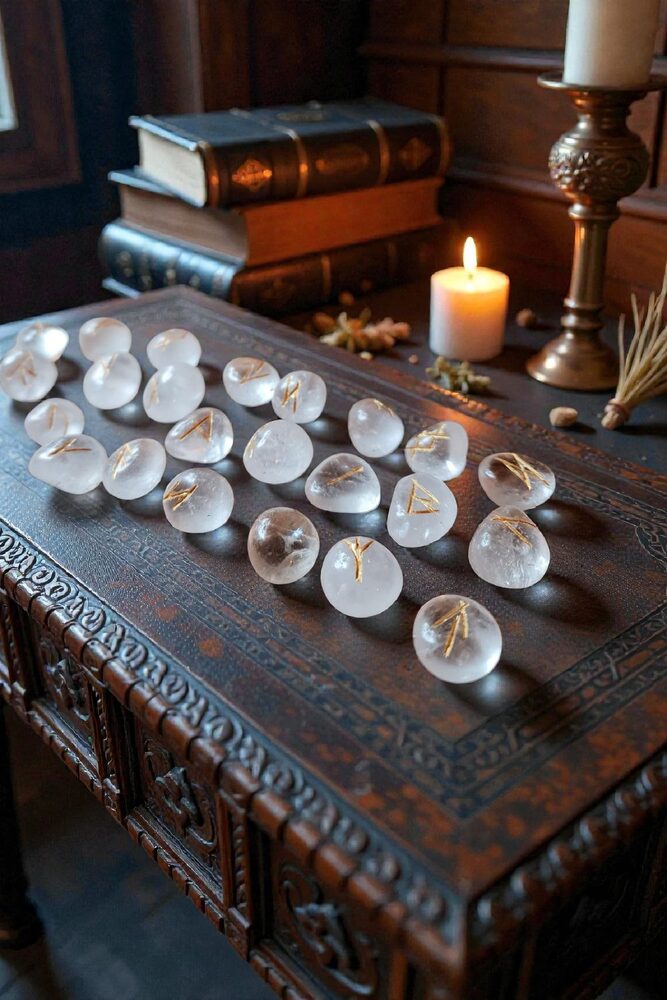
What is rune magic? Rune magic means using runes for protection, healing, love or cursing. It appears in medieval poetry (the Edda, the sagas) and on real finds such as the Sigtuna amulet, the Canterbury charm and rune sticks from Bergen.
Did the Vikings use runes for magic? Partly, yes. Eleventh-century copper amulets with formulas against wound fever show runes used for healing and protection. Most runic inscriptions, though, are plain: names, memorials and ownership marks.
What does alu mean in runic inscriptions? Alu is the most common formula word of the early runic period, especially on gold bracteates. Its meaning is unresolved; suggestions include "ale", "protection" or a word for ecstasy.
Where does the Edda talk about rune magic? Mainly in the Hávamál (stanzas 138–145 and the Ljóðatal, 146–163, especially stanza 157), in the Sigrdrífumál (stanzas 6–13) and in Skírnismál 36.
Is modern rune magic historical? No. Rune oracles and fixed magical meaning lists are modern esoteric readings that cannot be traced back to the medieval sources.
For courage. For remembrance. For legends that live on.
Runes & their meaning · The Vindelev gold hoard · The Golden Horns of Gallehus · Norse symbols: real or invented? · Which rune to engrave?.
All Runes & Writing articles →
Some runestones move us across a thousand years. The Skarpåker stone in Södermanland is one: a father casts his grief …
Read more →A Danish stone from the early 9th century carries two riddles at once: a symbol of three interlocking drinking-horns …
Read more →A runestone from Jutland reveals how closely the North was interwoven with the southern shore of the Baltic – through a …
Read more →The passage from the heathen to the Christian North did not happen overnight – and sometimes both worlds stand on one …
Read more →