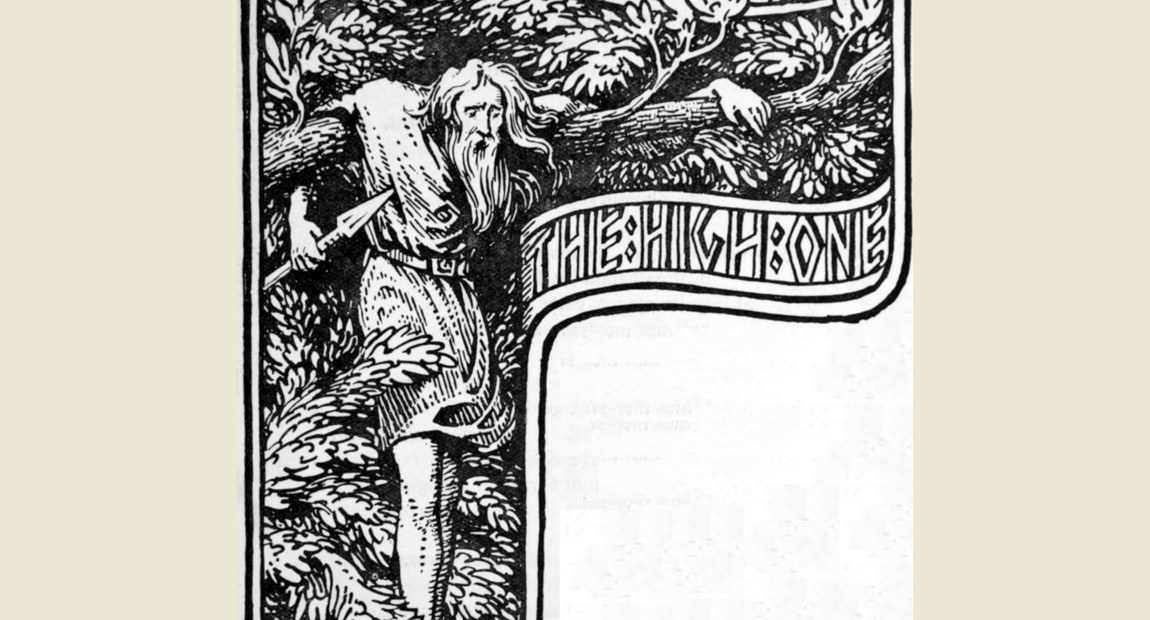
The Rúnatal is the passage of the Hávamál (stanzas 138–145) in which Odin tells, in his own voice, how he hung nine nights on a windy tree, wounded by a spear, "given to Odin, myself to myself", with no bread and no drink – and how he took up the runes, screaming. What follows is a set of mighty songs, a draught from Óðrerir, a lesson on carving and colouring runes and a catechism of sacrifice. We walk through the text stanza by stanza, show you what is solid, and where scholars have been arguing for more than a century.
A god hangs on a tree. A spear has wounded him, nobody hands him bread, nobody hands him a horn. For nine nights the wind tears at him. Then he leans down, grasps something, cries out – and falls. What he is holding are the runes.
These few lines are among the most haunting verses the North ever produced. Every generation of scholars has read something different in them: an initiation, a shamanic journey to the dead, an echo of the Crucifixion, a mirror of real human sacrifice. We engrave runes every day into slate, wood and glass. That is exactly why we want to know what the text that tells their mythical origin actually says.
The Hávamál, "Sayings of the High One", is a long poem of the Poetic Edda in which Odin speaks as "the High One". Most of it is practical wisdom on hospitality, friendship and reputation – see our article on the sayings of the Hávamál. Towards the end the adviser turns into a magician talking about himself.
The poem survives almost entirely in the Codex Regius (GKS 2365 4to), written in Iceland around 1270; its story is told in our article on the Edda. The Hávamál is usually seen as a compilation of several originally independent pieces whose age cannot be pinned down.
The name Rúnatal ("rune-tally", usually "rune song") is not in the manuscript. The heading Rúnatals þáttr Óðins comes from later paper copies. In the standard Neckel/Kuhn numbering, the Rúnatal covers stanzas 138–145 and the following Ljóðatal ("tally of songs") stanzas 146–163. Henry Adams Bellows moved one stanza in his 1923 English translation, so in his edition Odin's hanging begins at stanza 139. If English versions online seem off by one, that is why.
Read the full text in our bilingual Hávamál, or look up single stanzas with the Hávamál verse finder. The translations below are our own, kept as literal as possible.
Veit ek, at ek hekk vindga meiði á / nætr allar níu, / geiri undaðr ok gefinn Óðni, / sjálfr sjálfum mér, / á þeim meiði, er manngi veit, / hvers hann af rótum renn.Hávamál 138, Old Norse
I know that I hung on the windy tree / all of nine nights, / wounded with a spear and given to Odin, / myself to myself, / on that tree of which no one knows / from what roots it rises.Our own translation
"I know" – that is how seers and knowers speak in Eddic poetry. Odin is not narrating from outside; he is witnessing his own ordeal. The word for the tree is meiðr, a poetic word for tree or trunk. No name is given. Identifying it with Yggdrasil, the World Tree, is the usual reading – but it is a reading. One pointer is the last line: Fjǫlsvinnsmál says almost the same of the tree Mímameiðr, that nobody knows from what roots it grows.
Nine is never random in the North: nine worlds in the Völuspá, nine mighty songs two stanzas later, a great sacrifice every nine years at Uppsala. And they are nights, not days – Old Norse counted time in nights, as English still does in "fortnight".
Geiri undaðr, wounded by a spear. The spear is Odin's weapon above all; in Snorri's Edda it is called Gungnir. Whose spear struck here, the Hávamál does not say. Then the two half-lines on which everything turns: gefinn Óðni, sjálfr sjálfum mér – "given to Odin, myself to myself". Gefinn is the word for a sacrificial dedication. Odin is victim, priest and recipient in one.
Við hleifi mik sældu né við hornigi; / nýsta ek niðr, / nam ek upp rúnar, / æpandi nam, / fell ek aptr þaðan.Hávamál 139
They gave me no comfort with bread, nor with the horn; / I peered down, / I took up the runes, / screaming I took them, / I fell back from there.Our own translation
No loaf, no drinking horn – and the horn stands for every kind of hospitality. Anyone in a hall not offered the horn is shut out. Odin hangs beyond every human bond. The prose of Grímnismál offers a striking parallel: King Geirrǫðr has the disguised god sit between two fires for eight nights without food. Only when young Agnarr hands him a full horn does Odin begin to speak and reveal the order of the worlds. Deprivation at a threshold, then knowledge pours out – a related pattern.
Nýsta ek niðr – I peered down. Where to, the poem does not say. Some think of the depths below the tree, of roots, wells and the dead; John McKinnell, for one, has suggested that taking up the runes points to a journey into the realm of the dead. That is interpretation, not evidence. The verb nema means "to take" but also "to learn": Odin seizes the runes and learns them in the same motion, screaming – from pain, triumph or ecstasy, the poet leaves open.
The word rún originally meant "secret, whispered message", related to Gothic rūna and German raunen, "to murmur". Odin takes up hidden knowledge, not just letters. The script itself is far older than any version of the myth: the earliest runic inscriptions date to the 2nd century AD. For the real history, see our honest introduction to the runes.
Nine mighty songs I learned from the famous son / of Bǫlþorn, Bestla's father, / and I got a drink of the precious mead, / poured from Óðrerir.Hávamál 140, our own translation
Bǫlþorn – roughly "evil thorn" – is a giant; his daughter Bestla is, according to Snorri, Odin's mother. Her "famous" brother would be Odin's uncle. The poem does not name him; Mímir is often proposed, but that is an unproven guess. What stands out: Odin draws his knowledge from his mother's giant kin. The fimbulljóð, "mighty songs", are spell-chants (galdrar) whose power lies in their wording – compare the Merseburg Charms.
In Snorri's Skáldskaparmál, Óðrerir is one of three vessels in which the dwarves kept the mead brewed from wise Kvasir's blood; in Hávamál 107 the name seems rather to mean the mead itself. It is usually explained as "that which stirs the mind (óðr)". How Odin won the mead of poetry from the giantess Gunnlöd is told in our article on Kvasir. In the Rúnatal the draught answers the horn denied on the tree: first deprivation, then the most precious drink of all. Some editors, Bellows among them, regard the stanza as an interpolation.
Then I began to quicken and grow wise, / to grow and to thrive; / word sought me word from word, / deed sought me deed from deed.Hávamál 141, our own translation
Frævask belongs with frjó, seed: Odin germinates. After hanging and scream there is no flash of enlightenment but growth, like a plant – and the knowledge multiplies itself. Anyone who has learned a craft knows the feeling: a hard apprenticeship first, then one thing starts to fit into the next.
Runes you will find, and staves to be read, / very great staves, very strong staves, / which the mighty sage coloured and the great powers made / and the Hroptr of the gods carved.Hávamál 142, our own translation
Now Odin addresses a "you", probably his pupil Loddfáfnir. Three acts are named: a fimbulþulr, a "mighty reciter", coloured the runes; the ginnregin, the great powers, made them; and Hroptr rǫgna, a name of Odin, carved them.
The verb fá ("to colour, to paint") is a genuine technical term. Rune stones were painted, and traces of pigment survive on several. The verb even appears in inscriptions: the Noleby stone from Västergötland, now in the Swedish History Museum in Stockholm, opens with runo fahi raginakundo, "I paint (or: prepare) the rune descended from the gods". Its dating varies in the literature, but it is clearly older than the Viking Age.
That blood could serve as paint is told in Egil's Saga (ch. 44): Egill carves runes on a drinking horn, reddens them with his blood, and the horn holding poisoned ale bursts. A saga, not a workshop report – but it shows that carving and colouring were seen as one magical act.
Stanza 143 shares rune-lore among the worlds: Odin among the Æsir, Dáinn for the elves, Dvalinn for the dwarves, Ásviðr for the giants – "some I carved myself". Dáinn and Dvalinn are otherwise dwarf names and are also borne by two of the harts on Yggdrasil.
Veiztu, hvé rísta skal? Veiztu, hvé ráða skal? / Veiztu, hvé fá skal? Veiztu, hvé freista skal? / Veiztu, hvé biðja skal? Veiztu, hvé blóta skal? / Veiztu, hvé senda skal? Veiztu, hvé sóa skal?Hávamál 144
Eight questions in a different metre, like an exam formula. "Do you know how to carve?" – rísta (carve), ráða (interpret, read – related to English read and riddle), fá (colour), freista (test), biðja (ask, pray), blóta (sacrifice), senda (send, offer up), sóa (slaughter). The first four verbs belong to writing, the last four to cult. For the poet both were one sacred craft. What sacrifice actually looked like is gathered in our article on Germanic sacrifices and sanctuaries.
Better not asked than over-offered, / a gift always looks for a return; / better not sent than over-slaughtered. / So Þundr carved before the fate of peoples; / there he rose up when he came back.Hávamál 145, our own translation; the ending is uncertain
The first half is sober advice on offerings: a gift expects a gift in return – the same idea the Hávamál applies to presents between friends. Moderation applies to the gods too. The second half is dark. Þundr, "the roaring one", is a name of Odin; fyr þjóða rǫk can be read as "before the fate" or "before the origin of peoples". Whether "rising up" means the return from the tree, nobody knows. Anyone offering a confident translation is selling certainty the text does not contain.
From stanza 146 Odin lists eighteen spell-songs "that no king's wife knows, nor any son of man" – "a first I know", "a second", and so on to stanza 163. He never gives the words, only the effects: help against grief, blunted enemy blades, burst fetters, an arrow stopped in flight, a fire quenched, a calmed sea, friends brought home safe from battle, a woman's favour. The twelfth song (st. 157) leads back to the tree: if Odin sees a hanged man swinging, he carves and colours runes until the dead man climbs down and talks with him. So the Hávamál mention runes not only in the Rúnatal but here and in stanza 80 as well.
If the tree is the World Tree, one name suddenly speaks volumes. Yggdrasill is usually read as "Yggr's horse": Yggr, "the terrible one", is a name of Odin, and drasill a poetic word for horse. In skaldic verse the gallows can be called a "horse" that the hanged man "rides". Yggdrasil would then be Odin's gallows.
That is not undisputed. Ferdinand Detter linked yggr to "terror" ("tree of terror"), Franz Rolf Schröder proposed "yew pillar", and Anatoly Liberman argues the name first meant Odin's actual horse – which would be Sleipnir. John Lindow notes that scholars almost unanimously identify the Rúnatal tree with Yggdrasil, even though the Hávamál never names it.
Odin is strikingly bound up with hanging. Snorri lists Hangaguð, "god of the hanged", among his names; according to Ynglinga saga he sat beneath hanged men to learn from them, and before his death had himself marked with a spear point.
The closest parallel is in the late medieval Gautreks saga. King Víkarr is to be hanged in a mock sacrifice: Starkaðr puts a noose of calf's guts around his neck and touches him with a reed. But the reed becomes a spear, the guts a strong rope, and Starkaðr says: "Now I give you to Odin." Hanging, spear, "given to Odin" – all three elements of Hávamál 138. It does not prove real ritual practice, but it shows how an offering to Odin was imagined. More on the god in our main article Odin – wisdom at any price.
The key comparison comes from an opponent. Around 1075, Adam of Bremen described the temple at Uppsala in his History of the Archbishops of Hamburg (book IV) – from others' reports, not his own eyes. Every nine years, he writes, the Swedish provinces held a joint festival. Nine of every male creature were sacrificed and their bodies hung in the grove beside the temple, dogs and horses alongside men; every tree there was held divine because of the victims. Marginal notes add a huge evergreen tree by the temple and a spring into which a living person was plunged.
The nine, the hanging on trees, Odin as recipient: the closeness to the Rúnatal is obvious. Still, Adam was a churchman with an agenda reporting hearsay, and the Rúnatal is poetry, not a ritual protocol. You can lay the texts side by side, but not use one to prove the other. What excavation has found is in our article on Old Uppsala.
The most obvious reading is initiation: separation from the community, suffering at a threshold between sky and earth, symbolic death, return with new knowledge. Stanza 141 then reads like a description of a newborn. Historians of religion such as Jan de Vries asked whether real initiation rites lay behind it – plausible, but unproven.
In his book on shamanism (1951), Mircea Eliade compared Odin's hanging with Siberian shamans: the World Tree as axis, ecstasy, a journey to the dead, return with knowledge. Odin's ravens, his eight-legged horse, his shape-shifting in Ynglinga saga and seiðr seem to fit. Clive Tolley showed in 2009 how carefully this must be handled: Siberian accounts come from other times and cultures. "Odin was a shaman" is a comparative hypothesis, not a finding.
A god on a tree, pierced by a spear, denied drink, crying aloud, offered to the highest god: the likeness to the Crucifixion is obvious. The Norwegian philologist Sophus Bugge made it a thesis in his "Studier over de nordiske Gude- og Heltesagns Oprindelse" (1881–1889): the Rúnatal was shaped by the image of the crucified Christ, known to Norsemen through England and Ireland. He pointed to the lance of Longinus, the cry from the cross, and the medieval habit of calling the cross a "tree" – in the Old English "Dream of the Rood" it speaks as a tree.
The counter-arguments weigh heavily. Odin does not die for others and redeems no one; he sacrifices himself to win knowledge for himself. The hanging fits a series of distinctly Norse testimonies: the god of the hanged, the spear-marking, the trees of Uppsala, Víkarr. Today most scholars consider a pagan core likely, without ruling out Christian influence on how the scene was shaped – the poem lived for a long time in a society where both faiths coexisted. Kimberley Patton placed Odin's self-sacrifice in a comparative study of divine self-sacrifice in 2009. How closely Christian and older imagery interlocked in the North shows on carved stones such as the Gosforth Cross, where Ragnarök scenes stand beside the Crucifixion.
Set the theories aside and one hard statement remains: knowledge costs. The highest god is not handed the runes; he pays with hunger, pain and isolation – and only then does word grow from word. We think of that whenever someone asks us to engrave a rune. How runes were used in real formulas is the subject of Rune magic – alu, laukaz and the formula words.
What is the Rúnatal? The passage of the Hávamál (st. 138–145 in Neckel/Kuhn, 139–146 in Bellows) in which Odin tells how he hung nine nights on a tree and took up the runes. The title Rúnatals þáttr Óðins comes from later copies.
Why did Odin hang on the tree for nine nights? To win the runes and the hidden knowledge bound up with them. He offered himself "myself to myself" – victim and recipient in one.
Is the tree in Odin's rune song Yggdrasil? The poem names no tree, but scholars almost unanimously identify it with Yggdrasil, a name usually explained as "Odin's horse", i.e. the gallows.
Who is the son of Bölþorn? A brother of Odin's mother Bestla. He is not named; Mímir is often suggested, but that is conjecture.
Did Odin discover 18 runes? No. The eighteen of the Ljóðatal are spell-songs; there was never a historical row of 18 runes.
For courage. For remembrance. For legends that live on.
Runes & their meaning · Rune magic – alu, laukaʀ and the formula words · Vegvísir & Ægishjálmr · Which rune to engrave? · Norse symbols: real or invented?.
All Runes & Writing articles →
Before the runes became oracle stones in a pouch, they were simply the first alphabet of the North – for names, trade …
Read more →Some runic inscriptions form no smooth sentence, but only single, recurring words: alu, laukaʀ, laþu. They stand on …
Read more →Some runestones move us across a thousand years. The Skarpåker stone in Södermanland is one: a father casts his grief …
Read more →A Danish stone from the early 9th century carries two riddles at once: a symbol of three interlocking drinking-horns …
Read more →