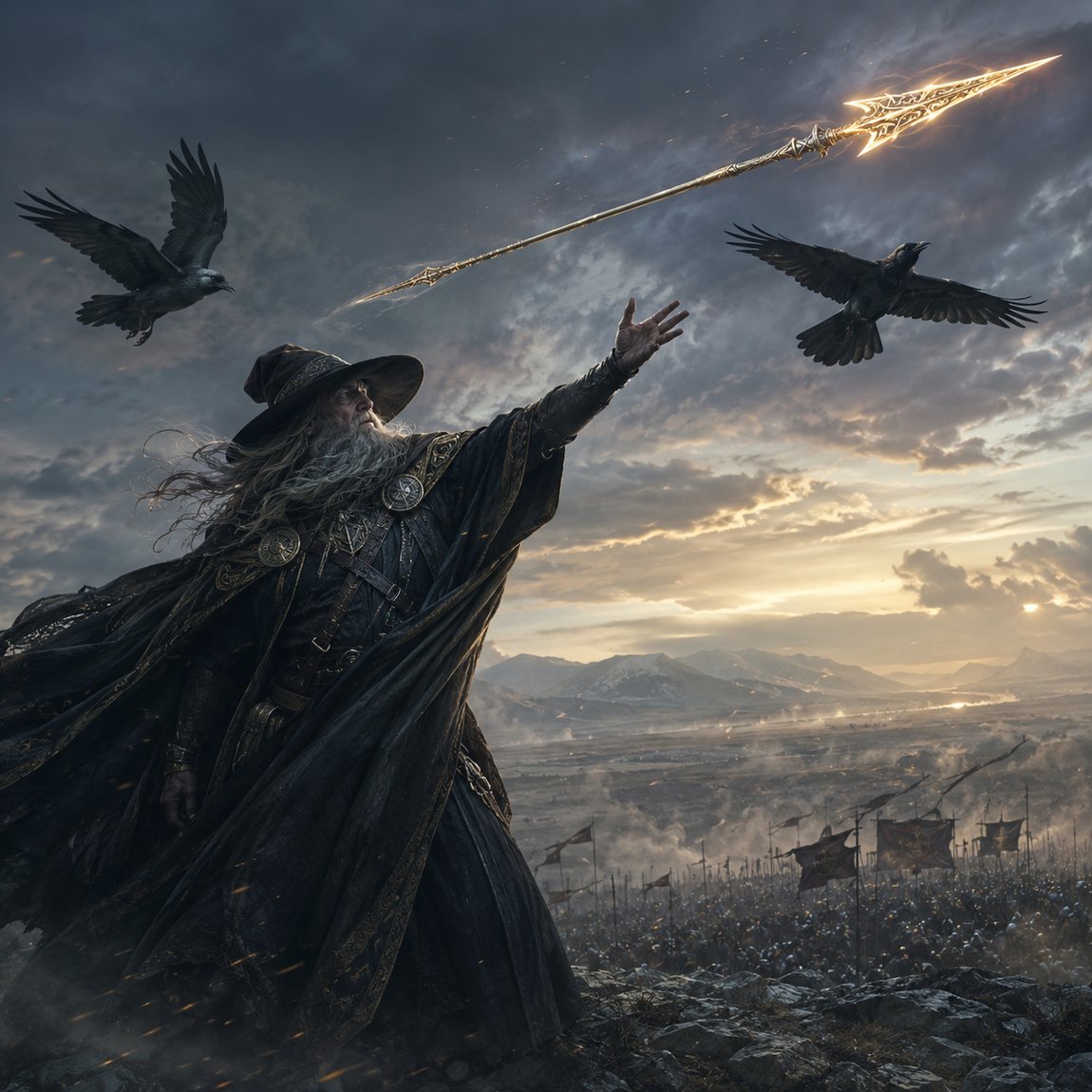
Gungnir is the spear of the god Odin: according to the Prose Edda it was forged by the dwarf sons of Ívaldi and handed to Odin by Loki as part of a settlement. The name most likely means "the swaying one". The Poetic Edda places runes on its point, Odin's spear-cast over a host opens the first war in the world, and at Ragnarök he carries it against the wolf Fenrir. Here is what the sources actually say, what the sagas describe as custom, what the ground has given up, and what was invented much later.
Picture a lake in eastern Jutland around AD 200. On the shore stand the men who have just won a battle. In front of them lies the gear of the defeated: swords, shields, belts, horse harness – and spears, hundreds of them. The victors snap the shafts, bend the heads and throw everything into the water. Nobody keeps a thing. What was promised to the gods belongs to the gods.
About a thousand years later an Icelander writes down that the highest of the gods owns a spear that never stops in its thrust. Between the lake at Illerup and a thirteenth-century parchment lie whole worlds, yet both belong to one story: the story of Gungnir, the spear of Odin.
Thor has his hammer, Freyr his ship. Odin – god of rule, war, poetry and the dead – does not carry a sword. He carries a spear. We will walk through the evidence step by step: Snorri, the Eddic poems, the sagas, the images, the finds – and the parts that the modern world, from Wagner to Hollywood, simply made up.
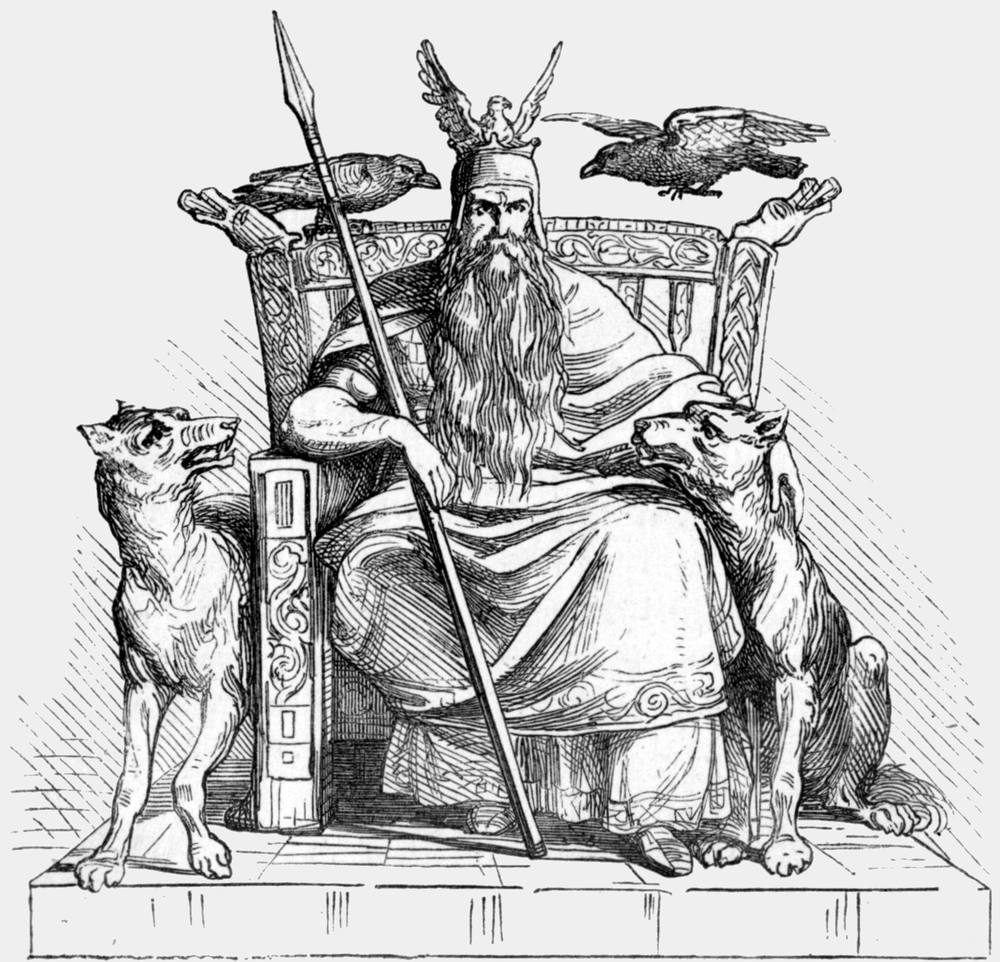
The only full origin story comes from the Prose Edda of the Icelander Snorri Sturluson, written around 1220, in the section called Skáldskaparmál ("The Language of Poetry"). Snorri tells it to explain why skalds call gold "Sif's hair".
Loki has cut off the hair of the goddess Sif. Thor threatens to break every bone in his body, so Loki swears to make amends and goes to the dwarfs known as the sons of Ívaldi. They forge three treasures for him: new hair of gold that will grow like real hair, the ship Skíðblaðnir, and the spear that became Odin's possession and was called Gungnir.
That could have been the end of it. Instead Loki bets his head with the dwarf Brokkr that Brokkr's brother cannot make three treasures as good. In most manuscripts and editions the brother is called Eitri; in part of the tradition, and in Arthur Brodeur's 1916 English translation, he is Sindri. Loki pesters the smiths in the shape of a fly, and during the third piece Brokkr lets go of the bellows for a moment. Out come a ring, a golden boar and the hammer Mjöllnir with its too-short handle. We tell the whole wager in our article on Sindri and Brokkr.
Odin, Thor and Freyr sit in judgement. Loki gives Odin the spear and declares that it will never stop in its thrust. Brokkr gives Odin the ring Draupnir. The verdict: the hammer is the best treasure, because it protects the gods against the giants. Loki saves his forfeited head only by arguing that the dwarf has no claim on his neck, so Brokkr sews his lips shut instead.
The punchline belongs to the hammer; the spear is one of six treasures of the gods born from a prank, a wager and an act of sabotage. And Snorri does not describe Gungnir at all – no material, no length, no ornament. Every picture of it you have seen is imagination.
Scholars usually explain Old Norse Gungnir as "the swaying one" or "the swinging one". The name is linked to a word family still alive in Scandinavia: Swedish gunga means "to rock" or "to swing". The image is probably the long shaft that flexes as it is thrown and quivers in flight.
The derivation is not watertight. "The swaying one" is the standard and defensible reading – nothing more, nothing less.
Gungnir carries runes on its point. That detail does not come from Snorri but from the Poetic Edda, in Sigrdrífumál. The valkyrie Sigrdrífa, woken by Sigurd from an enchanted sleep, teaches the hero rune-lore. In a long list she names the places where runes were carved: on the shield before the shining goddess, on Sleipnir's teeth, on Bragi's tongue, on glass and gold, in wine and beer – and, in stanza 17, á Gungnis oddi, "on Gungnir's point", right next to Grani's breast and the nails of the Norns.
On glass and on gold, | and on goodly charms, / In wine and in beer, | and on well-loved seats, / On Gungnir's point, | and on Grani's breast …Sigrdrífumál 17, tr. Henry Adams Bellows (1923)
The poem does not say what those runes do. It fits, though, that the spear of the god who won the runes himself should be inscribed with them. Bellows adds only a short note: Gungnir is Odin's spear, made by the dwarfs.
Inscribed spear- and lance-heads are among the oldest runic finds of all. A lance-head from Øvre Stabu in Norway, usually dated to the late second century, reads raunijaz, generally taken as "tester" or "prober". A head from Dahmsdorf in Brandenburg, Germany, reads ranja, understood as "the one who charges" or "attacker". At Illerup Ådal two lance-heads carry the same name, wagnijo.
None of them mentions Odin. But "runes on the spearhead" was real practice roughly a thousand years before Sigrdrífumál was written down – and spears could carry names, just like Gungnir. You will find more on these finds in our article on runes on weapons.
Even more striking is a find from the bog at Kragehul on southern Funen: a Migration Period lance shaft found in 1877 and now in the National Museum of Denmark. Its inscription (DR 196) opens roughly with "I, the erilaz of Āsugīsalaz, am called Muha" – an erilaz was probably a rune-master or some kind of official. Then comes the puzzling gagaga, read as a ritual cry, a battle shout or a dedication formula, and towards the end there seems to be talk of "hail" dedicated to the spear. Whether this is an offering to a god or a battle charm is disputed. What is certain is that the text goes well beyond a simple owner's mark.
Gungnir's most famous scene – even though the name never appears in it – is in the Völuspá, "The Seeress's Prophecy". The seeress remembers the first war in the world. It starts with the fate of the mysterious Gullveig, who is pierced with spears and burned three times, and three times comes back. Then the gods hold council: should the Æsir pay a penalty, or should all gods share in the offerings? And then:
Fleygði Óðinn ok í folk of skaut, / þat var enn folkvíg fyrst í heimi. – Odin hurled and shot into the host; that was the first war in the world.Völuspá 24 (23 in Bellows' numbering), our own translation
The war between Æsir and Vanir ends in stalemate: the wall of the Æsir's stronghold is broken and the Vanir trample the field. Later the two sides make peace and exchange hostages – we tell the full story in our article on the war of the Æsir and Vanir.
What matters here is what Odin does. He does not charge. He casts into the enemy host, and that cast is what starts the war. It is an opening, perhaps a dedication – and the sagas know exactly this act as a custom.
The most vivid spear dedication appears in Styrbjarnar þáttr Svíakappa, a short tale preserved in the great Icelandic compilation Flateyjarbók from the late fourteenth century.
It is set before the battle of Fýrisvellir near Uppsala, usually dated to around 985. King Eric of Sweden faces his nephew Styrbjörn, who is coming with Danish backing and Jomsvikings. Eric goes to Odin's sanctuary and pledges himself to the god: in ten years Odin shall have him. That night a tall man with a hat pulled low over his face appears and gives Eric a reed. He tells him to shoot it over Styrbjörn's army and say: Óðinn á yðr alla – "Odin has you all".
Eric does so. In flight, the tale says, the reed turns into a spear. Styrbjörn's men are struck blind, a landslide buries them, and Styrbjörn falls. Other accounts of the battle say nothing about Odin; the þáttr is a late story, not a war report. But its formula matches the Völuspá perfectly.
A scene in Gautreks saga works in much the same way. King Víkarr is to be sacrificed, supposedly only as a pretence. Starkaðr, foster-son of Odin in his disguise as "Hrosshársgrani", touches the king with a reed stalk and says: "Now I give you to Odin." The reed becomes a spear and runs the king through.
And then there is Eyrbyggja saga. In chapter 44, before a fight with Snorri goði, Steinþórr of Eyrr throws a spear over the heads of the opposing band – according to the old custom, as the saga puts it, and for his own good luck. That nuance matters: the saga says nothing about giving the enemy to Odin. It speaks of luck for the thrower. An earlier version of this article was inaccurate on this point.
The eeriest appearance of the spear is the one in which it turns against its own master. In the Hávamál, the wisdom poem of the Poetic Edda, Odin speaks in the first person:
I ween that I hung | on the windy tree, / Hung there for nights full nine; / With the spear I was wounded, | and offered I was / To Othin, myself to myself …Hávamál 138 (139 in Bellows), tr. Henry Adams Bellows (1923)
Nobody gives him bread or a drinking horn. He peers downward, takes up the runes with a scream and falls back. This passage, known as the Rúnatal, is one of the most enigmatic texts in the whole Edda. Whether sacrificial practice, initiation ritual or Christian imagery lies behind it has been debated since the nineteenth century.
Here the spear is not a fighting tool but an instrument of dedication. Odin does to himself what the sagas show being done to others – "given to Odin". In Ynglinga saga, the first part of Snorri's royal history Heimskringla, Snorri has Odin, imagined as a human king, "mark himself with a spear-point" as he dies and claim for himself all who fall by weapons (ch. 9, ch. 10 in some editions). The spear marks who belongs to Odin.
In Völsunga saga (thirteenth century), Sigmund, father of Sigurd, fights his last battle. A one-eyed man in a low-hanging hat steps up to him and holds out a spear. Sigmund's sword – the very sword Odin himself once thrust into the tree Barnstokkr – shatters against it. Sigmund falls.
Odin gives the sword, and Odin takes the victory away. The spear is the instrument of that decision. It does not kill by itself; it ends the luck of a hero whose time has run out. Richard Wagner would later take up exactly this scene.
The texts date from the thirteenth and fourteenth centuries; the images are far older. Does Odin's spear show up there too? Cautiously: probably yes.
The best-known candidates are the four bronze Torslunda dies, found on Öland in 1870 and now in the Swedish History Museum in Stockholm. In the Vendel Period (sixth to seventh centuries) they were used to press thin foil panels for parade helmets. One shows a dancing man holding spears, wearing a horned headdress that ends in bird heads, next to a warrior in a wolf skin. The dancer lacks one eye, apparently removed on purpose – many scholars see Odin in him. More in our article on the Torslunda plates.
In 2014 Neil Price and Paul Mortimer made a related observation on the Sutton Hoo helmet: behind the garnets of one eyebrow the gold foil backing is missing. In the firelight of a hall the helmet would have looked one-eyed. Their suggestion: wearers of such helmets staged themselves in Odin's role. A stimulating idea, but not a proven one.
Helmet panels from the boat graves at Vendel and Valsgärde in Uppland also show a rider with spear and shield, with two birds flying above him. The common reading, found for example in Rudolf Simek and John Lindow: Odin with his ravens Huginn and Muninn. Again, no label says who is meant.
The gold bracteates of the Migration Period (fifth to sixth centuries) often show a head above a horse, frequently with birds. Many scholars read the figure as Odin, though the spear plays no prominent role there. Much later, in the eleventh century, the Böksta runestone in Uppland shows a rider with a spear hunting an elk, whom some interpret as Odin – again, a possibility.
Denmark and northern Germany hold the great war-booty sacrifices of the Roman Iron Age and Migration Period: Illerup Ådal, Nydam, Vimose, Thorsberg, Ejsbøl, Kragehul. These are not battlefields but places of offering in what were then lakes.
At Illerup Ådal near Skanderborg, excavations between 1950 and 1985 recovered more than 15,000 objects from several deposits dating between roughly AD 200 and 500. The oldest and largest deposit alone contains around 12,000 objects, among them close to 200 swords and hundreds of lance- and spearheads. According to current interpretation it belonged to an army from the Scandinavian Peninsula that the locals defeated.
This is the strongest archaeological parallel to Odin's spear-cast: an entire army and its weapons "given away" after victory, completely and irrevocably. No find tells us who received these offerings, though. A link to Odin is a reasonable assumption, not an established fact.
Why a spear of all things? Because it was the weapon. In Viking Age graves the spear is, alongside the axe and shield, the most common weapon; swords were expensive and much rarer. A spear needs little iron and a shaft, usually of ash; it gives reach and can be thrown. Everything about head types, sockets and inlay is in our article on the Viking spear.
The sword is the weapon of the individual hero; the spear is the weapon of the war-band. If you want to dedicate a whole army, you throw what a whole army carries.
The spear was also a legal symbol. In Lombard law, the Edict of King Rothari of 643, a formal legal act for transferring property is called gairethinx, usually interpreted as "spear-thing". And Old Norse vápnatak, the taking up of weapons with which an assembly signalled consent, became wapentake in the English Danelaw – the name of an administrative district. At the thing, weapons were not only there for fighting.
In the end, even a spear that never stops in its thrust is of no help. The Völuspá says briefly that Odin goes to fight the wolf and that a second grief comes to Frigg. Vafþrúðnismál adds that the wolf will swallow the Father of Ages and that Víðarr will avenge him.
Neither poem mentions Gungnir. It is Snorri who paints the picture: in Gylfaginning, Odin rides at the head of the einherjar at Ragnarök, with a golden helmet, a fair mail-coat and his spear called Gungnir. He goes against Fenrir – and the wolf swallows him.
The mightiest weapon of the highest god does not save its bearer. This is not a world where the good side wins. It is a world where they show up anyway, knowing how it ends.
Many people know Odin's spear from Richard Wagner's Ring of the Nibelung (first staged as a full cycle in 1876) rather than from the Edda. There it is the centre of Wotan's power – with properties no Old Norse source knows.
In Wagner, Wotan broke a branch from the World Ash and cut the shaft from it; the tree then slowly withered. Carved into the shaft are the runes of the treaties on which Wotan's rule rests. The spear is legal instrument and shackle at once. In Die Walküre, Siegmund's sword breaks on Wotan's spear, just as in Völsunga saga. In Siegfried, Siegfried shatters the spear with the reforged sword, and Wotan's time is over.
It is a clever condensation: runes from Sigrdrífumál, the breaking sword from Völsunga saga, the spear as a sign of law. But a shaft cut from the World Ash and treaties carved into it are Wagner's inventions. In comics, films and games Gungnir has since become a sceptre, an energy weapon or a boomerang – which also has little to do with the sources.
Named in the sources: made by the sons of Ívaldi and handed over by Loki (Snorri, Skáldskaparmál); never stops in its thrust (ibid.); runes on Gungnir's point (Sigrdrífumál 17); Odin with Gungnir against Fenrir at Ragnarök (Snorri, Gylfaginning).
Odin's spear, but unnamed: the cast that opens the first war (Völuspá), the self-sacrifice on the tree (Hávamál), the spear that breaks Sigmund's sword (Völsunga saga), the marking with a spear-point (Ynglinga saga).
Described as custom, in late texts: the spear-cast over the enemy (Eyrbyggja saga, Styrbjarnar þáttr) and the formula "Odin has you all".
Archaeologically tangible, but without any god's name: runes on spear- and lance-heads and on the Kragehul shaft, sacrificed weapons at Illerup Ådal and other bogs, spear-bearers on helmet plates.
Not attested: that Gungnir returns to the hand; that it always hits; any detail of material, length or appearance; the World Ash shaft and the treaties (Wagner).
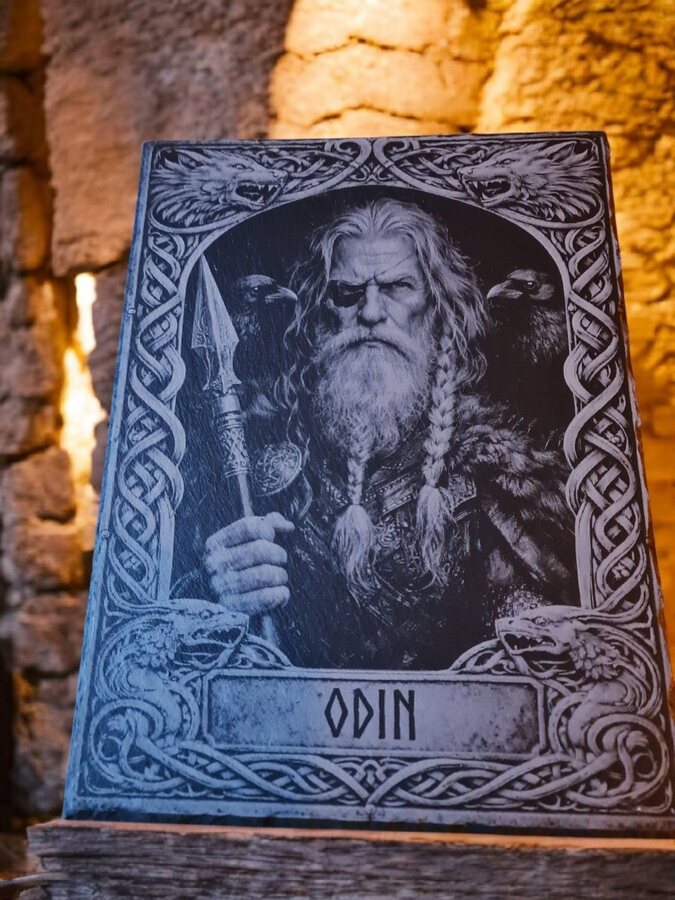
What is Gungnir? Gungnir is the spear of the god Odin in Norse mythology. According to Snorri's Prose Edda it was forged by the sons of the dwarf Ívaldi and given to Odin by Loki.
What does the name Gungnir mean? It is usually interpreted as "the swaying one" or "the swinging one", related to words for rocking and swaying. The derivation is likely but not certain.
Does Gungnir never miss its target? Not according to the sources. Snorri says the spear never stops in its thrust; "never misses" and "returns to his hand" are modern embellishments.
Where is Gungnir mentioned in the Edda? By name in Sigrdrífumál (runes on its point) and in Snorri's Skáldskaparmál and Gylfaginning. Völuspá and Hávamál speak of Odin's spear without naming it.
Why does Odin throw a spear over the enemy army? In the Völuspá the cast opens the first war in the world. Later sagas describe a similar throw as an old custom, in Styrbjarnar þáttr with the words "Odin has you all".
What happens to Gungnir at Ragnarök? According to Snorri, Odin rides with Gungnir against the wolf Fenrir and is swallowed. No source tells us what becomes of the spear.
For courage. For remembrance. For legends that live on.
All the treasures of the Edda at a glance · Mjöllnir – Thor’s hammer · Odin (Wotan) · Æsir & Vanir · Yggdrasil.
The mead of poetry turns anyone who drinks it into a poet or sage. It lies deep in the mountain, guarded by the giant's …
Read more →The valkyries are seen as cold directors of battle. The story of Helgi and Sigrún shows the other side: love, loyalty …
Read more →When Baldr is dead, one dares the most perilous ride of all the myths: Hermod, a son of Odin, rides into the underworld …
Read more →There are scenes in Norse poetry that take your breath away. Hervör’s night walk to the grave-mound of her dead father …
Read more →