The valkyries are seen as cold directors of battle. The story of Helgi and Sigrún shows the other side: love, loyalty and a grief that reaches beyond death.
We like to imagine valkyries as cold tools of Odin – directors of battle who only carry out what the all-father decrees. The story of Helgi and Sigrún shows the other side: a valkyrie who loves, chooses and follows her own heart, even against the will of men and against what fate has laid out for her. Therein lies the warmth and the tragedy of these lays.
Sigrún, daughter of King Högni, rides with a band of nine riders through storm and over the waves. She is promised to another, the unloved Höðbroddr. But when she meets the young hero Helgi Hundingsbani, she chooses him herself as her beloved and asks him to save her from the unwanted marriage. Helgi takes up the challenge – and so begins a chain of battle, victory and loss.
To win Sigrún, Helgi must fight her kin and her suitors. In a great battle Höðbroddr falls, and with him much of Sigrún’s family, including her father. Sigrún now stands between grief for her own kin and love for the man who slew them – a division Norse poetry paints again and again with relentless honesty. She chooses Helgi.
But fate exacts its price. Sigrún’s brother Dagr, who had sworn Helgi peace, sacrifices to Odin and receives his spear. With it he stabs Helgi from behind in a grove – revenge for the slain father. When Dagr confesses the deed, Sigrún speaks one of the most terrible curses in the Edda over her own brother: may no ship carry him, no horse save him, no sword serve him unless it strikes himself.
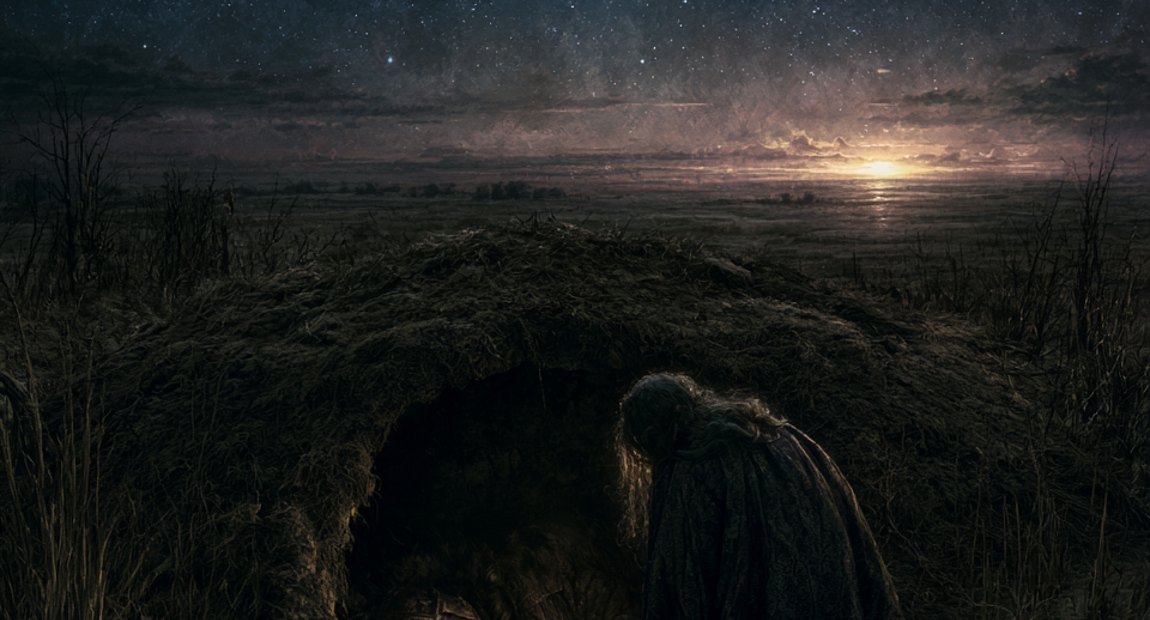
Then follows one of the most moving scenes in all the Poetic Edda. In the evening a maidservant sees Helgi ride with many men to his grave-mound – the dead hero has returned from Valhalla. Sigrún hears of it and goes without fear into the mound. There, between the worlds, she holds her beloved in her arms once more. She makes him a bed in the grave and would stay with him, though his hair is covered with rime and his body death-cold.
„Now am I as glad of our meeting as Odin’s greedy ravens when they scent the slain." — Helgakviða Hundingsbana II, after Bellows
Before daybreak Helgi must ride back to Valhalla – he cannot stay, for his time among the dead has come. Sigrún does not long survive that night: soon after she dies of grief and longing. Rarely has any poetry crossed the border between life and death as tenderly and as painfully as in this one night in the mound.
A brief prose epilogue in the manuscript adds that Helgi and Sigrún were reborn – he as a later Helgi, she as the valkyrie Kára. This note is one of the few witnesses hinting at a Norse belief in rebirth. Whether genuine folk belief lies behind it or a learned explanation by the medieval compilers is disputed to this day. What is certain is only that the idea consoles: the love that death parted finds its way back together in a new life.
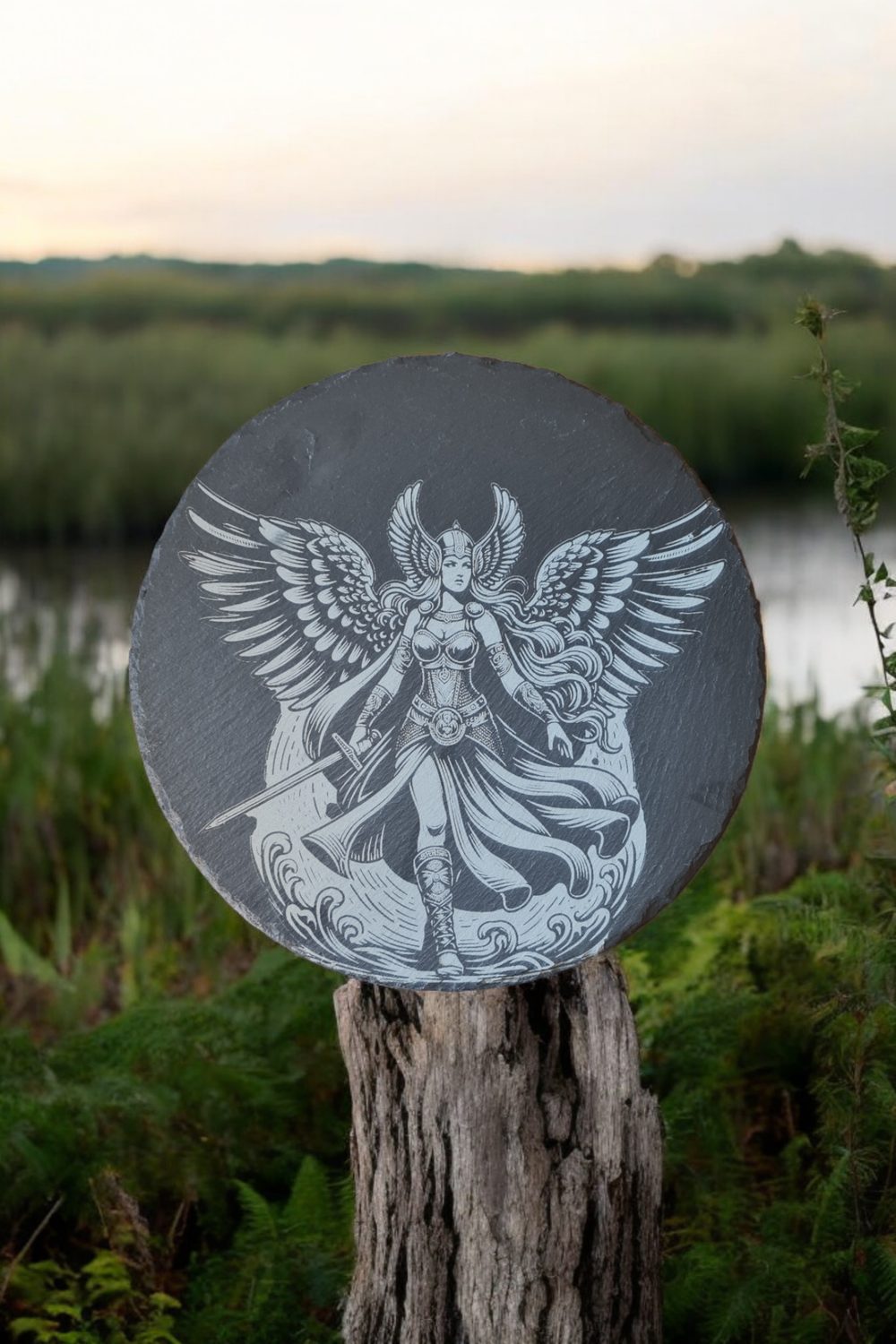
For us Sigrún is therefore a valkyrie who must not be reduced to the director of battle. She carries both within her – the hardness of the war-goddess and the whole depth of a loving human being. When we bind a valkyrie into slate, we think of figures like her: of women whose loyalty reaches beyond battle, curse and even death.
Helgi and Sigrún are no isolated case. The Codex Regius preserves three Helgi lays, and the manuscript itself links their heroes through the motif of rebirth: Helgi Hjörvarðsson, Helgi Hundingsbani and a third Helgi are held to be the same soul, returning again and again into the world – and with it the valkyrie who loves him. So arises the image of a couple whom death parts but can never finally tear apart. This chaining is a rare and fascinating witness to how the old poets thought about soul, fate and return.
Striking, too, is how far the valkyrie here breaks free from the pure war-figure. Sigrún rides through the air and over the sea like her sisters, yet her actions are ruled by love, not by Odin’s command. She thus stands in a line with Brynhild and other valkyries of heroic poetry who become tragic lovers – women between divine power and human heart. It is exactly this tension that kept the material alive for centuries, on into opera and modern fantasy.
Valkyries · Darraðarljóð · Hervör & the Cursed Sword · Skarpåker – a Father’s Grief.
Helgakviða Hundingsbana I & II (Poetic Edda); Karl Simrock, Die Edda (1851); Bellows (1923). Rudolf Simek, Dictionary of Northern Mythology.
When Baldr is dead, one dares the most perilous ride of all the myths: Hermod, a son of Odin, rides into the underworld …
Read more →There are scenes in Norse poetry that take your breath away. Hervör’s night walk to the grave-mound of her dead father …
Read more →When the shining god Baldr dies, the Æsir give him the most splendid funeral of the North – upon Hringhorni, the …
Read more →It begins with a drunken braggart and ends with a splinter in the thunder god's skull. The tale of Thor and Hrungnir is …
Read more →