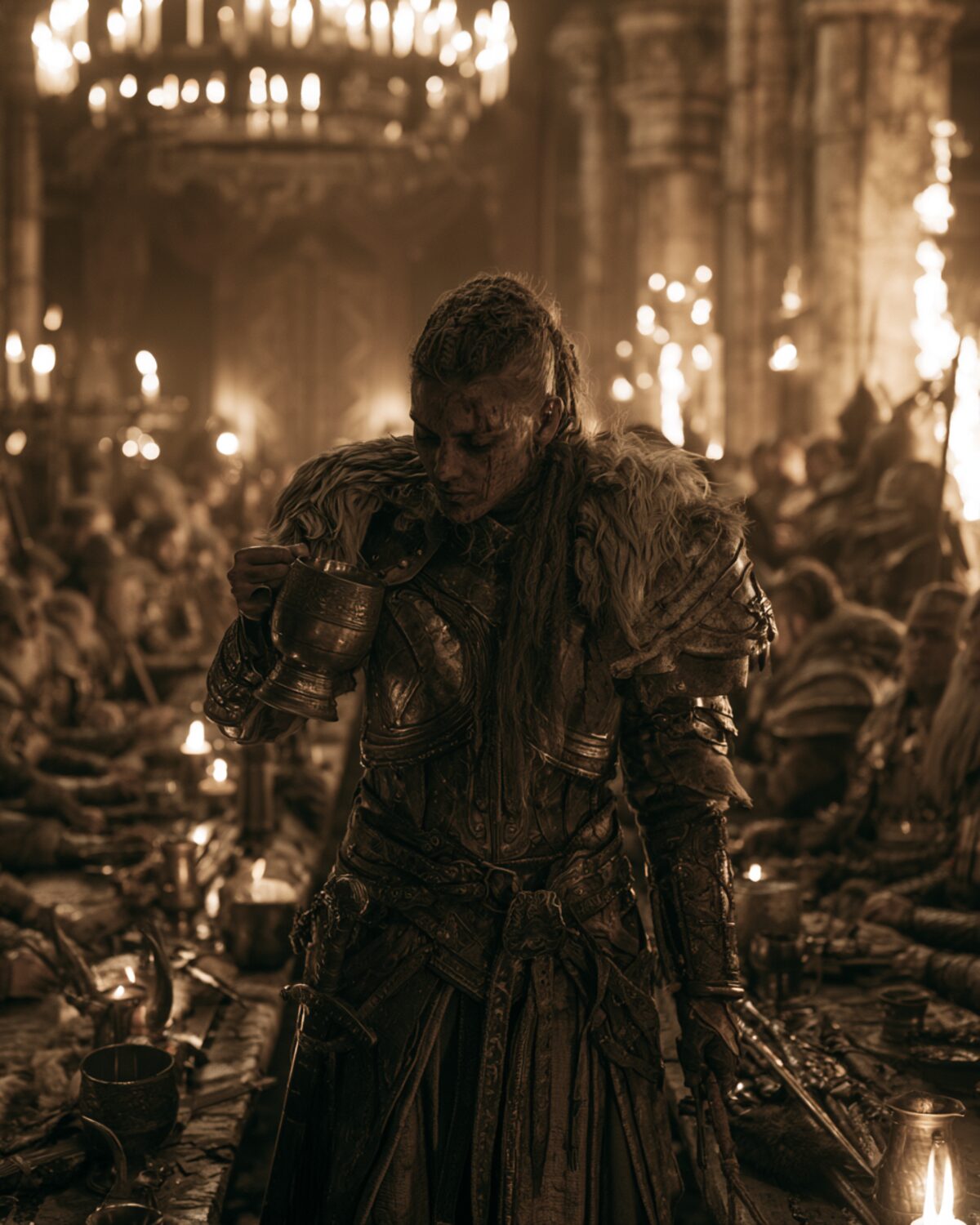
Valkyries are the female figures of Norse mythology who decide, on Odin's behalf, which warriors fall in battle – and who bring the chosen dead to Valhalla, where they hand them the drinking horn. The Old Norse word valkyrja literally means "chooser of the slain". Yet the sources show far more than the winged heroines of the opera stage: death-weavers working a loom strung with entrails, kings' daughters in love with mortal heroes, swan maidens and tiny silver women holding out a horn. Here is what the Edda, skaldic poetry and archaeology actually tell us.
Picture a battle in the tenth century: shield wall against shield wall, spears in the air, men shouting over the din. And above it all, unseen by the fighters, women in helmets and mail ride through the sky, deciding who dies today. That, at least, is how Scandinavian poets imagined it. In their world nobody fell by accident. The dead had been chosen.
At Glanz & Gravur we have engraved valkyries onto slate, wood and glass for years, and we want the motif to be right. So let's take the evidence step by step: the word, the Eddic poems, Snorri, the skalds, the heroic legends, the finds in the ground – and finally Wagner.
Old Norse valkyrja (plural valkyrjur) is a compound. The first element, valr, means the slain – the whole heap of the fallen left on a battlefield. The second belongs to the verb kjósa, "to choose". The English word "choose" comes from the same Germanic root. A valkyrie is therefore a "chooser of the slain".
The interesting question is what exactly she chooses. The sources offer two versions. In one, the valkyrie picks among men already dead those whom Odin wants in his hall. In the other, she decides beforehand who will fall and who will win. Snorri Sturluson says it plainly in the thirteenth century: the valkyries choose who is to die and decide victory. That pulls them close to the Norns, the powers who shape each person's fate.
The word is not limited to Scandinavia. Old English has an exact counterpart, wælcyrige (more on that below), which suggests the idea is older than the Viking Age. Modern English "valkyrie", on the other hand, is a learned borrowing from Old Norse that only became familiar through the antiquarian enthusiasm of the eighteenth and nineteenth centuries – and through Wagner.
The best-known list of names comes from the Völuspá, "the Prophecy of the Seeress", the opening poem of the Poetic Edda. The seeress tells Odin the history of the world from creation to its destruction. After the killing of Baldr and the first signs of doom, she sees the valkyries coming. Most editions number the stanza 30; some translations count it differently, for example as 24.
She saw valkyries come from far away, ready to ride to the people of the Goths. Skuld held a shield, Skögul was the second, Gunnr, Hildr, Göndul and Geirskögul. Now the maids of Herjan are named, ready to ride over the earth, the valkyries.— Völuspá 30, our own rendering from the Old Norse
Herjan is one of Odin's many bynames, roughly "lord of hosts". The valkyries are explicitly his maidens. Look at the first name: Skuld, which is also the name of the youngest of the three Norns. A valkyrie and a fate-woman sharing a name is no coincidence – both groups "decide", one over life, the other over death in battle. The other names are almost all war words: Gunnr and Hildr both simply mean "battle", and Geirskögul contains geirr, "spear". Göndul is usually connected with gandr, a word from the sphere of sorcery, though the precise meaning is debated.
For context: the Völuspá survives in the Codex Regius, an Icelandic manuscript of about 1270. The poem itself is often placed around the year 1000, but it cannot be dated securely. So we are reading a text that may come from the era of conversion – written down generations later.
The Grímnismál, "the Lay of Grímnir", paints a very different picture. Odin, in disguise and held captive between two fires, reveals the order of the divine world in a long monologue. When he comes to Valhalla, he names the women who serve there:
Hrist and Mist shall bring me the horn, Skeggjöld and Skögul, Hildr and Þrúðr, Hlökk and Herfjötur, Göll and Geirahöð, Randgríðr and Ráðgríðr and Reginleif – they carry ale to the einherjar.— Grímnismál 36, our own rendering from the Old Norse
Here the valkyries are not riders of death but hostesses. In the hall of the fallen they fill the cups of the einherjar, the dead warriors who wait in Valhalla for the final battle. The poem calls the drink öl, ale; elsewhere in the Edda the goat Heiðrún supplies the endless mead. The names in this stanza hardly sound like table service, though. Hrist is usually read as "the shaker", Hlökk as "noise, battle", and Herfjötur as "army-fetter" – a valkyrie who paralyses warriors in the fight. Several of these meanings are uncertain; Rudolf Simek discusses them one by one in his Dictionary of Northern Mythology.
A few stanzas earlier, in Grímnismál 14, there is a detail that is easy to miss. Freyja rules in Fólkvangr and each day chooses half of the slain; the other half belongs to Odin. Freyja does exactly what the valkyries' name describes. Some scholars therefore see her as a kind of chief valkyrie, but no source spells out such a hierarchy.
What the poems scatter, Snorri Sturluson put in order around 1220 in his Prose Edda. In the section Gylfaginning ("the Deluding of Gylfi"), chapter 36 in the usual numbering, he first quotes the list of names from Grímnismál. Then he explains: these women are called valkyries. Odin sends them to every battle. They choose who is to die and decide victory. And he adds the sentence no article on valkyries can do without: Gunnr and Róta and the youngest Norn, called Skuld, always ride out to choose the slain and decide the killings.
Skuld again – now explicitly both Norn and valkyrie. Róta does not appear in the Völuspá list; the name is usually linked with "storm, tumult". Snorri was a Christian scholar organising the old poetry as a handbook for young poets. His tidy "valkyrie department" in Odin's household is partly his own construction; the poems themselves are messier.
Anyone who thinks valkyries are gentle maidens should read the Darraðarljóð. The poem is preserved in chapter 157 of Njáls saga, an Icelandic saga from the late thirteenth century. The frame story: on Good Friday 1014 a man called Dörruðr in Caithness, in the far north of Scotland, sees twelve women ride to a bower. He looks through a gap in the wall and sees them working at a loom.
And what a loom it is. Human heads serve as loom weights, entrails as warp and weft, swords and an arrow as weaving tools. As they weave, the women chant eleven stanzas. They name themselves – Hildr, Hjörþrimul, Sanngríðr, Svipul, Guðr and Göndul – and weave the outcome of a battle into the gruesome cloth. At the end they tear the web down and ride away, six to the south and six to the north, according to the saga.
The battle in question is the Battle of Clontarf near Dublin, also fought on Good Friday 1014. The Irish high king Brian Bóruma faced an alliance of Leinster, Dublin and warriors from the isles. Brian was killed, yet his side won. Whether the Darraðarljóð really is a contemporary poem about this battle, or originally referred to some other fight, is debated among scholars. What is certain is that the saga author tied it to Clontarf, and that the poem's language seems considerably older than the saga around it.
The weaving valkyries show how closely fate and handiwork were linked in northern imagination. The Norns, too, spin and knot destiny. Weaving was everyday women's work – which is exactly what makes this image so unsettling. The English poet Thomas Gray adapted it in 1768 as "The Fatal Sisters".
The oldest datable valkyrie scenes come from two memorial poems for dead kings composed in the tenth century. They stand closer to the Viking Age than almost anything else we have on the subject.
The Eiríksmál was probably composed soon after the death of Eric Bloodaxe, who fell in England around 954; the poet is unknown. Odin wakes from a dream and orders Valhalla to be prepared for a great guest: the einherjar are to set the benches, the valkyries to bring wine, as if a king were coming.
Even more striking is the Hákonarmál, composed by Eyvindr skáldaspillir for King Hákon the Good, who died around 961 after the battle of Fitjar. Odin sends two valkyries, Göndul and Skögul, to choose which of the kings shall come to him. Göndul leans on her spear shaft; the two sit high on horseback, with helmets and shields. Hákon overhears them and asks why they dealt out victory as they did, when he deserved better. Skögul replies, in essence: we made sure you held the field and your enemies fled. Then she rides ahead to Valhalla to announce the king.
The scene is a key to the whole idea. The king wins the battle and still dies. Victory and death are no contradiction – the valkyrie grants both. And there is a twist: Hákon had been baptised, yet the poet still sends him to Odin's hall.
In the heroic poems of the Edda something strange happens. The valkyries acquire fathers, faces and feelings. They are kings' daughters riding out as shield-maidens – and they fall in love with mortal heroes.
Sváva appears in the Helgakviða Hjörvarðssonar. She gives the silent, nameless prince Helgi his name and shows him a sword, and later protects him in his battles. The same poem contains one of the loveliest valkyrie images in all Old Norse verse: three times nine maidens ride, one rides ahead, white under her helmet; from their horses' manes dew falls into deep valleys and hail onto tall trees. Battle and fertility in a single picture.
Sigrún is the valkyrie of the two poems about Helgi Hundingsbani. She loves Helgi against the will of her father, who has promised her to another man. In the fight over her Helgi kills her father and a brother – and is later murdered by another of her brothers. The most famous scene: Sigrún enters Helgi's burial mound to spend one more night with the dead man. His hair is full of frost, his hands are cold, his wounds still bleed. We tell the full story in Helgi and Sigrún – the valkyrie at the burial mound. A prose note in the Edda even claims that Helgi and Sigrún were Helgi and Sváva reborn – a rare hint of rebirth beliefs in the north, though the scribe himself calls it an "old belief".
The best-known valkyrie of all is Brynhild. In the Sigrdrífumál the hero Sigurd finds a sleeping figure in full armour on a mountain and cuts open her mail-coat. The woman who wakes calls herself Sigrdrífa. She tells him Odin pricked her with the sleep-thorn because she gave victory to the wrong king and let Odin's favourite fall. As punishment she must marry – and she vowed to take only a man who knew no fear. Then she teaches Sigurd rune-wisdom. The Völsunga saga identifies Sigrdrífa with Brynhild; whether the older tradition already did so is disputed.
These valkyries defy Odin, love, suffer and die. Many scholars see a separate strand of tradition here – the warlike king's daughter as heroine – which later merged with the mythic valkyrie. These poems tell us little about whether real women warriors existed.
Another variation appears in the Völundarkviða, the lay of Völund the smith. Three brothers find three women spinning flax on the shore of a lake, their swan-shirts lying beside them. The prose introduction names them Hlaðguðr Svanhvít, Hervör Alvitr and Ölrún and states plainly: they were valkyries. They live with the brothers for seven winters, then grow restless and fly away to seek out battles. The brothers are left behind.
The tale of the swan maiden who sheds her feathered skin and marries a mortal is found across the world. In the north it was linked with the valkyries – one root of the later "winged" valkyrie, except that the Edda means swan-shirts, not angel's wings.
Do valkyries exist outside the texts? Archaeology offers a group of images long associated with them: small figures and pendants in silver or bronze showing a woman in a long, trailing gown with elaborately knotted hair, usually in profile, often holding out a drinking horn. Such pendants are known in some numbers from Scandinavia, including graves at Birka on Lake Mälaren. On Gotlandic picture stones such as the Tjängvide stone, a woman with a horn greets a rider – often read as a dead man arriving in Valhalla.
The link to literature is tempting – Grímnismál 36 and the Eiríksmál both have valkyries serving drink. But it is not certain. A woman with a horn may equally be a lady of the house offering the welcome cup, or a goddess such as Freyja. Serving the horn in the hall was a real duty of high-ranking women, so the image shows a social ritual first; whether its owner thought of Valhalla, we cannot know.
In 2012 a remarkable find was added: the Hårby figure from Funen in Denmark. An amateur detectorist found a three-dimensional figure only 3.4 centimetres tall, made of gilded silver with niello inlay and dated to around 800. It shows a woman in a long patterned dress, her hair tied in a knot at the nape – holding a sword in her right hand and a round shield in her left. It is now in the National Museum of Denmark.
The same caution applies to grave Bj 581 at Birka. Since a DNA study in 2017 showed that the richly armed burial belonged to a woman, headlines have spoken of a "valkyrie grave". Whether she was a warrior is debated – but the grave has nothing to do with the mythic valkyries.
A look across the North Sea is worthwhile. Old English has the word wælcyrige or wælcyrge, the exact counterpart of valkyrja. It turns up not in heroic poetry but mainly in glosses: learned monks used it to translate Latin words such as Bellona, the Roman war goddess, or the Erinyes, the avenging Furies of Greek myth. For them the wælcyrge was a terrible, vengeful figure, not a cup-bearer.
A passage by Archbishop Wulfstan of York is especially interesting. In his sermon Sermo Lupi ad Anglos, whose longer version is dated to 1014 – the same year as Clontarf – he lists the sinners bringing ruin upon England. Alongside killers and perjurers he names wiccan and wælcyrian, "witches and valkyries". He apparently means living women accused of sorcery. In Christian England the chooser of the slain had become a worker of evil.
A continental echo may survive in the Merseburg Charms of the tenth century. There the idisi settle down, fasten fetters, hold back an army and loosen bonds. That sounds strikingly like the valkyrie Herfjötur, "army-fetter". Whether the idisi are valkyries or rather correspond to the dísir is an open question – but the resemblance is too striking to ignore.
Say "valkyrie" today and few people think of the Völuspá. They hear music. Richard Wagner's opera Die Walküre, the second part of his cycle Der Ring des Nibelungen, premiered in Munich on 26 June 1870 – at the insistence of King Ludwig II and against Wagner's wishes, since he wanted the whole Ring performed together. The first complete Ring followed at Bayreuth in 1876.
Wagner blended freely. His Brünnhilde is Wotan's favourite daughter, disobedient out of compassion, punished with sleep and ringed with fire. That draws on Sigrdrífumál and Völsunga saga, but also on the German Nibelungenlied, in which Brünhild is no valkyrie at all but a formidably strong queen in Iceland. The famous "Ride of the Valkyries" opens Act Three: eight valkyries gather on a rocky summit with slain heroes slung over their saddles.
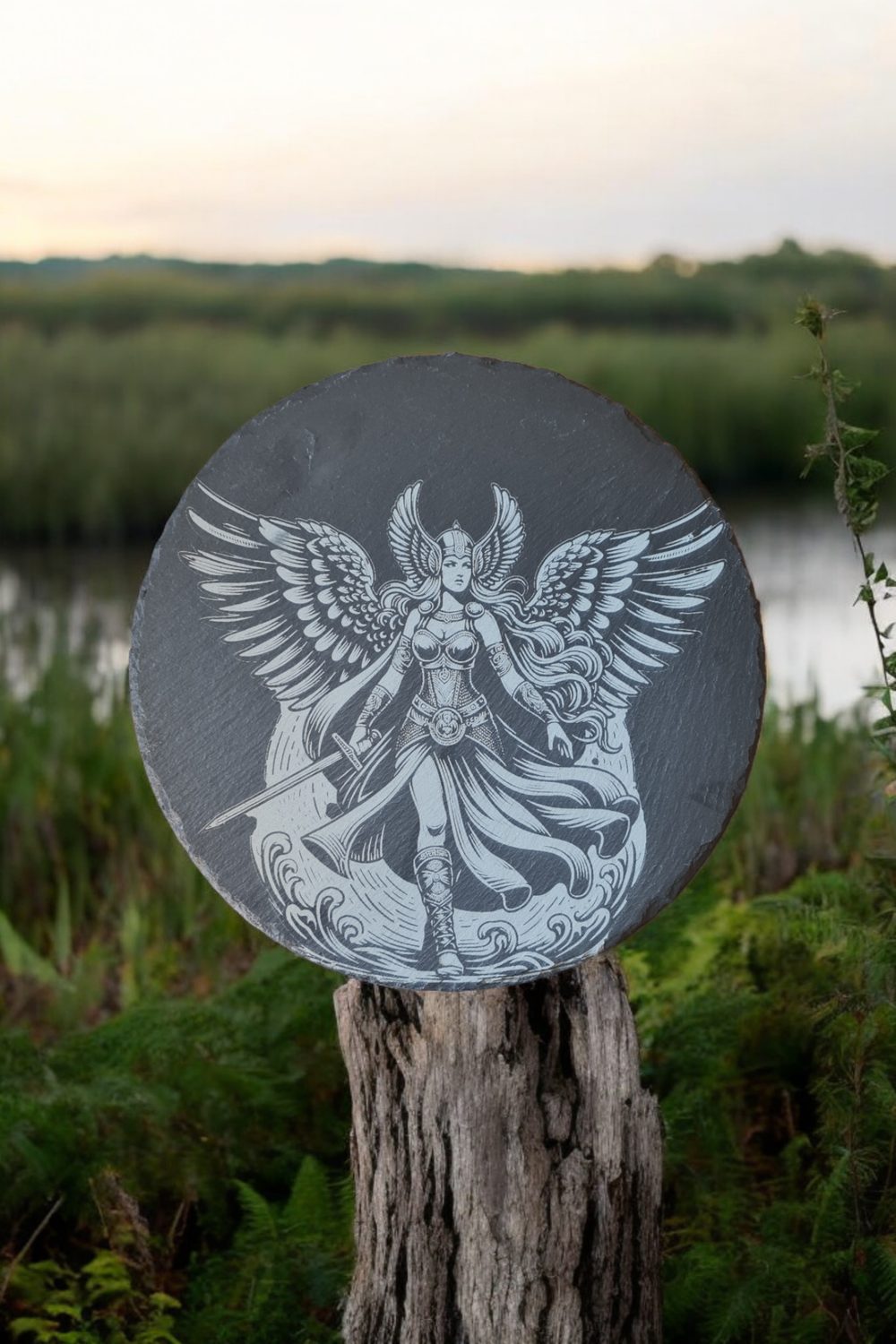
Nineteenth-century stage costumes and paintings such as those of Peter Nicolai Arbo shaped the image that lives on in posters, games and films: flowing hair, breastplate, winged helmet, a white horse in the storm. Magnificent theatre – but only loosely connected to the sources.
The Edda and the name lists of Snorri's Edda (the þulur) preserve some two dozen valkyrie names. A selection, with the usual – not always certain – interpretations:
Death-messenger, hostess, weaver of fate, lover: this many-sidedness is exactly why we enjoy working with the motif in our workshop – not as a comic-book warrior, but as a figure from the sources, with spear, shield and drinking horn. Whoever fell had been chosen. Whoever was chosen was greeted with the horn in Odin's hall.
What does valkyrie mean? Old Norse valkyrja means "chooser of the slain". It combines valr, "the slain on the battlefield", with kjósa, "to choose".
What do valkyries do in Norse mythology? On Odin's behalf they decide who falls in battle and who wins, and they bring the chosen to Valhalla. There they serve drink to the einherjar.
What are the names of the valkyries? Well-known names include Hildr, Gunnr, Skögul, Göndul, Skuld, Hrist, Mist, Þrúðr and Reginleif. The main lists are in Völuspá 30, Grímnismál 36 and Snorri's Gylfaginning 36.
Is Brynhild a valkyrie? In the Norse tradition, yes: the Völsunga saga identifies Brynhild with the valkyrie Sigrdrífa, whom Odin punished with the sleep-thorn. In the German Nibelungenlied, however, Brünhild is a queen in Iceland, not a valkyrie.
Did valkyries have wings? No. The sources show valkyries on horseback in helmet and mail, and as swan maidens with feathered skins. Winged valkyries and winged helmets come from nineteenth-century art and opera.
For courage. For remembrance. For legends that live on.
Valhalla · Odin · Sigurd · The Norse pantheon.
Before the gods of the North were one family, they waged the first war of the world – against each other. The War of …
Read more →When in deepest winter the storm howls, so people believed, a spectral host rides through the night: the Wild Hunt. At …
Read more →At the centre of the Norse picture of the world stands a tree. At its roots fate is decided, in its crown an eagle …
Read more →The world of the Vikings is, quite literally, built from a corpse. From the slain primal giant Ymir the first gods …
Read more →