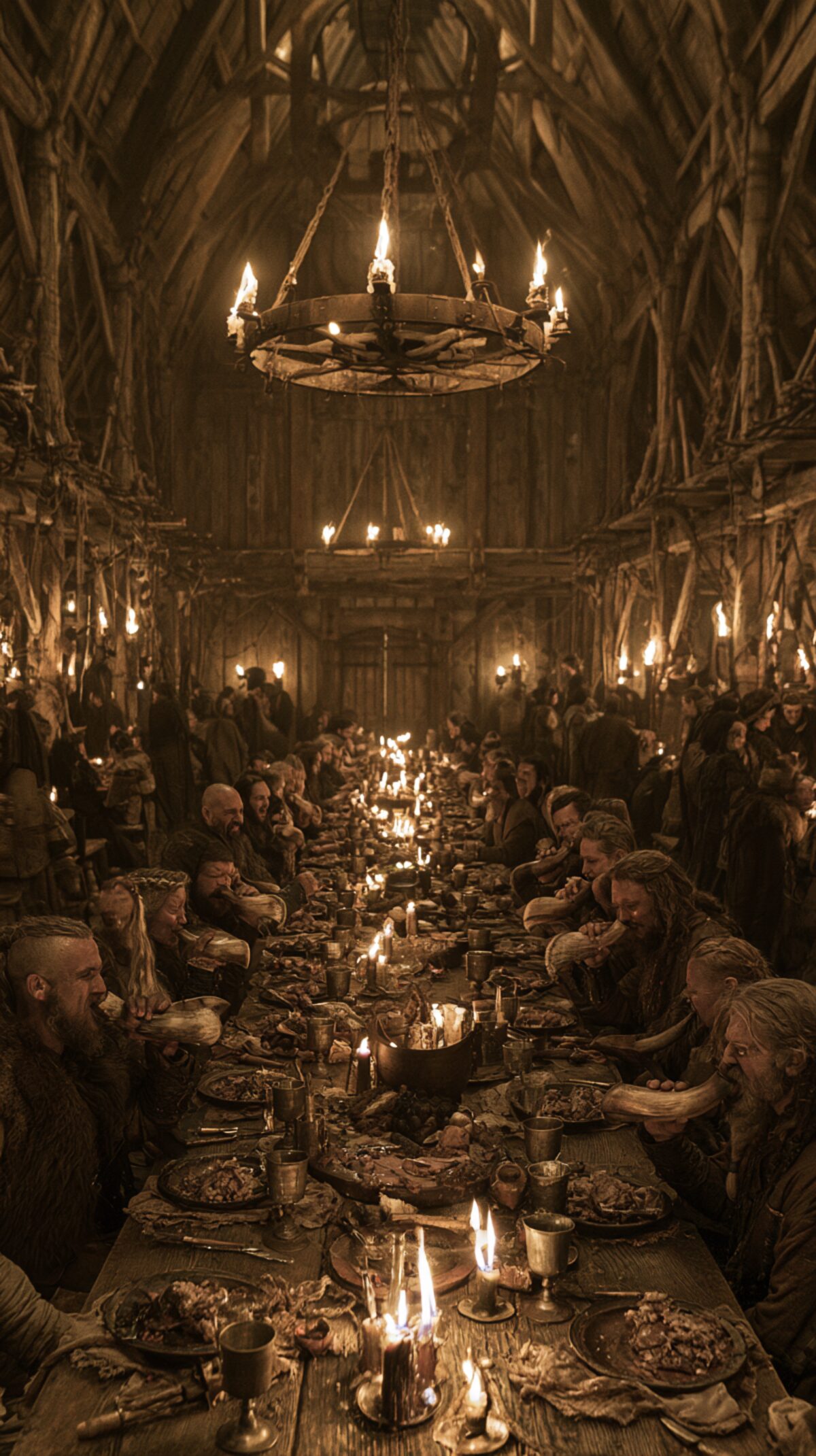
Valhalla (Old Norse Valhǫll, “hall of the slain”) is Odin's enormous hall in Asgard, where a chosen share of those killed in battle go to fight and feast until the end of the world. That is how the Poetic Edda and Snorri Sturluson in the 13th century describe it. Here we look at the place itself: its roof, its gates, where it lies, who was on the guest list – and why “every warrior goes to Valhalla” is not what the sources say.
Picture a hall roofed not with shingles but with shields. Its rafters are spear shafts, mail shirts lie on the benches, and an eagle hovers above the door. Five hundred and forty doors lead out, and a whole warband marches through each one. This is not a fantasy film set. It is the place Old Norse poetry calls Valhalla – the hall of Odin.
We have separate articles on the people who live there, the einherjar, and on the valkyries who choose them. This one is about the building itself – from its name to a hall of fame on the Danube.
Old Norse Valhǫll has two parts. Valr means the slain on a battlefield, the dead of a fight taken as a group. It has relatives across the Germanic languages: Old English wæl, Old High German wal, and it survives in the German word Walstatt, “battlefield”. The valkyrja, the valkyrie, is literally the “chooser of the slain”. The second part, hǫll, is simply a hall. The standard translation is therefore “hall of the slain”.
But the story has a second strand. The historian of religion E. O. G. Turville-Petre and the Viennese scholar Rudolf Simek point to Swedish folk tradition, where certain rocks and hills were called valhall – places where the dead were believed to dwell. That raises the possibility that behind the glittering hall of the gods lies an older “rock of the slain”, a mountain of the dead into which the departed passed. It fits Icelandic sagas in which the dead enter a mountain such as Helgafell, and Saxo Grammaticus, whose hero Hadding visits an underground world where fallen warriors fight on.
The English “Valhalla” and German “Walhalla” are early modern scholarly forms of Valhǫll that spread through books, poems and eventually Richard Wagner.
Our key source for its location is the Eddic poem Grímnismál, “the Lay of Grímnir”. Odin, disguised as a wanderer, sits trapped between two fires in the hall of King Geirröd and, half roasted, recites the dwellings of the gods: Ýdalir, Álfheim, Valaskjálf, Sökkvabekk – and fifth, Gladsheim (Glaðsheimr, roughly “home of gladness” or “shining home”). There, says stanza 8, gold-bright Valhalla stands wide, and there Odin chooses the weapon-dead each day.
So Valhalla lies in Asgard, the realm of the Æsir, within a place called Gladsheim. The poems give no more geography than that. The list in Grímnismál is a catalogue, not a travel guide – and that matters for anyone asking “how do you get to Valhalla”. The sources do not describe a destination you walk to, but a place you are taken into.
Look at who else is on the list. The ninth hall is Fólkvangr, “field of the host”, where Freyja arranges the seats and each day chooses half of the slain – Odin gets the other half (stanza 14). From the very start, then, Valhalla was not the only destination for the honoured dead. More on that below.
Stanzas 9 and 10 are the real building description, and they are surprisingly concrete. In paraphrase: Odin's hall is easy to recognise for anyone who comes to him. Its rafters are spear shafts, the hall is roofed with shields, and mail coats are strewn across the benches.
The next stanza adds a wolf hanging before the western door, with an eagle hovering above it. Don't read this as a blueprint. Read it as a poetic image from the world of warrior halls. A roof of shields is a kenning turned into architecture: in skaldic verse the shield was already the warrior's “roof” or “hall”. Valhalla takes the metaphor literally. Mail on the benches recalls real halls where a retinue's gear lay close at hand – precious pieces like the byrnie were displayed, not hidden.
The wolf and eagle are harder. Both are the classic “beasts of battle” that, along with the raven, feed on the dead after a fight in Old Norse and Old English poetry. At the door of the hall of the slain they work like a coat of arms: whoever enters here has come from the battlefield. Whether a real animal emblem over a hall door lies behind the image remains open.
Snorri Sturluson knew the shield-roof motif too. At the very start of his Gylfaginning (“The Beguiling of Gylfi”, c. 1220–1230), the Swedish king Gylfi, travelling as Gangleri, reaches a huge hall roofed with golden shields like shingles, and Snorri backs it up with a verse by the skald Þjóðólfr of Hvinir. The golden shields that turn up in so many retellings of Valhalla come from this frame story, not from Grímnismál itself.
A second group of stanzas deals with access. Stanza 22 names the gate Valgrind, “lattice of the slain”. It stands on the plain, holy before holy doors; the gate is old, and few know how it is locked. Grind is a lattice or slatted gate, the kind that closed off pastures and farmyards. Note the counterpart in the realm of Hel, where poetry speaks of Helgrind, Hel's gate. Both worlds of the dead have a gate, and both mark a boundary you do not simply cross back over.
Then comes the most famous number in all of Valhalla lore:
“Five hundred doors and forty there are, / I ween, in Valhall's walls; / Eight hundred fighters through one door fare / When to war with the wolf they go.”— Grímnismál 23, Henry Adams Bellows (1923, public domain)
540 doors times 800 warriors gives 432,000 fighters. It is a tempting sum, and people love to make it. Two caveats. First, Old Norse “hundred” could mean the long hundred of 120, which would make the numbers bigger still. The number mainly wants to say one thing: unimaginably many.
The very next stanza, 24, uses the same figure of 540 for the rooms of Bilskirnir, the hall of Thor. So the number is a poetic measure of vastness rather than a building spec. And the purpose of the doors is spelled out: they open when the host goes to war with the wolf – on the day of Ragnarök, when Fenrir breaks free.
In Gylfaginning, Snorri turns these stanzas into a connected account. Gangleri asks very practical questions.
In chapter 38 (in the usual numbering) Gangleri asks how so many people are fed in Valhalla. The answer: the cook Andhrímnir boils the boar Sæhrímnir in the cauldron Eldhrímnir, and every evening the boar is whole again. Odin himself does not eat; he gives his food to his wolves Geri and Freki and lives on wine alone. Chapter 39 turns to drink. On the roof stands the goat Heiðrún, grazing on the tree Læraðr, and so much mead flows from her udder that all the einherjar have their fill. Snorri has Hár remark, in effect, that it would be a strange lord who invited kings and jarls home and then served them water. Beside the goat stands the stag Eikþyrnir, from whose antlers the rivers of the world flow.
Chapter 40 deals with the size of the hall and quotes the stanza about the 540 doors. Chapter 41 describes the pastime: every day the einherjar arm themselves, go out into the courtyard and fight until they cut each other down. At mealtime they ride home, sit down to drink and are reconciled.
Some of the most striking images of Valhalla come not from the Edda but from two 10th-century poems composed for real, historically known kings.
Eiríksmál was composed after the death of Eric Bloodaxe, who fell in England in 954. Tradition links it to his widow Gunnhild; the poet is unknown, and the poem survives only in fragments in the kings' saga collection Fagrskinna. Odin wakes from a dream in which he was making Valhalla ready for fallen warriors: rousing the einherjar, strewing the benches, rinsing the cups, having the valkyries bring wine. Bragi, god of poetry, hears a din as if a thousand were coming – and Odin knows it is Eric. He sends the legendary heroes Sigmund and Sinfjötli out to greet the king. Asked why he takes Eric now, Odin answers, roughly: the future is uncertain, for the grey wolf stares at the seats of the gods.
Hákonarmál is by Eyvindr skáldaspillir and mourns King Hákon the Good of Norway, who died around 961 after the battle of Fitjar. Here the valkyries Göndul and Skögul ride over the battlefield and announce that Hákon shall come to Odin with a great host. In Valhalla he is greeted by Hermóðr and Bragi. Hákon is wary at first and wants to keep his weapons. The twist: Hákon had been raised a Christian at the English court. The poem still brings him into Odin's hall and praises him for sparing the gods' sanctuaries. The ending is famous: the Fenris wolf will run unfettered over the world of men before so good a king comes to take his place.
Notice who is arriving: kings. Both poems celebrate rulers, not ordinary farmer-warriors. In skaldic verse Valhalla is a place for the elite – princes and their retinues. That is a useful counterweight to the modern idea that every Viking was bound there.
Are there Viking Age images of Valhalla? The best candidates stand on Gotland. The island's picture stones, large painted and carved limestone slabs, often show ships, fights and riders. On the Tjängvide stone (now in the Swedish History Museum in Stockholm, c. 700–900 AD) a small rider sits on an eight-legged horse while a woman steps towards him holding a drinking horn. Below sails a great ship, and a runic inscription names the dead man the stone commemorates.
The most common reading: a dead man (or Odin himself) rides Sleipnir into the other world and a valkyrie welcomes him with a drink – the arrival in Valhalla. That reading is supported by poems in which valkyries hand the horn to the einherjar, and by the many small silver figures of women with drinking horns found across Scandinavia. But there are alternatives: some see Sigurd on his horse Grani, others simply a homecoming, with eight legs signalling speed.
Where did the poets get their picture of a vast hall with benches, a high seat and endless feasting? From their own world. Archaeologists have excavated a whole series of monumental halls in Scandinavia that show what a lord's seat in the Iron and Viking Ages looked like.
At Lejre on Zealand, the legendary seat of the Skjöldung kings, excavators found a hall 48 metres long and 11 metres wide – according to the National Museum of Denmark, the largest known Viking Age building in the country. The site goes back to the 6th century. Lejre also produced the tiny silver figure of someone on a high seat flanked by two birds, often (though not uncontroversially) read as Odin on his throne Hliðskjálf.
At Gamla Uppsala, the old cult and royal centre of the Svear, digs uncovered a great Vendel-period hall (before the Viking Age, roughly 600–750) on artificial terraces, along with massive rows of posts across the landscape – see our article on Uppsala. And at Borg in the Lofoten Islands stood a chieftain's house whose foundation was 83 metres long, the largest building of its kind yet found in Scandinavia. It was discovered in 1983, enlarged in the 8th century and abandoned around 950; a full-size reconstruction stands there today.
These halls were home, banqueting room, court and probably cult space all at once. Here the lord sat raised above the rest, handed out rings and weapons, and fed his retinue meat and mead. You find exactly this pattern in Valhalla: Odin as lord of the hall, the einherjar as his retinue, Sæhrímnir as the roast, Heiðrún's mead as the drink. Valhalla is what a Viking chieftain would have wanted – only infinitely big, infinitely rich and infinitely long.
Anyone asking about Valhalla usually asks next: where did everyone else go? The sources know several destinations, and they don't agree.
Valhalla is Odin's hall for a share of the battle dead. Snorri says in one place (Gylfaginning 20) that all who fall in battle are Odin's adopted sons and go to Valhalla and Vingólf. Elsewhere he takes over from Grímnismál that Freyja gets half. Snorri contradicts himself.
Fólkvangr is Freyja's field with her hall Sessrúmnir. We learn almost nothing about life there. A scene from Egils saga is revealing: Egil's daughter Þorgerðr says she will eat nothing until she dines with Freyja – apparently a woman could imagine a place with Freyja, no battlefield required.
Hel, in Snorri, receives those who die of sickness and old age – which means most people. Hel is not a place of punishment, not a Christian hell, but simply the ordinary realm of the dead. Read more in our articles on Hel and the direct comparison Valhalla or Helheim.
People search this a lot, and the honest answer is: you don't get there, you are taken. In every source, Odin or his valkyries decide – not the dead. Death in battle is the main condition, but not a guarantee. The valkyries choose, and not everyone is chosen.
In Ynglinga saga, his euhemerised prehistory of the Swedish kings, Snorri adds two more details. He says the “historical” Odin made it law that the dead be burned with grave goods, and that they would arrive in Valhalla with whatever went onto the pyre with them. And when Odin himself died in his bed, he had himself marked with a spear point and so claimed all who fall in battle. This is later learned tradition, not an eyewitness account of Viking ritual, but it shows that medieval writers did think about the “entry requirements”.
An Eddic example shows how much rank counted. In the second Lay of Helgi, the fallen hero Helgi is invited by Odin in Valhalla to rule everything alongside him. Valhalla is not a hall of equals; it has a seating plan.
Valhalla is an armoury for the end of days: the einherjar drill because Odin knows Fenrir will break loose. And there lies the tragedy. The sources never say the army wins. In Völuspá Odin is swallowed by the wolf. Valhalla prepares for a battle that is lost anyway – at least for the old world of the gods.
In the 19th century Valhalla began a second career. In 1807 Crown Prince Ludwig of Bavaria conceived a hall of fame for great Germans. As King Ludwig I he had it built to designs by Leo von Klenze above the Danube at Donaustauf, near Regensburg. Construction ran from 1830 to 1842, and it opened on 18 October 1842. The building looks like a Greek temple modelled on the Parthenon – so the architecture has little to do with Norse myth. What was borrowed was the idea: a hall where the “heroes” are gathered. At the opening there were 96 busts; today there are about 130 busts and some 65 plaques.
Richard Wagner's influence was even greater. In Das Rheingold, the first part of his Ring of the Nibelung, Wotan has the castle Valhalla built by the giants Fasolt and Fafner and pays a heavy price for it. In Götterdämmerung Valhalla goes up in flames. Wagner worked freely with his sources, mixing the Edda, the Völsunga saga and the Nibelungenlied into something of his own. Many of the images now attached to “Valhalla” – the castle on a cloud-capped peak, the fiery collapse – owe more to the opera house than to the Edda.
When we engrave a Valhalla motif in our workshop in Alsdorf – a drinking horn, a shield wall, a line for a memorial piece – it is rarely about battle romance. It is about what the old poems mean at heart: that someone who lived bravely is not forgotten. That someone is there to welcome them. That a place at the table stays free. Eiríksmál is, at bottom, a poem of mourning, made for a widow who wanted to see her husband walk into a worthy hall. That longing does not age.
What does Valhalla mean? Old Norse Valhǫll means “hall of the slain”, from valr (the battlefield dead) and hǫll (hall). One scholarly theory also sees an older “rock of the dead” behind it.
Who goes to Valhalla? According to the sources, a share of those killed in battle, chosen by Odin and the valkyries. Half the slain go to Freyja according to Grímnismál, and those who die of age or sickness go to Hel according to Snorri.
How many doors does Valhalla have? Grímnismál 23 gives 540 doors, with 800 einherjar marching out of each. The figure is poetic hyperbole, not a floor plan.
Is Valhalla the same as Walhalla? Yes in meaning: both are later forms of Old Norse Valhǫll. Walhalla is also the name of Ludwig I's hall of fame near Regensburg, opened in 1842.
Where is Valhalla located? In Asgard, in a place called Gladsheim, according to the Eddic poem Grímnismál. The gate Valgrind stands before it.
Can women go to Valhalla? The sources only name men as einherjar; women appear there as valkyries who serve the drinking horn. For women, Egils saga hints instead at a place with Freyja.
For courage. For remembrance. For legends that live on.
Valkyries · Ragnarök · Odin · The Norse pantheon.
They are far more than the winged warrior-maidens of the opera: the valkyries decide who falls in battle – and who is …
Read more →Before the gods of the North were one family, they waged the first war of the world – against each other. The War of …
Read more →When in deepest winter the storm howls, so people believed, a spectral host rides through the night: the Wild Hunt. At …
Read more →At the centre of the Norse picture of the world stands a tree. At its roots fate is decided, in its crown an eagle …
Read more →