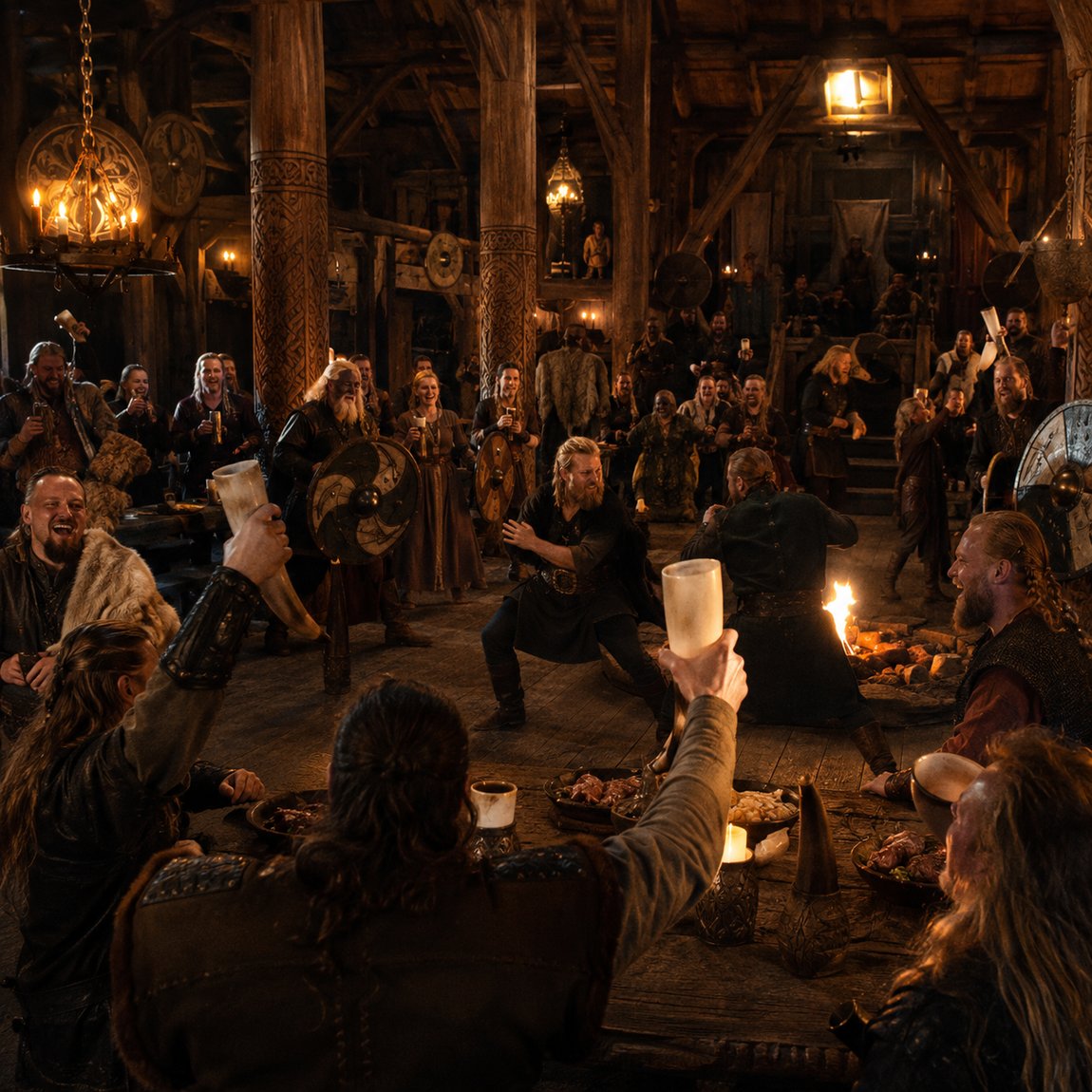
The einherjar (Old Norse, singular einheri) are the warriors who fell in battle and were chosen by the valkyries to live in Odin's hall, Valhalla. Every day they fight one another; every evening they eat the flesh of Sæhrímnir and drink the mead of the goat Heiðrún – all while waiting for Ragnarök, the battle against the wolf that they are not going to win. Here is what is genuinely old, and what Snorri added in the thirteenth century.
Picture a hall roofed with shields, its rafters made of spear shafts. Mail shirts lie strewn across the benches. A wolf hangs by the west door and an eagle hovers above it. Inside sit men who were hacking at each other this morning and are now drinking together, reconciled. Tomorrow they will go out again. And the day after. Until the world ends.
The strangest afterlife in the Norse tradition: no rest, but service past the point of death. Below we look at what the Eddic poems and the court poets actually say, where Snorri Sturluson tidied things up, what the picture stones of Gotland show, and why the popular rule "die in battle, go to Valhalla" falls short.
The Old Norse form is einherjar, singular einheri. The second element is easy: herr, "army, war-band", related to English "harry". The first, ein-, is the problem. Three readings stand side by side: "those who fight alone" (the most common, often with a question mark), "those who belong to one army", and "the foremost warriors", with ein- as an intensifier. In 1874 Guðbrandur Vigfússon also compared the man's name Einarr and the adjective einarðr, "steadfast, bold". Rudolf Simek's dictionary of Northern mythology lists several readings without committing to one, and Heinrich Beck's entry in the German Reallexikon der Germanischen Altertumskunde leaves the question open as well. Anyone selling you the one "true" translation is selling you too much.
Every reading fits the setting. In the Edda Odin carries names like Herjafǫðr, "father of hosts", and Valfǫðr, "father of the slain". A god with titles like that needs troops. The einherjar are those troops.
Most of the old information about the einherjar comes from a single poem, Grímnismál, "The Lay of Grímnir". It belongs to the Poetic Edda, a collection of mythological and heroic poems preserved in an Icelandic manuscript of around 1270, the Codex Regius. The poems themselves are older; how much older can only be estimated poem by poem.
The frame story is brutal: King Geirrøðr has a guest seated between two fires for eight nights. The guest is Odin, and he answers with a flood of divine lore.
Valhalla sits right in the middle of this catalogue. Stanza 8 names Glaðsheimr, "the bright home", where Valhalla rises gold-bright and wide; there Hroptr – one of Odin's names – chooses each day the vápndauða vera, the "weapon-dead men". Stanza 9 describes the building: spear shafts for rafters, shields for a roof, mail coats on the benches. Stanza 10 puts the wolf by the west door and the eagle above. Then comes the famous one:
Five hundred doors and forty there are,
I ween, in Valhall's walls;
eight hundred fighters through one door fare
when to war with the wolf they go.Grímnismál 23, trans. Henry Adams Bellows, 1923 (public domain)
Taken at face value, that is 540 times 800: 432,000 warriors. But Old Norse often counted in the long hundred – hundrað frequently meant 120, not 100. On that reckoning "five hundred and forty" becomes 640 doors and "eight hundred" becomes 960 men, which gives 614,400. We simply do not know which count the poet had in mind.
The intention matters more than the total. The stanza is not counting, it is marvelling: more than you can imagine. And it states the purpose – in the Old Norse, við vitni at vega, "to fight against the wolf". Vitnir is a poetic word for wolf, and the wolf meant is Fenrir. So even in a poem that otherwise has little to say about the end of the world, the reason for the whole host is already spelled out. A small aside: the very next stanza, 24, gives Thor's hall Bilskírnir exactly the same number – 540 rooms. For this poet, five hundred and forty evidently meant "enormous".
An army that size has to eat. The Edda solves that with animals that never run out.
The meat. Grímnismál 18 names the cook Andhrímnir, who boils the creature Sæhrímnir, "the best of meats", in the cauldron Eldhrímnir. Three names built on the same root, hrím, "rime, soot": Soot-face, Fire-sooty, Sea-sooty? The wordplay is obvious; the precise meaning of Sæhrímnir is not. The stanza ends drily: few know what the einherjar feed on. That Sæhrímnir is a boar, slaughtered and cooked every day and whole again by evening, is Snorri's addition in Gylfaginning. The poem says nothing about a self-renewing pig.
The mead. According to Grímnismál 25 the goat Heiðrún stands on the hall of the Host-father, browsing the foliage of the tree Læraðr. She fills a vessel with clear mead, and that drink never runs short. Snorri adds that the mead flows from her teats, every day enough for all the einherjar to drink their fill. Precision pays here: in both sources it is mead. The common line that "her milk is brewed into mead" is a modern smoothing-over.
The water. Beside her stands the stag Eikþyrnir, "oak-thorny", also feeding on Læraðr. From his antlers liquid drips into the spring Hvergelmir, source of all the world's rivers (Grímnismál 26).
The host. And Odin? He eats nothing. He gives his meat to his wolves Geri and Freki and lives on wine alone (Grímnismál 19). According to stanza 36, the valkyries serve the ale.
The daily routine comes from Vafþrúðnismál, a contest of wisdom between Odin and the giant Vafþrúðnir. Stanza 41 runs:
Allir einherjar Óðins túnum í hǫggvask hverjan dag; val þeir kjósa ok ríða vígi frá, sitja meirr um sáttir saman.
All the einherjar in Odin's courts hew at one another every day; they choose the slain and ride home from the fight, and afterwards sit together reconciled.Vafþrúðnismál 41, Old Norse text and our own translation
That word sáttir, "reconciled", is the real point. The men who cut each other down in the morning share a table at night. Note also the phrase val þeir kjósa, "they choose the slain": it is the very formula hidden in valkyrja, "chooser of the slain".
The poem does not explicitly say that every wound heals and every fallen man gets up again. That is Snorri's spelling-out, and it follows his sources closely. In Gylfaginning, his textbook of mythology written around 1220, the Swedish king Gylfi asks about Valhalla over several consecutive chapters (38–41 in the usual numbering): how many men are there, what do they eat, what do they drink, how big is the hall, what do they do all day? Every day, Snorri says, the einherjar put on their armour, go out into the courtyard, fight and fell one another; when it is time to eat, they ride home to Valhalla and sit down to drink.
One remark betrays Snorri's outlook: asked whether the einherjar drink water, he sneers that Odin would hardly invite kings and jarls to his hall and then serve them water. His Valhalla is a royal hall – and the feast merely the end of a day of training combat, not an eternal paradise.
If you want to know whether the einherjar were dreamed up by learned Christians in the thirteenth century, you have to turn to two poems from the tenth. They are not mythological lays but memorial poems for dead kings, composed by skalds – professional court poets whose tightly built verse can be dated comparatively well.
Eiríksmál was composed after the death of Eric Bloodaxe, who fell in England in 954; tradition says his widow Gunnhild commissioned it. It survives only as a fragment in the kings' saga Fagrskinna. Odin wakes from a dream: he has been preparing Valhalla for slain men and rousing the einherjar. Bragi, god of poetry, hears a din – Eric is coming with five kings, and the heroes Sigmund and Sinfjǫtli are to greet him.
Then comes the crucial exchange. Sigmund asks Odin why he robbed Eric of victory when he thought him so brave. Odin's answer, in paraphrase: because no one can know when the grey wolf will fall upon the dwellings of the gods. So Odin lets his best men die on purpose, because he needs them for the end: not reward but recruitment – some 250 years before Snorri.
Hákonarmál was composed by the skald Eyvindr skáldaspillir for King Hákon the Good, who died around 961 after the battle of Fitjar. Snorri preserves it at the end of his saga of Hákon in Heimskringla. Odin sends the valkyries Gǫndul and Skǫgul to choose among the kings who shall come to Valhalla. Hákon, who had been raised a Christian in England, enters the hall warily and wants to keep his weapons, fearing Odin's hostility. Bragi assures him of the peace of all the einherjar. The poem closes with a lament, roughly: the Fenris wolf will break loose before so good a king takes the throne again.
Two points matter here. First, Valhalla, valkyries, einherjar and the wolf at the end already belong together in the tenth century. Second, these poems are royal praise. They place kings in Valhalla, not every man with an axe. Keep that in mind when you ask who got into this hall.
The einherjar do not arrive on their own. They are fetched. The word valkyrja says it all: valr, "the slain", and kjósa, "to choose". The valkyries decide who falls and escort the chosen to the hall; in Snorri, Odin sends them to every battle. The same valr is in Valhalla (Valhǫll, "hall of the slain") and in Valgrind, the gate before the hall. Snorri calls the einherjar Odin's óskasynir, his "wish-sons" – it sounds like family but means retinue.
Time to clear up a popular misunderstanding. Not all the slain belong to Odin. Grímnismál 14 is plain: Freyja rules in Fólkvangr, the "field of the host" or "people's field"; she assigns the seats there, and every day she chooses half of the slain, while the other half belongs to Odin. Snorri repeats this and names her hall Sessrúmnir.
What the halving means is an open question. The sources are silent. The passage stands rather alone, and scholars have read it in different ways for a century – as a trace of an older martial role for Freyja, as evidence of rival cults, or simply as a poetic honour for the goddess. All that is certain is this: the idea that "all brave fallen warriors sit with Odin" is contradicted by the very poem that tells us most about Valhalla.
The familiar rule of thumb: death by weapons leads to Valhalla, "straw death" – dying in bed of sickness or old age – leads to Hel. At heart it comes from Snorri. Gylfaginning says Hel receives the sóttdauðir menn ok ellidauðir, those dead of sickness and of age. Grímnismál speaks of the "weapon-dead" whom Odin chooses. Clear enough so far.
Then it gets interesting. In Ynglinga saga, the first part of Heimskringla, Snorri presents Odin as a sorcerer-king of ancient times who dies of illness in Sweden. Shortly before his death he has himself marked with a spear point – lét marka sik geirsoddi – and claims all men who die by weapons as his own (ch. 9, ch. 10 in some editions). His successor Njǫrðr later does the same. Battle death is made up for symbolically.
That any such ritual actually existed in the Viking Age is not attested. All we have is Snorri's narrative, written around 1230 by a Christian scholar who explains the old gods as deified humans. For the Valhalla question, though, the passage is revealing: even Snorri imagined the boundary between battle death and other deaths as permeable. In the same saga he has Odin decree that everyone will come to Valhalla with whatever was burned or buried with him – an explanation for rich grave goods of the kind Viking-Age burials really do contain.
In popular culture Hel is often the hell of cowards. In the sources she is not. Hel is both the name of a goddess, Loki's daughter, and of her realm Helheim, the general realm of the dead, which you do not earn but simply enter. The word is related to English "hell" and to a root meaning "to conceal": Hel is the hidden place. Snorri paints it grimly; in the older Baldrs draumar, by contrast, mead stands ready there for the expected Baldr.
Baldr himself breaks Snorri's scheme: he dies by a weapon, the mistletoe dart, and still goes to Hel. Those lost at sea, in the sagas' view, went to the sea-goddess Rán; Eyrbyggja saga reports the belief that drowned men were well received by Rán if they appeared at their own funeral feast. And in several sagas of Icelanders the dead pass into a holy mountain, to join their kin.
Helgakviða Hundingsbana II shows beautifully how fluid the borders were. The hero Helgi falls and comes to Valhalla, where, according to the prose of the poem, Odin offers to share rule of everything with him. But one evening he rides back with his retinue to his burial mound, and his wife Sigrún spends a night there with the dead man before he must leave again at dawn. In this poem Valhalla and the grave mound are not opposites but two places of the same dead man.
So Valhalla is not heaven to Hel's hell, but a special hall for a warrior elite alongside a general realm of the dead. More in Valhalla or Helheim?.
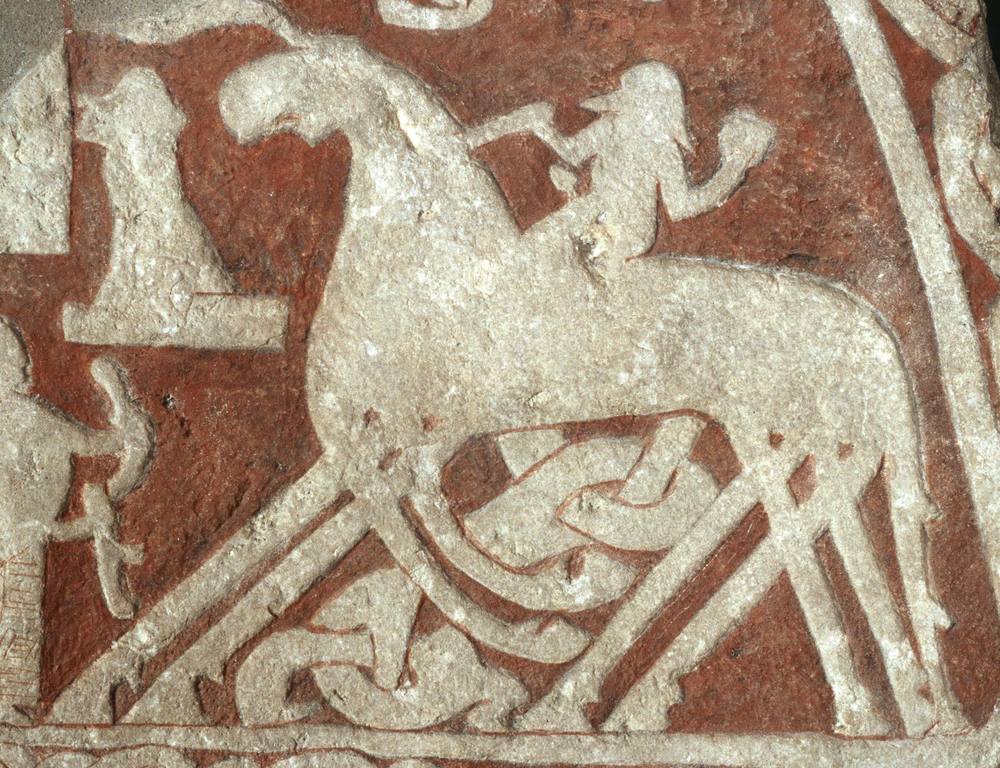
Is there any trace of the einherjar outside the texts? The usual candidates are the picture stones of Gotland: tall limestone slabs with carved, originally painted scenes, raised on the Baltic island from the fifth to the eleventh century. On stones of the eighth and ninth centuries one motif recurs: a rider received by a woman who offers him a drinking horn.
On Tjängvide I (Alskog parish, now in the Swedish History Museum in Stockholm) the rider's horse has eight legs. Ardre VIII, whose surface carries a whole series of further scenes, shows something similar. The usual reading: Odin on Sleipnir, or a dead warrior welcomed by a valkyrie at the gate of Valhalla. Fighting scenes and ships often appear below or beside.
Add to this the gilded silver figurine from Hårby on Funen, found in 2012, a little over three centimetres tall, with sword and shield – generally identified as a valkyrie. The catch: none of these objects carries an inscription. No stone says "einherjar". The identification rests on laying manuscripts written centuries later over the images. An eight-legged horse is no accident – but the reading is still not proven. The woman with the horn could be a lady of the house greeting a guest.
The end is the reason for everything. Vafþrúðnismál (st. 18) tells us where the last battle will be fought: on the plain of Vígríðr, a hundred leagues in every direction. In Gylfaginning Snorri describes how, as Ragnarök begins, Heimdall blows the Gjallarhorn, the Æsir and all the einherjar arm themselves and march out onto the field; Odin rides at their head in a golden helmet, with his spear Gungnir, against the Fenris wolf.
What happens to the einherjar after that, no source tells us. They march out, and then the camera swings to the single combats of the gods: Odin against Fenrir, Thor against the Midgard Serpent, Freyr against Surtr. Of the hundreds of thousands from Valhalla there is no further word. Vǫluspá, the great poem of the world's end, does not mention them at all.
The picture has a bitter logic, and there is no need to explain it away. Odin knows – so the tradition presents it – that he will lose. He gathers his army anyway. The Ragnarök story is not about victory but about how to face defeat. There is a telling parallel: in Skáldskaparmál Snorri tells of the endless battle of the Hjaðningar, whose fallen are woken again every night by Hildr and fight on until the end of the world. The notion of an unending battle of the dead was not confined to Valhalla.
A passage from the Roman historian Tacitus' Germania (ch. 43, around AD 98) is regularly pulled into this discussion: the Harii, who blackened their shields, dyed their bodies and chose dark nights for their attacks. Tacitus calls them a ghostly army, an exercitus feralis, whose appearance no enemy could withstand.
The name probably belongs to the root of herr. Early twentieth-century scholars drew a line from it through cultic warrior bands to the einherjar and the Wild Hunt. Lindow and Simek report this while stressing the uncertainty: more than a thousand years separate Tacitus from the Edda. Nor should the berserkers be equated with the einherjar – the former are living fighters, the latter dead.
Valhalla is no retirement home. It is a camp where men drill for a fight whose outcome is already known. The gods will lose. The einherjar ride out anyway. In that lies something that runs through much of Norse literature: you do not fight because you will win. You fight because it is right – and because someone is counting on you.
Perhaps that is why customers in our Alsdorf workshop ask for Valhalla motifs when they want to remember someone who fought. The skalds who placed kings in Valhalla with nothing but words would have understood.
What does einherjar mean? The Old Norse einherjar combines ein- ("one, alone") with herr ("army"). It is usually rendered "those who fight alone" or "those who belong to one army"; the exact meaning is not settled.
How many einherjar are there in Valhalla? According to Grímnismál 23, 800 warriors march out of each of Valhalla's 540 doors – 432,000 in all. Counting with the Old Norse long hundred (120) gives 614,400.
What do the einherjar eat and drink? Meat from Sæhrímnir, cooked by Andhrímnir in the cauldron Eldhrímnir, and mead from the goat Heiðrún.
Did every warrior who died in battle go to Valhalla? No. Grímnismál already gives half of the slain to Freyja for her hall Fólkvangr. The tradition also knows Hel, Rán and the burial mound.
What is the difference between Valhalla and Hel? Valhalla is Odin's hall for a chosen warrior elite preparing for Ragnarök. Hel is the general realm of the dead – according to Snorri, where those who die of sickness and old age go – and not a place of punishment.
What happens to the einherjar at Ragnarök? They march with Odin onto the plain of Vígríðr against the forces of chaos. No source describes their fate in the battle.
For courage. For remembrance. For legends that live on.
His byname sounds like a reproach: Eyvindr skáldaspillir, „the plagiarist“ (or „spoiler of poets"). It probably means …
Read more →No being do the gods of the North fear like Fenrir, the wolf. They rear him themselves, they bind him by cunning – and …
Read more →What does the strongest god do when he has been stripped of his hammer, his belt of strength and his iron gloves? He …
Read more →In the beginning there was no word and no bang, but a void: Ginnungagap, the ‘yawning gap’. Between the fire in the …
Read more →