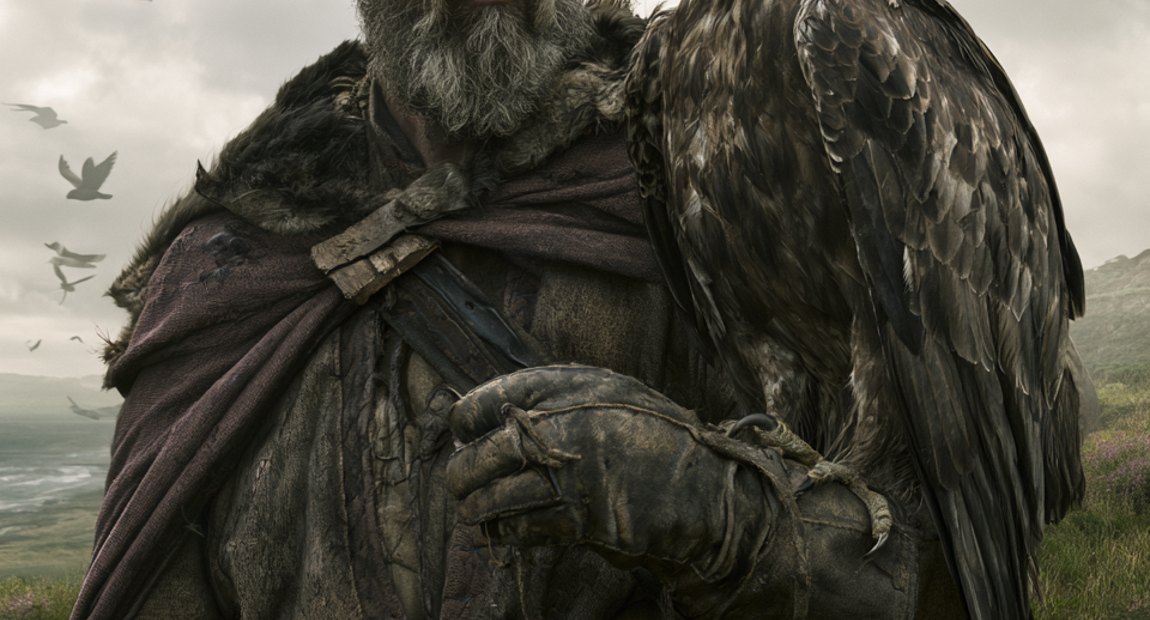
What does the strongest god do when he has been stripped of his hammer, his belt of strength and his iron gloves? He sets out anyway. The tale of Thor's journey to Geirröd is a masterpiece of Norse storytelling: it begins with Loki's mischief, leads through a river that a giantess swells with her own water, and ends with a red-hot iron bar flying the wrong way. Behind it stands one of the hardest and oldest skaldic poems of all.
As so often, Loki is the spark that lights the fire. Out of pure curiosity he borrows Frigg's falcon cloak and flies out into the world of the giants until he comes to Geirröd's hall. There he perches at the window as a falcon and peers in. Geirröd senses that this is more than a bird, has him caught, and looks into his eyes. No ordinary falcon stares like that. The giant locks him in a chest and starves him for three months, until Loki confesses who he is. To save his life he swears a fateful oath: he will bring Thor to Geirröd's hall, and do so without Thor's hammer Mjölnir, without the belt of strength Megingjörð, and without the iron gloves. A thunder god without his three most important things, that is the plan by which Loki wins his freedom. One can already sense what the tale is really about: it is a test of whether Thor remains Thor even when his gear is taken from him.
Loki does indeed persuade Thor to come along unsuspecting. But on the way they stop with the giantess Gríðr, a well-disposed acquaintance and mother of Odin's son Víðarr. While Loki is not paying attention, she warns Thor: Geirröd is treacherous and dangerous, and Thor is travelling without his own weapons. She does what a good host does and lends him her own. She gives him her staff, the Gríðarvölr, along with her iron gloves and a belt of strength. So equipped, Thor travels on, in borrowed gear but not defenceless. One can feel how much the North loved to tell that even the strongest sometimes depends on the kindness of others. It is also striking that a giantess is the one who saves Thor: not all inhabitants of the giant world are enemies, and the border between gods and giants runs far less sharply in the Edda than one might assume. Gríðr herself belongs to that very race Thor otherwise fights, and yet she equips him precisely against one of her own.
Soon they reach the river Vimur, greatest of all streams. Thor girds himself with Gríðr's belt, leans on the staff, and wades in, with Loki clinging to the belt. But in the middle the water rises furiously until it foams over Thor's shoulders. He looks upstream and sees the cause: Gjálp, a daughter of Geirröd, stands in a mountain gorge and swells the river with her own water; it is she who means to drown him. Thor lifts a great stone from the riverbed and hurls it at her with the words that a river must be stemmed at its source. He strikes, and the water falls. At the bank he grasps a branch of the rowan tree and pulls himself ashore. From that, the tale says, comes the saying that the rowan is Thor's salvation. It is a fine detail, the way a concrete image from nature and an old folk belief knot themselves around the tree here, for the rowan was long held to be a protective tree against evil powers.
Grow not, Vimur, / for I wish to wade / over into the giants' garth.after the Prose Edda / Skáldskaparmál (public-domain translation tradition)
In Geirröd's hall Thor is shown to a guesthouse containing a single chair. Thor sits down, dead tired from the river. Then he feels the chair rise beneath him, higher and higher, towards the ceiling. He braces Gríðr's staff against the beams above and presses back with all his might. A crack, a shrill scream, then silence. Beneath the chair Geirröd's daughters Gjálp and Greip had crouched, pushing it upward to crush Thor against the rafters. But Thor's counter-pressure broke both their backs. So the two giant daughters died of their own cunning. It is a grim scene, and the North told it without sentiment: whoever means to crush the thunder god had better reckon with the thunder god.
Now Geirröd summons Thor into his own hall, supposedly for games. In the middle great fires are burning. As Thor enters, Geirröd seizes a red-hot iron bar from the embers with a pair of tongs and flings it at him. But Thor is wearing Gríðr's iron gloves. He catches the glowing iron in mid-flight. Geirröd leaps behind an iron pillar for cover. Thor throws the bar back with such force that it passes through the pillar, through Geirröd, through the wall behind him, and finally lodges in the earth outside. So ends the giant who had believed he could rob the thunder god of his strength merely by taking his tools. For the true strength Thor always carried within himself; hammer, belt and gloves were mighty, but the courage with which he faced the river and the fire was mightier still. Anyone wishing to meet the other side of this eternal troublemaker will find him in the portrait of Loki the Cunning.
Snorri tells the Geirröd journey in Skáldskaparmál and there cites the Þórsdrápa of the skald Eilífr Goðrúnarson from the end of the tenth century, a notoriously difficult praise poem composed at the court of Hákon Jarl. This means the core of the story is markedly older than Snorri's prose version around 1220 and was known to the skalds of the Viking Age. The motif of Thor wading through a river appears, moreover, in several independent sources and belongs to the firm image of the god.
A popular reading holds that Geirröd's daughters Gjálp and Greip stand for two swelling streams or mountain torrents and that the whole journey is a disguised nature allegory of a thunderstorm over the mountains. That is a possible interpretation, but only an interpretation of the nineteenth and twentieth centuries, not the wording of the sources. Snorri tells a hero's journey, not a weather parable. Such allegorical explanations should be labelled as later interpretation and not presented as what the Viking Age itself thought about its thunder god.
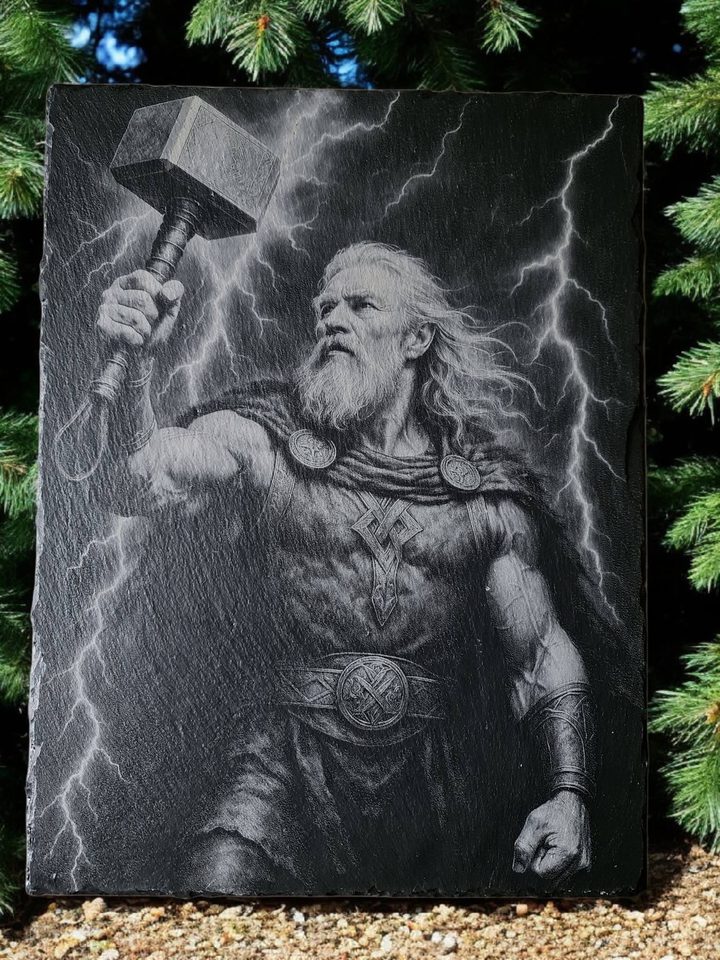
Thor · Thor versus Hrungnir · Loki · Thor's goats · The Norse pantheon.
In the beginning there was no word and no bang, but a void: Ginnungagap, the ‘yawning gap’. Between the fire in the …
Read more →Neither iron nor chains tamed the mightiest monster of the North, but a ribbon thin and soft as a silken thread …
Read more →A king has gold and peace ground for him – and grants the maids who turn the mill no rest. Grottasöngr is one of the …
Read more →A boar whose bristles are gold and glow in the dark, running over sky and water faster than any horse: Gullinbursti …
Read more →