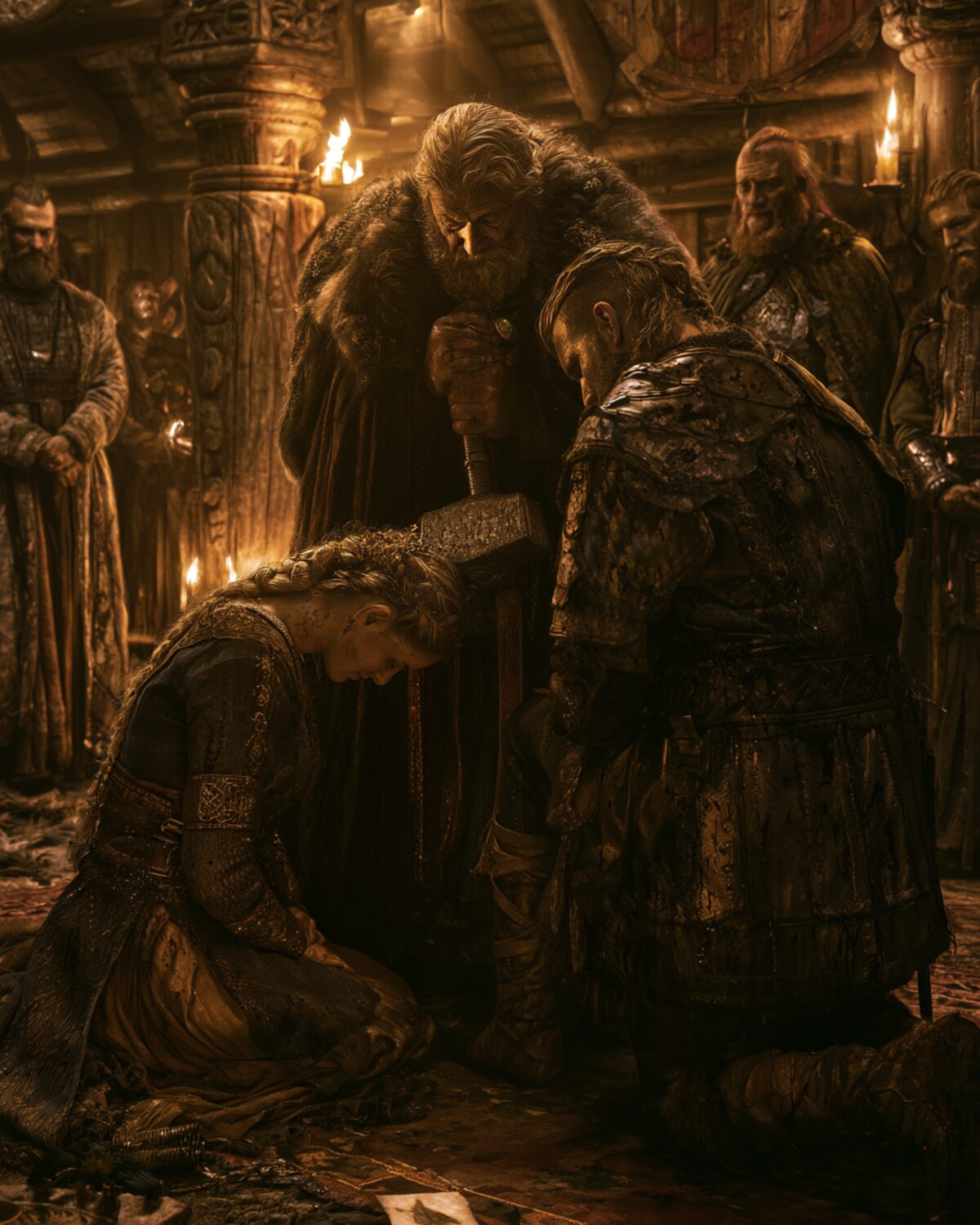
No god was so beloved by ordinary people as Thor. With hammer, strength-belt and thunder-chariot he holds the powers of chaos in check – red-bearded, quick-tempered, and with an appetite that frightens even giants.
Thor (Old Norse Þórr, continental Donar) is the god of thunder and the foremost protector of gods and humans. Son of Odin and the earth-goddess Jörð, he embodies strength, reliability and the tireless war against the giants, the powers of chaos. Where Odin works by cunning and sorcery, Thor works with the hammer.
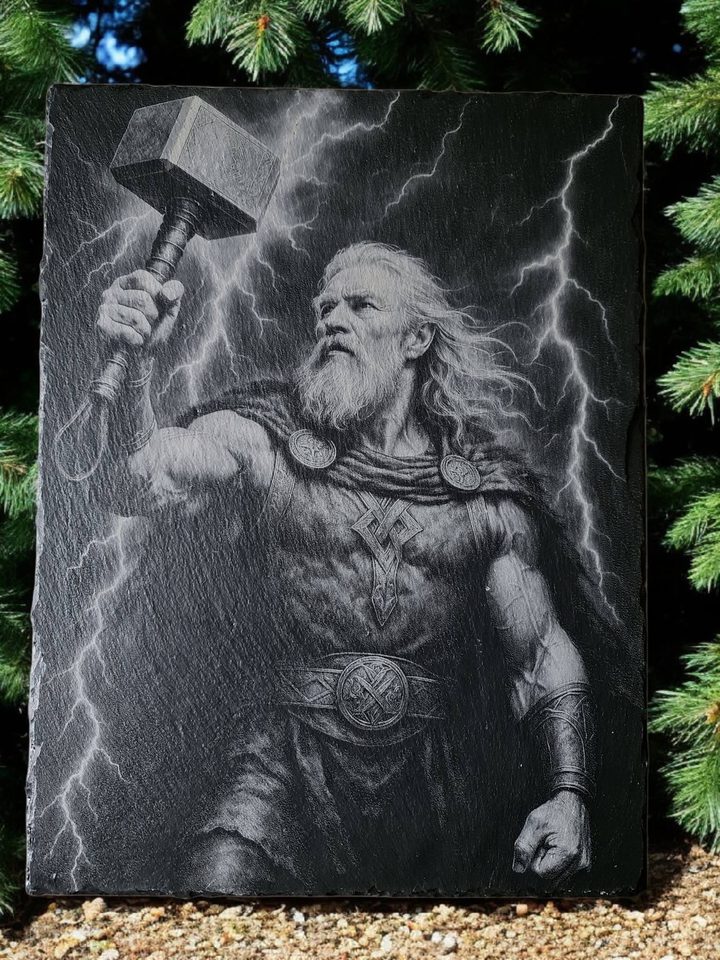
If Odin was the uncanny god of kings, then Thor was the god of the people – and by far the most beloved. He is the strongest of all the Æsir, protector of Asgard and Midgard, the wall between the ordered world and the chaos of the giants. Where Odin works through cunning and knowledge, Thor works through sheer strength, courage and reliability. He is the god one called upon when the thunderstorm rolled over the fields, when an oath was to be sealed or a marriage hallowed, when danger threatened. No wonder archaeology knows hundreds of Thor's-hammer amulets but hardly any Odin pendants: Thor was the god the common people wore on their bodies.
This article leads through the whole nature of the thunder god: his name and origin, the hammer Mjölnir and the goats, his great battles against giants and the Midgard Serpent, the famous journeys to Utgard and to Thrym, his role as the hallowing god of the people, his continental face as Donar – and his death at Ragnarök. As always, we separate what is documented from what remains later interpretation.

Thor's name is the thunder. Old Norse Þórr, Old High German Donar, Old English Þunor all go back to Proto-Germanic *Þunraz ("thunder"), which in turn points to the Indo-European root *(s)tenh₂- "to thunder" – the same as in Latin tonare and the English word "thunder" itself. God and natural phenomenon are inseparable: when his goat-drawn wagon rolls across the sky, the thunder rumbles; where his hammer strikes, the lightning flashes. To this day Thursday bears his name ("Thor's day"), formed after the Roman day of Jupiter, god of lightning and thunder.
Thor's weapon is the most famous object in all mythology: the hammer Mjölnir. It came about when Loki drove the dwarves Brokkr and Sindri into a contest against the sons of Ivaldi – and it was Loki's own sabotage (as a fly he stung the dwarf) that made the handle too short. Yet this very "flaw" makes Mjölnir the perfect throwing and striking weapon: it shatters skulls and mountains, always returns to Thor's hand, and at the same time hallows – blessing marriage, boundary and grave. Thor also wears the belt of strength Megingjörð, which doubles his power, and the iron gloves Járngreipr, with which he can grasp the glowing shaft. He rides a wagon drawn by the goats Tanngrisnir and Tanngnjóstr ("teeth-gnasher" and "teeth-barer"), which he can slaughter in the evening and revive from their unbroken bones. His hall is called Bilskírnir and has, says the Grímnismál, five hundred and forty rooms – the largest in all the realm of the gods.
Thor's life-task is the battle against the giants (Jötnar), the powers of chaos that constantly threaten the order of the world. Again and again he sets out, alone or with Loki, for Jötunheim to keep them in check. "Where have you been? Slaying giants" is practically his signature. This role makes him the true protector of gods and men: without Thor's hammer, Asgard would long since lie in ruins. In the myths he is therefore usually on the road when the other gods fall into distress – the reliable fighter one fetches when things turn serious.
Perhaps the greatest Thor story tells of his journey to the fortress of the giant king Utgard-Loki. There Thor and his companions are challenged to seemingly easy contests – and all fail. Loki loses an eating contest against "Logi", Thjalfi a race against "Hugi", and Thor himself cannot empty a drinking horn, cannot lift a grey cat off the ground, and is forced to one knee by the old woman "Elli". Only at parting does Utgard-Loki reveal the truth: all was illusion. Logi was fire, Hugi was thought, Elli was old age – whom no one defeats. The drinking horn reached into the sea (Thor drank it down measurably and so created the tides), and the "cat" was in truth the Midgard Serpent – Thor had nearly lifted it out of the world. The story is a masterpiece: even the strongest god is humbled, and yet his very "failure" shows how immense his strength is.

The most famous of all Thor myths is his fishing trip. The Eddic poem Hymiskviða and Snorri tell how Thor was a guest of the giant Hymir and rowed out fishing with him. As bait he tore the head from one of Hymir's oxen, cast the line – and onto the hook came his arch-enemy, the world-serpent Jörmungandr, which encircles the whole world in a ring. Thor braced himself against the bottom of the boat with such force that his feet broke through and stood on the sea-floor. He hauled the serpent up over the gunwale, hammer raised – but at the decisive moment the terrified Hymir cut the line, and the monster sank back into the deep. This scene was so popular that it was carved in stone on several picture stones (Altuna, Hørdum, Ardre) – one of the few myths we possess in image from the Viking Age itself.
Thor is not always just muscle – sometimes he is the punchline. In the Thrymskviða, one of the funniest Eddic poems, the giant Thrym steals Thor's hammer and demands the goddess Freyja as his wife in ransom. Instead of sacrificing Freyja, the gods disguise Thor himself as the bride – in a bridal veil, with Freyja's necklace Brísingamen. Loki accompanies him as a maid. At the wedding feast the "bride" devours a whole ox and eight salmon, and her eyes glowing under the veil terrify the giant – until Loki smooths it over with white lies ("she has not slept for eight nights out of longing"). When Thrym brings the hammer to hallow the bride, Thor seizes it – and slays the whole giant kin. The story shows a very different side of the god: coarse, comic, but in the end still the unbeatable fighter.
Two further great battles show Thor at the height of his power. Against the stone-giant Hrungnir, the strongest of the Jötnar, he fought a duel: Hrungnir's whetstone and Thor's hammer collided in mid-air, the stone shattered – a splinter lodged forever in Thor's head. Hrungnir fell, but his leg lay across the stunned god, and no Ase could lift it; only Thor's barely three-year-old son Magni pushed it aside – a hint of the future after Ragnarök. In the Þórsdrápa, meanwhile, Thor journeys against the giant Geirröd, this time without his hammer, only with the borrowed gifts of the giantess Gríðr (belt, gloves, staff). When Geirröd hurls a glowing iron bar at him, Thor catches it with the iron gloves and throws it back – straight through pillar, giant and wall.
For all his battle-fury, Thor was above all a near, helpful god. He was lord of weather and fertility: his thunderstorm rain made the fields flourish. Farmers and free men worshipped him as patron of house, farm and law; his hammer hallowed the bride at the wedding and sealed the oath. While Odin drew to himself the elite of skalds and princes, Thor was the god of the broad population – so much so that in Iceland, at the settlement, countless people bore names like Thorstein, Thorgeir or Thorgerd and adorned their high-seat pillars with images of Thor. In a famous passage Odin mocks in the Hárbarðsljóð: "Odin gets the nobles who fall in battle – Thor gets the kin of thralls." What was meant as mockery is in truth Thor's greatest honour.
Thor's hammer was not only a weapon but a sign of blessing. On several runestones stands the formula "Þórr vígi" – "may Thor hallow (these runes/this monument)", as on the stones of Glavendrup, Virring and Sønder Kirkeby. As Christianity advanced, many people defiantly wore the Thor's hammer as a counterpart to the cross; the famous mould from Trelleborg could cast hammer and cross side by side – the craftsman served both worlds of belief. A Danish hammer from Købelev even bears the runic inscription "this is a hammer". So Mjölnir became the strongest sign of faith of the late heathen age – and is to this day the most popular Norse motif of all.
Long before the Vikings called him Þórr, the continental Germani worshipped him as Donar. The Romans equated him with Hercules (interpretatio Romana) – the club-wielding protector. His sacred tree was the oak, into which the lightning strikes; the most famous, the Donar oak at Geismar, was felled by the missionary Boniface around 723 to prove the old god's impotence. In folk belief the thunder god lived on: prehistoric stone axes were held to be "thunderstones" buried under the threshold for protection. More on this in our articles on Donar and Wodan, Donar and Ziu.
Thor's fate is bound up with his arch-enemy. At Ragnarök, the doom of the world, the thunder god and the Midgard Serpent meet one last time. Thor slays the monster with Mjölnir – but struck by its venom, he staggers only nine steps before sinking down dead. It is a worthy, tragic death: the protector dies by dragging the last, greatest threat down into ruin with him. Yet the world does not end forever – after the fire it rises anew from the sea, and Thor's sons Magni and Modi survive and carry the hammer into the new age (see What comes after Ragnarök).
No other Norse god is as present today as Thor. He stands in the calendar (Thursday), his hammer hangs on thousands of necks, and popular culture – from Wagner to Marvel – has made him world-famous. It is worth an honest look at the sources, though: the Marvel Thor is a modern invention that shares with the god of the Edda only the name and the hammer. Loki is his "brother" there (in the mythology he is not), Hel becomes an adversary, and Mjölnir gets an invented inscription. The real Thor is coarser, older and deeper: a red-bearded god of the thunderstorm, of fertility and protection, beloved by farmers and warriors alike. That is exactly what makes him, to this day, the heart of Norse art – the reliable god who stands between us and chaos.
Thor himself springs from a union of order and wilderness: his father is Odin, his mother the earth goddess Jörd ("Earth") – so the thunder god is, quite literally, a child of sky and earth. His wife is the golden-haired Sif, whose shining hair has always been read as an image of the ripe cornfield; their marriage links the weather god with the fertility of the fields. From Thor's union with the giantess Járnsaxa comes the superhumanly strong Magni ("the mighty"), together with Modi ("the brave") and the daughter Thrud ("strength"). Sif's son Ull, the archer and ski god, is Thor's stepson. In this family Thor's whole nature is mirrored: earth, harvest, raw strength and courage.
A consequential story begins with a nasty prank: Loki, out of malice, cut off the sleeping Sif's magnificent hair. Thor's wrath was so great that Loki had to swear to provide a replacement. So Loki descended to the dwarves – and to save his head, drove two dwarven workshops into a contest. From this one misdeed came the six greatest treasures of the gods: new, real gold hair for Sif that grows by itself, plus Odin's spear Gungnir and ring Draupnir, Freyr's ship Skíðblaðnir and boar Gullinbursti – and, as the crown, Thor's hammer Mjölnir. So the north owes its most important object, of all things, to a wicked joke about Sif's hair.
Unlike most gods, Thor often travels with humans at his side. On the way to Jötunheim he stopped at a poor farming family and slaughtered his two goats for the meal – with the instruction to lay all the bones unbroken on the hides. But the son Thjalfi secretly split a bone to get at the marrow. When Thor revived the goats in the morning with his hammer, one was lame. In his rising wrath Thor seized the hammer – but instead of slaying the family, he took the children Thjalfi and Röskva as servants. Thjalfi, the swiftest runner, became one of his most faithful companions. The story shows Thor's human side: hot-tempered, but just – and generous towards the weak.
Thor does not always win with the hammer – sometimes with patience. In the Alvíssmál the dwarf Alvíss ("all-wise") had come to marry Thor's daughter Thrud, who had been promised to him in Thor's absence. Thor, returned home, could not break the contract openly – so he set the dwarf a ruse: he had him explain the names of all things in the languages of gods, giants, elves and men. The vain dwarf answered question after question until, over the debate, the sun rose – and Alvíss, who like all dwarves cannot bear daylight, turned to stone. "With great cunning, I tell you, you have been outwitted", Thor mocks. The thunder god, usually the man of raw strength, here wins through cleverness – and saves his daughter.
The frame of the Hymiskviða tells why Thor went to the giant Hymir in the first place. The gods wanted to hold a great feast at Ægir's, the lord of the sea – but a cauldron was lacking, large enough to brew ale for all the Æsir. Only Hymir owned such a one, a mile deep and huge. Thor and Týr set out to fetch it; Thor passed Hymir's tests (he smashed a cup on the giant's own forehead, for it was harder than any stone), and in the end carried off the mighty cauldron – pursued by a whole army of giants, whom he shattered with the hammer. Only this stolen cauldron made the famous feast of the gods possible. The story unites two of Thor's roles: the tireless giant-slayer and the guarantor of the festive community.
Thor's cult was widespread and deeply rooted. Adam of Bremen describes (as a hostile outside view) the temple of Uppsala, where three god-images stood – and Thor, according to him, sat in the middle, as the mightiest, flanked by Odin and Freyr; he ruled, says Adam, over weather, thunder, wind, rain and the crops. Whether this reflects a real ranking or is Adam's interpretation remains open – but it shows how central Thor was held to be. In Iceland farms, people and temple pillars bore his name; many settlers, on arrival, threw their high-seat pillars adorned with Thor into the sea and settled where the gods drove them. The thunder god was the god of everyday life – near, reliable, everywhere.
How was Thor imagined? The sources agree: a powerful man with a red beard, flowing hair and flashing eyes, whose mere wrath hurls lightning. When he is angry, "his eyes swelled" – an image that runs through all the myths. His goat-drawn wagon is the mythic explanation of thunder itself: the rumble in the sky is the rolling of his wheels over the clouds. The Romans, by the way, knew this link in their Jupiter, the Celts in Taranis with his wheel – the thunder god with his weapon in the sky is an ancient, common Indo-European image that in the north merely found its most powerful form. This close bond of god and weather made him as tangible as no other: every thunderstorm was a visible sign of his nearness.
No other god has left so clear an archaeological footprint as Thor. Over a thousand Thor's-hammer amulets are known – in silver, bronze, amber and plain iron, worn as pendants at the neck, found in graves and hoards from Scandinavia to England and into the Kievan Rus. The archaeologist Jörn Staecker classified them; the most common form is the simple iron hammer, while the richly decorated silver examples are rarer. Especially telling is the mould from Trelleborg, which could cast Thor's hammer and Christian cross side by side – a craftsman serving both worlds of belief in the turning of the age. And the hammer from Købelev (Denmark) bears the runic inscription "this is a hammer" – as if the wearer wanted to remove any doubt. This wealth of real finds makes Thor the best materially attested god of the north – more solid than any saga could ever be.
Thor's popularity can also be read in the language. No god's name appears in so many personal names: Thorstein (Thor-stone), Thorbjörn, Thorgeir, Thorvald, Thorgerd, Thorunn – and beyond English "Thursday" in countless place names like Torslunda ("Thor's grove") or Torsåker ("Thor's field"). While Odin's name hardly appears in personal names, Thor was the god after whom people named their children – an unmistakable sign of how deeply they trusted him. The weekday too carries him across the Germanic languages: Old Norse Þórsdagr, Danish/Swedish torsdag, Dutch donderdag, English Thursday, German Donnerstag – five languages, one god. Whoever is called "Thorsten" today carries the thunder god in their own name.
What makes Thor so alive are his very human traits. He is hot-tempered – at the smallest outrage his hand goes to the hammer – but his wrath is always turned against real threats, never against the weak. He is a mighty eater and drinker: in the Thrymskviða, as the "bride", he devours a whole ox, eight salmon and three casks of mead, and at Hymir's he puts away two oxen at once. He can be deceived (at Utgard-Loki), he can be disguised (at Thrym's), he loses his composure – and yet remains the one who, in the end, can be relied upon. This mix of raw strength, coarse humour and deep loyalty sets him apart from the cool, calculating gods. Thor is the god one can identify with: not perfect, but upright, brave and true.
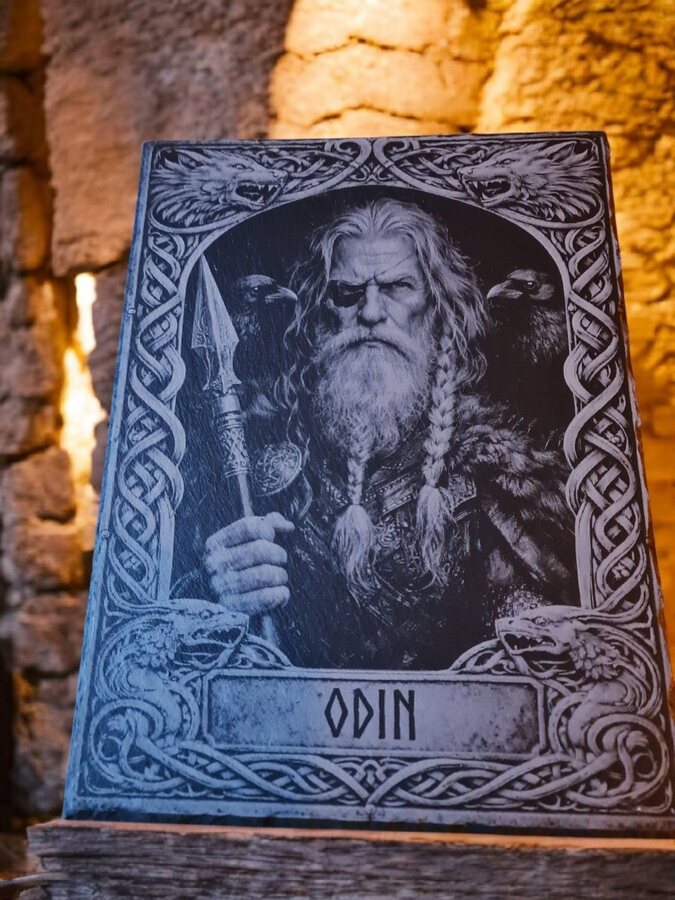
Father and son embody two opposite ideals of the north. Odin is the god of the elite – of kings, skalds and sorcerers, who works through cunning, knowledge and betrayal and gathers the fallen for his own purpose. Thor is the god of the people – straightforward, reliable, without hidden motives. Odin breaks oaths; Thor seals them. Odin takes; Thor protects. In the flyting poem Hárbarðsljóð the two attitudes face each other, and the mockery of the disguised Odin reveals the gulf: the aristocratic world of the few against the farming world of the many. That Thor remained the more beloved through the centuries says much about which god the people really trusted.
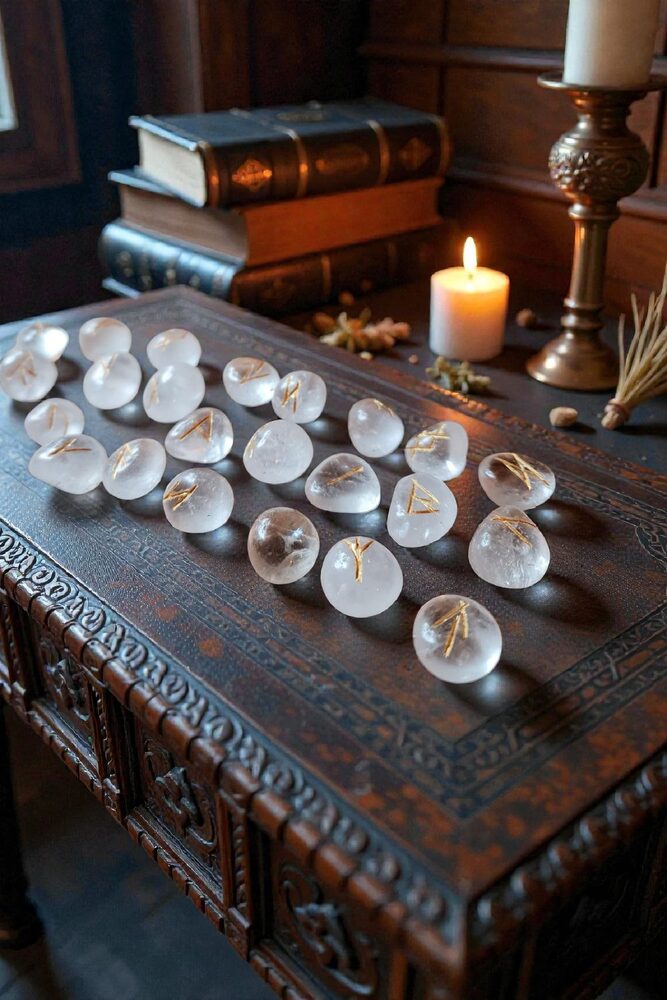
Thor is the most accessible of all Norse gods – and perhaps for that very reason the most enduring. He embodies values that matter in every age: strength in the service of protection, courage without calculation, reliability, a hot heart with a good core. He is no distant ruler but the god who lends a hand himself, who fights for his own and in the end even gives his life to save the world from the serpent. For us as a Norse workshop he is the very heart of it: the hammer we engrave in slate, wood or crystal glass is no mere ornament but the oldest protective sign of the north – a symbol of strength, blessing and togetherness, worn for over a thousand years and to this day undiminished in power. Whoever has a Thor's hammer engraved chooses this heritage consciously: not a fashionable accessory, but a sign with two thousand years of history – from the Hercules of the Romans through the Donar oak and the silent iron hammers of the Viking graves to the red thunder that still rolls over our fields today.
"Then Thor grew wroth and gripped the hammer, so that the rock of the mountains burst to gravel."after the Poetic Edda (public-domain translation)
Mjölnir – Thor’s hammer · The Midgard Serpent · Thor & Skrymir · Jötunheim · Ragnarök · The Norse pantheon.
Völuspá, Þrymskviða, Hymiskviða, Hárbarðsljóð (Poetic Edda), English public domain: Henry Adams Bellows (1923). Snorri Sturluson, Gylfaginning, Skáldskaparmál. Willibald, Vita Bonifatii (c. 760). Scholarship: Rudolf Simek, Dictionary of Northern Mythology; John Lindow, Norse Mythology (2001).
All Gods & Goddesses articles →
Tyr is the god who knew what order costs – and was willing to pay it with his own hand. Once perhaps the highest …
Read more →He is one of the best-known “unknown” gods: everyone who studies the mythology knows his name – and yet Ullr scarcely …
Read more →Odin is the god who pays any price for knowledge – his eye, death on the tree, and nearly his head. In Vafþrúðnismál he …
Read more →Think of Norse gods and you think of the Aesir: Odin, Thor, Tyr. But the sources know a second divine family – the …
Read more →