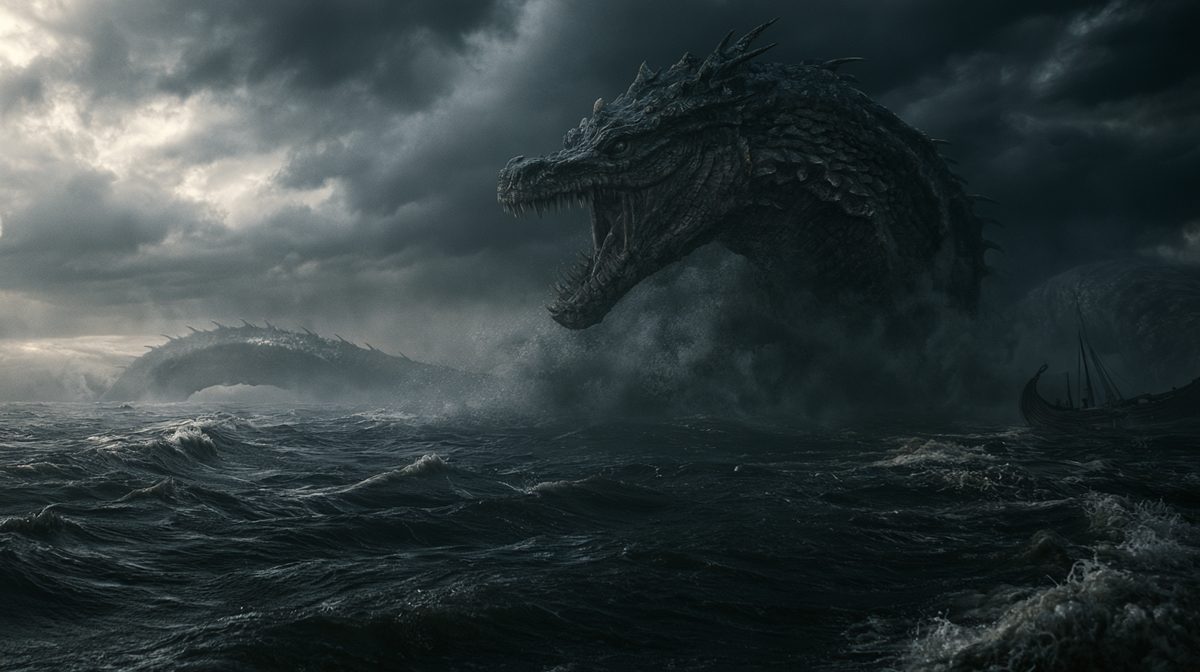
Jörmungandr, the Midgard Serpent, is the gigantic sea serpent of Norse mythology that lies in the world ocean, coils around the entire inhabited earth and bites its own tail. It is a child of Loki and the giantess Angrboða, Thor’s lifelong enemy – and at Ragnarök the two destroy each other. This guide explains what the name means, which sources actually tell its story, why picture stones from Sweden, Denmark and England matter so much, and which parts are later interpretation.
Picture a grey autumn sea off the coast of western Norway. The swell is heavy, the horizon empty. For people of the Viking Age, that emptiness was not empty at all. Somewhere out there, at the very edge of things, something lay coiled – something so vast that it wrapped around the world like a ring.
That something has a name. Several, in fact. In this guide we follow them from the meaning of the word through the Eddic poems and some remarkably early skaldic verse to the stones on which Thor casts his line. Along the way we keep a clear line between what the sources say and what later centuries made of them.
In Old Norse the serpent is called Jǫrmungandr, usually anglicised as Jörmungandr or Jormungand. The name is a compound. The first element, jǫrmun-, is an intensifier meaning something huge, immense, almost all-encompassing. It also appears in the name of the Gothic king Ermanaric (Old Norse Jǫrmunrekkr). Some scholars have proposed an old noun jǫrmunr meaning “world”, which would make Jörmungandr literally the “world serpent” – but that is a hypothesis, not an established fact.
The second element, gandr, is harder to pin down. It can mean “staff”, especially a magic staff, but it is also used of supernatural beings and monsters, and in poetry of long, slender things such as snakes or rivers. That is why you will see the name translated as “mighty staff” or “huge monster”. Both fit nicely: an endlessly long, snake-shaped body that is at the same time a magically charged beast.
The plainer name is Miðgarðsormr, “the Midgard Serpent” or literally “the worm of Midgard”. Ormr is the ordinary Old Norse word for both snake and dragon – a distinction modern readers make but Viking-Age Scandinavians largely did not (more on that in our article on dragons and serpents in the North). Midgard, the “middle enclosure”, is the world of humans. So the serpent is named not for what it is but for where it lies: it is the thing that surrounds Midgard.
The fullest origin story comes from Snorri Sturluson in Gylfaginning, chapter 34 – part of the Prose Edda, written in Iceland around 1220. Loki has three children with the giantess Angrboða (“she who forebodes grief”): the wolf Fenrir, the Midgard Serpent and Hel. The gods learn from prophecies that great harm will come from these siblings – because of their mother, and even more because of their father.
So Odin, whom Snorri calls the All-Father, takes action. He has the children brought to him and, in effect, assigns each of them a prison. Hel is sent down to Niflheim and given power over the dead. Fenrir is raised among the gods and eventually bound. The serpent Odin throws into the deep sea that surrounds all lands. There it grows until it lies in the middle of the ocean, encircling the whole earth and biting its own tail.
Notice what the gods do not do: they do not kill the threat. They store it away. The wolf is chained, the death goddess dispatched, the serpent sunk. The folklorist John Lindow has pointed out that a serpent biting its own tail is essentially a bound serpent – it holds itself fast. That links it to Fenrir and to Loki himself, who ends up bound as well. All three are waiting. All three break loose at Ragnarök.
The best-known Jörmungandr story is a fishing trip. It is told in the Eddic poem Hymiskviða, “the Lay of Hymir”, preserved in the Codex Regius, the manuscript of the Poetic Edda written in the later thirteenth century. How old the poem itself is remains debated; many scholars regard it as a relatively late, deliberately elaborate composition that recombines older material.
The frame: the gods want to feast at the hall of the sea-giant Ægir, but he lacks a cauldron big enough to brew their ale. So Thor and Tyr travel to the giant Hymir, who owns one. At dinner Thor wolfs down two whole oxen, so the next day there must be fish.
For bait, Thor tears the head off a black ox from Hymir’s herd. Out on the water he urges the giant to row further than Hymir would like. Hymir hauls up two whales at once – not bad. Then Thor casts his line with the ox head. In stanzas 21–24 (numbering of the standard Neckel/Kuhn edition; other editions differ slightly) the serpent takes the bait. Here the poem calls Thor orms einbani, “the serpent’s sole slayer”.
Thor drags the monster up to the gunwale and strikes its head with his hammer. Rocks roar, the old earth shudders – and then “the fish” sinks back into the sea. Hymir rows home in sullen silence.
What the Hymiskviða does not contain is just as interesting: Hymir cuts no line. The serpent simply escapes – or the text has a gap here. Bellows himself suspected that a line had been lost. The famous severed line comes chiefly from another source.
Snorri tells the fishing trip in Gylfaginning, chapter 48, at greater length and with a different setup. In his version Thor sets out alone, disguised as a young lad, and asks Hymir if he may row out with him. The giant scoffs that such a scrap of a boy will be no use at sea.
Thor fetches his own bait: he rips the head off the biggest ox in the herd, Himinhrjóðr (roughly “heaven-bellower” or “sky-breaker”; the meaning is uncertain). Far out at sea the Midgard Serpent bites; the hook catches in the roof of its mouth, and it jerks so hard that Thor’s fists slam against the gunwale. Now Thor grows angry, summons his full divine strength and braces so hard that he pushes both feet through the bottom of the boat and stands on the sea floor.
Thor glares at the serpent; the serpent glares back and spews venom. Hymir goes pale with terror. Just as Thor raises his hammer, the giant grabs his bait-knife and cuts the line. The serpent sinks back. Thor hurls his hammer after it.
Then comes one of the most honest moments in the whole Prose Edda. In Arthur Gilchrist Brodeur’s 1916 translation, Snorri’s narrator reports that “men say that he struck off its head against the bottom” – but adds that in his own view the Midgard Serpent still lives and lies in the encircling sea. Two versions, side by side. Snorri clearly knew there were competing traditions, and he chose the one that fitted his Ragnarök finale. To round things off, Thor boxes Hymir on the ear so that the giant tumbles overboard, and wades ashore.
This is where it gets exciting, because the Edda manuscripts date from the thirteenth century – Christian times. Yet Thor’s fishing trip is one of the earliest attested motifs in all of Norse mythology. The reason is skaldic poetry, the court verse of the Viking Age, whose strict metre helped preserve it with surprising accuracy. Our article on the Edda explains how that transmission worked.
Bragi Boddason, “Bragi the Old”, is regarded as the earliest skald known by name and is placed in the ninth century. Several stanzas about Thor’s fishing are attributed to him, and in them a frightened Hymir cuts the line. Whether these stanzas belong to the Ragnarsdrápa, Bragi’s poem about a painted shield, is disputed. That they are old and attributed to Bragi is not.
Úlfr Uggason composed the Húsdrápa, the “House Poem”, around 985. According to Laxdæla saga, he performed it at a wedding feast in the new hall of the Icelandic chieftain Óláfr pái at Hjarðarholt. The hall’s wooden panels were carved with mythological scenes, and Úlfr described them. One of them was Thor’s fishing trip – and in Úlfr’s version Thor strikes the serpent’s head off. No escape for the monster. This is most likely the tradition Snorri meant by “men say”.
Eysteinn Valdason, another tenth-century Icelandic skald, left three half-stanzas about the fishing trip, preserved only because Snorri quotes them in his handbook of poetics, Skáldskaparmál. And Gamli gnævaðarskáld, also of the tenth century, has Thor kill the serpent in a surviving stanza.
The picture that emerges is striking. Already in pagan times there were at least two endings. In one, the serpent escapes because the giant cuts the line. In another, it dies at the boat. The neat Edda narrative we know today is the product of a choice.
Four stones from three countries are linked with Thor’s fishing trip by scholars. Their dates range from the eighth to the eleventh century, which makes them independent witnesses alongside the poetry.
Ardre VIII is a picture stone from Gotland, dated broadly to the eighth to tenth century. In one of its panels many scholars see two men in a boat with a fishing line – Thor and Hymir. The identification is not universally accepted, because the Gotland stones carry no inscriptions and their scenes are open to interpretation. If it is right, Ardre VIII is the oldest image of the myth. You can learn more about this unique type of monument in our article on the picture stones of Gotland.
The Altuna stone (runic inscription U 1161) stands in Uppland, Sweden, and dates from the eleventh century. It is a memorial stone raised by sons for their father; the inscription names Balli and Frøystæinn as carvers. One side shows Thor alone in his boat, hammer raised, line cast with the ox head as bait, the serpent below – and, beautifully clear, a foot pushing through the bottom of the boat. Snorri writes this detail down only some 150 to 200 years later. Hymir is missing, perhaps simply because the narrow face of the stone left no room. The ornament is carved in the Urnes style, the last great animal style of the Viking Age.
The Hørdum stone was found in 1954 during work next to the church at Hørdum in Thy, northern Jutland, Denmark, and is now displayed inside the church. The fragment shows two figures in a boat, the fishing line, part of the serpent and, again, the foot breaking through the hull. One figure, probably Hymir, appears to hold a tool – possibly to cut the line.
Furthest west is the so-called Gosforth fishing stone in Cumbria, northern England. It is kept in St Mary’s Church and is thought to be the work of the same sculptor who carved the famous Gosforth Cross of the early tenth century. It shows two men in a boat, bait that looks like an ox head, and fish in the water. More on this in our article Gosforth and Thorwald’s Cross.
Thor’s second great encounter with Jörmungandr comes in disguise. Snorri tells it in Gylfaginning, chapters 46–47. Thor travels with Loki and his servants Þjálfi and Röskva to the giant king Utgard-Loki. There the guests must prove their strength in contests, and Thor loses one after another.
One task seems laughable: Thor is to lift a large grey cat off the floor. He puts his hands under its belly and heaves. The higher he lifts, the higher the cat arches its back. In the end the thunder god manages to raise just one paw from the floor. Utgard-Loki sneers that he expected no more – Thor is small next to the folk here.
Only when Thor leaves does the giant reveal the truth. It was all illusion. The drinking horn Thor could not empty was connected to the sea, and his gulps lowered the ocean so much that this is why we have ebb tides. The old woman who beat him at wrestling was Old Age herself. And the cat? That was the Midgard Serpent, which lies around all lands. Thor had lifted it so high that head and tail barely touched the earth and his reach almost touched the sky. The giants had been terrified.
The serpent here is not just a monster but a yardstick. It is as large as the world, and anyone who lifts it moves the world. That Thor nearly does so without even knowing it makes him greater than any won wager could.
What the fishing trip left open is decided at the end of the world. The Völuspá, “the Prophecy of the Seeress” and the most famous poem of the Poetic Edda, describes in stanza 50 how Jörmungandr writhes in giant-rage and lashes the waves. Bellows renders it: “In giant-wrath does the serpent writhe.” The serpent comes out of the sea – and the sea comes with it.
In stanza 56 (usual numbering; the stanzas of this passage are jumbled in the manuscripts and partly corrupt) Thor, called here “the son of Fjörgyn”, faces the serpent. Bellows translates: “Nine paces fares the son of Fjorgyn.” The Old Norse word neppr used of Thor means something like “exhausted, spent”. The stanza does not explicitly mention venom, and Thor’s death is hinted at rather than spelled out.
Snorri turns this into a clear scene in Gylfaginning, chapter 51. The Midgard Serpent blows out so much poison that air and sea are drenched with it. On the plain of Vígríðr the old enemies meet. Thor kills the serpent, walks nine steps away from it and falls dead to the ground – killed by the venom it has spat at him. So the poison as cause of death comes from Snorri’s prose; the nine steps are already in the poem.
Nine is one of the weighty numbers of the Edda – nine worlds, nine nights on the tree. Thor wins, and then walks his own short stretch to death. His hammer survives him: in the renewed world after the end, according to the poem Vafþrúðnismál, his sons Magni and Móði inherit Mjölnir.
Snorri’s image of the serpent lying around the earth and biting its own tail reminds many people of the ouroboros, the “tail-devourer”. The symbol is very old: a self-encircling serpent already appears on one of the gilded shrines from the tomb of Tutankhamun, in the fourteenth century BC. In late antique alchemy it later became an emblem of eternity and cyclical renewal.
So is Jörmungandr a Norse ouroboros? We are cautious. First, the comparison is only a comparison: there is no evidence that Viking-Age Scandinavians knew the Egyptian or Greek symbol. Second, the gesture means something different in the North. The ouroboros stands for eternal return; the Midgard Serpent stands for a boundary that will one day break. It holds not because it is eternal but because it is bound. That the learned Snorri knew the image from books is conceivable, but cannot be proven.
Four lines of interpretation are common – and none of them is more than a reading.
The serpent as world ocean and world boundary. The most obvious reading is cosmological. The inhabited world is a disc or island surrounded by ocean, and at its edge lies something that holds everything together. Jörmungandr embodies the border between order and the outside. As long as it stays in the sea, Midgard holds. When it comes ashore, the sea floods the land – exactly what happens at Ragnarök. How the Edda structures the cosmos, and which parts are later systematisation, we explain in our article on the nine worlds.
The serpent as chaos. Closely related is the reading of the serpent as a force of chaos. Many mythologies know a storm god fighting a serpent or dragon: Indra against Vritra in India, the Baltic and Slavic thunder god against his adversary, Zeus against Typhon. Thor’s fight would then be a Norse variant of an old Indo-European pattern – a plausible comparative reconstruction, not something the sources say.
The premature fight. In an influential 1986 essay, the Danish philologist Preben Meulengracht Sørensen suggested reading the fishing trip as a battle that comes too early. Thor wants to kill the serpent, but its time has not yet come – and since it holds the world together, its death before Ragnarök would itself be a catastrophe. The giant who cuts the line, of all people, saves the cosmic order. A lovely ironic twist, and one that fits Snorri’s version especially well.
Christian readings. For the Gosforth stone and the world of the Anglo-Scandinavian crosses, scholars have discussed whether Thor’s fishing was understood as a counterpart to a Christian image: Christ catching Leviathan, the sea monster, with the cross as his fishhook – an idea widespread in medieval theology. Whether the sculptors meant it that way, we do not know.
Since the eighteenth century, painters have been drawn above all to the fishing scene. An early and famous example is Henry Fuseli’s Thor Battering the Midgard Serpent of 1790, which belongs to the Royal Academy of Arts in London – one of the first large-scale depictions of the scene in European art.
Today you are most likely to meet Jörmungandr in comics, novels and games. In the video game God of War (2018) the “World Serpent” is a colossal, almost friendly figure; in Marvel comics Thor fights it regularly. As free retellings these are perfectly legitimate – they just have little to do with the sources.
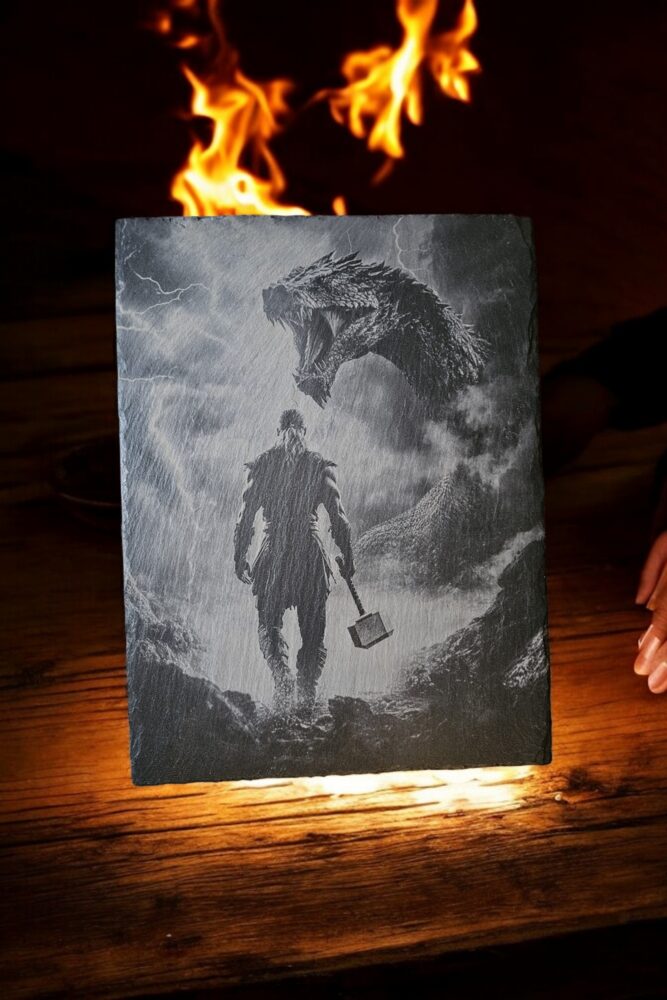
For us in the workshop in Alsdorf, the Midgard Serpent is a gift. An endless body that closes into a circle is almost the perfect composition for a round slate plaque or a wooden tree slice. For the detail work we like to draw on the slender, interlaced animal bodies of the Urnes style, as on the Altuna stone.
Two motifs we especially recommend:
You can see how we translate motifs like these onto slate on our page about slate engraving. And if you have an idea of your own – a serpent for a sailor, a gift for someone who loves the old stories – get in touch via our custom engraving page.
What does Jörmungandr mean? The name combines jǫrmun-, “huge, mighty”, with gandr, “staff, magic staff, monster”. It is usually translated as “mighty staff” or “huge monster”.
Who are the parents of the Midgard Serpent? According to Snorri’s Prose Edda, it is a child of the god Loki and the giantess Angrboða. Its siblings are the wolf Fenrir and the death goddess Hel.
Why does Jörmungandr bite its own tail? After Odin throws it into the sea, it grows so large that it encircles the entire earth. In Snorri the tail-bite is an image of the world’s boundary, not of eternal recurrence.
Who kills Jörmungandr? Thor kills the serpent at Ragnarök. He then walks nine steps and dies of its venom.
Where is Thor’s fishing trip shown on stones? On the Altuna runestone in Sweden, the Hørdum stone in Denmark, the Gosforth fishing stone in England, and probably on the Ardre VIII picture stone on Gotland.
For courage. For remembrance. For legends that live on.
Thor · Fenrir, the wolf · Loki · Gotland’s picture stones · Ragnarök · The nine worlds · The Norse pantheon.
No god of the North is without his treasure: Thor without his hammer would be only an angry giant, Odin without spear …
Read more →Where does poetry come from? The North had an uncannily beautiful answer to this: from the blood of a wise being …
Read more →A feast of the gods, ale in plenty – and a guest who exposes every single one of them. The Lokasenna („Loki’s flyting") …
Read more →Every misdeed has its price, and Loki’s bill is settled all at once. After the death of Baldr and his merciless mockery …
Read more →