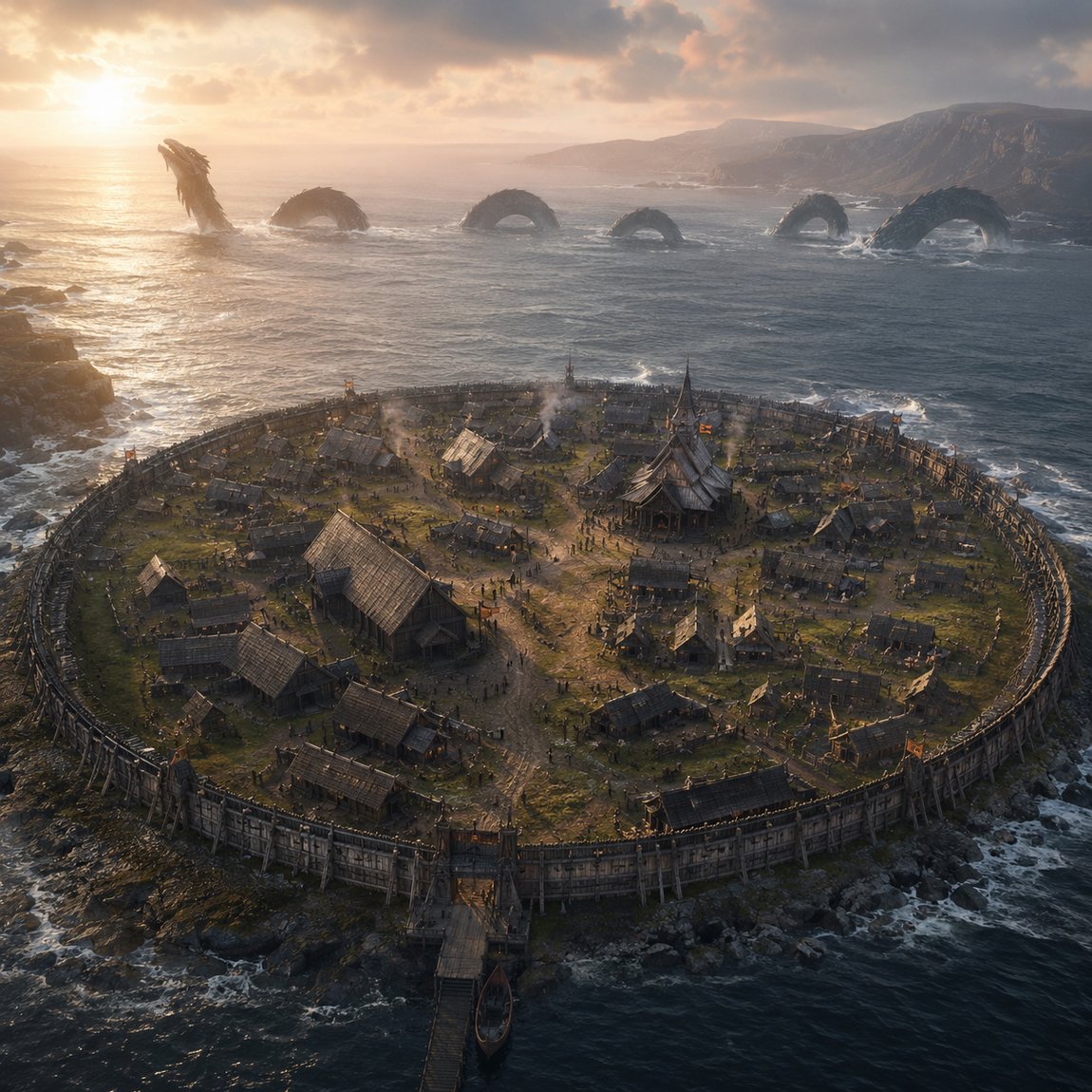
Midgard (Old Norse Miðgarðr) is the world of humans in Norse mythology: the “enclosed place in the middle”, raised from the sea by the sons of Burr in the Poetic Edda and, according to Snorri, fenced off against the giants with a wall made from the brows of the primeval giant Ymir. Beyond it lies the world ocean and the Midgard Serpent. The word itself is far older than the Edda – Goths, Anglo-Saxons and continental Saxons used it long before the Viking Age. Here we separate evidence, late tradition and modern interpretation.
You are standing in Midgard right now. When a Viking talked about the world where people plough fields, build houses, marry and die, that is what he called it. Midgard is not a distant realm of gods and not a fantasy continent. It is the inhabited earth under your own feet – imagined as a fenced farmyard in the middle of a cosmos that is cold, wet and crawling with giants on the outside. That is what makes the idea so powerful. One single word tells you how people ordered their world: the familiar inside, the dangerous outside, and a fence in between.
The name is built from two plain parts. Mið- means “middle”, the same root as English “mid” and “middle”. Garðr first meant a fence, then whatever a fence encloses: a yard, a farmstead, a hedged piece of land. The same word survives in English “yard” and “garden” and in German “Garten”. Historical linguists reconstruct a common Proto-Germanic form *midja-gardaz (the asterisk marks a form that is inferred, not attested), literally “the enclosed place in the middle”.
The fence is the key. A garðr is not a natural feature; it is something people make. Whoever puts up a fence creates an inside and an outside. So from the very beginning Midgard is not simply “the earth” in a geographical sense. It is the cultivated, ordered world that humans live in. That fits a farming society in which the fence around the homestead literally marked the line between safety and wilderness.
This is where it gets interesting, because Midgard is not some Icelandic peculiarity. The oldest attestations come from Christian texts. In the 4th century the Gothic bishop Wulfila translated the Bible into Gothic and needed a word for the Greek oikoumene, the inhabited world. He chose midjungards. In the Gospel of Luke, where Emperor Augustus orders a census of the whole world, the Gothic Bible uses exactly this word. The Gothic form has an extra -n- in its first element, but the meaning is the same.
In England the word appears as middangeard, and in famous places. Cædmon's Hymn, preserved in connection with Bede's history of around 731 and counted among the oldest surviving English poems, praises God as the one who afterwards made middangeard for mankind. Beowulf uses middangeard several times, and so does religious poetry such as Christ I with its celebrated address to Earendel, “brightest of angels, sent to men over middangeard” – a line that will come back later.
On the Continent the word survived too. The Old Saxon Heliand, a 9th-century retelling of the Gospels, speaks of things happening “over middilgard”. And in the Old High German Muspilli, a Bavarian poem about the end of the world from the 9th century, line 54 contains a half-line that makes every Edda reader sit up: mano uallit, prinnit mittilagart – “the moon falls, Middle-earth burns”.
Pause on that for a moment. A Christian text from Bavaria describes the end of days with the image of a burning Midgard, and centuries later the Icelandic Völuspá tells how the world perishes in fire at Ragnarök. Whether both draw on a shared pre-Christian image, or whether both independently reflect Christian apocalyptic ideas, is disputed among scholars. What is certain is this: the word for the human world was in use across the whole Germanic-speaking area before Iceland had even been settled.
The key mythological passage sits right at the start of the Völuspá, the “Prophecy of the Seeress” that opens the Poetic Edda. The seeress remembers the time when nothing existed: no sand, no sea, no cool waves, no earth and no sky above, only a yawning gap – Ginnungagap. Then comes stanza 4. In Old Norse it begins Áðr Burs synir bjǫðum um yppðu. In our own, fairly literal rendering:
Until the sons of Burr lifted up the lands,
they who shaped the glorious Midgard;
the sun shone from the south on the stones of the hall,
then the ground was grown with green leek.Völuspá 4, our own translation from Old Norse
The sons of Burr are, according to Snorri, Odin, Vili and Vé. What stands out is that the Völuspá does not mention Ymir's body here at all. The picture is a different one: land is lifted up out of the depths, the sun shines on it, and it turns green. Many scholars read this as the earth rising from a primeval sea – a creation image that stands beside the dismembered-giant myth without the sources ever neatly joining the two.
What the Völuspá hints at in four lines, Snorri Sturluson turned into a full building plan in his Prose Edda around 1220. In Gylfaginning (“The Deluding of Gylfi”) Odin and his brothers kill the primeval giant Ymir and make the world out of him: the earth from his flesh, the sea and lakes from his blood, mountains from his bones, rocks and scree from his teeth and broken bones, and the sky from his skull.
Then, in chapter 8, comes the passage we care about. In Arthur Gilchrist Brodeur's public-domain translation of 1916, the earth “is ring-shaped without, and round about her without lieth the deep sea”. Along the shore of that sea the gods gave land to the races of giants to live in. But on the inner side of the earth they built a stronghold around the world against the hostility of the giants – “for their citadel they raised up the brows of Ymir the giant, and called that place Midgard.”
Snorri is drawing on the eddic poem Grímnismál. Stanza 41 reads En ór hans brám gerðu blíð regin / miðgarð manna sonum – roughly: “From his brows the kindly gods made Midgard for the sons of men.” The preceding stanza 40 lists flesh, blood, bones, hair and skull. A similar creation catalogue appears in Vafþrúðnismál.
The Old Norse word brár can mean “eyelashes” or “eyebrows”, and translators still disagree. The image works either way: just as lashes frame and guard the eye, the wall frames the human world. Notice that in Snorri “Midgard” can mean two things. Sometimes it is the fortification itself, the rampart of Ymir's brows. Elsewhere it is the whole land inside that rampart where people live. According to Snorri the first humans, Ask and Embla, were given their dwelling “under Midgard” – in the protected interior.
Put Snorri's details together and you get a picture of concentric rings. On the very outside, the deep world ocean. On its shore, the lands of the giants. Then the wall. Inside it, Midgard, the world of humans. And in the middle of the world, Snorri says in chapter 9, the gods built their own stronghold, Asgard – which he identifies, either learnedly or with a wink, with Troy.
That is a horizontal model of the world: centre against edge, inside against outside. Alongside it the sources also offer a vertical model organised around the world tree Yggdrasil, whose roots reach into different realms. The two images do not fit together seamlessly, and that is not a mistake of modern scholarship but a feature of the sources themselves.
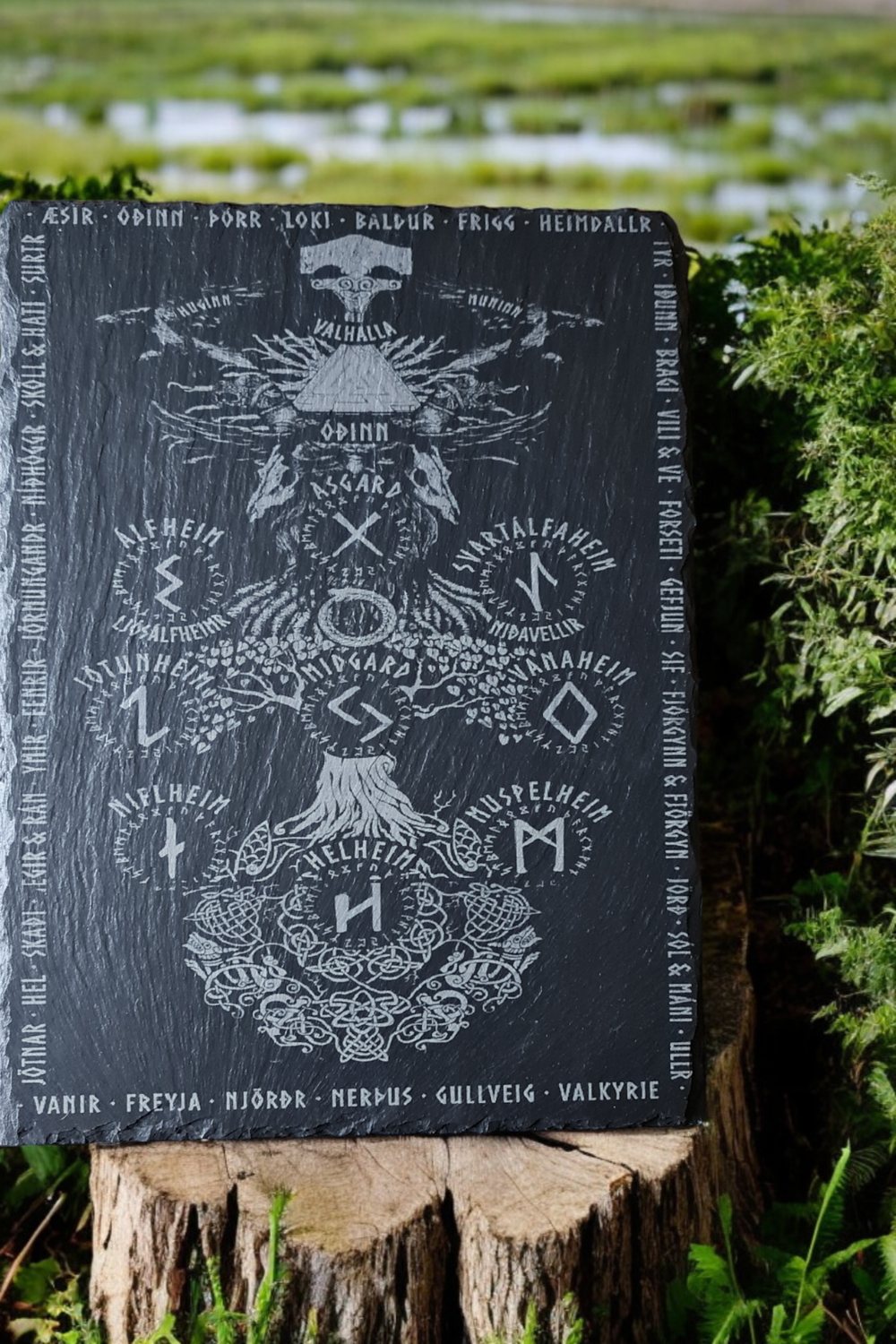
The famous “nine worlds” belong here as well. Völuspá stanza 2 mentions nine worlds but never names them. The list you see everywhere today – Midgard, Asgard, Vanaheim, Jotunheim, Alfheim, Svartalfheim, Niflheim, Muspelheim and Hel – is a modern compilation from scattered references. How that list came about, and where it wobbles, is the subject of our article on the nine worlds.
Midgard is fenced, but it is not sealed off. According to Snorri the gods built a bridge from earth to heaven called Bifröst – in Brodeur's words, “a bridge from earth, to heaven, called Bifröst”. Humans see it as a rainbow. The gods ride over it every day to their court at the Well of Urðr, and at its head Heimdall keeps watch against the giants.
That gives Midgard a clear position in the cosmos. It is the centre to which the world of the gods is connected, and at the same time the most exposed zone, because it lies between gods and giants. At Ragnarök, the prophecy says, Bifröst will break beneath the sons of Muspell.
If you have read a little about Norse mythology, you have almost certainly met the pair Midgard and Utgard. Útgarðr means “the outer yard, the outside”. The model is seductive: inside, the ordered world of humans and gods; outside, the chaotic world of giants, usually equated with Jotunheim. It is not plucked out of thin air – Snorri really does put the giants on the outer shore and protects Midgard with a wall against them.
The model was popularised above all by structuralist scholarship in the 20th century, including the Russian historian Aron Gurevich and the mythologist Eleazar Meletinsky, and later by the Danish anthropologist Kirsten Hastrup, who applied it to medieval Icelandic society.
Scholars have since grown more cautious. The catch: as a place name, Útgarðr appears in the mythological sources almost only in a single story – as the stronghold of the giant king Útgarða-Loki, whom Thor visits in Snorri's tale and who makes a fool of him with illusions. A fixed cosmic counter-realm called “Utgard” is not attested in the Eddas. The Swedish place-name scholar Per Vikstrand examined Ásgarðr, Miðgarðr and Útgarðr from a linguistic angle in 2006, and Klaus Böldl summarises the state of research in the Reallexikon der Germanischen Altertumskunde (vol. 20, 2001). The usual line today: the contrast between inside and outside is clearly felt in the myths, but the tidy pair Midgard–Utgard is more a tool of scholars than a word the Vikings used.
Outside, beyond wall and giant coast, lies the world ocean. And in it lies the Midgard Serpent, Old Norse Miðgarðsormr, also called Jörmungandr. The name is usually explained as “mighty staff” or “mighty monster”; the first element jǫrmun- means “huge, all-embracing”. According to Snorri the serpent is a child of Loki and the giantess Angrboða. Odin threw it into the sea that surrounds all lands, and there it grew until it lay in the middle of the ocean around every land, biting its own tail.
So the human world is bounded not only by a wall but also by a living ring. As long as the serpent holds its tail in its mouth, the order stays closed. The serpent is both border and threat – it holds Midgard together, and in the end it will destroy it.
The most famous encounter with the serpent is Thor's fishing trip. In the eddic poem Hymiskviða, Thor rows out to sea with the giant Hymir. For bait he takes the head of Hymir's finest ox. Then something bites that the poem names with a wonderful phrase: umgjǫrð allra landa, “the girdle of all lands”. Thor hauls the serpent up to the gunwale and strikes its head with his hammer. In the poem it then slips free and sinks back into the sea.
Snorri tells the scene more dramatically in Gylfaginning. Thor braces himself so hard against the pull that his feet break through the bottom of the boat and he stands on the seabed. Hymir panics and cuts the line before Thor can strike. Skaldic poets knew the story too: Bragi the Old, whose poem is usually dated to the 9th century, and Úlfr Uggason in his Húsdrápa (c. 985) both describe Thor's fishing, Úlfr explicitly from carvings in an Icelandic hall.
Best of all, we have stones that show the story, independently of Snorri.
On top of that there is the picture stone Ardre VIII on Gotland, where many scholars also see a fishing scene, though this reading is less clear-cut. For you, this means the tale of the god who fishes for the world serpent was not invented in the 13th century. It was known centuries earlier, from Sweden to northern England.
No god is as closely tied to Midgard as Thor. In the Völuspá's account of Ragnarök he bears the title Miðgarðs véurr, “protector” or “hallower” of Midgard. That fits everything we know about him: Thor is the god who goes out to kill giants so that there is peace inside. He is the watchdog at the world's farmyard fence, not the lord in the hall.
At Ragnarök the two enemies meet one last time. The serpent heaves itself out of the sea, and the waters flood the land with it. Thor kills it, walks nine paces, and then falls dead – according to Snorri, struck by the serpent's venom. Afterwards the earth sinks into the sea and the world goes down in fire. When its guardian dies, Midgard ends as well.
Yet the Völuspá knows a new beginning. The seeress sees the earth rise from the sea a second time, ever-green, with waterfalls and an eagle hunting above them. Here the circle closes back to stanza 4: just as Midgard was lifted out of the depths at the beginning, so the world rises again after its fall. It is one of the most beautiful frames in the whole Edda.
Why imagine the human world in the middle? The idea is not uniquely Norse; many cultures have placed their own world at the centre. What is remarkable about the Germanic word is the fence. The middle is not simply given – it is enclosed, built and defended.
That mirrors everyday life. A Scandinavian farm was a small world of its own: longhouse, outbuildings, pasture, all surrounded by fences and banks. Outside lay bog, forest, mountains and sea – places where you could get lost, freeze or meet things you would rather not. In Icelandic law texts the expressions “inside” and “outside the fence” appear as perfectly practical terms for pasture and boundaries. Mythology scaled that everyday feeling up to the size of the cosmos.
Hardly any fantasy fan realises they are using an ancient Germanic word every time they say “Middle-earth”. J. R. R. Tolkien was a professor of Old English at Oxford and knew middangeard from the poetry inside out. In Middle English it had become middel-erde, because speakers reinterpreted the second part as “earth”. Tolkien's “Middle-earth” is nothing more than a modernised form of that word. In his letters he stressed that it was not his invention but an old term for the inhabited world of men.
The link runs even deeper. Tolkien described how the lines of the Old English Christ, in which Earendel is sent “over middangeard”, struck him. That Earendel became Eärendil, the mariner of his own mythology. For more on the Norse and Old English threads Tolkien picked up, see our article on Tolkien and Norse mythology.
For us in our workshop in Alsdorf, Midgard is one of the most rewarding motifs there is, because it links something personal to the great myth. Midgard is your own place, the fenced yard. A door sign with a serpent ring enclosing a name or a house says exactly that: in here is our world. The Altuna stone makes an especially good model for the serpent, because its lines are clear and translate well into an engraving.
On slate, a Midgard motif in concentric rings looks striking: the sea and serpent on the outside, then the wall, the land at the centre. The dark stone and the pale engraved lines give it an archaic feel. If you prefer something simpler, take a single word – Miðgarðr in Latin letters or in Younger Futhark runes – or the half-line from Muspilli. You can see how we work with stone on our page about slate engraving.
What does Midgard mean? Midgard (Old Norse Miðgarðr) literally means “enclosed place in the middle” or “middle yard”. It refers to the world inhabited by humans, imagined as a fenced area between gods and giants.
Who created Midgard? According to the Völuspá, the sons of Burr – in Snorri, Odin, Vili and Vé. They shaped the earth from the body of the primeval giant Ymir and built a wall against the giants from his brows.
What is the difference between Midgard and Asgard? Midgard is the world of humans, Asgard the stronghold of the gods. According to Snorri, Asgard lies in the middle of the world, and the bridge Bifröst connects earth with heaven.
What is the Midgard Serpent? The Midgard Serpent Jörmungandr is a child of Loki that lies in the world ocean around all lands, biting its own tail. At Ragnarök, Thor and the serpent kill each other.
Is Utgard really in the Edda? As a place name, Útgarðr appears almost only as the stronghold of the giant Útgarða-Loki in Snorri. The pair Midgard–Utgard as a world model is mainly an interpretation of modern scholarship.
Does Middle-earth come from Midgard? Tolkien's Middle-earth goes back to Old English middangeard, which is a cognate of Midgard. In content, though, Tolkien's world has little in common with Norse cosmology.
For courage. For remembrance. For legends that live on.
Ymir & the making of the world · Jötunheim – land of the giants · The Midgard Serpent · The Nine Worlds · The Norse pantheon.
All The Nine Worlds articles →
In the south of the world-order blazes Muspelheim – the world of fire. Embers, sparks and flames, so hot that only its …
Read more →Far in the north of the world-order, in icy remoteness, lies Niflheim – the ‘mist-home’. Here reign cold, frost and …
Read more →Deep beneath the earth, in the half-dark of shafts and forges, lies Svartalfheim – the world of the black elves, as the …
Read more →Apart from Asgard, in a world whose location the sources leave vague, dwell the Vanir – the other family of gods …
Read more →