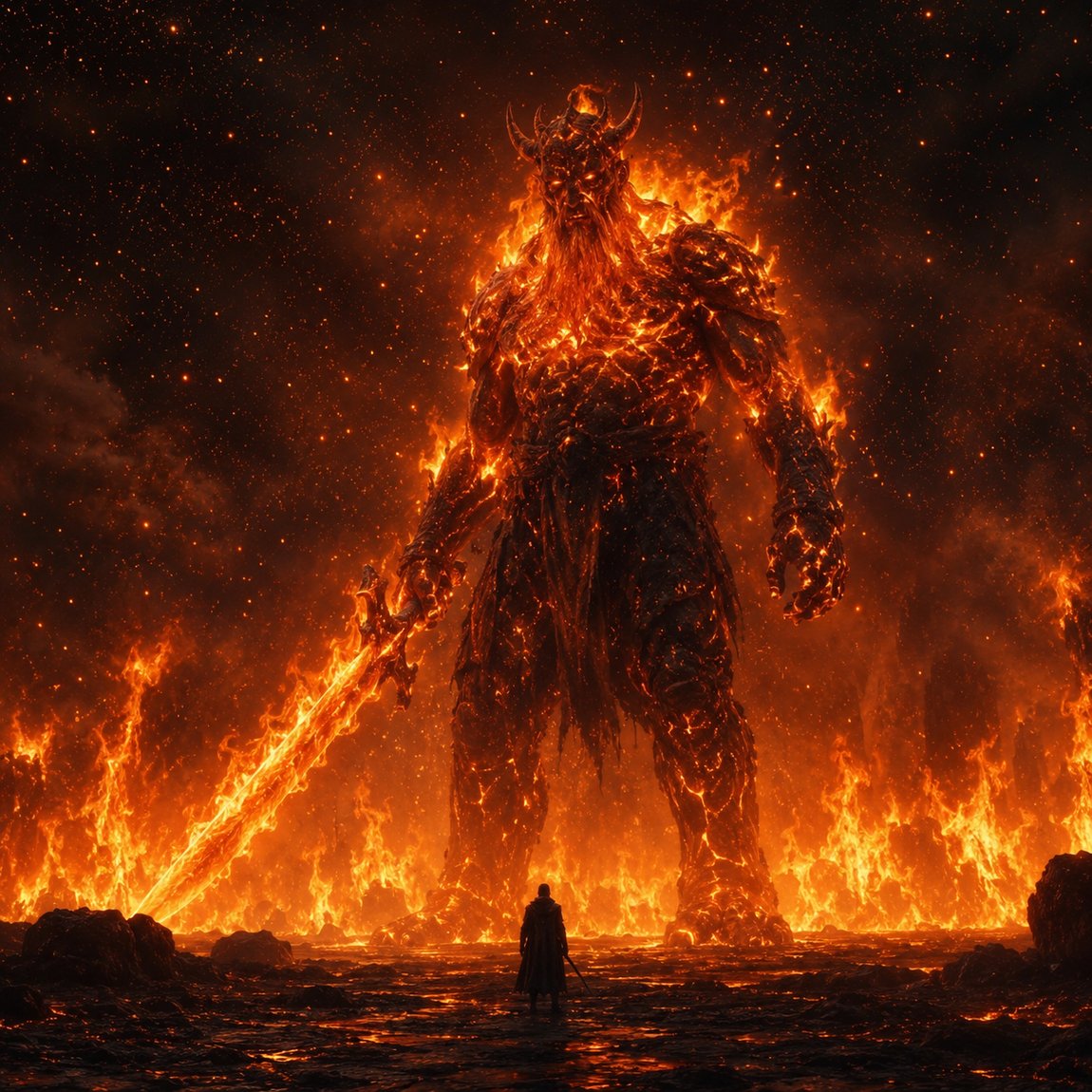
Muspelheim is the realm of fire in Norse mythology: a bright, burning land in the south, impassable to outsiders and guarded by the fire giant Surtr with his flaming sword. According to Snorri, its sparks thaw the ice that brings forth the first life and later become the sun and stars – and at Ragnarök the sons of Muspell ride out of it across Bifröst to burn the world. Yet the name Muspelheim appears only in Snorri, and the word behind it turns up in Christian poems about Judgement Day. Here we sort out source, system and interpretation.
Most creation stories begin in darkness. The Norse one, as Snorri Sturluson wrote it down around 1220, begins with two extremes. In the north lies a world of mist, ice and rime. In the south lies a world so bright and so hot that nobody can enter it unless they belong there. Between them yawns the void. And on the edge of the fire world sits someone who waits. Since the beginning. Until the end.
That fire world is Muspelheim, Old Norse Múspellsheimr, "the home of Múspell" – often simply Múspell in Snorri. Nobody travels there, no god visits it, no saga describes its halls. Muspelheim is less a place than a force: the origin of heat and light, and the threat that hangs over everything.
One distinction runs through this whole article. The word Múspell is old and puzzling; it appears in the Eddic poems and even in two poems from the European mainland. The name Múspellsheimr, and the tidy map with fire in the south and ice in the north, we know only from Snorri's Prose Edda.
Gylfaginning ("the deluding of Gylfi") is the first major part of the Prose Edda. A legendary king, Gylfi, questions three mysterious figures – High, Just-as-High and Third – about the gods and the world. When he asks what came first, he hears about the void Ginnungagap and the icy Niflheim. Then, in chapter 4, comes the decisive passage:
"But first there was the world in the southern region called Múspell. It is bright and hot; that region blazes and burns, and it cannot be entered by those who are foreign there and have no inheritance there. Surtr is the name of the one who sits there at the land's end to guard it. He has a flaming sword, and at the end of the world he will go out and wage war, defeat all the gods and burn the whole world with fire."Snorra Edda, Gylfaginning 4; our own translation
Note the little word "first". Muspelheim existed before gods, giants and humans. And it has a guardian who does not stand up once in the whole narrative – until the final chapter.
In chapter 5 Snorri explains how the two worlds interact across Ginnungagap. The northern part of the void fills with ice and rime from the rivers Élivágar. The southern part is lit by the sparks and glowing masses flying out of Muspelheim. Where the heat meets the rime, it melts and drips – and, Snorri says, "by the power of that which sent the heat" (Brodeur's 1916 wording) the drops quicken into life: the primeval giant Ymir. Soon after, the cow Auðhumla appears, whose milk feeds him.
Who is that sender of the heat – Surtr, a nameless primal power, or, shining through, the Christian creator? The text does not say.
Ymir is later killed by Odin and his brothers, who build the world from his body. But a world needs light, and here Snorri returns to Muspelheim. In chapter 8 the sons of Bor take the glowing embers and sparks that had been cast out of Muspelheim and were drifting loose, and set them in the middle of Ginnungagap's sky, above and below, to light heaven and earth. Some lights they fix in place; others are given paths beneath the sky. By them, days and years are reckoned.
Chapter 11 repeats the idea: the sun that Sól drives across the sky was shaped by the gods from the sparks that flew out of Muspelheim. For the sun goddess and her deeper roots, see our article on Sunna and Sól.
So the light by which we measure time is borrowed fire from the very world that will one day burn everything. Every star, if you follow Snorri, is a tamed splinter of the final blaze. For a while.
Muspelheim's guardian is Surtr (often anglicised as Surt). The name probably means "the black one", related to Old Norse svartr. John Lindow has suggested it may evoke a charred, sooty appearance. For more on the figure himself, see our article on Surtr the fire giant.
Surtr is old. He is not Snorri's invention but appears in several Eddic poems. In Vafþrúðnismál Odin asks the wise giant about the field where Surtr and the gods will meet; the answer is Vígríðr, a hundred leagues in every direction. Later in the same poem we learn that Víðarr and Váli will dwell in the gods' sanctuaries "when Surtr's fire is slaked" (Surtalogi). Even in the poetry, Surtr is bound to the fire that ends the world.
A less familiar passage sits in Fáfnismál, the dialogue between Sigurd and the dying dragon Fáfnir. In stanza 14 Sigurd asks the name of the island where Surtr and the Æsir will mingle their blood. Fáfnir answers in stanza 15: Óskópnir. There all the gods will fight with spears, and the bridge will break as they ride out. Óskópnir and Vígríðr seem to be two names for the same final battlefield – or two traditions that were never harmonised.
Snorri turns this giant into an eternal border guard. Andy Orchard has pointed out that the image recalls another sentinel: in Genesis, after the expulsion from Paradise, cherubim with a flaming sword stand at the gate of Eden. Whether Snorri borrowed it deliberately cannot be proven.
The Poetic Edda never mentions a place called Muspelheim. It only knows the people, or sons, of Múspell – as if Múspell were a being rather than a landscape.
The most famous passage is in Völuspá, "the prophecy of the seeress"; for the poem and how it survived, see our guide to the Edda. In stanza 51 (Codex Regius numbering) a ship sails from the east. "Muspell's people" (Múspells lýðir) come over the sea, and Loki stands at the helm. The next stanza is among the most powerful images in all of Old Norse poetry:
"Surtr fares from the south with the bane of branches,
from the sword of the slain-gods shines the sun.
Stone cliffs crash, troll-women stumble,
heroes tread the road to Hel, and heaven splits."Völuspá 52; our own close translation from Old Norse
The "bane of branches" (sviga lævi, rendered "scourge of branches" by Bellows) is a kenning, a poetic circumlocution: it means fire, the destroyer of boughs and forests. In the following stanza Freyr, "the slayer of Beli", faces Surtr – and falls.
A further witness is Lokasenna, the flyting in which Loki insults every god at the sea giant Ægir's feast. In stanza 42 he mocks Freyr: he bought the giant's daughter Gerðr with gold and gave away his sword for her; when Muspell's sons ride over Myrkviðr, the Dark Forest, he will not know what to fight with. We tell the story of that sword in our article on Skírnismál. The point here: the poetry already links the sons of Muspell, the end of the world and Freyr's missing weapon.
Because Völuspá has Muspell's people arrive by ship while Snorri has them ride over the bridge, editors have intervened. Bellows himself, in 1923, printed "Hel" for "Muspell" and "north" for "east" in stanza 51 – noting honestly that the manuscripts read otherwise. The tradition is less tidy than later systematisers would like.
In Snorri, these scattered verses become a carefully staged final battle. Already in chapter 13, describing the rainbow bridge Bifröst, he has Gylfi learn that strong as it is, it must break when the sons of Muspell go forth harrying and ride over it.
Chapter 51 keeps that promise. In his account of Ragnarök, the sky splits amid the din and the sons of Muspell ride out. Surtr rides first, with fire burning before and behind him; his sword is exceedingly good, and light shines from it brighter than the sun. As they ride over Bifröst, the bridge breaks. The sons of Muspell advance to the plain of Vígríðr, where they form their own battle line, shining brightly. The Fenris wolf, the Midgard Serpent, Loki with the host of Hel, and the frost giants gather there too.
In the fighting Freyr meets Surtr. It is a hard contest, but Freyr falls because he lacks the good sword he once gave to his servant Skírnir. When gods and monsters have slain one another, Surtr flings fire over the earth and burns the whole world.
Read closely and you notice a quiet reshuffle. In Völuspá Loki steers the ship carrying Muspell's people. In Snorri, Loki leads the people of Hel, and the ship Naglfar is steered by the giant Hrymr. Snorri smooths and reassigns roles; his version is not simply "the" Norse apocalypse.
And afterwards? The world burns, sinks into the sea and rises green again; the human pair Líf and Lífþrasir have survived Surtr's fire in Hoddmímir's wood. More in our article What comes after Ragnarök? Muspelheim's fire is not the last word but a passage.
The form Múspellsheimr is attested only in Snorri's Prose Edda. No Eddic poem, no skaldic verse, no runic inscription names a world of that name.
What's more, the popular list of "nine worlds" in which Muspelheim stands beside Asgard, Midgard, Jötunheim and the rest is found in no medieval source. Völuspá mentions nine worlds but never lists them, and Snorri offers no such list either. The familiar set of nine is a modern reconstruction; we explain how it came about in our article on the nine worlds.
Snorri's cosmology – fire in the south, ice in the north, the void between – is a masterpiece of order. Whether a pagan Icelander of the tenth century saw the world that way we cannot know; that Snorri, a learned Christian, drew on scholarly ideas of a hot south and a cold north is entirely plausible. More about the man in our portrait of Snorri Sturluson.
The first continental witness is an Old High German poem that scholars name after this very word: Muspilli. It survives in a single manuscript, now in the Bavarian State Library in Munich (Clm 14098). The codex contains a Latin theological treatise that Bishop Adalram of Salzburg presented to the young Louis the German. At some point in the ninth century someone wrote an alliterative poem in Bavarian dialect into its blank pages and margins, untidily and with many errors. 103 lines survive; beginning and end are lost.
The Muspilli is Christian through and through: the judgement of the soul, the Last Judgement, Elijah fighting the Antichrist. When Elijah's blood drips onto the earth, the poem says in effect, the mountains catch fire, no tree remains standing, the waters dry up, the moon falls and the whole earth burns. Line 57 then contains the key word:
"dar ni mac denne mak andremo helfan uora demo muspille"
"There no kinsman can then help another before the muspilli."Muspilli, line 57; our own translation
The second witness is the Old Saxon Heliand, an alliterative gospel poem of the first half or middle of the ninth century. The word appears twice, as mutspelli and mudspelli (around lines 2591 and 4358). In the second passage mudspelli comes in the dark night like a thief – a clear echo of the biblical saying that the day of the Lord comes like a thief in the night.
Three times the same word in three languages – Múspell, mudspelli, muspilli – and each time linked with the end of the world. That is no coincidence.
More than twenty derivations have been proposed; none has won the field. A common analysis splits the word into a first element that might mean "earth" or "world" and a second linked to a root meaning "destruction". Muspilli would then mean something like "world-destruction" – a sense that fits all three witnesses. Others see in the second element the Germanic word for "speech, pronouncement", as in Gothic spill ("tale"); the word would then point to a verdict at the end of time. Still others take the first element from Latin mundus ("world"), which would make the whole word a Christian coinage.
When it comes to the word's history, two camps face each other:
In favour of the second: the Norse texts treat the word like an opaque name. In favour of the first: Surtr and the world-fire are firmly rooted in several poems. The honest answer is that we do not know. What is certain is that by the ninth century Múspell stood at the seam between old images of the end and Christian teaching.
In western Iceland, in the lava field Hallmundarhraun, lies Surtshellir, "Surtr's cave", a lava tube roughly a mile long. The lava field was formed by a long eruption in the first decades of Iceland's settlement, around 880 to 920. Landnámabók, the Icelandic "Book of Settlements", tells of a man called Þorvaldr holbarki who crossed the highlands to recite a praise poem to the giant living in the cave.
For a long time the cave was thought to have sheltered outlaws. Excavations in 2001, 2012 and 2013, involving among others the archaeologist Kevin P. Smith, changed that picture. Deep inside, animal bones were found – sheep or goats, horses, pigs and cattle – now interpreted as remains of Viking Age ritual activity lasting several decades, until shortly before Iceland's conversion around the year 1000. Whether these rites were addressed to Surtr cannot be proven archaeologically, but a fire power honoured where the ground had only just burned is not a far-fetched thought.
The second Icelandic Surtr is younger. On 14 November 1963 an undersea eruption began off Iceland's south coast near the Westman Islands. A new island rose from the sea, and Icelanders named it Surtsey, "Surtr's island". The eruption lasted until 1967. Today Surtsey is a strictly protected nature reserve and, since 2008, a UNESCO World Heritage Site, because it shows how plants and animals colonise brand-new land. A world-burning giant whose island became a cradle of life – Snorri would have enjoyed that.
Iceland is a land of fire and ice. It is tempting to read Snorri's creation image – sparks from the south meeting rime from the north – as a mirror of Icelandic experience.
In the early twentieth century the British scholar Bertha Phillpotts interpreted Surtr as a kind of volcano demon. In 2018 a team led by volcanologist Clive Oppenheimer (Cambridge), with the medievalist Andy Orchard, published a study in Climatic Change dating the huge Eldgjá fissure eruption in southern Iceland to 939 and at least into 940. The authors argue that Völuspá's grim imagery – a darkened sun, sinking land, steam and fire – may echo memories of that disaster, and that the poem may have used them to prepare the turn to Christianity.
Attractive, but not settled. Rudolf Simek notes that the idea of Surtr as the gods' enemy probably did not originate in Iceland; his southern home is better explained by the association of south and heat. And the Bavarian Muspilli and the Saxon Heliand show that the word for the world-fire was known on the Continent, far from any volcano. Christian tradition also knows an end-time fire, as in the Second Letter of Peter, where the elements melt with fervent heat.
Our view: Iceland's volcanic landscape probably coloured these images and made them terrifyingly vivid for listeners. It probably did not invent the world-fire.
Set the debates aside and a remarkably coherent picture remains. The fire of the south stands at the beginning: without its heat, no Ymir. It stands in the middle: its sparks shine as sun and stars. And it stands at the end, when Surtr swings his sword. What gives warmth can also destroy; order is only wrested from chaos for a time. Heimdall watches at the bridge, Surtr at the border. Both are waiting.
In our workshop in Alsdorf this has a very practical side: a laser is focused light that burns material. Every engraving is a small, tamed spark.
Pop culture has furnished Muspelheim far more lavishly than the sources do. In Marvel, Surtur is a colossal fire demon who sets Asgard ablaze in the film "Thor: Ragnarok" (2017); the game "God of War Ragnarök" (2022) features Surtr and Sinmara – whose link to Surtr in Fjölsvinnsmál rests only on an editorial guess. Lava kingdoms with castles and demon armies are unknown to the Edda. How the Eddas shaped Tolkien too, we show in Tolkien and the Edda.
What is Muspelheim in Norse mythology? According to Snorri's Prose Edda, Muspelheim is the hot, bright realm of fire in the south that existed before creation. Its sparks melt the ice in Ginnungagap so that the giant Ymir comes into being, and later become the sun and stars.
Who rules Muspelheim? Snorri names the fire giant Surtr as its guardian, sitting at the land's end with a flaming sword. No medieval source explicitly calls him its king.
Who are the sons of Muspell? That is what the Eddic poems and Snorri call the host that marches against the gods at Ragnarök. In Snorri they ride with Surtr at their head over Bifröst, which breaks beneath them; no source says exactly who they are.
Is Muspelheim mentioned in the Poetic Edda? No, the name Múspellsheimr occurs only in Snorri. The poems speak of "Muspell's sons" or "Muspell's people", for example in Völuspá 51 and Lokasenna 42.
What does Muspelheim have to do with the Muspilli? The ninth-century Old High German poem Muspilli uses the same word for the fiery end of the world, as does the Old Saxon Heliand. Whether it is an inherited pagan word or a Christian loan is still debated.
Is Surtsey named after Surtr? Yes, the volcanic island that rose from the sea off Iceland from 14 November 1963 is "Surtr's island". The lava cave Surtshellir in western Iceland bears his name too.
For courage. For remembrance. For legends that live on.
Niflheim – the ice world · Ginnungagap · Ragnarök · Jötunheim · The Nine Worlds.
All The Nine Worlds articles →
Far in the north of the world-order, in icy remoteness, lies Niflheim – the ‘mist-home’. Here reign cold, frost and …
Read more →Deep beneath the earth, in the half-dark of shafts and forges, lies Svartalfheim – the world of the black elves, as the …
Read more →Apart from Asgard, in a world whose location the sources leave vague, dwell the Vanir – the other family of gods …
Read more →The world was ordered, the sun ran its course – but the shore lay empty. Then three gods found on the sea-strand two …
Read more →