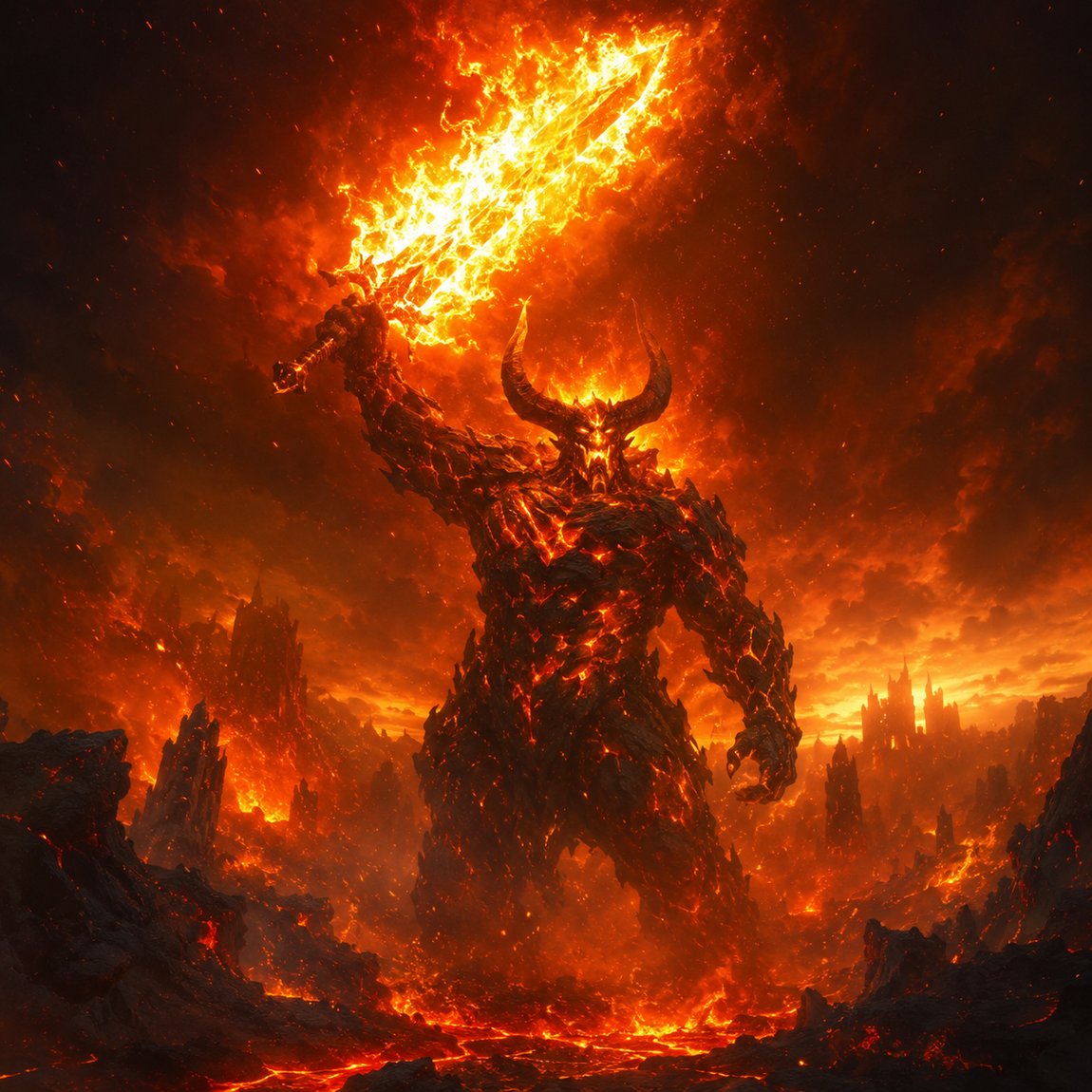
Surtr (Surtur, Surt; Old Norse for “the black one”) is the fire giant of Norse mythology who, at Ragnarök, comes from the south with a blazing sword, kills the god Freyr and sets the world on fire. That is how the Völuspá and Snorri Sturluson tell it in the thirteenth century. Here you will find every passage where Surtr appears, with the Eddic verse kept apart from later embroidery, a walk into the Icelandic lava cave Surtshellir with its burnt animal bones, and an honest look at the idea that Iceland's volcanoes shaped the fire giant.
Odin talks, Loki taunts, Thor shouts. Surtr says nothing at all. In not one surviving source does the fire giant utter a single line. He has no backstory, no love affair, no quarrel over stolen treasure. He sits at the edge of the world, holds a sword and waits. When he finally moves, it is over – for gods, giants and humans alike. Surtr is less a character than a condition: the fire that comes at the end.
The medieval texts about him are strikingly brief: a handful of stanzas in the Poetic Edda, a few paragraphs in Snorri Sturluson, some place-names and a turn of phrase in skaldic verse. Yet he has something almost no other mythological figure can claim: an archaeological site that bears his name, where Viking Age people apparently slaughtered animals and burned bones for generations.
To keep the ground firm under your feet, let us sort the evidence. The poems of the Edda were written down around 1270 in the Codex Regius; their material is partly older, but how much older is debated for every single poem. Snorri's Prose Edda (c. 1220–1225) is the learned retelling of a Christian Icelander. The cave finds date to the ninth and tenth centuries. And the volcanic reading is modern scholarship – stimulating, but a hypothesis.
Surtr is the Old Norse form; Surtur is modern Icelandic and became common in German through Karl Simrock's 1851 translation; English writers usually say Surt. The name belongs with Old Norse svartr “black”, Old English sweart and modern English “swart” and “swarthy”. Rudolf Simek renders it simply as “the black one”; John Lindow suggests a charred, soot-blackened look.
A lord of fire called not “the glowing one” but “the black one” sounds odd at first. It is not. Anyone who has stood on a cooled lava flow or a burnt-out farmstead knows what fire leaves behind: blackness. The same word family turns up again in the Völuspá, in the stanza on the end of the world, without Surtr being named: sól tér sortna, “the sun begins to turn black”. Whether the poet was consciously playing on the giant's name we cannot know.
In skaldic poetry surtr can even work as a common noun for “giant”. Snorri quotes a verse by the tenth-century skald Eyvindr skáldaspillir that speaks of “Surtr's deep valleys” – simply the land of the giants. The direction is telling too. In the Edda giants usually live in the east or north, but Surtr comes from the south. Simek's explanation is heat: the fire world lies in the south, and that is where a fire giant belongs.
The oldest and most powerful passage stands in the Völuspá, “the Prophecy of the Seeress”, the first poem in the Codex Regius. A seeress tells Odin the history of the world from creation to collapse. In the numbering of the Neckel/Kuhn edition, which Henry Adams Bellows also follows, the key stanza is 52:
“Surt fares from the south with the scourge of branches, / The sun of the battle-gods shone from his sword.”Völuspá, st. 52, trans. Henry Adams Bellows (1923)
Bellows stays close to the Old Norse. The phrase með sviga lævi means literally “with the bane of twigs” – a kenning, a poetic circumlocution: what destroys branches and wood is fire. Bellows notes that kennings of this kind are relatively rare in Eddic verse and more typical of skaldic poetry. The sword appears in the second line, shining with sól valtíva, “the sun of the slaughter-gods”: either the blade flashes like the sun, or the sun is reflected in it. The stanza goes on: crags split, giantesses stumble, the dead tread the road to Hel, and heaven is cloven. Karl Simrock's German version, by contrast, simply gives Surtr a “flaming sword” in the first line – smoother, but less faithful.
Stanza 53 brings the duel. Odin goes out to fight the wolf, and “Beli's fair slayer seeks out Surt”. Beli's slayer is Freyr, who according to Snorri once killed the giant Beli with a stag's antler because he no longer had his sword. The Völuspá does not say who wins. It says only that at the same moment “Frigg's joy” falls – that is, Odin. That Freyr loses is spelled out only by Snorri.
Two further stanzas are harder. In stanza 47, as the world tree Yggdrasil trembles, the seeress mentions “the kinsman of Surt” who will swallow someone. Bellows takes this to mean the wolf Fenrir; other scholars think of fire itself. The passage is obscure and the manuscripts do not agree. And stanza 57 describes the world-fire without naming Surtr at all: steam rages, and the “life-feeding flame”, until fire leaps high about heaven itself.
In Vafþrúðnismál Odin, travelling as Gagnráðr, wagers his head against the giant Vafþrúðnir in a contest of knowledge. Twice the questions turn to Surtr.
In stanza 17 the giant asks for the name of the field where Surtr and “the gracious gods” will meet in battle. Odin answers in stanza 18: Vígríðr, roughly “battle-surge”, a hundred rastir in every direction. A röst was an Old Norse measure of distance, the stretch between two rests; Bellows writes “a hundred miles”. The number is meant to impress, not to be surveyed. What stands out is that here Surtr alone faces the gods. He is not one attacker among many; he is the opponent.
Near the end of the contest Odin asks who will rule the realm of the gods “when the fires of Surt have sunk”. The Old Norse word is Surtalogi, Surtr's flame. The giant answers in stanza 51: Víðarr and Váli will dwell in the gods' sanctuaries, and Thor's sons Móði and Magni will hold Mjölnir. The world-fire is not the last word here. It is a border beyond which a new age begins – a theme we follow in detail in What comes after Ragnarök?
A third Eddic passage hides in heroic legend. In Fáfnismál the dragon Fafnir lies mortally wounded before Sigurd, and the two talk about fate and myth. In stanza 14 Sigurd asks the name of the isle where Surtr and the gods will mingle “sword-sweat”, meaning blood. Fafnir answers in stanza 15: Óskópnir, “the not-yet-made”. The bridge breaks as they cross, and the horses swim in the flood.
So Vafþrúðnismál names a field and Fáfnismál an island. Bellows treats both names as the same battleground; it is just as possible that different poets used different images. And notice: already here, in an Eddic poem, the rainbow bridge Bifröst breaks – not only in Snorri.
Why Freyr looks so poor against Surtr is hinted at in another poem. In Lokasenna (st. 42) Loki mocks the god: he gave away his sword for the giant's daughter Gerðr and will not know how to fight “when Muspell's sons ride over Myrkviðr”. The background is told in Skírnismál: Freyr hands his sword, which fights by itself, to his servant Skírnir as payment for wooing Gerðr on his behalf. More in Skírnismál – how Freyr lost his sword.
The Surtr most people know was shaped by Snorri Sturluson. In Gylfaginning, the first part of his Prose Edda, three mysterious figures explain the world to a Swedish king. In chapter 4 Snorri describes the time before creation. First, he says, there was a world in the south called Muspell: bright and hot, flaming and burning, impassable for anyone not native to it.
Then comes the decisive sentence, in paraphrase: the one who sits there at the land's end to defend it is called Surtr. He has a flaming sword, and at the end of the world he will go forth, wage war, defeat all the gods and burn the whole world with fire. Snorri's word for his task is landvörn, land-defence. Here Surtr is first of all a border guard, not an aggressor. Against whom he guards the fire world, Snorri does not say.
What Snorri leaves out is just as interesting. In chapter 5 he explains how life began in Ginnungagap, the yawning void between fire and ice: sparks and heat from Muspell met the rime from the north, it thawed, and from the drops came the primeval giant Ymir. Surtr plays no part in this.
Where Snorri got the image of a guardian with a flaming sword is an open question. Andy Orchard has pointed to a striking parallel: in Genesis 3:24, after the expulsion from Paradise, God places cherubim and a flaming sword that turns every way to guard the Garden of Eden. Snorri was a learned Christian who knew his Bible. Whether he borrowed deliberately or gave an old native image a biblical tint cannot be decided.
In chapter 51 of Gylfaginning Snorri tells the end of the world as one continuous scene – something no Eddic poem does. He clearly relies on Völuspá and Vafþrúðnismál, which he quotes, but he arranges, connects and fills gaps.
The sky splits open and Muspell's sons ride out. Surtr rides first, with burning fire before him and behind him. His sword is exceedingly good; light shines from it brighter than from the sun. As they ride over Bifröst, the bridge breaks – Snorri refers back to an earlier passage where he explained that not even the strongest bridge will hold when Muspell's sons come. The host rides to the field of Vígríðr, where Fenrir, the Midgard Serpent, Loki and the frost giants also gather.
Then the duel. Freyr fights Surtr, and there is a hard encounter before Freyr falls. Snorri gives the reason at once: his death comes because he lacks the good sword he gave to Skírnir. In doing so Snorri binds three poems – Völuspá, Lokasenna, Skírnismál – into a single tragic chain. Whether this connection was already told in pagan times or is Snorri's own system-building, we do not know.
When the great fights are over, Surtr flings fire over the earth and burns the whole world. Afterwards, Snorri says, a new green earth rises from the sea. Víðarr and Váli live, harmed by “neither sea nor Surtr's flame”; Baldr returns; and the human pair Líf and Lífþrasir have survived in Hoddmímir's wood. Earlier, in his chapter on the hall Gimlé, Snorri has Gangleri ask what will protect that place “when Surtr's fire burns heaven and earth”.
Modern retellings like to make Surtr the arch-villain of the apocalypse. The sources hardly support that. He hates no one, threatens no one, is insulted by no one. Unlike Fenrir or the Midgard Serpent, there is no tale in which the gods bound or humiliated him, nothing to explain a revenge. Surtr is simply there, the way fire is there.
Rudolf Simek considers the idea of a fire giant who burns the world to be old – older than Iceland. One piece of support comes from far away: a ninth-century Old High German poem on the Last Judgement, known to scholars as “Muspilli” after one of its words. There muspilli stands for the world-fire, and the word is plainly related to Norse Muspell. The notion of a fiery end therefore had a history in the Germanic-speaking world long before an Icelander wrote it down. How much of it was pagan and how much already Christian has been argued over for more than a century.
We have no Viking Age image of Surtr, by the way. The Gosforth Cross in northern England shows scenes from Ragnarök, but no figure on it can be securely identified as Surtr – see our piece on the Gosforth and Andreas crosses.
Now we leave the parchment and go underground. In western Iceland, in the Hallmundarhraun lava field, lies Surtshellir, “Surtr's cave”. It is a lava tube: molten rock kept flowing beneath an already solidified crust and left a hollow passage behind. Surtshellir is about 1.6 kilometres long and belongs to the island's longest lava cave system. The lava field covers some 240 square kilometres and formed during the first decades of Iceland's settlement, around 900 – within a few years of the first settlers' arrival.
The name is first recorded in Landnámabók, the Icelandic Book of Settlements from the twelfth or thirteenth century. It tells of a man named Þorvaldr holbarki (“hollow-throat”) who travelled to Surtr's cave and performed there a drápa, a formal praise poem, that he had composed about the giant in the cave. A praise poem for a giant is unusual even by Icelandic standards. Later tradition turned the cave into a hideout for outlaws; the Sturlunga saga places a brutal maiming there in 1236. The naturalists Eggert Ólafsson and Bjarni Pálsson, who described the cave in the 1750s, were told by locals that whoever went in would not come out alive.
Deep inside, about 300 metres from the entrance and more than ten metres below the surface, archaeologists found something that does not fit a robbers' den. A team led by Kevin P. Smith (Haffenreffer Museum of Anthropology, Brown University) and Guðmundur Ólafsson (National Museum of Iceland) excavated there in 2001 and again in 2012–2013. They documented a boat-shaped stone structure in a raised side passage, piles of domestic animal bones stretching along some 120 metres of the cave's dark zone, and remains burnt at high temperatures. According to the report in Archaeology magazine (2017), about 7,500 bone fragments were catalogued, mostly sheep and goat, with cattle, pig and horse.
The finds include 63 beads, among them glass beads probably from the Baghdad region, and flecks of orpiment, a yellow arsenic mineral pigment from eastern Turkey. These are luxury goods, and the researchers conclude that members of Iceland's elite were involved. One of the last things placed in the boat-shaped structure was a set of lead scale weights, one of them shaped like a cross.
What exactly happened there is interpretation, and it is not uncontested. Smith reads the finds as rituals with which the settlers responded to the first major volcanic catastrophe they had witnessed with their own eyes – perhaps annual sacrifices, perhaps directed at the being they held responsible for the fire under the earth. Guðmundur Ólafsson, according to the 2017 report, still considered outlaw occupation the more likely explanation and said the answer was not yet in. What is certain: the cave already bore Surtr's name in the Middle Ages, and within it, during the Viking Age, animals were slaughtered, bones burned and precious objects left behind over generations.
Stand in Iceland and the idea suggests itself. Fire bursting from the ground, a blackened sky, land sinking into the sea – it reads like an eyewitness account. The British scholar Bertha Phillpotts already considered Surtr a volcano demon inspired by Icelandic eruptions. Simek is more careful: in Iceland, Surtr seems to have been understood as a giant ruling the subterranean volcanic fire, but the figure of the gods' enemy was probably not invented there.
In 2018 the debate gained new energy. A team led by the volcanologist Clive Oppenheimer (Cambridge), with the dendroclimatologist Markus Stoffel, the historian Tim Newfield and the philologist Andy Orchard, used Greenland ice cores and tree rings to date the eruption of the Eldgjá fissure in southern Iceland to spring 939 through at least autumn 940. With roughly 20 cubic kilometres of lava it was the largest eruption in Iceland since settlement. Chronicles from Ireland, Germany and Italy mention a blood-red, weakened sun, and the tree rings show one of the coolest summers of the last 1,500 years.
Against this background the authors reread the Völuspá. Stanza 57 – the sun turns black, the land sinks into the sea, the bright stars fall from the sky, steam and fire rage – could echo memories of Eldgjá, as could stanza 41, which speaks of black sunshine in the summers that follow. Their further claim: the Völuspá, which they think could date as early as 961, deliberately stirred up these memories to prepare the ground for Christianity, which Iceland accepted around the year 1000.
How solid is this? There are three objections worth knowing. First, the date of the Völuspá itself is disputed; that it existed as early as 961 is an assumption, not an established fact. Second, world-fire and world-end also exist outside Iceland, as the Old High German Muspilli shows, and the motifs of a darkened sun and falling stars are familiar from biblical apocalyptic too. Third, the world-fire stanza does not name Surtr at all. The volcanic thesis may explain why Icelanders painted the end of the world so vividly – not where the fire giant himself came from.
The finest twist comes from archaeology anyway. Surtshellir was born in an eruption the first settlers lived through, and it carries Surtr's name. That people lit fires, slaughtered animals and left treasures in a freshly cooled lava tube shows how close myth and landscape came on this island.
Iceland never forgot him. On 14 November 1963 a submarine volcano off the south coast, near the Westman Islands, broke the surface of the sea. By 5 June 1967 a new island had grown out of the waves. It was named Surtsey, “Surtr's island”. It has been a nature reserve since 1965, only a few scientists may land there, and since 2008 it has been a UNESCO World Heritage Site because it lets researchers watch life colonise brand-new land. A fire giant's island where seeds take root – you could hardly put end and new beginning into landscape more neatly.
Astronomy has borrowed the name as well: a small moon of Saturn is called Surtur, and a volcano on Jupiter's moon Io is named Surt. Since 1963 Surtur has also fought Thor in Marvel comics, and the film “Thor: Ragnarok” (2017) turned him into a horned, crowned fire demon. Good entertainment, but it has little to do with the sources. What holds up and what does not, we check in Marvel's Thor fact-checked.
In our workshop we work with fire too, if a focused kind: the laser writes with heat into slate and wood, and on wood the engraving darkens almost to black at the edges. Surtr would probably not be impressed. We are. For the whole end of the world in context, read our main article on Ragnarök, and for the seeress's own words our bilingual Völuspá.
Who is Surtr in Norse mythology? Surtr (Surtur, Surt) is a fire giant who, according to Snorri, guards the border of the fire world Muspell. At Ragnarök he comes from the south with a flaming sword, kills Freyr and burns the world.
What does the name Surtr mean? It means “the black one” and is related to Old Norse svartr and English “swart”. It probably refers to the charred, soot-blackened state that fire leaves behind.
Why does Surtr kill Freyr? The Völuspá only mentions the duel. Snorri explains that Freyr lost because he had given his good sword to his servant Skírnir as payment for wooing the giantess Gerðr.
Is Surtr evil? The sources do not portray him as a villain with motives but as a cosmic force. He guards, he rides out, he burns – no text gives him reasons.
What was found in Surtshellir cave? Archaeologists found a boat-shaped stone structure, burnt and unburnt bones of domestic animals, imported beads and a rare pigment. The finds date between Iceland's settlement and shortly after 1000 and are usually interpreted as ritual offerings.
For courage. For remembrance. For legends that live on.
Ragnarök · What comes after? · Freyr · Ginnungagap & Muspelheim · The nine worlds.
All Gods & Goddesses articles →
No god was so beloved by ordinary people as Thor. With hammer, strength-belt and thunder-chariot he holds the powers of …
Read more →Tyr is the god who knew what order costs – and was willing to pay it with his own hand. Once perhaps the highest …
Read more →He is one of the best-known “unknown” gods: everyone who studies the mythology knows his name – and yet Ullr scarcely …
Read more →Odin is the god who pays any price for knowledge – his eye, death on the tree, and nearly his head. In Vafþrúðnismál he …
Read more →