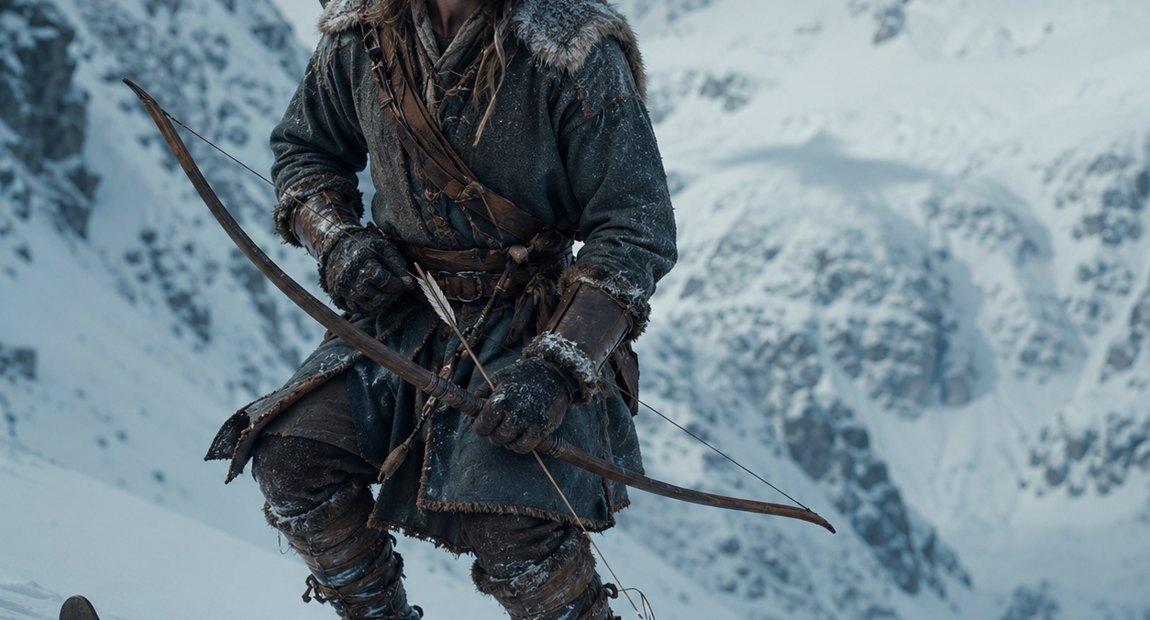
Ullr is the Norse god of archery, hunting and skiing: Snorri calls him the son of Sif and stepson of Thor, so skilled with bow and skis that no one can compete with him. The label “god of winter” is a modern one – in the old texts he is above all a marksman, a helper in single combat and a witness to oaths. Not a single myth about him survives, yet his name lives on in dozens of places across Norway and Sweden. Here is what the evidence shows, and where interpretation takes over.
Picture a god whose name people gave to their farms, meadows, islands and sanctuaries. A god warriors swore by, and whom you called on before a duel. Now picture that not one story about him has come down to us. No adventure, no wedding, no brawl with giants. That is Ullr.
Anyone who reads a little Norse mythology runs into his name sooner or later – and then finds a strangely empty stage. A few sentences in Snorri, two stanzas in a mythological poem, an oath in a heroic lay, one twisted episode in the Danish chronicler Saxo. Add some poetic circumlocutions, a disputed runic inscription and a map full of place-names, and you have the raw material. From these splinters we have to piece the god together.
That makes Ullr a perfect test case. He shows how much we do not know about the old religion – and how much we can still establish if we keep the sources apart. So that is the plan: the texts first, then the name, then the ground, and finally the ski slopes of today.
The fullest description sits in Gylfaginning, the first main part of the Prose Edda, written around 1220 by the Icelander Snorri Sturluson. Snorri goes through the Æsir one by one, and in chapter 31 (chapter 30 in some editions) Ullr's turn comes:
Ullr heitir einn, sonr Sifjar, stjúpsonr Þórs. Hann er bogmaðr svá góðr ok skíðfœrr svá at engi má við hann keppask. Hann er ok fagr álitum ok hefir hermanns atgervi. Á hann er ok gott at heita í einvígi.
“One is called Ullr, son of Sif and stepson of Thor. He is so good an archer and skier that no one can compete with him. He is also handsome to look at and has all the accomplishments of a warrior. It is good to call on him in single combat.”Prose Edda, Gylfaginning 31; our own translation
Four sentences, and a whole profile. Ullr is the son of Sif, the golden-haired wife of Thor, which makes the thunder god his stepfather. Who his father was, Snorri does not say – and neither does any other source. He is an archer and a skier, a man of the hunt and of open country. He is handsome and warlike. And he has a very specific remit: if you are about to fight an einvígi, a formal duel, he is the one to invoke.
The Sif connection is not Snorri's invention. Viking Age skalds already refer to Thor as Ullr's stepfather – among them Þjóðólfr of Hvinir in Haustlǫng (around 900) and Eilífr Goðrúnarson in Þórsdrápa (late tenth century). The family arrangement was familiar to poets long before the Prose Edda was written.
In the second part of his book, Skáldskaparmál (“the language of poetry”), Snorri lists the ways a poet may refer to Ullr: son of Sif, stepson of Thor, ǫndurás (“ski-god”), bogaáss (“bow-god”), veiðiáss (“hunting-god”) and skjaldaráss (“shield-god”). The ski comes first on the list.
The oldest mention in the Poetic Edda comes in Grímnismál, a poem in which Odin, held captive between two fires, recites the dwellings of the gods. Stanza 5 reads:
Ýdalir heita, þar er Ullr hefir sér um gǫrva sali.
“Ydalir call they the place where Ull a hall for himself hath set.”Grímnismál 5, trans. Henry Adams Bellows (1923, public domain)
Ýdalir means “yew dales”. The name occurs nowhere else, but it fits like a glove. Yew, tough and springy, made the finest bows in Europe – from the bow carried by the Iceman found in the Ötztal Alps to the English longbow. An archer-god living in the yew dales is not a coincidence; it is a calling card. For the wood, the finds and the craft, see our article on bow and arrow in the North.
Look at who shares the stanza: Freyr, to whom the gods gave Álfheimr as a “tooth-gift”, a present for a child's first tooth. Ullr stands side by side with a Vanir god here – a pairing we will meet again on the map.
The second Grímnismál passage is much stranger. In stanza 42 the captive Odin says:
Ullar hylli hefr ok allra goða hverr er tekr fyrstr á funa …
“His the favor of Ull and of all the gods who first in the flames will reach; for the house can be seen by the sons of the gods if the kettle aside were cast.”Grímnismál 42, trans. Henry Adams Bellows (1923, public domain)
Whoever reaches into the fire first wins the favour of Ullr and all the gods. Within the poem that makes sense: Odin has sat between two fires for eight nights, and whoever frees him can expect a divine reward.
But why Ullr, and why named before “all the gods”? Scholars have suspected a ritual behind the lines, perhaps at the hearth, involving a cauldron being lifted away. Nothing about it is certain. What the stanza does show is that the poet could put Ullr ahead of every other god. That is not how you treat a minor figure.
The third Eddic passage takes us into a heroic poem, Atlakviða, the Lay of Atli. It is often counted among the oldest poems in the collection, and some scholars place it in the ninth century, though its date is disputed. Near the end, Guðrún throws Atli's broken promises back at him – all the oaths he once swore to her brother Gunnar:
“It shall go with thee, Atli, as with Gunnar thou heldest the oaths ofttimes sworn, and of old made firm, by the sun in the south, by Sigtyr's mountain, by the horse of the rest-bed, and the ring of Ull.”Atlakviða 30 (stanza 32 in Bellows), trans. Henry Adams Bellows (1923, public domain)
The Old Norse reads at hringi Ullar, “by Ullr's ring”. The oath is sworn by the sun, by the mountain of the victory-god (Odin), by the “horse of the rest-bed” (probably the bed itself) – and by Ullr's ring. Bellows noted drily that nothing is known of this ring.
We are not entirely in the dark, though. Icelandic sources describe a sacred oath-ring that lay on the altar of a temple and was worn by the chieftain-priest at assemblies; Eyrbyggja saga and the Book of Settlements both mention such rings, if from a Christian distance. We have a whole article on them: oath-rings of the Viking Age. Linking such a ring to Ullr makes him a god of binding commitments. That chimes with Snorri's duel, which was a legal procedure with rules, not a brawl. In this role Ullr moves close to Tyr, the other ancient god of law and combat.
In skaldic poetry Ullr turns up mostly in kennings. A kenning is a compact metaphor that names one thing through another – battle as “storm of swords”, gold as “fire of the sea”. The shield has a whole family of Ullr kennings: askr Ullar, far Ullar, kjóll Ullar, all words for “ship” or “boat”. The shield is “Ullr's ship”, and Snorri confirms in Skáldskaparmál that a shield may be called that.
Why a ship? The myth behind it is lost. The obvious guess is that Ullr travelled on his shield as on a boat – or as on a board over the snow. Here a lovely note from antiquity comes in. In his Life of Marius (chapter 23), Plutarch describes how the Cimbri, crossing the Alps around 102/101 BC, climbed through deep snow to the summits, then sat on their broad shields and slid down the steep slopes – to the horror of the Romans watching. That is no evidence for Ullr, but it shows Germanic warriors were not strangers to the shield as a sledge.
The other way round, skalds call a warrior an “Ullr of the sword” or a “shield-Ullr”: the name was firmly tied to weapons. For what a real Viking shield looked like and how it was built, see our round shield fact check.
The only story in which Ullr actually does something comes not from Iceland but from Denmark. Around 1200, Saxo Grammaticus wrote his Latin history of the Danes, the Gesta Danorum. Saxo was a Christian cleric and treats the old gods as sorcerers who had tricked people into worshipping them. In Book 3 he tells how Othinus – Odin – is banished by the other gods for his disgraceful conduct in wooing Rinda.
His place is taken by one Ollerus, who assumes not only the rule but Odin's very name, and governs for about ten years. Then Odin is recalled, Ollerus has to give way, flees to Sweden and is killed there by Danes. Saxo adds a curious detail: Ollerus was such a cunning wizard that instead of a ship he used a bone marked with spells, and crossed the sea on it.
A bone for a boat sounds like Saxo enjoying himself. Yet it matches “Ullr's ship” remarkably well, and many scholars think Saxo is passing on a genuine, garbled tradition. Some point to bone skates, well attested archaeologically in the North: glide across a frozen lake on them and you really are crossing water on a bone. Attractive – but an interpretation.
Even more has been read into the stand-in story. An older god who briefly takes Odin's place, is driven out, and ends up in Sweden, where Ullr place-names are thickest? Scholars have seen a clash of cults here: an older Ullr worship in Sweden against a rising Odin religion. Some older researchers even called Ullr a “winter Odin”. There is no direct evidence for either idea, and Saxo, writing around 1200, had an agenda of his own.
Where the texts fall silent, language sometimes speaks. Ullr goes back to Proto-Germanic *wulþuz – the asterisk marks a form reconstructed by linguists rather than attested. Its meaning is secure because the word survives in neighbouring languages: Gothic wulþus means “glory, splendour”, and Old English wuldor, “glory”, is one of the commonest words in Anglo-Saxon Christian verse, where God is wuldorfæder, “Father of glory”.
So Ullr is “the glorious one”, “the radiant one”. The initial w regularly dropped before u in Old Norse – compare Óðinn with English Woden. Further back, some linguists trace the word to an Indo-European root meaning “to see, appearance” and set it beside Latin vultus, “face, expression”. The sense would then have shifted from “appearance” to “shining appearance, glory”. Snorri's “handsome to look at” sounds almost like an echo of the name.
Norwegian place-names also show a second form, Ullinn. Whether that is a by-form of the same god, a divine twin or even a female partner remains open. The historian of religion Jan de Vries set the pair Ullr–Ullinn beside Óðr–Óðinn. No text mentions Ullinn at all; we know the name only from the landscape.
Now jump back a thousand years before Snorri, into the Roman Iron Age. In the Thorsberg bog near Süderbrarup in Angeln, not far from Schleswig in northern Germany, people deposited weapons, clothing and gear as offerings over generations. The Danish archaeologist Conrad Engelhardt excavated there between 1858 and 1861. Among his finds was a bronze chape – the metal fitting at the tip of a sword scabbard (our article on scabbards and chapes shows how they worked).
Both faces carry Elder Futhark runes. One reads owlþuþewaz, the other niwajemariz. The second is fairly clear: “not ill-famed”, a double negative meaning “well-renowned”. The first is the exciting one. Its opening element is wulþu-, “glory” – exactly the word that later becomes Ullr. The second element, -þewaz, means “servant”.
The reading “servant of Wulþuz” – servant of the god later called Ullr – is tempting and often quoted. But there is a snag: for “servant of the god” you would expect a genitive, which is missing. Most runologists therefore read a personal name built like many Germanic names: “Wulþuþewaz is well-renowned”. The “glory-servant” might also refer to the sword or its owner. If the name does mean the god, it would be Ullr's oldest trace and the only one south of Scandinavia. That is not certain.
Where the texts are silent, place-names speak up. Ullr is among the gods whose names appear most often in Scandinavian place-names – above all in eastern Norway around the Oslofjord and in central Sweden: Uppland, Västmanland, Västergötland and Östergötland. In Denmark, by contrast, there are no secure Ullr names at all. For how such names are interpreted, see our introduction to gods in place-names.
Some examples whose derivation is backed by specialists:
Caution is still needed: not every name beginning with “Ull-” belongs to the god; some go back to words for wool, wolf or landforms. What counts are the oldest written forms.
The endings are revealing. -vi means “sanctuary”, -hof a cult site with a building, -akr and -vin cultivated land or pasture. Ullr was worshipped not just on mountain slopes but in the middle of farmland. That sits awkwardly with the image of a lone hunter in the snow.
And there is an odd neighbourliness: in Sweden Ullr names cluster near names containing Njörðr, in Norway near Freyr – both Vanir gods of fertility, wealth and growth. Find out more about Njörðr and Freyr. What the pairing means is unclear. What is clear is that in cult Ullr was closer to the gods of growth than Snorri's catalogue of the Æsir would suggest.
One site has even produced archaeological confirmation. At Lilla Ullevi in Upplands-Bro, north-west of Stockholm – the name means “little sanctuary of Ullr” – Swedish archaeologists uncovered a cult site: a stone setting with two wing-like arms, traces of four large posts and, nearby, some 65 amulet rings. The site is dated to the Vendel Period, roughly the sixth to eighth centuries. Here the god is not just in the name; cult demonstrably happened.
Lots of place-names, almost no myths: this mismatch has puzzled scholars since the nineteenth century. The most common explanation is that Ullr was a very old god whose cult was already fading by the Viking Age. When the myths were written down in Iceland in the thirteenth century, little more than a name and a few attributes was left. Iceland itself was settled only from around 870, largely from western Norway – and no Ullr place-names are known there.
Some saw Ullr, the “glorious” one, as an early sky god; others, like Tyr, as an old god overlaid by Odin and Thor. Not absurd, but not provable either. The honest bottom line: Ullr was once very important in parts of Scandinavia, and we do not know exactly why.
The comparison with Skadi is still worth making. Snorri calls her ǫndurdís, “ski-goddess”, just as Ullr is ǫndurás, “ski-god”. Both hunt with the bow, both move through the mountains on skis. In the North, skiing was not just a way of getting about; it was a divine skill.
And a glance south: Ullr's stepfather Thor was known to the continental Germanic peoples as Donar. We have written about that older thunder god in Donar – the Germanic thunder god before he was Thor.
The god without myths has a lively afterlife – thanks to the ski. When modern skiing took shape in nineteenth-century Norway, its pioneers reached back to Snorri's line about the unbeatable skier, and Ullr became the patron of skiers.
On 29 January 1883, students in Kristiania, today's Oslo, founded the ski club SK Ull, credited as the second-oldest ski club in the world after Christiania SK. Its ski jump was called Ullbakken; its cabin of 1893 was named Ydale, after Ýdalir, the yew dales of the Edda. Reception at its best: students who knew their Edda.
From Norway, Ullr travelled with skiing across central Europe and on to North America. For decades skiers have worn small medals showing an archer on skis around their necks as a good-luck charm against falls; ski patrollers and professionals wear them too. There is no link to any pre-Christian custom here – this is a twentieth-century tradition.
In Breckenridge, Colorado, two Norwegians organised the first “Ullr Dag” on 22 March 1963: torchlight parade, royal ball, dog-sled races, and the town styled as a “kingdom” with its own coins. The festival lapsed after a few years, was later revived, and today runs every January as Ullr Fest – a parade, plenty of tongue-in-cheek fun and a collective plea for snow. It has little to do with Viking Age religion, but it does not take itself too seriously either.
Finally, the Norwegian municipality of Ullensaker, the old Ullinshof, has carried Ullr himself on its coat of arms since around 1980. Oslo's main airport, Gardermoen, lies within its boundaries – fitting for a god who liked to travel.
For us in Alsdorf, Ullr is a god for people who are outdoors when it turns cold: hunters, archers, skiers, hikers. When we engrave him on slate, we show him the way the sources draw him – with bow and skis, not a horned helmet. And we say honestly that his myth is lost.
Why an Æsir god keeps turning up next to the Vanir is the most intriguing open question about him – more on that in our article on Æsir and Vanir.

Who is Ullr in Norse mythology? Ullr is one of the Æsir, son of Sif and stepson of Thor. Snorri describes him as an unrivalled archer and skier who should be invoked in single combat.
Is Ullr the god of winter? Not literally. Skis, hunting and the bow belong to him, but no old source calls him the god of a season; the winter-god image is modern.
Where does Ullr live? According to Grímnismál, in Ýdalir, the “yew dales”. Yew made the best bow wood, so the name suits an archer-god.
Why is Ullr the patron of skiers? Because Snorri calls him the best skier of all. Norwegian ski pioneers picked that up in the nineteenth century, for example with the club SK Ull in 1883; Ullr medals and festivals like Ullr Fest in Breckenridge came later.
What does the name Ullr mean? It goes back to Proto-Germanic *wulþuz, “glory, splendour”, related to Gothic wulþus and Old English wuldor.
Who was Ullr's father? No source says. Only his mother Sif is known; Thor is his stepfather.
For courage. For remembrance. For legends that live on.
Thor · Njörðr – god of the sea · Freyr – god of fertility · Sköll & Hati · The old year's cycle up close.
All Gods & Goddesses articles →
Odin is the god who pays any price for knowledge – his eye, death on the tree, and nearly his head. In Vafþrúðnismál he …
Read more →Think of Norse gods and you think of the Aesir: Odin, Thor, Tyr. But the sources know a second divine family – the …
Read more →In Germanic thought vengeance was no blemish but a duty – and the North gave it two gods. Víðarr, the silent god who at …
Read more →For a seafaring people the sea was both: lifeline and maw. No wonder the North gave it a divine couple. Ægir, the vast …
Read more →