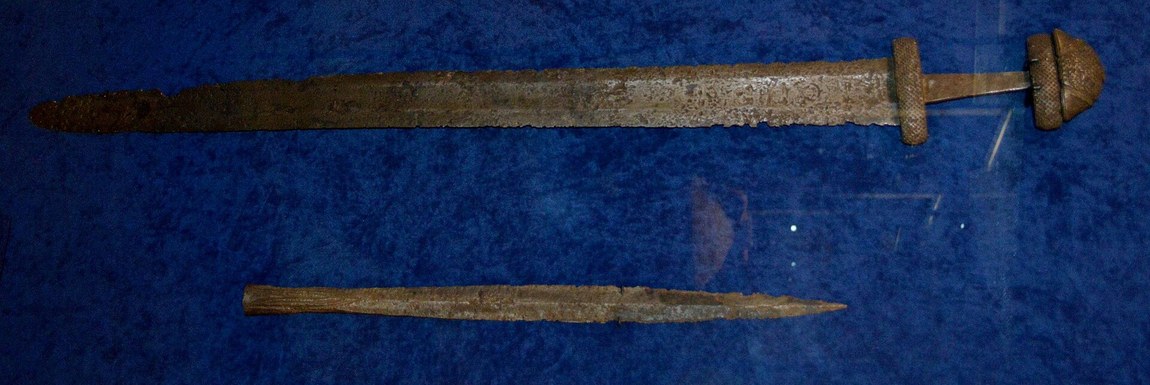
A great deal has been written about Viking swords: about pattern welding, about inlaid blade inscriptions, about hilt typologies. Remarkably little about the object in which the blade spent ninety-nine per cent of its life. Yet the scabbard is the real test of craftsmanship: thin wood, a lining, leather, fittings, suspension – and all of it has to work together, or the blade rusts fast in its housing and the sword bangs against your knee as you walk. This article gathers what excavation reports, wood identifications and images actually show, and keeps evidence and interpretation strictly apart.
A Viking Age sword was expensive on a scale that is hard to imagine today. The better blades often came from the Frankish realm, imported or imitated; the famous blades with inlaid names are the best-known evidence of how far that trade reached (see the article on the Ulfberht blades). Nobody who owned such a thing left it lying in a sack. The scabbard was the component that kept this small fortune dry, made it portable, and – not least – displayed it.
Even so, it has long been a footnote in the literature. The reason is banal: it consists almost entirely of wood, fur, textile and leather, and all of that decays. What archaeologists usually hold is a rusted blade – and if they are lucky, the rust preserves an impression of whatever once surrounded it. Whole chapters of scabbard studies hang on such millimetre traces.
The construction is remarkably uniform across Europe. The basis of every early medieval sword scabbard is a wooden body made of two long, identically cut laths. Their thickness is usually somewhere between one and five millimetres – think veneer rather than planks. The inner face was hollowed out to the shape of the blade so that it sat snugly without jamming.
The grain orientation matters: the laths were deliberately split from the trunk so that the annual rings run across their narrow sides. That is not a quirk but structural sense. Radially split wood warps less, splits less readily and can be worked this thin in the first place. And there is a point easily overlooked: a scabbard also had to take a beating. In a scuffle you parry with whatever is in your hand, and that evidently included the scabbard.
For the eighth to twelfth centuries a catalogue of roughly forty-three wood-identified scabbards now exists, assembled from excavation reports from Hedeby to Kyiv. The result is pleasingly unspectacular: people used whatever grew locally and split well. Beech and alder appear most often, then oak, lime, maple, poplar and willow, ash, birch and hornbeam. The Hedeby harbour finds alone cover beech, oak, maple and alder.
Two individual cases are instructive. In Iceland, where timber was notoriously scarce, birch appears – simply because that was what was available. And a high medieval ceremonial scabbard in Vienna is made of olive wood, which shows that different rules applied to display pieces. The summary claim in some overviews that conifers never occur should be read cautiously: pine is recorded for Eikrem in Norway and for one piece from Mikulčice. Rare, yes – but not nil.
Here it gets trickier, because a reenactment standard has settled so firmly that it now circulates as fact: sheepskin, fleece inwards, the lanolin protecting the blade from rust. It is attested – but not everywhere, and not as a rule.
There are genuine finds of fur linings with the hair inwards, for instance on the Norwegian swords from Kvam and Eikrem, where untanned fur is explicitly recorded. Esther Cameron, however, pointed out in her study of English scabbards that fur lining looks rather like a western European trait, while in Scandinavia textile frequently appears as the inner layer. The two best documented Viking scabbards of all – Ballateare and Cronk Moar on the Isle of Man – had textile directly against the blade, probably wool, not fur.
As for the lanolin: that it protects metal from moisture is undisputed and still exploited today. That ninth-century people fitted fur for precisely that reason is a plausible functional reading, but not a statement in any source. No text says so, and the archaeological record cannot. Woollen lining does the same job, since even washed wool carries residual grease – and wool was in every household.
Over the wooden body there typically lay a textile layer and, over that, leather. At Cronk Moar the sequence reads with unusual clarity: textile against the blade, two oak laths two to three millimetres thick, bound together with linen, the whole wrapped in leather whose front was worked into a raised pattern. Ballateare follows the same logic, only with a finely woven textile as the binding.
This matters, because it shows the scabbard was not a box with a lid but a composite: each layer has a job. The textile holds the laths together and takes up tolerances, the leather provides a surface that sheds moisture and can be decorated. Waxed linen barely stretches, which gives the whole thing dimensional stability. Anyone interested in the workshop side will find the background on tanning and working in the article on Viking Age leatherwork.
One subgroup stands out: scabbards densely wound with narrow textile or leather straps. Alfred Geibig described the technique for the central European material, Kainov for the finds from Gnyozdovo. The straps are about eight millimetres wide, with roughly two millimetres between windings, so up to four layers can sit on one spot; with doubled straps that becomes up to eight. The shortest archaeologically preserved wrappings count eighteen turns, the longest over fifty.
Wrapping was concentrated where the mechanical stress is greatest – at the tip. In other words, the wrapping replaces or supplements exactly what a chape otherwise does. Glued windings are so far demonstrable only at Gnyozdovo; if that was common, it was extremely effective edge protection. Such scabbards turn up in Norway, Denmark, Germany, Sweden, Britain, Bohemia and the Rus, always in well furnished graves, and they are depicted in western European manuscripts. And – a nice detail – a wrapped scabbard appears on the Oseberg tapestry. The motif was clearly worth depicting in the North as well.
At the upper end, where the blade enters, better pieces carry a mouth band: a narrow metal strip that grips the vulnerable edge and stops the wooden laths from working apart as the blade is drawn. On the scabbard from Sæveli a narrow gap between scabbard and lower guard is recorded, apparently once filled by exactly such a mouthpiece.
At Cronk Moar, by contrast, a leather band around the mouth is interpreted as reinforcement – a reminder that metal was by no means standard here. Further down the body sit the suspension plates. At Ballateare they lie 129 and 287 millimetres below the mouth, at Cronk Moar considerably closer together, 81 and 148 millimetres. The bands were laid around the scabbard, backed with a leather strip and riveted. Both scabbards are roughly the same length, around 72 centimetres, and between six and a half and seven and a half centimetres wide.
The chape is the U-shaped metal fitting at the scabbard tip. Its job is twofold: it holds the end together and shields it from abrasion and damp – and it is the place where visible effort could be spent. The Old Norse name is wonderfully vivid: dǫggskór, “dew shoe”, because this fitting protected the tip from wet grass. Alongside it stands sverðskór, “sword shoe”.
Frequency matters here, and it is sobering. Chapes were rare. Fedir Androshchuk assembled one hundred and fifty-four Scandinavian examples – for a period of roughly two centuries and an area stretching from Iceland to the Volga. For comparison: thousands of swords are known from Norway alone. Nine chapes come from Norway, eight from Denmark, six from Iceland. The overwhelming majority of scabbards therefore simply ended in wood, leather or a strap wrapping. Nor was every chape metal: the tip of the Cronk Moar scabbard carried a now-perished piece of bone interpreted as a chape.
The classic ordering is Peter Paulsen's: Schwertortbänder der Wikingerzeit, Stuttgart 1953, with the telling subtitle “a contribution to the early history of Eastern Europe”. Paulsen distinguished seven types by decoration and geographical distribution. The book remains the reference for placing a chape – and it is interesting precisely because Paulsen read these objects from the outset as an east-west phenomenon.
The more recent scheme was published by Androshchuk in 2014, likewise with seven types, now weighted towards style and chronology. The motifs are strikingly narrow in range. Type 2 shows a Borre-style beast with an interlaced body and a beast or human mask at the centre, dated roughly 970 to 990. Type 3 is the great bird group: 3a a schematic bird, often with dotted circles; 3b a bird with clearly rendered head, wings and tail; 3c a “bird-beast” in Borre, Jellinge or Mammen style with an interlaced, double-contoured body. Type 6 shows one or two interlaced beasts with figure-of-eight bodies. Bronze clearly dominates, gilding is rare, silver is known mainly from the Baltic lands. For the style names see the overview of the Norse art styles; for technique, the article on Viking Age goldsmithing.
The distribution is the genuinely interesting finding. Of Androshchuk's one hundred and fifty-four pieces, forty-nine come from Sweden, thirty-eight from Eastern Europe, twenty-nine from the Baltic lands and eleven from Finland – the entire west of Scandinavia, meaning Norway, Denmark and Iceland combined, stays under twenty-five. Since production is also demonstrable in Sweden, it is reasonable to see Sweden as the distributor of this object group.
For individual types the eastern weighting is even sharper: of bird type 3a, seventeen pieces come from the Baltic lands and ten from Eastern Europe, against seven from Sweden and two from Norway. Charlotte Hedenstierna-Jonson has read one of these groups explicitly as a mirror of the political geography of its time. One need not adopt that reading – a chape may travel as merchandise, as a gift, or on a traveller's hip – but as a distribution map these objects are solid evidence of how tightly the Swedish, Baltic and Russian spheres were linked. Other scholars, Paulsen among them, thought several production centres likely.
The scabbard hung from two points. That is the decisive technical finding, and it follows directly from the fittings: an upper plate or band, a lower band with a suspension ring, both laid around the body and riveted. From these two points straps run to a distributor.
On the Isle of Man those distributor rings survive. At Ballateare a ring twenty-one millimetres across with three clasps; at Cronk Moar a ring twenty-three millimetres across with two clasps and a buckle, with a plain glass cabochon set in the centre. Strap ends accompany them, in one case apparently a reused book clasp. The two-point solution has a practical purpose: it sets the scabbard at an angle against the body, usually around forty-five to sixty degrees, so the tip points backwards and does not strike the knee. It was worn on the left if you were right-handed – you reach across the body with the right hand.
Now for the question that divides opinion. The Old Norse for sword belt is sverðfetill; fetill generally denotes a carrying strap or sling, and the matching buckle is the fetils sylgja. The word settles nothing, because a strap can run over the shoulder or around the waist.
For the baldric there are reconstructions based directly on the Manx finds: the distributor ring would then sit on the left thigh, with the strap crossing the chest to the buckle. Against this stands the pictorial record. In western European manuscript art of the ninth to eleventh centuries the great majority of depictions show belts, not baldrics; shoulder carriage occurs but remains exceptional, often in biblical scenes. Accordingly, part of the scholarship regards two-point suspension from a waist belt as the prevalent solution from the mid-ninth century onwards. Honestly: both are arguable, and the metal parts that survive in the ground look much the same either way. Anyone claiming a clear answer here has read the sources rather generously.
Now to the image everyone carries in their head and which comes from no medieval source at all: the sword slung across the back, grip above the shoulder, one bold reach behind and the blade is free.
The problem is geometry. A Viking Age blade runs to about eighty centimetres; the reassembled Ballateare sword measures a good eighty-six centimetres overall, the Cronk Moar sword nearly ninety-one. To clear a blade fully from a scabbard you need a draw at least as long as the blade. The human arm is not that. Drawing from the back therefore works only with trick scabbards, very short blades, or in films. Add the practical objection: your arm hangs unprotected in the air for whole seconds, and sheathing is blind.
The archaeology fits. The fittings sit so that the scabbard hangs lengthwise along the leg, not across the shoulder. In graves the sword regularly lies at the side of the body. And in contemporary imagery – picture stones, manuscripts, later the Bayeux Tapestry – nobody carries a sword on their back. The tapestry is in any case a latecomer, made in the 1070s and thus after the Viking Age; it shows Norman conditions and is usable as evidence only with that caveat. But it shows what all the others show: belt, hip, left.
The sword on the back is a twentieth-century image, popularised by film and fantasy. There is no Viking Age find, no depiction and no text for it; with an eighty-centimetre blade the draw length simply makes it impossible. “All scabbards were lined with sheepskin” is likewise too crude: fur lining is attested but looks more like a western European trait, while in the North textile frequently lay against the blade – Ballateare and Cronk Moar are the clearest cases. “Every sword had a chape” is wrong: some 154 Scandinavian chapes are known in total; the mass of scabbards ended in wood, leather or strap wrapping, in one case in bone. And the popular formula “lanolin protected the blade” is a functionally plausible reading by modern craftspeople, not a statement in any source.
One detail of this story is almost too neat to believe – and it is well attested. Carolingian sword belts carried trefoil-shaped strap distributors: metal mounts that divided the belt into three straps so the sword sat better. Precisely the component this article is about.
Such distributors reached Scandinavia as merchandise, gift or loot. There they were not built into Norse sword belts – Egon Wamers has argued that Norse warriors specifically did not adopt the Carolingian belt – but were fitted with a pin by enterprising craftsmen and converted into brooches. The mount of an enemy's war harness became a fastener for a neckline, a shawl or a cloak. The early pieces still carry Carolingian acanthus ornament, the later ones Norse animal styles.
The trefoil brooch became a fixture of Norse women's dress within a very short time and was produced in quantity. It occurs virtually only in women's graves, often centrally between two oval brooches. The gilded female figurine from Revninge in Denmark shows a triangular ornament at belt height strikingly like a trefoil brooch – possibly an echo of the original function. Whether the Franks noticed this repurposing of their war gear, we do not know. More on the dress side in the article on Viking Age jewellery.
Old Norse is unusually differentiated here, and the vocabulary betrays something about construction. Slíðrar is the common term for scabbard; the word is plural, and it has been connected with the two wooden halves. Spænir, plural of spánn, “lath, splint”, probably denotes precisely that wooden core. Skálpr also means scabbard, but is used in contexts that point rather to the leather covering. Umgerð or umgjǫrð, finally, means the finished whole of wood and leather – um is “around”, gjǫrð a girdle.
So there are separate terms for wooden core, leather skin and complete scabbard. That is no accident among people who built these things themselves. Add the dǫggskór already mentioned for the chape. The form “umgerdi” occasionally seen online does not exist – the word is umgerð. Incidentally, no secure Old Norse name survives for the mouth band or the strap slide. Anything definitive you read on that is a reconstruction.
One element of the scabbard was purely legal in character: the friðbǫnd, “peace bands”. These were straps wound around the sheath and fastened to a ring at the hilt. As long as they were in place the sword could not be drawn, at least not quickly. The phrase for undoing them is spretta friðbǫndum.
They were used where the use of weapons was forbidden, notably at assemblies. One example stands in Gísla saga, chapter 28, at the spring assembly at Þorskafjörður. One should not overstretch the evidence: the sagas were written down in the thirteenth century and describe a literarily shaped world. But the rule itself is plausible and fits what the legal texts say about weapon truces at places of judgement. Narratively the motif is gold – a man who loosens his peace bands at the assembly has announced what comes next.
And then there is the level at which the sword stops being a tool. In Laxdœla saga the sword Skǫfnungr, supposedly taken from the grave mound of the Danish king Hrólfr kraki, passes from Eiðr to his kinsman Þorkell. Eiðr sends instructions with it that suit a creature rather better than an object.
“Such is the nature of this sword: no sun shall shine upon its hilts, and it shall not be drawn while women are near. If a man takes a wound from this sword, that wound cannot heal unless the healing stone that belongs with it is rubbed upon it.”Laxdœla saga, ch. 57 (Old Norse: “sú er náttúra sverðsins, at eigi skal sól skína á hjǫltin …”, Íslenzk fornrit V, p. 172); own translation
Kormáks saga, chapter 9, has a parallel: there the sun must not fall on the upper hilt, the sword is not to be drawn except in preparation for combat, and a pouch belongs with it that must be left alone. What this means for our subject is remarkably sober: both sets of rules amount to keeping the sword in its scabbard. Here the scabbard is not packaging but restraint. One should not, however, turn this into Viking Age ritual practice. Both sagas are thirteenth-century texts, Skǫfnungr is a legendary sword, and these instructions belong to the narrative type “enchanted object”, not to the archaeological record.
Why do we know anything at all about materials that decay? Because iron rusts. As it corrodes, iron compounds migrate into adjacent organic material and replicate its structure; wood cells, fur hairs and weave patterns survive as mineralised impressions on the rust. These pseudomorphs are why beech can be told from alder, and twill from tabby, on a corroded blade.
On that basis Esther Cameron worked out developmental trends for England – in the making of the wooden laths, for instance, or in the use of particular mouth bands. Occasionally this even permits statements about an object's biography: recent work has examined whether blade and scabbard are the same age, or whether an older blade received a younger scabbard. Exactly what one would expect of an heirloom. A sword could outlast generations; a scabbard of thin wood and leather certainly could not. That a sword got through several scabbards in its lifetime is the likeliest assumption – proving it case by case remains hard.
A last word on maintenance: no Viking Age text describes how a sword was greased. That it happened is practically certain, since unprotected iron in a damp North Sea climate is a problem within weeks. Grease, oil and fat-dressed leather are the obvious means. But here too: obvious is not attested.
The basic construction is covered by numerous finds: two internally hollowed wooden laths about 1–5 mm thick, radially split, an inner lining of textile or fur, a textile layer and leather outside. Around 43 wood-identified scabbards of the eighth to twelfth centuries show almost exclusively deciduous woods, most often beech and alder. Scabbards densely wound with 8 mm straps are known from several countries and from western European manuscript art, and appear on the Oseberg tapestry. For suspension, two fitting points plus a distributor ring are secured by the finds from Ballateare and Cronk Moar (Bersu/Wilson 1966); the scabbard hung at an angle on the left side of the body. Chapes are rare: Androshchuk counts 154 Scandinavian pieces, concentrated in Sweden, the Baltic and Eastern Europe. The Old Norse name is dǫggskór. The derivation of the trefoil brooch from Carolingian strap distributors is attested by early pieces with Carolingian acanthus ornament.
Look at the material and you quickly see where the Viking Age put its design energy: not into the blade. The blade carried patterns from the forging process and occasionally an inlaid inscription, but it was first of all a tool. What was decorated were pommel, guard, grip bands – and, at the lower end, the chape. Precisely there, on a piece of bronze three to eight centimetres tall, sits the finest ornament of the whole ensemble: a bird, a double-contoured beast, interlaced bodies in Borre or Mammen style.
That is a useful lesson for any engagement with Norse ornament. The surface that makes the biggest impression is rarely the biggest surface. The Viking Age placed ornament where the eye goes anyway – on edges, ends and transitions. Working from these objects rather than inventing motifs keeps you closer to the evidence. And for what is historically demonstrable about the weapon itself, see the article on the Viking sword.
The Viking Sword · The Ulfberht sword · Weapon Lore · Viking Smithing · Viking-age art styles · Viking leatherwork · Viking jewellery.
All History & Finds articles →
Long before the Viking Age and before the Icelandic Edda there was Germanic cult – and one of the most striking stood …
Read more →