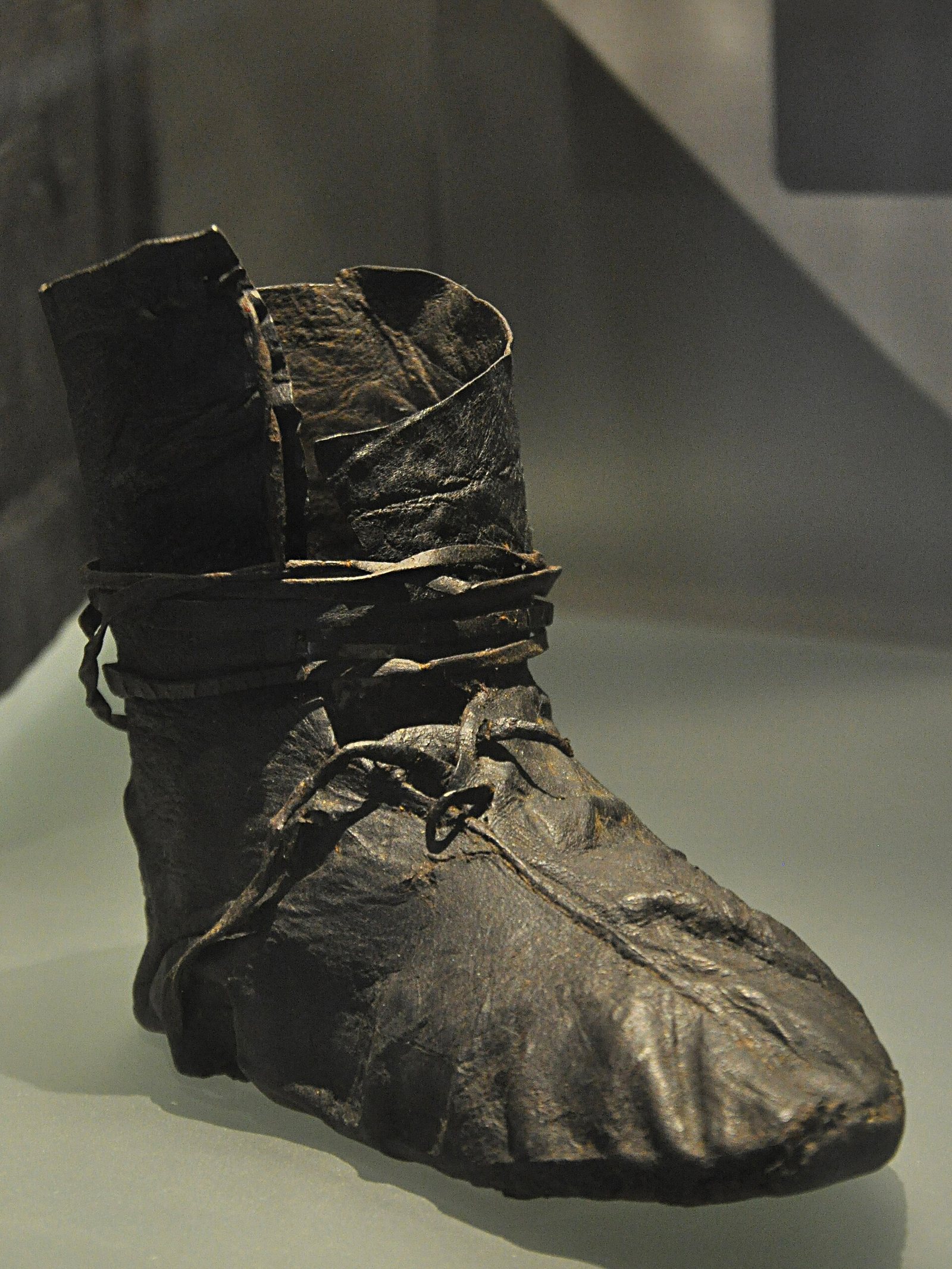
 Leather was the quiet everyday material of the Viking Age – under every step, on every belt, around every blade. Not a gleaming prestige metal, but tough, patiently tanned craft. Let us take a look inside the workshop of the Norse leatherworkers.
When we think of the Vikings we think of swords, ships and silver. But the material that literally carried their daily life was leather. On every foot sat a leather shoe, around every hip lay a leather belt, every knife and every sword sat in a leather scabbard. Straps, pouches, harness, bags, sheaths – leather everywhere. It is simply so perishable that it rarely survives archaeologically; where it does, usually in wet, oxygen-poor soils like the harbour layers of Hedeby, York (Jorvik) or Dublin, a window opens onto a highly developed craft.
Precisely because leather was so ordinary, it says a great deal about the people. It shows how they walked, how they dressed, how carefully they worked – and where the limits of their material lay.
It all began with the animal. Hides of cattle, goat and sheep were the basis, with cattle the sturdy workhorse for soles and thick straps, and goat or sheep for finer, more supple pieces. The hides came as a by-product of animal husbandry anyway – if you used the meat, milk and wool, you also had the hide at the end, and nobody threw that away.
Before a hide could become leather it had to be dehaired and cleaned of flesh residue – laborious, pungent handwork with blunt scraping irons. Only then began the decisive step: tanning.
The dominant method was vegetable (plant) tanning with tannins from tree bark, especially oak bark (tanbark). The tannins make the raw hide durable, more water-repellent and supple – rawhide becomes leather. This was no afternoon project: good, thick leather of sole thickness could sit in the pit for months, in some cases up to a year, until the tannin had penetrated the whole hide.
This long processing time explains an important observation: leather tanned especially carefully and suitable for fine tooling was expensive and rare. It was used for small, valuable pieces such as knife sheaths rather than for mass production – the material dictated where the effort was worthwhile.
The most common leather product was the shoe. Viking-Age shoes were almost always so-called turnshoes: they were sewn inside out and then turned, so that the seam lay on the inside and the foot rested on smooth leather. Typical are low, turn-sewn models of vegetable-tanned cowhide – the plain Hedeby type and the Jorvik type with a toggle fastening are among the best-known reconstructions from genuine finds.
How precious a material leather was even in daily life is betrayed by mythology itself. The Prose Edda says of the shoe of the god Víðarr, with which he tramples the wolf Fenrir at Ragnarök:
That shoe is made of the strips of leather which men cut from their shoes at toe or heel; therefore he who desires to render help to the Æsir must cast away these strips.Snorri Sturluson, Gylfaginning (Prose Edda), public-domain translation by Brodeur 1916
A myth of the gods that speaks of the leather off-cuts of shoemaking – it could hardly be shown more beautifully how naturally the craft belonged to everyday life.
After the shoe came the belt. It not only held the clothing but carried a person’s whole portable inventory: knife, pouch, fire steel, small tools. Belts were mostly rather narrow and fitted with buckles and mounts of bronze or iron – it is those metal fittings that survive in the soil and betray to us the existence of the long-vanished leather bands.
Leather also produced straps of every kind, bags and pouches, sheaths, carrying loops and harness for the horses. Wherever something had to be bound, carried or fastened, leather was the material of choice – tough, repairable and made from material already at hand.
Every knife needed a sheath, every sword a protection. Knife sheaths were often made entirely of leather, folded and stitched along the edge; sword scabbards usually had a core of thin wooden laths, frequently lined with fur or textile and covered on the outside with leather. The wooden core gave rigidity and protected the blade, the leather the surface.
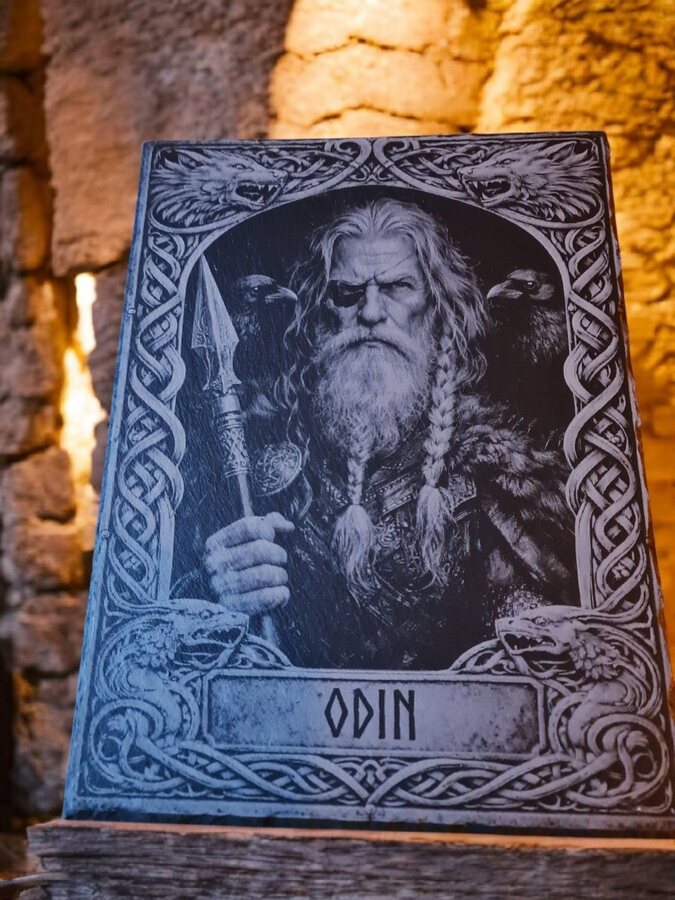
Here an honest look at the finds is worthwhile: the leather covers of Viking-Age sword scabbards from York, Dublin and the Isle of Man were mostly rather plain – simple lines or low raised ridges created by strips laid underneath, but rarely the lavish decoration known from later periods or from fantasy imagery. Elaborate, deep tooling was reserved for small, especially valuable pieces.
Decoration did happen – but selectively. From Viking-Age Dublin dozens of scabbard fragments are known, among them pieces with incised and embossed patterns: geometric interlace, lines, animal-style ornament. The finest and most elaborate decoration is often found on knife and seax sheaths of especially carefully tanned, tooling-capable leather – that very material whose production consumed so much time.
The techniques were essentially the same ones that still shape fine leatherwork and engraving today: incising the damp leather, pressing patterns with tools, modelling lines and surfaces. What survives is mostly fragmentary – but it is enough to show that people with an eye and patience were at work here, not merely functional labourers.
The leatherworker’s toolkit was modest and effective: the awl for pre-piercing holes, sharp knives for cutting, needles and waxed thread for sewing, scraping irons and slickers for the surface, tools for decoration. Sewing was mostly done with natural thread, often in the sturdy saddler’s stitch with two needles.
In the end stands a craft that is quieter than the forging of a sword, but no less artful: through patience, knowledge and handwork a raw hide becomes a shoe, a belt, a scabbard, a piece of lived everyday life. It is precisely this union of tough natural material and fine handwork that makes Viking leatherworking so approachable to this day.
Well attested are vegetable-tanned (bark/tanbark) turnshoes from the harbour layers of Hedeby, York (Jorvik) and Dublin, leather belts with metal buckles and fittings, and knife and sword scabbards (leather, or a wooden core with leather cover). Dozens of scabbard fragments with incised and embossed patterns are known from Dublin; tanning tooling-capable leather could take up to a year.
The “thick leather barbarian armour” of films and fantasy is not an archaeological standard: leather was an everyday material for shoes, straps and scabbards, not the typical battle armour of the Vikings. And while the famous scabbard decorations are real, sword scabbards from York, Dublin and Man were mostly rather plain – deep, lavish tooling was reserved for small, especially valuable pieces, and much survives only in fragments.
The Mästermyr tool chest · Comb-makers & bone-carvers · Dyeing – the colours of the Vikings · Viking clothing & fashion · Everyday Viking life.
All Everyday Life & Craft articles →
The shining swords, the fine brooches, the carved ships – behind all of it stood a craftsman with his tools. What those …
Read more →From honey, water and time comes the oldest intoxicating drink of the North. But mead was more than a drink – it was …
Read more →Again and again, peat-cutters in Ireland, Scotland and Scandinavia find the same riddle: a lump of waxy, ancient …
Read more →