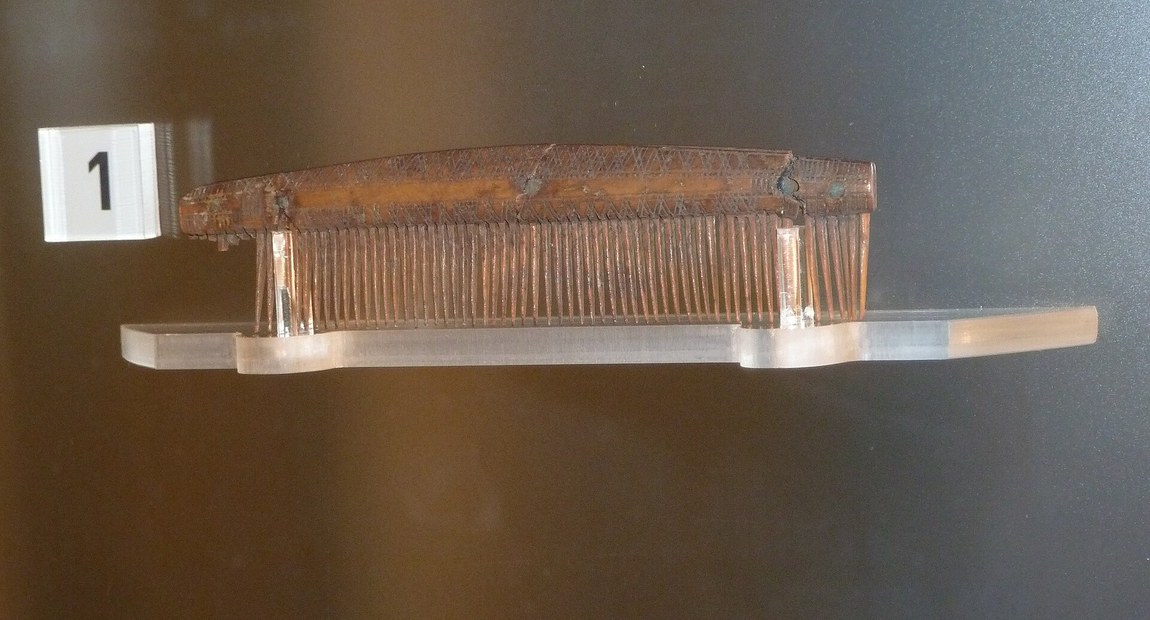
Viking comb makers were specialist craftworkers who turned deer antler, and occasionally bone, into composite combs: narrow tooth plates riveted between two side plates, decorated, and only then sawn into teeth. Their waste lies in Ribe, Hedeby, Birka and York, and some of their raw material was reindeer antler from the far north. Here is how such a comb was made, what protein analysis reveals about Viking trade routes, whether comb makers really wandered from market to market, and why a comb was never just a comb.
Picture a market day in Ribe, some time in the late eighth century. Between the pots, glass beads and quernstones sits someone with a saw, a knife and a pile of antler. The ground around him crunches underfoot: shavings, sawn-off tines, botched blanks. That rubbish is exactly what tells us, twelve centuries later, who sat there and what he did. The comb maker left hardly any names behind, but he left an enormous amount of mess.
Combs are among the most common finds of the Viking Age. They turn up in graves, rubbish pits, house floors, harbours and marketplaces. And they are not simple objects. A good Viking comb is a multi-part precision piece. To understand it, you need to know its material, its technique, its workshops and the routes along which the antler travelled.
"Bone carver" is a catch-all label that lumps together bone, antler, horn and ivory. To a craftworker these are very different materials. Bone comes from every slaughtered cow, but it is brittle and splinters. Horn is a keratin sheath, soft and flexible, and usually rots away in the ground. Antler is true bone tissue that deer grow and shed every year, and it is remarkably tough and springy.
That springiness is what a comb needs. Fine teeth dragged daily through tangled hair snap quickly if the material is brittle. The British archaeologist Steven Ashby, one of the leading specialists in this craft, stresses that comb makers deliberately chose antler, while bone went into countless other everyday objects. When antler ran short, they compromised: the side plates, which carry less load, could be made of bone. The famous comb case from Lincoln, according to the British Museum, is made of cattle bone.
Three deer species were available in the North. Red deer lived across the northern European lowlands, including Denmark and northern Germany. Elk (moose, to North American readers) lived in Scandinavia and around the Baltic but was largely absent from Denmark and further south. Reindeer were confined to the Arctic and subarctic: the Norwegian mountains and the far north of Sweden and Finland. So when reindeer antler turns up in Ribe or Hedeby, it must have travelled. That is how a humble comb becomes a star witness for long-distance trade.
One detail is easy to miss: most comb makers did not work with antler from hunted animals but with shed antler. Deer cast their antlers every year, and anyone who knows where the herds stand in late winter can collect them. Deer bones are strikingly rare in Viking towns, so the antler there rarely came from someone's dinner. Behind every comb stands a network: collectors who knew the woods and fells, traders who passed the raw material on, and craftworkers who turned it into something useful.
The typical Viking comb is called a composite comb, or more precisely a three-layer comb. A middle layer of tooth plates is sandwiched between two side plates, also called connecting plates. Why so complicated? Because antler is strong in only one direction. Its fibres run along the beam, but the teeth must run across it. A beam of antler therefore yields only narrow plates with the grain running the right way. A long one-piece comb is almost impossible to make from antler, so it was assembled from parts.
Workshop waste, half-finished pieces and experimental reconstructions let us follow the process quite closely:
Those saw nicks prove that the teeth were cut after assembly, and they show how fine the teeth were. Many combs have coarser and finer teeth, and double-sided combs often carry two different rows. A fine side meant for lice and nits? Likely enough, but that is interpretation, not evidence.
How much work went into one? Experimental archaeology suggests that a skilled person could finish not much more than about one comb a day. That is a rough order of magnitude, not a fixed rate, but it makes the point: a comb was no disposable item. Unsurprisingly, many surviving combs were repaired, re-riveted or kept in use with broken teeth.
Combs changed shape over the centuries, and that is what makes them so valuable to archaeologists. In 1981 the Swedish archaeologist Kristina Ambrosiani published a typology based on the combs from Birka and Ribe that is still in use; her Type A covers the long combs of the early Viking Age. Further systems come from Johan Callmer and Steven Ashby. For you, the upshot is simple: a comb is a time stamp, often narrowing a find layer down to a few decades.
Towards the end of the Viking Age combs became shorter, and double-sided combs more common. Alongside them came comb cases: sleeves of antler or bone plates that protected the teeth inside a belt pouch.
Ribe on the west coast of Jutland is regarded as Scandinavia's oldest town. From the early eighth century traders and craftworkers met there on a marketplace divided into plots. The town's beginnings and its first coins are covered in our article on Ribe and the first coins of the North. For comb makers Ribe is a gift: archaeologists have uncovered workshop layers of bead makers, metal casters and comb makers there, most recently during the 2017–18 excavations of the Northern Emporium project led by Søren Sindbæk.
The breakthrough came from a new method. In 2015 Steven Ashby, Ashley Coutu and Søren Sindbæk published "Urban Networks and Arctic Outlands" in the European Journal of Archaeology, analysing combs, manufacturing waste and raw antler from Ribe, Aarhus and Aggersborg with ZooMS.
ZooMS stands for Zooarchaeology by Mass Spectrometry. A tiny amount of collagen, the main protein in bone and antler, is extracted and run through a mass spectrometer. Every animal species has slightly different collagen building blocks, a molecular fingerprint. This means that even a finished, decorated comb can be identified as red deer, elk or reindeer, something that is usually impossible by eye. The method was developed at the BioArCh laboratory of the University of York, and it is minimally destructive: a few milligrams of drilling dust are enough.
The result from Ribe: among the waste were tine tips, burrs and part-worked blanks of reindeer antler, dating to the 780s at the latest. Whole antlers were being shipped to Ribe and worked there. Since there were no reindeer in Denmark, the material came from the Scandinavian north, from Norway or central Sweden. The authors see this as the earliest clear evidence of exchange between the markets of the southern North Sea and the Scandinavian Peninsula, before the raid on Lindisfarne in 793 that traditionally opens the Viking Age.
The control test came from Scotland. In 2014 Isabella von Holstein and colleagues found no reindeer antler in pre-Viking Scottish combs. So the combs offer no evidence for Scandinavian contact with Britain before 793, but they do document traffic down the Norwegian coast to the south.
Here we have to correct the earlier version of this very article. It said, in essence, that many Hedeby combs were made of reindeer antler imported from Norway and worked on site. The truth is more interesting.
Antler working at Hedeby (Haithabu) was studied in detail by Ingrid Ulbricht as early as 1978. The workshop waste there is overwhelmingly red deer, with some elk. Reindeer accounts for only about half a percent of the identifiable waste in her figures. Whoever made combs at Hedeby used what the surrounding woods provided.
Then, in 2023, the journal Antiquity published "In the footsteps of Ohthere" by Mariana Muñoz-Rodriguez, Steven Ashby and colleagues, including the Hedeby excavators Volker Hilberg and Sven Kalmring. They sampled 49 long combs that belong, by form and decoration, to the ninth century. The result: 44 of them, about 90 percent, were made of reindeer antler. The rest could only be identified as "deer or cattle", and one gave no result.
The contradiction is striking: finished combs almost entirely reindeer, workshop waste almost entirely red deer. The authors conclude that these early combs were not made at Hedeby at all. They arrived ready-made, in the luggage of traders, travellers or settlers from the north, perhaps from northern Scandinavia itself, perhaps from another trading place such as Ribe or Kaupang in Vestfold. According to the study there is no evidence for comb making at Hedeby in the ninth century; local production using red deer antler began only in the tenth.
There is a twist. A group of combs with ring-and-dot decoration had long been attributed to Frisian comb makers travelling north. In the samples, practically all of them turned out to be reindeer antler, and none could be shown to be continental deer. A Frisian origin now looks a good deal less likely.
The study's title alludes to Ohthere, or Ottar, a northern Norwegian magnate who around 890 described his travels to King Alfred of Wessex. By his account he owned some 600 tame reindeer, and he also sailed to Hedeby. You can follow these routes further in our overview of Viking trade.
At Birka in Lake Mälaren the picture changes again. Most of its combs come from the graves Hjalmar Stolpe excavated in the nineteenth century, others from the "Black Earth", the dark settlement soil of the trading town. In the production waste there, according to a review by the archaeologist Sjoerd van Riel, elk antler dominates at roughly two thirds, followed by red deer and about one eighth reindeer. That fits Birka's setting: central Sweden had plenty of elk, and reindeer came in along the trade routes from the north.
Far to the west lies York, the Viking-age Jórvík. The excavations at Coppergate produced a huge quantity of antler waste, published in 1999 by Arthur MacGregor, Ailsa Mainman and Nicola Rogers in The Archaeology of York. Most of the manufacturing evidence there relates to comb making in the Anglo-Scandinavian period, roughly from the mid-ninth to the late eleventh century, and the volume itself debates whether resident craftworkers or visiting ones did the work. Pits full of comb-making waste have also been found elsewhere in the city, for instance at Hungate. The story of the city's Norse settlers is told in The Northmen of Jórvík.
For a long time it seemed settled: Viking comb makers travelled from market to market. Ambrosiani argued this forcefully in 1981. Her reasons: combs look remarkably similar across vast areas, and many sites yield only small amounts of production waste, roughly what one craftworker might leave in a season. It is a seductive picture. A man with saw and file collects shed antler in spring, sits at the markets in summer and moves on in autumn.
Steven Ashby has questioned this. Working antler on any scale needs a reliable supply, local knowledge and contacts with hunters, collectors or farmers. Add regional peculiarities, such as how rivets were set, and a degree of workshop specialisation. Ashby therefore prefers the idea of restricted mobility: comb makers perhaps moved in fixed circuits between a few places, but they were not rootless vagrants.
In 2017 the Dutch archaeologist Sjoerd van Riel pushed back. Tools are easy to carry, raw material could be bought at markets, and in towns like Dorestad or York comb-making waste is scattered over many spots, which rather suggests changing workplaces. The ZooMS results shift the debate again: if no combs were made at ninth-century Hedeby, only ready-made northern combs used there, then perhaps it was the goods and their owners that travelled rather than the craftworkers.
Why go to all this trouble for a hair tool? Because hair mattered in the North, socially and practically. The cliché of the lice-ridden, matted barbarian refuses to die, and we take it apart in our fact-check Typical Vikings?. The combs are the strongest counter-argument.
Written sources add to it. The Arab envoy Ibn Fadlan described the Rus on the Volga in 921–922 and their morning wash: a basin of water was passed round, each man washed his face and hair in it, combed his hair and spat into it. Ibn Fadlan found it disgusting, but he also testifies that they combed, every morning. You can read the passage in our Ibn Fadlan reading edition.
From England comes a much-quoted complaint attributed to a chronicler known as John of Wallingford, written down only in the thirteenth century: the Danes, it claims, combed their hair daily, bathed on Saturdays, changed their clothes often and so charmed noble women. That is later tradition with a mocking edge, not an eyewitness account, but it does mirror a reputation. More on baths, tweezers and ear spoons in Viking personal hygiene, and on the hairstyles all these combs served in Comb, bath and the "reverse mullet".
A comb was personal. People carried it on the body, in a belt pouch or a case, and often took it into the grave. Combs appear in cremations and inhumations alike, with men and with women. It would be too much to call this a rule, but the comb was evidently part of what a person took along as part of themselves.
At the same time, size and finish show that combs were meant to be more than practical. Many early long combs are considerably larger and more richly decorated than combing alone requires. Ashby reads them partly as markers of taste and belonging. A comb of far-travelled reindeer antler with bronze rivets said something about its owner, much as a good watch does today.
The sheer frequency of combs in graves also skews the picture. Antler survives well in many soils, and combs are easy to spot in excavation. Wooden combs certainly existed but have almost everywhere decayed. So "everyone had an antler comb" is plausible for town dwellers and for those buried with grave goods, but it cannot be proven for every person in the North.
Some comb makers did leave us their names, or at least one did. The comb case from Lincoln, now in the British Museum, carries a runic inscription usually read kamb : koþan : kiari : þorfastr, "Þorfastr made a good comb". The case is made of cattle bone, about 13 centimetres long, assembled with bronze rivets and dated to the tenth century. Whether Þorfastr was really the maker, or whether the line is a kind of tongue-in-cheek advertisement, cannot be decided. Either way it is delightful: a craftsman praising his own work. In our workshop, we understand him perfectly.
Even older and even more direct are the runes from Ribe. The 2017–18 excavations produced a broken antler comb carved with runes on both sides. Lisbeth Imer of the National Museum of Denmark and Søren Sindbæk published it in Danske Studier in 2021, dating it to the first half of the ninth century; press reports said "around 800". The inscription, believe it or not, names the object: one side carries the noun "comb", the other a form of the verb "to comb", apparently cut by two different hands. It is among the earliest inscriptions in the Younger Futhark.
The tradition is old. One of the earliest runic finds of all is a comb: the antler comb from the Vimose bog on Funen bears the inscription harja and is dated to around AD 160. It is usually read as a name. Combs were evidently popular writing surfaces, smooth, hard and personal. How runes work in general is explained in The runes – an honest introduction.
Combs were the showpiece, but far from the only product of antler and bone workshops. Antler and bone became gaming pieces, such as the domed pieces for board games like Hnefatafl found in graves at Birka and elsewhere. There were needles for sewing and needle binding, hair and dress pins, weaving tablets, spindle whorls, awls and points.
Handles are very common: for knives, awls and files. Antler is easy to drill, an iron tang was driven in, and the result was a durable grip. Box mounts, strap ends and amulets were carved too. Horse and cattle foot bones were ground into bone skates, found in numbers at Hedeby, Birka and York. Pig fibulae made simple pins, sheep ribs became mounts for small boxes.
The bone carvers' tools differed little from those of other trades: saws, knives, files, drills, and compasses or centre bits for the typical ring-and-dot motifs. For a sense of what a Viking toolkit looked like, see the Gotland chest we present in The Mästermyr tool chest, and for where this craft sat among other trades, our overview Viking occupations and crafts.
A comb is a modest thing. Yet it bundles almost everything that defines the Viking Age: raw materials from forest and fell, gathered by people who knew the land. Traders who carried antler and combs hundreds of kilometres down the Norwegian coast to the North Sea and on to Hedeby. Craftworkers in Ribe, Birka and York who turned brittle-looking beams into springy, elegant tools. And people who cared about how they looked, and took their comb with them into the grave.
Twenty years ago nobody could have said which deer a particular comb came from. Today a few milligrams of collagen give away its origin. That is what we try to do with our engravings as well: make something lasting out of a plain material.
What were Viking combs made of? Mostly antler from red deer, elk or reindeer, because antler is more flexible and less likely to break than bone. Bone was used mainly for side plates and comb cases; wooden combs certainly existed but rarely survive.
What is a Viking composite comb? A comb assembled from a middle layer of narrow tooth plates riveted between two side plates. The teeth were sawn after assembly, which is why saw nicks often show on the side plates.
Where did the reindeer antler for Viking combs come from? From the Scandinavian north, such as the Norwegian mountains or northern Sweden, since Denmark had no reindeer. ZooMS shows reindeer antler at Ribe by the 780s at the latest and in about 90 percent of sampled ninth-century combs from Hedeby.
Were Viking comb makers travelling craftsmen? That is a widespread hypothesis going back mainly to Kristina Ambrosiani, but it is debated. There were probably both travelling specialists and settled workshops in the trading towns.
Are there Viking combs with runes? Yes. The best known is the comb case from Lincoln inscribed "Þorfastr made a good comb", and an antler comb from Ribe from the early ninth century carries the word "comb" itself.
For courage. For remembrance. For legends that live on.
The Mästermyr tool chest · Viking hairstyles & beards · Viking clothing & fashion · Hnefatafl – Viking chess · Dyeing – the colours of the Vikings.
All Everyday Life & Craft articles →
Among silver and glass, glowing red beads keep appearing in the rich women's graves of the Viking Age: carnelian. The …
Read more →How did people heal in a world without a pharmacy? With herbs, with knowledge – and with a charm to go with it. An Old …
Read more →The shining swords, the fine brooches, the carved ships – behind all of it stood a craftsman with his tools. What those …
Read more →From honey, water and time comes the oldest intoxicating drink of the North. But mead was more than a drink – it was …
Read more →