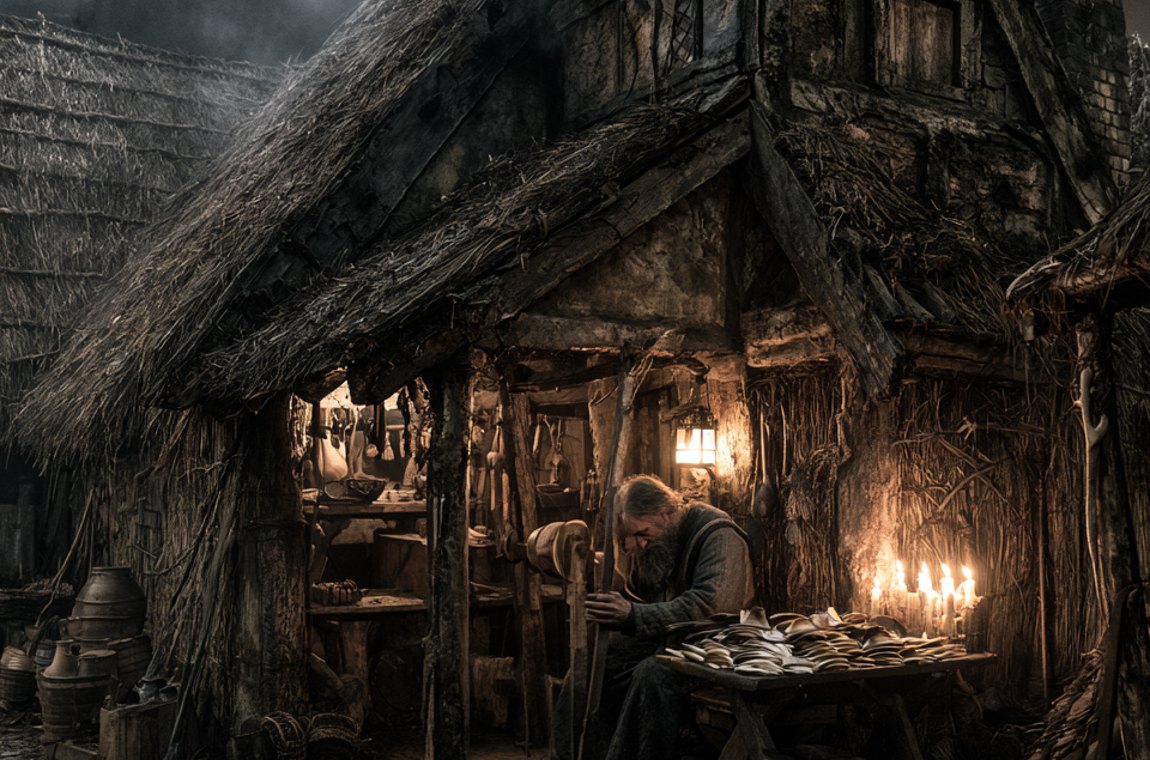
When we hear "Viking", we picture warriors on longships. Yet the vast majority of people in the North never went raiding. They ploughed fields, forged nails, spun wool, carved combs and haggled at markets. This overview walks through the trades and crafts of the Viking Age, points to our deep-dives, and separates evidence from legend.
Let us begin with the biggest misunderstanding. The Old Norse word víkingr does not describe a profession but an activity: to go á víking meant to travel overseas for a limited time in order to trade, raid or earn pay. You did not become a Viking the way you became a smith or a farmer; you went on a viking voyage and returned to the farm afterwards. The overwhelming majority of Norse people never saw a foreign monastery. They lived, worked and died where they were born, and the voyage was, for most, the exception rather than the point of life.
Northern society was a farming and craft world with a thin warrior elite at the top. To understand daily life you must look at the workbench and the field, not only at the deck of the dragon ship.
By far the most common "job" was that of the farmer, Old Norse bóndi. The free farmer who owned a homestead formed the backbone of society: he bore arms, spoke at the assembly, made sacrifices and fed everyone else. Growing grain, above all barley, keeping livestock, fishing and, in the North, hunting shaped the year. Even a chieftain was essentially a great farmer whose wealth lay in land, cattle and silver. To learn more about the foundation of this world, see our deep-dive on Viking farming.
Among farmers there were fine gradations: the wealthy hauldr with inherited land, the tenant who worked another man's ground, and at the very bottom the unfree þræll, the enslaved person who did the hardest work and had no will of their own before the law. Rank and labour were closely bound together.
The farm was also a small factory. Because a single homestead had to make as much as possible for itself, the farmer was a part-time carpenter, cobbler, net-knotter and smith for the simplest things. The specialised craftspeople this article describes grew out of exactly this everyday life, in the places where a surplus of time, raw material and silver allowed a person to limit themselves to a single art. Yet the self-sufficient farm remained the foundation on which everything else rested.
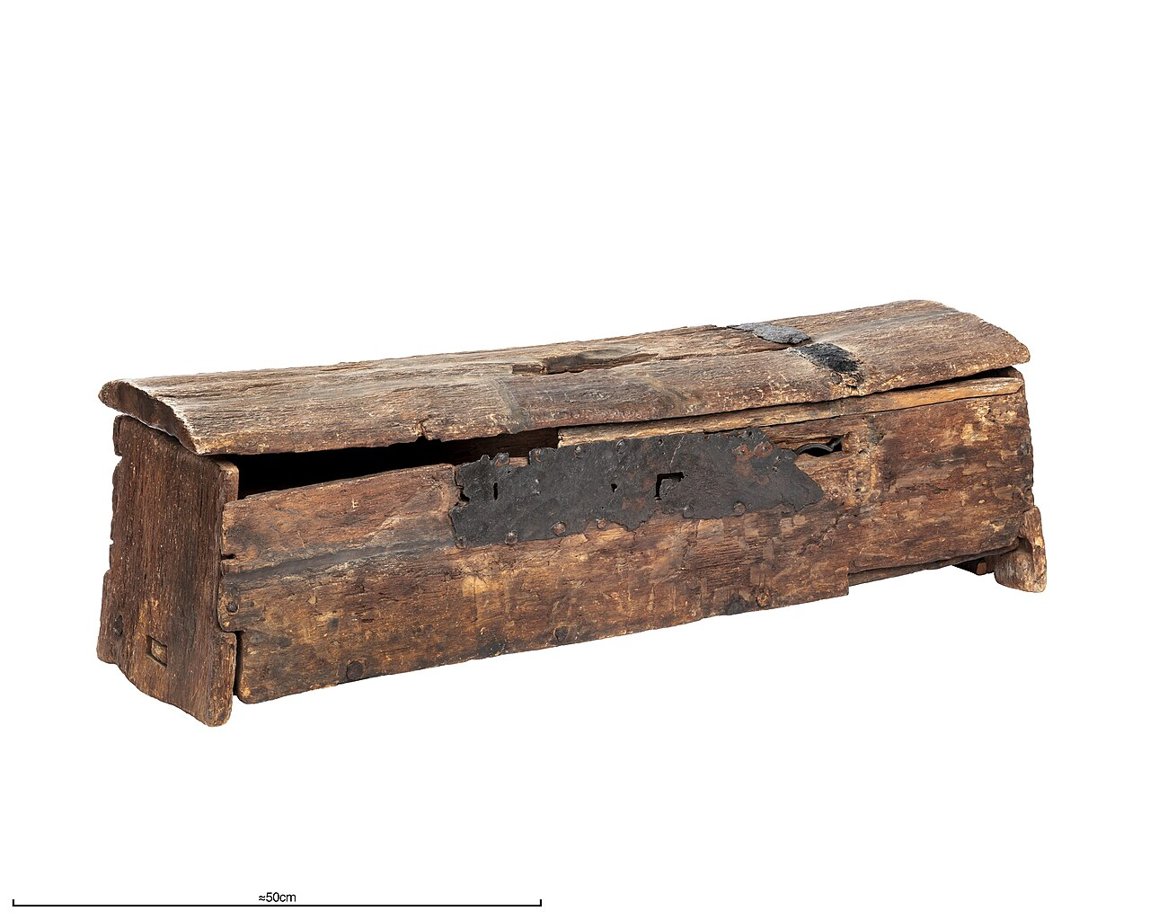
No craftsman enjoyed greater standing than the smith. He turned bog and mountain ore into tool, nail, fitting and weapon, and the best of them forged pattern-welded sword blades whose figures danced in the light. Smiths were thought to work half within the realm of mystery; it is no accident that in myth it is dwarves and the legendary smith Wayland who make the most precious things. Tool finds such as the Mästermyr chest show how versatile such a craftsman was. Read more in our deep-dive on Viking smithing.
The longship is seen as the crown of Norse technology, yet behind it stood a craft that left almost no written trace and was nonetheless supreme artistry. The boat-builder split oak trunks radially, not with the saw but with axe and wedge, to win planks that were tough and light at once. He built from the outside in, shaping the hull by experience and eye, without plans. Our deep-dive on Viking shipbuilding shows how tree and nail became a seaworthy ship.
Closely related was the woodcarver. Wood was the most important material of the North: houses, beds, wagons, sledges, vessels, ship stems, all bore carving. The animal styles from Oseberg to Urnes live on to this day in church portals. Whoever could carve beautified both everyday life and sacred things.
Textile work was perhaps the most labour-intensive activity of the entire Viking Age, and it lay firmly in women's hands. Wool had to be washed, combed, spun with the hand spindle and worked into cloth on the upright warp-weighted loom. A single large sail for a longship consumed the labour of two women over more than a year, more time than the building of the ship itself. Without the weavers, no voyage would have been possible. Our deep-dive on Viking weaving explains the tools, the patterns and the central role of women.
In the trading places specialised craft was concentrated. The bead-maker melted down imported Roman and Oriental glass fragments and drew colourful beads from them; at Ribe thousands of tesserae and half-finished pieces have been found. Read more in our deep-dive on the bead-maker and the glass bead.
The comb-maker made composite combs of antler, riveted and toothed; combs were mass-produced and a sign of the famed Norse grooming. Scientific analysis shows that Hedeby's combs were often made of reindeer antler brought from Norway, proof of long trade chains. More in the deep-dive on the comb-maker.
At the top of the fine crafts stood the goldsmith, who created brooches, pendants and Thor's hammers with filigree, granulation, niello and lost-wax casting, often from chopped trade silver. Our deep-dive on goldsmithing and the overview of Viking jewellery explore this glittering craft.
Beyond the famous trades stood a whole world of everyday craft. The leatherworker and cobbler made turn-shoes, belts, sheaths and straps from tanned hide; almost every person walked on his work. The cooper bent staves into buckets, tubs and barrels, held together with wooden hoops, the vessels in which milk, ale and provisions were stored. The amber grinder turned the "gold of the Baltic" into beads and pendants. The bone- and antler-worker made pins, needles, dice, gaming pieces, whistles and skates. The rope-maker twisted bast and, for ships, even walrus hide into cordage; the potter, where the wheel was rare, shaped simple cooking ware by hand, while the finest tableware was imported from the Rhineland. None of these people is famous, yet together they clothed, shod, fed and equipped the whole society.
The trader, Old Norse kaupmaðr, moved between the worlds. He shipped soapstone, whetstones, furs, amber, iron and enslaved people south and east, and brought back silver, silk, glass, wine and spices. He carried a folding balance and small weights, for silver was weighed, not counted; a ring was cut to pieces and hacked into hacksilver to make the right amount. Trading and raiding were not always cleanly separated in the same man: a voyage could turn from market to plunder and back. But the settled merchant with his booth in Hedeby or Birka was a respected specialist whose reach stretched from Ireland to Baghdad. Our deep-dive on Viking trade follows the routes and the silver.
And the warrior? He existed, but as an exception, not the rule. The men who lived by weapons alone were the retinue of a lord or king, the hird and the húskarlar, fed and paid to fight and to guard. Later, standing paid troops such as the þingalið in England point towards a true soldier's trade. But such men were a small, privileged minority. The ordinary raider was a farmer's son who rowed out in summer and came home to the harvest. The image of a whole people permanently in arms is a modern invention; war was a season, not a career, for almost everyone who ever went á víking.
There were no guilds, no schools and no apprenticeship contracts in the Viking North. A craft was learned by doing, from father to son, from mother to daughter, at the workbench and the loom of one's own home. The custom of fostering, sending a child to be raised in another household, could also pass on skills and bind families together. Specialised knowledge, from pattern-welding a blade to reciting the whole of the law, was carried in the head and the hands and taught by imitation over years. This is why so much craft left no written trace: it was never written down in the first place, only shown, repeated and remembered.
On the farm everyone was an all-rounder: people mended, carved and wove whatever daily life demanded. True specialisation, where a person lived from a single craft alone, arose only where enough people and silver came together: in the early towns and trading places. In Hedeby, Birka and Ribe workshops stood side by side, plot by plot, each geared to one trade. Here bead-makers worked next to bronze casters, comb-makers next to leatherers and amber grinders. This concentration was new and a sign that the North had long been woven into the wider world through trade. How that trade worked is shown in our deep-dive on Viking trade.
Not every "job" handled a tool. The skald, the court poet, mastered the intricate verse forms of dróttkvætt and praised his lord's deeds in interlocking kennings. A good skald was memory, chronicler and propagandist in one, and his praise could make a king immortal. His craft was the word, passed down over generations.
The law-speaker, Old Norse lögsögumaðr, carried the whole of the law in his head in Iceland and recited it year after year from the law rock of the assembly. Only in 1117/18 did people begin to write the law down, thereby stripping his memory of its power. More on law and order in the deep-dive on Viking law.
A special role was played by the völva, the wandering seeress, who in return for hospitality and gifts questioned fate and practised the magic of seiðr. She was feared and honoured at once, a specialist in what lay between the worlds. Famous is the scene in the Saga of Erik the Red in which a seeress is welcomed onto her high seat. Whether a wooden or iron staff in a grave was a magic wand or a distaff is still disputed today. Our deep-dives on the völva and on seiðr weigh evidence and interpretation.
There were three: one was called Thrall, the second Karl, the third Jarl. The Thrall built fences, dunged the fields, herded swine and kept the goats; Karl tamed oxen, hewed beams, built houses and forged the plough; but Jarl learned shield and bow, sword and spear, to ride the horse and to carve the runes.after the Rígsþula, Poetic Edda, rendering based on Karl Simrock 1851 / Henry A. Bellows 1923 (public domain)
The trades of the North paint a picture very different from the films: a busy, divided-labour world in which the field fed the ship, the weaver made the sails, the smith struck the nails and the trader brought the silver. The warrior stood not at the centre but at the edge, a seasonal role within an otherwise settled society. Whoever wants to understand the Viking Age honestly looks at the many hands that kept the North alive, not only at the single sword.
For us in the workshop this is a guiding thought too: behind every fine piece stands a craft that can be named honestly. The Norse took pride in good work, in a clean seam, a sharp blade, a tight joint, and that pride in honest labour is perhaps the most Viking thing of all, quite without a horned helmet.
Viking Farming · Viking Smithing · Viking Weaving · Viking Trade · Viking Goldsmithing.
All Everyday Life & Craft articles →
When we picture drinking in the North, foaming mead horns and roaring halls spring to mind at once. Yet the drink that …
Read more →The grey Viking wrapped in sackcloth is a cinema invention. The real textile finds tell another story: bright red from …
Read more →Matted hair, unwashed for years, reeking across the meadhall – that is the Viking of cliché. The finds tell another …
Read more →