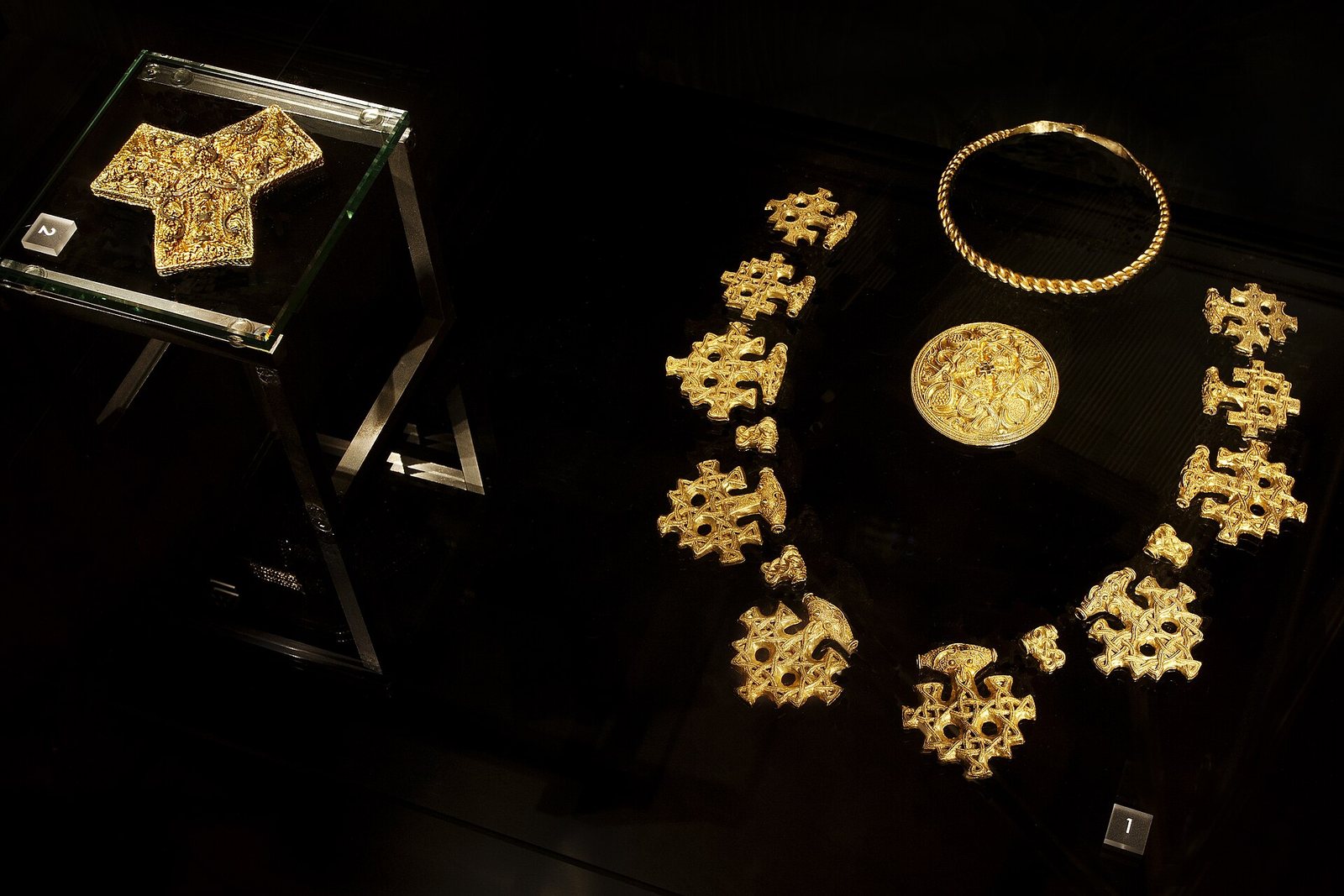
Say "Viking jewellery" and people picture glittering gold. The truth is quieter and finer: it was above all silver that filled the workshops of Hedeby and Birka – drawn into hair-thin wire, grained into tiny beads, blackened with niello and cast in moulds of clay and stone. The techniques behind this craft are the same ones we still use today when we tame metal. An honest look inside the fine-metal workshops of the North.
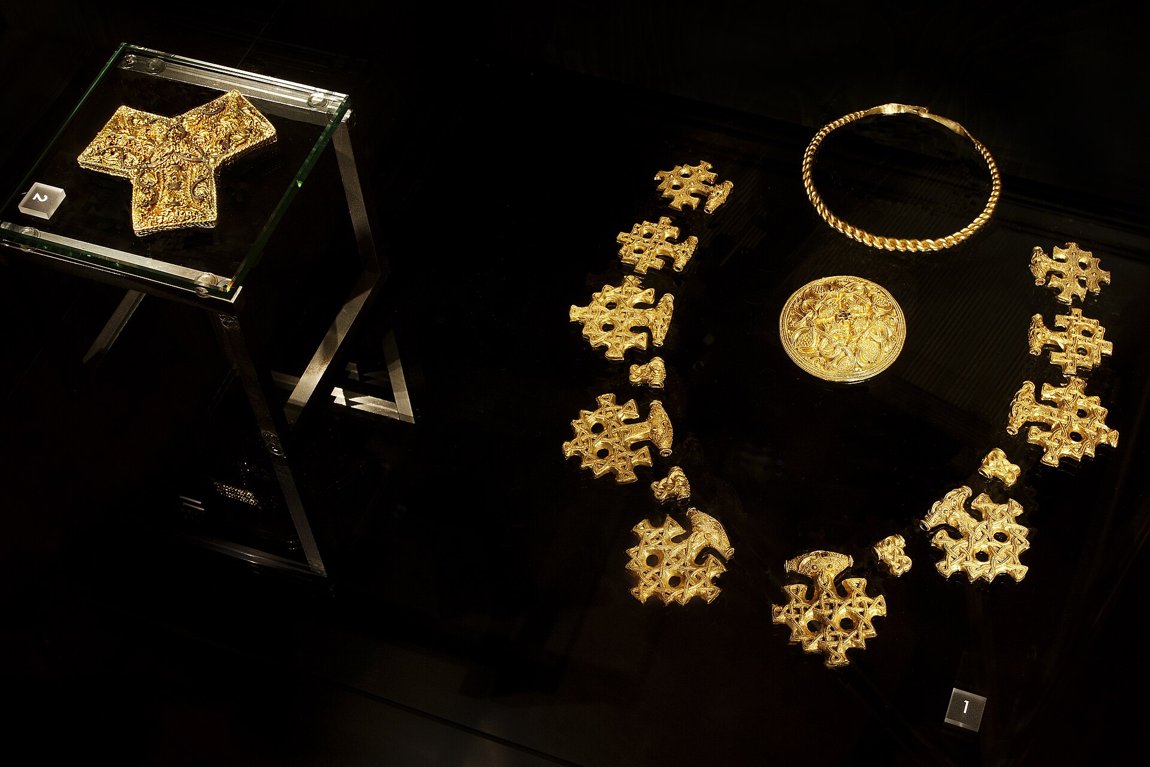
The first thing to understand about Viking goldsmithing is that gold was the exception. The North had no gold deposits of its own, and what little gold circulated arrived through trade and plunder – in small amounts, for the highest elite. The dominant precious metal of the Viking Age was silver. It flowed north by the tens of thousands as Arabic dirhams, as western European coin and as ingots, and it was melted down, reshaped and worn.
For everyday jewellery – the brooches and pendants found on almost every belt and necklace – smiths used base metal instead: bronze and, above all, brass, often fire-gilded so it shimmered golden without being gold. So when people speak of "Viking gold," they usually mean gilded brass. That is no flaw but craft: the art of making cheap metal look precious without deceiving anyone.
The basic technique of serial jewellery was lost-wax casting, cire perdue. The smith first modelled the design in beeswax, encased it in a clay mould and heated everything: the wax ran out, leaving a negative cavity into which molten metal was poured. Once cooled, the mould was smashed – so every single cast cost its own clay shell.
For larger runs, smiths used durable models of bronze, soapstone or clay – a master pattern that produced fresh wax blanks or casts again and again. And here a popular myth breaks apart: not every brooch is a unique piece. A single model could yield dozens of near-identical brooches. The Viking Age knew serial production – and yet each piece finally carried the hand of whoever re-chased and gilded it.
Perhaps the most striking technique is filigree: tendrils, loops and interlace bent from drawn, often twisted wire, soldered onto a base or joined freely into an openwork mesh. The wire was sometimes thinner than a millimetre, produced by drawing it through ever smaller holes in a draw-plate and frequently twisted into a beaded wire that catches the light in fine grooves.
Filigree demands a steady hand and exact soldering temperatures – too hot, and the delicate wires simply melt away. The finest examples are found on Scandinavian ornamental pendants and trefoil brooches, where silver and gold wire trace whole animal-style ornaments in raised lines. It is a technique you cannot fake: every mistake stays visible.
The sister of filigree is granulation: minute metal beads, often barely larger than a grain of sand, arranged into patterns and fields. The beads form when small metal fragments are heated – surface tension pulls them into perfect spheres. The real trick is the soldering: the beads must not run, but hold as clean points.
The Vikings adopted filigree and granulation from continental and Byzantine fine-metalwork and drove them to mastery. A single pendant could carry hundreds of individually set grains. Up close it looks like an ornament woven from dewdrops – from a distance, like a deep, matt sparkle.
Where silver needed contrast, niello came into play: a deep-black compound of metal sulphides, melted into engraved recesses and then ground smooth. The result is raven-black lines and fields that make the silver ornaments stand out sharply – a play of light and dark that still reads as elegant today.
Niello appears on sword pommels, strap-ends and fine silver jewellery. It is neither paint nor enamel but a true metallurgical inlay that fuses with the base. Precisely because silver darkens with age anyway, fine-metal smiths treated tarnishing and blackening as a design tool, not a defect.
Not every decoration was cast. Much was worked into the cold metal afterwards. In repoussé, a pattern is pushed out in relief from the back; in punching, hardened stamps strike small circles, triangles or ring-and-dot marks into the surface. Whole ornament fields were built from rhythmically repeated punch blows.
In inlay, finally, a soft precious metal – silver or gold – is hammered into fine grooves cut in a harder base such as iron. This is how weapons and fittings were decorated with silver lines on dark steel. These techniques needed no fire, but precision: a misplaced blow could not be undone.
No object stands for the era like the oval brooch, also called the tortoise brooch. Women wore them in pairs on the chest to hold the strap-dress (the smokkr) at the shoulders. Between the two brooches often hung a string of beads and small implements. These brooches were cast almost industrially in great numbers, mostly of gilded base metal, with dense animal-style ornament in raised fields.
It is precisely here that serial production is most obvious: many oval brooches follow a few standard types and were traded over long distances. They were at once costume element, status marker and, when needed, a silver reserve. Beautiful, practical and a little bit of a savings account.
Alongside the oval brooches stood the three-armed trefoil brooches, which grew out of Carolingian strap-mounts and developed into ornamental jewellery in their own right – often with the finest filigree. To these were added arm- and neck-rings of twisted or plaited silver wire, at once ornament and portable wealth, plus a whole family of small pendants.
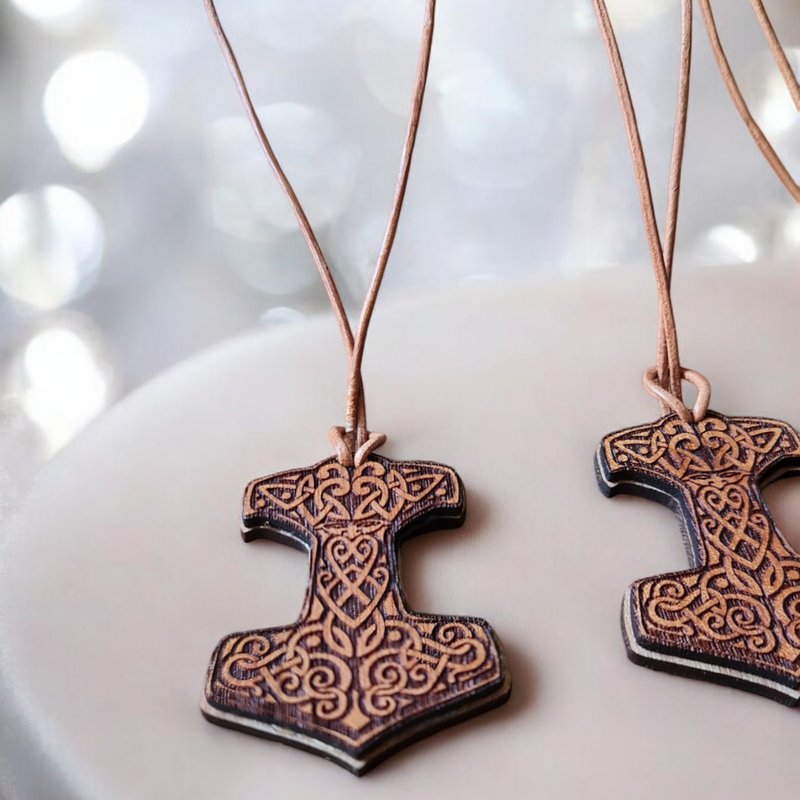
The most famous is the Thor's hammer, Mjölnir. But here too a closer look pays off: the richly filigreed, triangular ornamented showpiece Mjölnir seen everywhere today is rare among the finds – of some versions only a handful of originals exist. Far more common were plain hammers cut from simple iron or sheet silver. Everyday life was barer than the catalogue.
Fine-metalwork needed places where raw material, knowledge and customers met – the great trading centres. At Hedeby and Birka, excavators have found workshop areas with crucibles, mould fragments, half-finished pieces and waste: the quiet reverse side of the shining jewellery. To researchers these fragments are often more valuable than a finished masterpiece, because they show how the work was done.
Especially telling is a model from Trendgården in Denmark: a casting mould that could produce a Thor's hammer and a Christian cross in one and the same operation. A single craftsman thus served both worlds of belief – a hint that the shift from paganism to Christianity was more pragmatic at the workbench than legend would have it. The smith did not ask about creed, but about demand. Such finds remind us that history's great turning points often began very quietly: not on the battlefield, but at the crucible, where supply met the customer's wish.
The silver of the early Viking Age came mostly from the east: as Arabic dirhams along the Russian river routes. But that stream dried up in the late 10th century. Lead-isotope studies show that the silver sources shifted roughly between 965 and 980 – towards European silver, including from the Harz mountains and from Melle in western France. The metal changed; the craft remained.
This question of origin is no detail: it tells how tightly the North was woven into the economic worlds of Europe and the Caliphate. The jewellery on a Scandinavian chest could be made of silver originally minted in Central Asia or mined in the Harz. A dirham struck in Samarkand could travel by the Volga and the Baltic to Hedeby, end up in a crucible there and be reborn as a filigree pendant. Silver had no memory – it readily took on any new form a skilled hand gave it. Therein lay its power: it was raw material, currency and jewellery in one gleaming lump.
Silver was jewellery and currency at once. In a weight-based economy people weighed silver rather than counting coins – and for that, everything was cut up: coins, ingots and, when needed, rings and brooches too. This chopped-up silver is called hacksilver. That is why the hoards of the Viking Age hold showpieces beside cut fragments, often with small test-nicks used to check the fineness.
It also explains why arm- and neck-rings were so popular: they were portable wealth, divisible at any time. A ring on the arm was ornament, status symbol and emergency fund in one. If you want to know more about this double role of silver, our article on hacksilver and weight-money covers it in depth – and the finest pieces of our nature-jewellery world take up exactly these old forms, as do our Thor's hammer pendants.
To make bronze and brass shimmer golden without being gold, the fine-metal smiths mastered fire-gilding. Gold is dissolved in mercury to form a viscous amalgam, which is brushed onto the cleaned metal. On heating, the mercury vaporises and a thin, firmly bonded layer of gold remains. It is an ingenious and at the same time dangerous technique: the mercury vapours are toxic, and more than one medieval smith likely paid for it with his health.
The result explains many "golden" finds: what looks at first glance like solid gold is often only wafer-thin gilded base metal. For the wearer it made little difference – in the light of the hearth fire, both gleamed. For the workshop it was the difference between a showpiece almost anyone could afford and one open only to a few.
Behind every fine brooch stands a surprisingly small arsenal of tools. Melting needed clay crucibles and bellows to bring the charcoal fire to temperature. Shaping called for small anvils, hammers in many sizes, files, tongs and above all the draw-plate, through whose graded holes the wire was pulled ever thinner. For decoration came hardened punches, chisels and gravers.
Famous tool finds such as the large Mästermyr tool chest from Gotland show how versatile a craftsman was equipped – often the same man could forge roughly and chase finely. The knowledge lay less in the tool than in the hand: in the feel for temperature, the calm placing of the solder, the even blow of the punch. It is exactly this quiet skill that separates craft from mass production – then as now at our own workbench.
Viking jewellery was never merely material, but always story. Over the centuries different animal styles succeeded one another – from the interlaced gripping beast of the Borre style, through the strong bands of the Jelling style and the lush tendrils of Mammen and Ringerike, to the finely plaited band-animals of the Urnes style. On a single brooch, bodies, legs and bands could twine into an almost unravellable knot.
These ornaments were no random patterns but a shared visual language of the North, laid out by the smith in the cast and worked out in filigree, punching and engraving. Whoever learns to tell the styles apart can roughly date a find as if by tree rings. We deliberately take up this formal language in our engravings – historically sound rather than arbitrary.
In their dwellings at peace they played at tables, of gold no lack did the gods then know.Völuspá, stanza 8 (translation Henry Adams Bellows, 1923, public domain)
Viking jewellery · Hacksilver – silver as currency · Thor's Hammer · The Bead Maker · Drawing Animal-Style Ornaments.
All Everyday Life & Craft articles →
How do you pay when there is no money of your own? The Vikings had a simple answer: with silver, weighed on the scales …
Read more →Long before chess came to the North, people sat on the long winter evening over a different board: Hnefatafl, the …
Read more →In the darkest time of the year the Norsemen celebrated Jól. Some customs of this winter feast live on in our Christmas …
Read more →When archaeologists open a Viking-age grave, one find is almost always there: a comb. The comb was the most personal …
Read more →