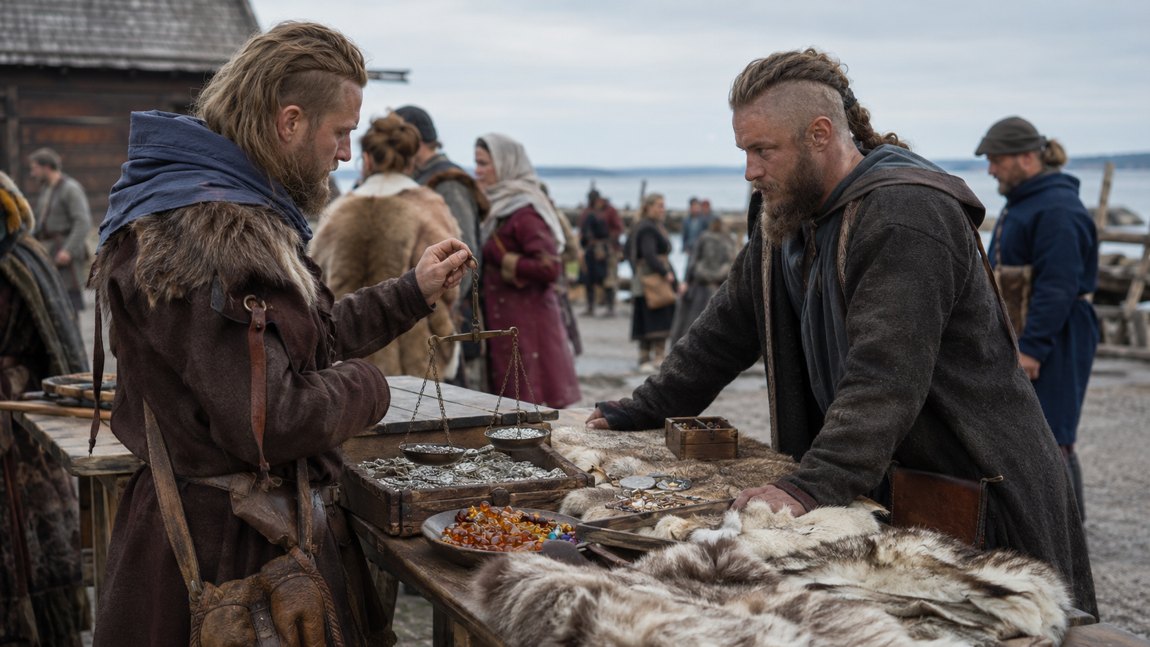
Vikings paid with silver by weight: coins, ingots and jewellery went onto a small folding balance and were chopped into pieces until the price was right. That hacksilver was their money, long before home-made coins took over in the North. Much of the metal arrived as Arab dirhams from the Caliphate. Here is how scales, weights and test marks worked, what the great hoards from Spillings to Galloway reveal, and when the coin finally pushed the hacksilver aside.
Picture a summer's day on Lake Mälaren, some time in the tenth century. A trader at Birka wants three marten pelts. He doesn't reach for a purse of matching coins. He opens a leather pouch full of odds and ends that glitter: half an Arab dirham, the end of an arm-ring, a flat ingot, a snipped-off piece of neck-ring. The seller unfolds a little bronze balance, sets his weights in one pan and lets the buyer pile silver into the other until the beam hangs level. Still a little short? A sliver is hacked off the arm-ring. Then the seller digs the tip of his knife into one of the pieces to see whether there is really silver underneath. Only then do the pelts change hands.
That, give or take, is how paying worked across much of the Viking world. The scene is invented; its ingredients are not. Scales, weights, chopped rings and nicked coins lie by the thousand in Scandinavian museums, and together they describe an economy in which value was weighed, not stamped.
Hacksilver (also spelled hack-silver) is the term archaeologists use for silver cut up to serve as payment: chopped coins, pieces of arm-rings and neck-rings, fragments of brooches and vessels, ingots and bits of ingots. The word describes a condition rather than an object. A splendid arm-ring is jewellery. The same arm-ring in four pieces is cash.
Behind it lies what specialists call a bullion economy, in German Gewichtsgeldwirtschaft, "weight-money economy": you pay with precious metal by weight, not with coins by face value. Two questions mattered. How heavy is it, and how pure? The German archaeologist Heiko Steuer did much of the groundwork describing such weight-based economies in early medieval Europe, and around the Baltic they were normal for centuries.
None of this means people in the North didn't know coins. They knew a great many. They simply treated most of them as small, handy wafers of silver. A dirham bearing a caliph's name was not "worth one dirham" in Scandinavia; it was worth what it weighed. That is why hoards contain whole coins next to halves, quarters and tiny crumbs used to fine-tune the balance. How closely ornament and payment were tied together is the subject of our piece on Viking jewellery.
Scandinavia had hardly any silver mines worked in the Viking Age. The metal came from outside, and for a long time mainly from the east. The dirham was the silver coin of the Islamic world, around three grams in weight, with nothing but Arabic script on both faces: the profession of faith, the mint and the year. The earliest dirhams in Scandinavian finds date from the Abbasid Caliphate, centred on Baghdad. In the tenth century the coins of the Samanids dominate, a dynasty based in Bukhara and Samarkand that controlled rich silver mines in Central Asia. One coin found at Grimestad in eastern Norway, for example, was struck in Tashkent between 907 and 914, according to researchers at the University of Oslo.
These coins travelled along the great rivers of Eastern Europe, the Volga above all, to the markets of the Volga Bulgars and the Khazars. There, merchants from the Caliphate met traders from the North who sold furs, wax, honey and people. That human trade belongs to the honest history of hacksilver; we look at it in our article on slavery in the Viking Age. Arabic writers called these northern traders the Rus, and who they were is the subject of our piece on the Rus.
One eyewitness tells us what happened to the silver. Ibn Fadlan, an envoy who travelled to the Volga on the caliph's behalf in 921–22, reports (paraphrased) that Rus women wore neck-rings of gold and silver: whenever a man owned 10,000 dirhams, he had a neck-ring made for his wife, and some women wore several. Whether the arithmetic was literally true we can't say. The principle is the one the hoards show: silver was accumulated, reshaped and worn where everyone could see it.
How many dirhams reached the North can only be estimated. In a 2023 study the French archaeologist Manar Hammad counts almost 500,000 dirhams in Scandinavian museums, from hoards buried between roughly 770 and 1050. Gotland alone has more than 350 recorded dirham hoards. Exact totals for the island vary from source to source, depending on whether fragments are counted and how much material has been catalogued. What is certain is that Gotland is the richest dirham landscape anywhere outside the Islamic world. The Oslo numismatist Svein H. Gullbekk even suggests that perhaps a billion dirhams flowed into the Viking world between 800 and 950, most of them melted down. That is an extrapolation, not a count.
In the second half of the tenth century the eastern stream ran dry. German and Anglo-Saxon pennies took its place, and they dominate the hoards of the eleventh century. The wider trade picture is in our article on Viking trade.
Paying by weight requires a balance. The typical Viking example is a folding balance: a bronze beam whose arms fold in, with two thin pans hanging from fine chains. Folded up, the whole thing fitted into a small round case, often bronze as well. Such balances turn up at trading places like Birka and Hedeby, and in graves where men, and sometimes women, were buried with their weighing kit. A balance was a tool and a badge at once: whoever carried one took part in the silver trade.
The weights mattered just as much. Two shapes stand out in the finds:
Both shapes have models in the Islamic world: along with the silver, northern traders adopted the measuring kit. For dating, one site is crucial: Kaupang in southern Norway. The publication of the 2000–2003 excavations, edited by Dagfinn Skre, concludes that such standardised weights were introduced across most of Scandinavia in the 860s and 870s. From then on, weighing silver became an organised system.
Nearly a thousand Viking-period weights are known from Sweden alone. Some cubo-octahedral examples turn out to have an iron core under a bronze skin instead of being solid bronze; whether that was cheap manufacture or something shadier is an open question. Heiko Steuer later studied the scales and weights from medieval Schleswig, Hedeby's successor town, and they show how routine weighing remained in a trading town on the Schlei long after the Viking Age.
Paying by weight has a catch. Weight tells you nothing about purity. A piece of copper with a thin silver skin looks like solid silver, and on a balance the difference in a small fragment is easy to miss. Anyone accepting silver had to test it, and the traces of that testing survive on countless finds.
The most common is the peck mark (also called a nick or test cut; Swedish tälja): a small cut made with a knife point or a chisel. It opens up the interior and shows whether there is silver or base metal beneath the surface. Poor silver also reveals itself by how hard or brittle it feels under the blade. Some coins carry a single peck, others dozens, as if every new owner had to take a look for himself.
A second method was the bend test. Good silver is soft and bends without snapping. That is why many coins in the hoards are bent, or bent and straightened again, and why arm-rings show kinks that have nothing to do with wear.
When did the testing start? A 2024 Stockholm University study by Jakob von Pistohlkors, drawing on Christoph Kilger's research, notes sporadic pecking already in the early tenth century; a Danish hoard from Bjerndrup, with a latest coin after 911, has the odd mark. Pecking peaks in the early eleventh century, just as western European pennies replaced the dirhams. The more foreign coins of uneven quality were in circulation, the more often people reached for the knife.
The chopping itself was simply necessary. Without small change, the only way to hit a price was to cut. An arm-ring was sliced, an ingot clipped, a coin halved. The smallest pieces of hacksilver weigh less than a gram. When you get change at a shop today, you are doing the same thing; the mint just did the hacking for you.
Weights alone don't make an accounting system. Norse sources name units, some of which lived on into modern times: the mörk (mark), the eyrir (plural aurar, the "ounce" or øre) and the ørtug. A mark held eight aurar, an eyrir three ørtugar. How many grams stood behind them cannot be stated uniformly for every region and century. For the late Viking Age, scholars usually reckon with an eyrir of around 24 to 27 grams and a mark of roughly 200 grams. These are approximations, not official standards.
The written sources are also later than the finds. Iceland's law collection Grágás, from the twelfth and thirteenth centuries, reckons many fines not in silver but in vaðmál, ells of standardised woollen cloth. That was money too, just woven. Silver was scarce in Iceland; every farm had cloth.
One of the liveliest debates around hacksilver concerns ring-money: plain arm-rings made of a broad stamped band or a simple rod, with little decoration, known especially from Scotland, the Isle of Man and Ireland. More than ninety complete examples are known from Scandinavian contexts in Scotland alone, most of them from the late tenth and early eleventh centuries.
Were they currency in ring form? In 1978 Richard Warner, with James Graham-Campbell, studied the weights of 72 such rings and found a cluster around 24 grams, matching the Norwegian eyrir. That looked like a kind of currency. Later work is more cautious: the deviations from any target weight are considerable, and complete rings are rather heavy for everyday dealings. Many scholars now see a hybrid: rings worn as ornament and given as gifts of status, but made roughly to a unit of account, so they could be weighed and spent when needed. The archaeologist James Barrett's phrase "coinage without a king" catches the idea, though it is meant as a provocation.
The ring meant more in the North than money anyway. Skaldic poetry calls a ruler a "ring-breaker" or "ring-giver", because he handed out rings to his followers. Oaths were sworn on rings, as our article on oath rings explains, and in the Edda Odin's ring Draupnir drips eight rings of equal weight every ninth night. A treasure that multiplies itself: a fitting myth for a silver economy.
Most of what we know about hacksilver comes from hoards, treasure buried on purpose. A few are so large that they have shaped our picture of the whole era. Our article on the great Viking silver hoards gives the full survey; here are the key ones.
Spillings, Gotland (1999). The largest known Viking-age silver treasure came to light in July 1999 at the farm of Spillings in Othem, north-east Gotland, shortly after a TV crew had been filming there for a report on looting. It consisted of two silver deposits totalling about 67 kilograms plus a bronze deposit of more than 20 kilograms. There were 14,295 coins, almost all dirhams, as well as nearly 500 arm-rings or parts of them, ingots and bars. The latest identified coin dates to 870/871, and the treasure lay under the floor of a building. For comparison, the Swedish History Museum puts a typical Gotlandic silver hoard at 200 to 300 grams. The full story is in our piece on the Spillings hoard.
Cuerdale, Lancashire (1840). Workmen repairing the bank of the River Ribble near Preston hit a lead chest containing about 40 kilograms of silver. According to the British Museum it held around 7,000 coins, mostly from the Danelaw, with English and Continental issues and a small group of Kufic, that is Arabic, coins, plus more than 1,300 other pieces: ingots, ornaments and a great deal of hacksilver. It was buried around 905. Silver from the Caliphate, Francia and England, all in one box.
Vale of York (2007). On 6 January 2007 David and Andrew Whelan, metal-detecting near Harrogate, found a smaller but exceptional hoard: 617 silver coins and 65 other objects, including ingots, hacksilver, a gold arm-ring and the gilt silver cup that held much of it, probably from a ninth-century Carolingian workshop. It was most likely buried around 927/928. The coins carry Islamic, Christian and Norse pagan imagery side by side. Valued at about £1.08 million, it was acquired jointly by the British Museum and York Museums Trust.
Galloway, Scotland (2014). Metal detectorist Derek McLennan found more than a hundred objects in south-west Scotland in 2014, probably buried in the early tenth century in several layers: flattened and folded arm-rings, ingots, an Anglo-Saxon pectoral cross and a silver-gilt lidded vessel packed with precious things. National Museums Scotland acquired the find. Galloway shows that a hoard can be more than a cash stash: alongside payment silver lie heirlooms and rarities.
And gold? Gold played a minor role in Viking-age payments, but it was the metal of the powerful. The most famous gold find on German soil is the Hiddensee treasure, washed out by storm floods on the island off Rügen in 1872–73: sixteen pieces, including a neck-ring, a brooch and fourteen pendants, about 600 grams of gold in all. It probably comes from the circle of Harald Bluetooth and is now in the Stralsund Museum. It is not a payment hoard; nobody ever hacked these pieces.
Why did nobody dig it up again? The simplest answer is security. There were no banks, and a hiding place under the floor or in a field was safer than a chest any raider could carry off. If the owner died or was driven away, the treasure stayed put.
On Gotland that explanation doesn't quite cover it. A striking number of hoards lie in or beside buildings, and the island was no more turbulent than anywhere else. Some researchers therefore suspect hoards were also part of the farm and its inheritance: silver as family capital belonging to the land. On Gotland's farmer-merchants, see our article on the Gotlanders.
And there is a third, religious explanation that goes back to a passage in Snorri Sturluson. In Ynglinga saga (chapter 8), written around 1230, Snorri has Odin, recast as a human king, lay down a law. In Samuel Laing's public-domain translation of 1844:
"Thus, said he, every one will come to Valhalla with the riches he had with him upon the pile; and he would also enjoy whatever he himself had buried in the earth."Snorri Sturluson, Ynglinga saga, ch. 8, trans. Samuel Laing 1844
So: whatever lay on your funeral pyre went with you to Valhalla, and so did whatever you had buried yourself. That is a thirteenth-century statement by a Christian scholar, written some three centuries after most of the hoards. Whether Viking-age people actually thought this way is not attested. It is an intriguing lead, and no more than that.
The North struck its own coins early, but for a long time they played a supporting role. As early as the eighth century, small silver coins were minted at Ribe: the so-called Wodan/monster sceattas, named after a bearded face on one side and a serpent-like creature on the other. A hoard of 262 coins found near Ribe in 2018, the Damhus find, shows according to Claus Feveile that minting continued there on a larger scale in the early ninth century, with a face and a stag as motifs.
In the ninth century came coins usually attributed to Hedeby, some modelled on Carolingian coins from Dorestad. The Spillings hoard contained four such Hedeby coins among more than 14,000 dirhams, a ratio that says a lot. Out in the countryside, people went on weighing.
The turning point came around the year 1000 and is closely tied to royal power and Christianity. Around 995 Sweyn Forkbeard had coins struck in his name; Denmark's central bank calls them the first official Danish coin, modelled on English pennies. At about the same time Olof Skötkonung began minting at Sigtuna, and coins are attributed to Olaf Tryggvason in Norway too. A royal coin announced something new: here is a ruler who vouches for the value.
Hacksilver didn't vanish overnight. In Denmark the coin economy took hold over the course of the eleventh century; Gotland went on weighing into the twelfth and only struck coins of its own around 1140. The Norwegian Mørstad hoard, with more than 5,000 coins from the time of Harald Hardrada, already belongs to a world where the coin counts, not the gram.
Much of the western European silver that reached the North around 1000 came from England, and not always through peaceful trade. After the defeat at Maldon in 991, King Æthelred II paid 10,000 pounds of silver, according to the Anglo-Saxon Chronicle, to make the raiders leave. The sums rose year after year; for 1012 the Chronicle gives 48,000 pounds, and in 1018 Cnut the Great levied 72,000 pounds from all England plus another 10,500 from London. The name Danegeld is later, by the way; contemporaries mostly called it gafol, tribute. The background is in our article on Danegeld and the Battle of Maldon.
The traces of these payments lie in Scandinavia today. Anglo-Saxon pennies of Æthelred and Cnut are so common in Swedish and Danish hoards that some types are better represented there than in England. The recipients left their own record. On the Yttergärde runestone in Uppland (U 344), a man called Ulf had it carved that he took three payments in England: the first that Tosti paid, then Thorketill's, then Cnut's. We present more such stones in our article on the England-farers. This silver, too, was weighed, pecked and chopped in the North.
When we engrave a motif in slate or wood in our workshop in Alsdorf, we sometimes think of those little nicks on the dirhams. Each one is the trace of a person who, more than a thousand years ago, wanted to check whether they were being handed good silver. A tool mark as an act of trust, or of healthy suspicion. In its own way, that is an engraving too.
Hacksilver tells of a world where value was something you could touch, wear on your arm, set on a balance and, if need be, break in two. And it tells of a network linking Samarkand, the Volga, Gotland and Northumbria long before anyone spoke of globalisation.
For courage. For remembrance. For legends that live on.
What is hacksilver in simple terms? Hacksilver is cut-up silver from coins, jewellery and ingots that served as money by weight in the Viking Age. Pieces were chopped off until the weight on the scales matched the price.
What money did the Vikings use? Mainly silver by weight, including huge numbers of Arab dirhams and later Anglo-Saxon and German pennies. Local coins existed at Ribe and Hedeby from the eighth and ninth centuries, but royal coinages in Denmark, Sweden and Norway only began around 995.
Why did Vikings cut coins in half? Because weight mattered, not face value. Halves and quarters acted as small change, letting buyer and seller hit the exact price on the balance.
What are the nicks on Viking silver? They are peck marks, small test cuts made to check that a piece was silver all the way through. They become more common during the tenth century and peak around 1000.
What is the largest Viking silver hoard? The Spillings hoard from Gotland, found in 1999: about 67 kilograms of silver with 14,295 coins, plus more than 20 kilograms of bronze. It was buried after 870/871.
When did Vikings stop using hacksilver? Royal coins spread from around 1000, and in Denmark the coin economy took over during the eleventh century. On Gotland, silver was still weighed into the twelfth century.
Carnelian – the Vikings' red beads · Viking jewellery · Ribe & the North's first coins · The Vindelev gold hoard · The Skuldelev ships.
All Everyday Life & Craft articles →
Long before chess came to the North, people sat on the long winter evening over a different board: Hnefatafl, the …
Read more →In the darkest time of the year the Norsemen celebrated Jól. Some customs of this winter feast live on in our Christmas …
Read more →When archaeologists open a Viking-age grave, one find is almost always there: a comb. The comb was the most personal …
Read more →Among silver and glass, glowing red beads keep appearing in the rich women's graves of the Viking Age: carnelian. The …
Read more →