Viking carnelian beads were imports from the East: these red, often faceted stone beads and their clear cousins in rock crystal reached Scandinavia mainly in the 9th and 10th centuries, along the river roads of the Rus and through the Volga markets that were linked to the Islamic world. The raw stone most likely came from India, Iran or the Caucasus, but for Scandinavian finds that has hardly been pinned down. Here is what graves at Birka and Kaupang show, how such a bead is cut and drilled, and why Ibn Fadlan wrote about green beads.
Picture a woman laid in her grave somewhere on Lake Mälaren around the year 900. On her chest sit two bronze oval brooches, heavy, gilded, covered in tangled animal ornament. Between them hangs a swag of beads: blue and yellow glass, a few lumps of amber, a silver bead. And in the middle, two or three or perhaps five beads that are different. They are deep red, half translucent, and they have edges. Small ground facets that catch the light when the excavators finally brush the soil away.
That is carnelian. Those few red beads had travelled further than almost anything else in the grave. Before they ended up at the throat of a woman in what is now Sweden, they probably lay on the bench of a stone cutter who had never heard of Scandinavia. They were traded, repacked, swapped for furs and silver, carried across seas and up rivers. Packed into a bead the size of a pea is the whole geography of the Viking Age.
Carnelian is not a mineral in its own right but a variety of chalcedony. Chalcedony is quartz that has not grown into big crystals but into microscopic, fibrous ones. That is why it looks milky and translucent rather than glass-clear, with a waxy lustre. Carnelian owes its red to orange colour to iron oxides dispersed through the stone. Darker, brownish-red material is usually called sard; the boundary is fluid.
On the Mohs scale carnelian sits at about 6.5 to 7. That is hard: it will scratch glass, and a steel blade will not mark it. Perfect for jewellery, because the polish lasts for centuries. Miserable for the craftsman, because every facet and every hole has to be ground away with an abrasive harder than the stone itself.
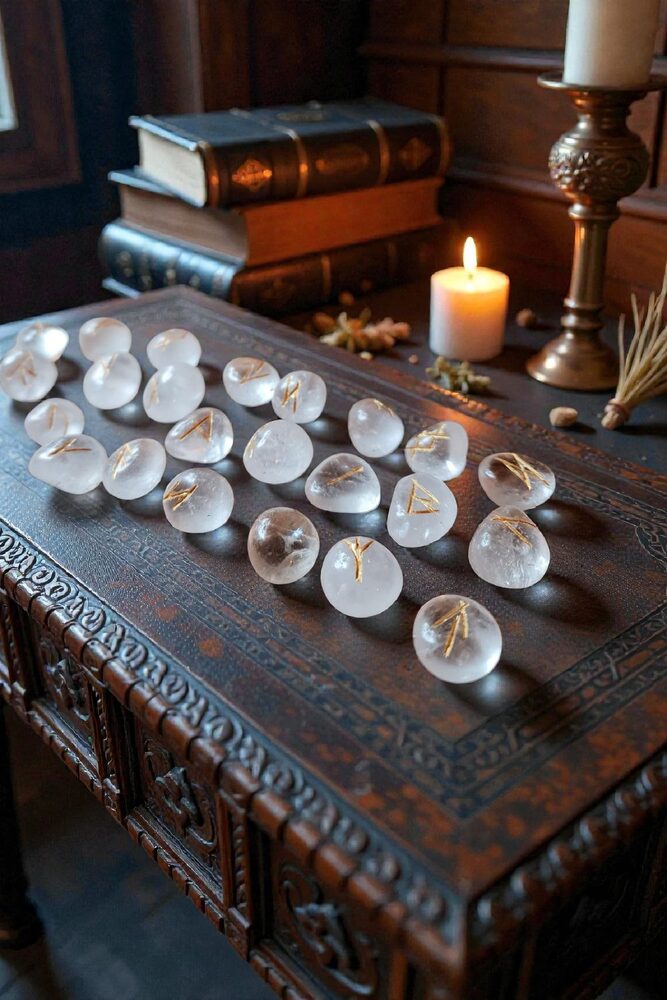
Rock crystal is the purest form of the same substance: colourless, transparent quartz grown in six-sided crystals, hardness 7, clear as water. Viking-age rock crystal beads were cut in many of the same shapes as carnelian ones, and where one turns up in a Scandinavian necklace, the other is often close by. So we treat the two together, even though, as you will see, their origin stories are not quite the same.
The word carnelian goes back to medieval Latin forms such as corneolus. Whether that originally referred to the cornel cherry or to Latin carneus, "flesh-coloured", is an old debate among etymologists. What the Vikings themselves called the stone, we simply do not know.
This is the honest part, and honesty here means: messier than most jewellery blurbs admit. Carnelian occurs naturally in many places. But the great historic centres of carnelian bead making lie in western India. Around Khambhat (formerly Cambay) in Gujarat, stone beads have been cut for thousands of years; the archaeologists Jonathan Mark Kenoyer, Massimo Vidale and Kuldeep Bhan studied the local workshops in detail in the 1990s and trace the craft back to the Harappan period. Other carnelian sources lie in Iran and in the Caucasus region, among others.
For Viking-age beads from Scandinavia, the archaeologist Heid Gjöstein Resi summed up the situation in her study of the gemstone finds from Kaupang (2011). Carnelian has a much more restricted raw-material origin than, say, amber; it arrived as a finished product from eastern trading centres; and judging by natural deposits and distribution, its place of manufacture should most likely be sought in Iran, India or the Caucasus. That is an assessment based on geology and find distribution, not a laboratory result.
The African results also show how mixed the market was. Even at sites plugged straight into the Indian Ocean trade, only part of the beads came from Gujarat. Necklaces from Birka may well combine stones from several regions. Anyone who tells you every Viking carnelian bead was Indian knows more than the research does.
Rock crystal is even more open. Clear quartz occurs almost everywhere, including Scandinavia and western Europe. Resi therefore considers local and western sources possible, but notes that rock crystal beads follow a distribution pattern strikingly similar to carnelian. That suggests at least some of them came with the same eastern goods. At Kaupang, raw and worked rock crystal was found in the soil; whether it was turned into beads there remains unclear.
To see how a stone from Gujarat or Iran reached Lake Mälaren, you have to turn the map. For 9th-century Scandinavians the richest world did not lie to the south but to the south-east: the Abbasid Caliphate with its capital Baghdad, and beyond it the Silk Roads, the ports of the Persian Gulf and the sea trade with India. There was no direct road there, but there was a chain of markets.
The main axis was the Volga. From the Gulf of Finland, traders went via Ladoga and smaller rivers into the Volga basin, down the great river to the markets of the Volga Bulgars near Bolgar, on to the Khazar realm at the Volga delta and out onto the Caspian Sea. Whoever arrived there with furs, wax, honey or slaves met merchants from Khurasan, Khwarazm and Iran. Payment was in silver, in Arabic coins called dirhams. We explain how this eastern world worked in The Vikings in the East and The Rus.
One of the oldest written sources comes from the Persian geographer and postmaster Ibn Khurradadhbih. In his "Book of Roads and Kingdoms" (completed in its surviving form around 885) he describes Rus merchants bringing beaver pelts, fox furs and swords, paying a tithe to the Khazar ruler, crossing the Caspian and sometimes carrying their goods by camel all the way to Baghdad. Not every detail is secure, but the Rus evidently knew routes that reached the heart of the Caliphate.
The silver shows the reverse flow. From the late 780s into the early 11th century, Arabic coin silver flowed north. Gotland alone has produced more than 350 dirham hoards, and Scandinavian museums together hold almost half a million of these coins. More on that in The Great Silver Hoards of the Vikings and Hacksilver. Carnelian beads travelled the same roads. Small, light, imperishable and valuable, they were ideal long-distance goods that fitted into any purse.
How many hands they passed through, we cannot tell. Hardly any Scandinavian will ever have seen a carnelian deposit. The beads moved from market to market, and only on the Volga or in Rus trading places such as Staraya Ladoga and Gnezdovo did they pass into northern hands.
The key dataset for Viking-age beads is still a book from 1977: Trade Beads and Bead Trade in Scandinavia ca. 800–1000 A.D. by the Swedish archaeologist Johan Callmer. He sorted bead finds from across Scandinavia into types and arranged them into a sequence of bead periods that archaeologists still use to date graves. His corpus covers 299 assemblages with almost 15,000 beads (amber and very small finds excluded).
Among them: 879 beads of carnelian (and the related agate) in 107 finds, and 689 rock crystal beads in 114 finds. Both occurred together in 85 finds. Not a single necklace consisted of carnelian alone. On average a find with carnelian held about eight such stone beads, but around 27 glass beads. Carnelian was the spice of the necklace, not the soup.
In date, these stones belong to the same phase in which dirham silver arrived in bulk. Carnelian and rock crystal beads are clearly present in 9th- and 10th-century material, whereas the bead fashions of the 8th century relied mainly on glass from western and Roman sources. We deliberately avoid naming a precise decade for their arrival and peak, because dates vary from site to site. The broad frame, though, is well established.
Birka is the key site. The town on the island of Björkö existed from roughly the mid-8th century until about 975; researchers distinguish an earlier phase (to around 860) and a later one. The 1990 excavations in the settlement's "Black Earth" alone produced 42 carnelian and 23 rock crystal beads, 38 of them faceted. Add to that the graves excavated by Hjalmar Stolpe in the 19th century, whose beads are still being re-analysed today.
At Kaupang in southern Norway, carnelian and rock crystal beads came from both the settlement and the graves. On Gotland, where dirham hoards are denser than anywhere else, "exotic materials such as carnelian and rock crystal" are also part of women's bead jewellery. In Denmark, by contrast, carnelian counts as rather unusual: the 10th-century jewellery find from Lerchenborg on Zealand contained exactly one carnelian bead among 41 glass and millefiori beads, and its publishers cite the ring fortress of Fyrkat as the Danish parallel.
And Ribe and Hedeby? Both were great bead hubs, but chiefly for glass. In Ribe, beadmakers were already turning remelted Roman and Byzantine mosaic cubes into glass beads in the 8th century, as a 2022 study by Barfod, Feveile and Sindbæk showed in detail. More in The Beadmaker. Single carnelian beads do turn up in south-western Scandinavia, but the distribution clearly points east: the closer you get to Lake Mälaren, Gotland and the Baltic route, the more red stone you find.
Pick up a Viking-age carnelian bead and the first thing you notice is the shape. Callmer's most common carnelian type is a prism with its corners cut off: take a tiny cube or block and grind away all eight corners until small triangular facets appear. The result throws light in many directions at once. That one type accounts for 256 beads in 52 finds. Next come hexagonal and octagonal prisms, spheres, barrels and biconical forms. For rock crystal, spheres are the most frequent shape, followed by the same faceted prisms.
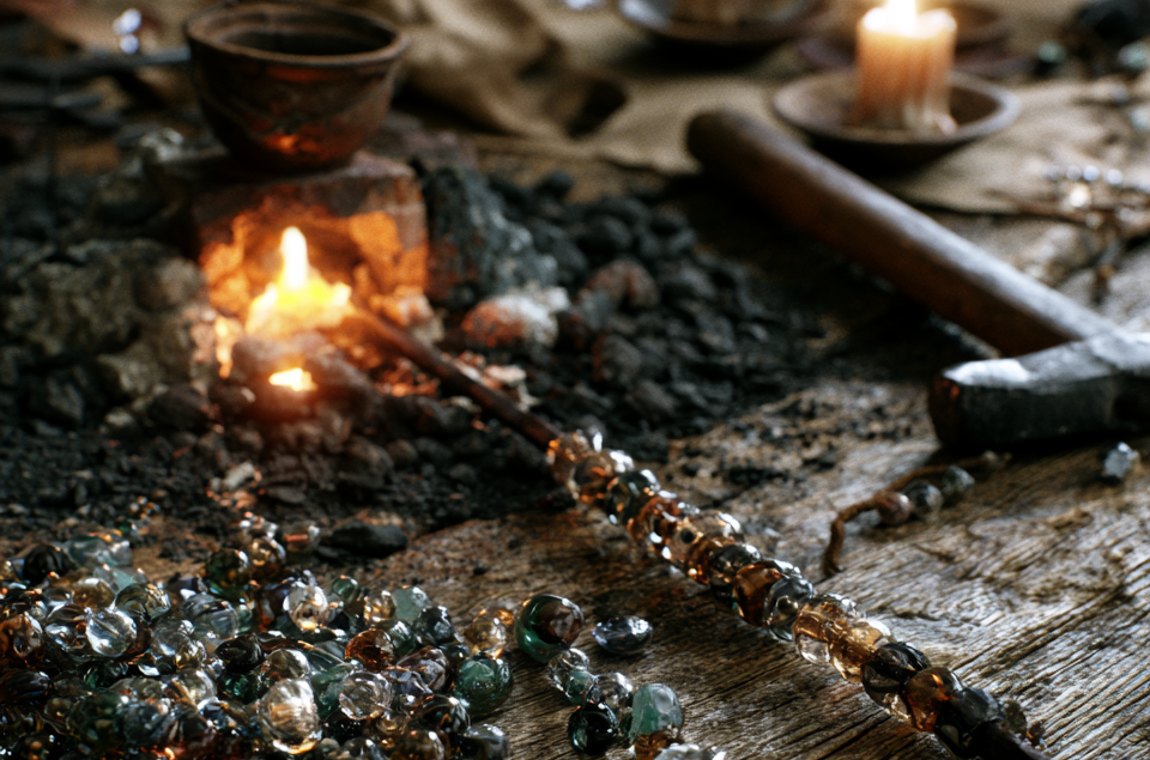
How these beads were made in detail can only be inferred from the beads themselves and from the craft tradition that still survives in Khambhat. There the work traditionally runs in stages:
Whether every northern carnelian bead went through exactly these steps, we do not know. But the basic problems are the same wherever the cutting happened. Drilling in particular is an art. Kenoyer and colleagues showed that carnelian beads from Nubia were perforated with diamond-tipped drills, a technique they trace to ancient Indian workshops. As far as we know, comparable microscopic studies of drill channels in Scandinavian beads are still to be done. Here is a research question waiting for a good microscope.
As an engraving workshop we look at this work with real respect. Our laser marks slate and glass in minutes. A 9th-century cutter needed hours for a single faceted bead in a stone harder than any knife. That alone explains part of its value.
Most carnelian beads come from graves, and mostly from women's graves. That is down to dress. Over her shift, a Scandinavian woman of the Viking Age wore a strap dress whose loops were fastened at the chest by two large oval brooches, often called tortoise brooches. Strings of beads frequently hung between them, sometimes in one swag, sometimes in several rows, along with pendants, small knives or tools on chains. We describe this outfit in Viking Clothing.
Whether the beads were attached directly to the brooches or worn on separate necklaces varies from grave to grave and cannot always be decided. Textile remains inside brooches from Hedeby, for example, include twisted cords that may have carried beads. What is certain is that the string lay visibly on the chest, right where the eye goes. Whoever wore carnelian was showing it.
On Gotland, dress looked different. Instead of oval brooches, women wore the island's distinctive box brooches and animal-head brooches. Bead strings occur there too, and the archaeologist Susanne Thedéen has drawn out a lovely detail: some graves of young girls contained numerous white beads long taken for local limestone. Analysis showed they were cowrie shells from the Indian Ocean or the Red Sea. Carnelian and cowrie: two greetings from the same distant world, on one necklace at the edge of the Baltic.
Why almost only women? Men wore beads too, but less often and usually just one or two. The big colourful strings were part of female dress. Who in a household actually owned which valuables is something a grave does not record. How much room women had to act in the Viking Age is the subject of Women in the Viking Age.
The only contemporary text describing how people from the North valued beads was not written in the North but by a man from Baghdad. In 921 Ahmad ibn Fadlan set out as secretary of an embassy sent by the caliph al-Muqtadir to the Volga Bulgars. There, on the Volga, in 922, he met traders he calls the Rūsiyya, the Rus. His account became famous above all for the chieftain's funeral he describes in detail. Read more in our piece on Ibn Fadlan.
About the women's jewellery he reports, in paraphrase: each woman wears on her breast a disc or box of iron, silver, copper or gold according to her husband's wealth; round their necks they wear rings of gold and silver, and for every ten thousand dirhams a man owns, he has another neck ring made for his wife. Then comes the sentence that matters to us. What they prize most, Ibn Fadlan says, are green beads of the kind carried on the boats. They pay a dirham for each bead and string them into necklaces for their wives.
Three things stand out. First, he speaks of green beads, not red ones, so he is evidently not describing carnelian. The Arabic text describes them as made of a ceramic or glassy material; the translator James Montgomery calls the passage a long-recognised crux. Most scholars think of glass beads. Second, a dirham per bead is a lot, considering beads could be mass-produced goods in the Caliphate. The Rus were apparently happy to pay silver for something they valued more than the seller did. Third, the man buys and the woman wears. The necklace becomes a visible statement of household wealth.
What a man owned was meant to be seen on his wife: in the rings around her neck, and in the beads he had paid for in silver, one at a time.Our summary of Ibn Fadlan's description, 922
This text needs careful handling. Ibn Fadlan was an outsider who saw through interpreters and with his own expectations, and the Rus on the Volga were a mixed merchant society, not simply "Swedes". Still, it is striking that an observer from Baghdad singles out beads as their favourite ornament. It fits remarkably well with what graves from Birka to Gnezdovo show.
Many texts on Viking jewellery tell you that beads were "money". There is a serious observation behind that, and also a shortcut.
In favour of a money-like role is Ibn Fadlan's fixed price: one dirham per bead. Where there is a fixed rate of exchange, an object can store and transfer value. Beads are also small, countable and durable, and unlike a silver ring they did not need to be hacked to pieces to be divided. You could string a necklace and unstring it again.
Much speaks against it. The real means of payment in the Viking-age Baltic was silver by weight, measured with folding scales and weights. A carnelian bead has no standard value: big or small, deep red or pale. And in the great silver hoards, which existed precisely to store value, beads play no prominent role. In other words, beads were sought-after trade goods and status objects whose value could be expressed in silver. Whether they regularly circulated as currency in everyday exchange is a hypothesis, not a finding.
On the status side we stand on firmer ground. Carnelian and rock crystal beads are a minority in the finds, almost always accompanied by many glass beads, and they often turn up in graves that are well furnished in other respects. A red, faceted bead from the East said: this family had access to the long-distance networks. Whether its wearer also expected protection from it, as later lapidaries claim for carnelian, no grave tells us.
A Viking-age necklace is a wearable atlas. The carnelian came from the south-east. Amber came from home shores, Jutland or the eastern Baltic, and was cut into beads and pendants in the North itself. Black jet mostly came from the coast near Whitby in Yorkshire and was worked above all in York. The glass was often recycled Roman and Byzantine material, reshaped in Ribe, Hedeby or Birka.
No Viking-age woman wore a necklace "in the style" of one region. She wore what her household had traded for, inherited and been given. Every bead had its own journey, and the red one from the far end of the known world probably had the best story. How jewellery in general was worn, given away and even cut up in the Viking Age is the subject of Viking Jewellery. And how far neck ornaments reached into the world of the gods is shown by Brísingamen, Freyja's necklace.
When we work on Norse motifs in our workshop in Alsdorf, it is often about big images: gods, runes, ships. The carnelian bead is a reminder that the Viking Age was also an age of small things that travelled far. A bead barely bigger than a pea links a stone cutter by the Indian Ocean or on the Iranian plateau, a caravan trader, a Rus merchant on the Volga, a silver dealer in Birka and a woman who was buried wearing it.
What we take from it is respect for craft that spends hours on a millimetre, and caution with quick answers. "From India" sounds good. "From India, Iran or the Caucasus, exact source still open" is more honest. We prefer the second version.
Where did Viking carnelian beads come from? Researchers suggest manufacturing centres in India (especially Gujarat), Iran or the Caucasus. We know of no broad geochemical provenance study of Scandinavian beads specifically, so the exact source remains open.
When did carnelian beads reach Scandinavia? Mainly in the 9th and 10th centuries, alongside the influx of Arabic silver via the Volga route. Key find sites include Birka, Kaupang and Gotland.
Did the Vikings cut carnelian themselves? There is no evidence for it. Kaupang produced no raw pieces or half-finished carnelian beads; the beads apparently arrived in the North already cut and drilled.
What beads did Ibn Fadlan describe? Green beads traded on the Rus boats at one dirham apiece. They are usually interpreted as glass beads, not carnelian.
Were beads used as money by the Vikings? That is a hypothesis. What is attested is that beads were bought with silver and served as status objects; the usual currency was silver by weight.
How did Viking women wear bead necklaces? Often as a swag or several rows strung between two oval brooches on the chest, mixing glass, amber, silver and occasionally carnelian or rock crystal.
For courage. For remembrance. For legends that live on.
Viking jewellery · Norse gifts for women · Norse words of love · Slate, Wood or Glass? · The Skuldelev ships.
All Everyday Life & Craft articles →
How did people heal in a world without a pharmacy? With herbs, with knowledge – and with a charm to go with it. An Old …
Read more →The shining swords, the fine brooches, the carved ships – behind all of it stood a craftsman with his tools. What those …
Read more →From honey, water and time comes the oldest intoxicating drink of the North. But mead was more than a drink – it was …
Read more →Again and again, peat-cutters in Ireland, Scotland and Scandinavia find the same riddle: a lump of waxy, ancient …
Read more →