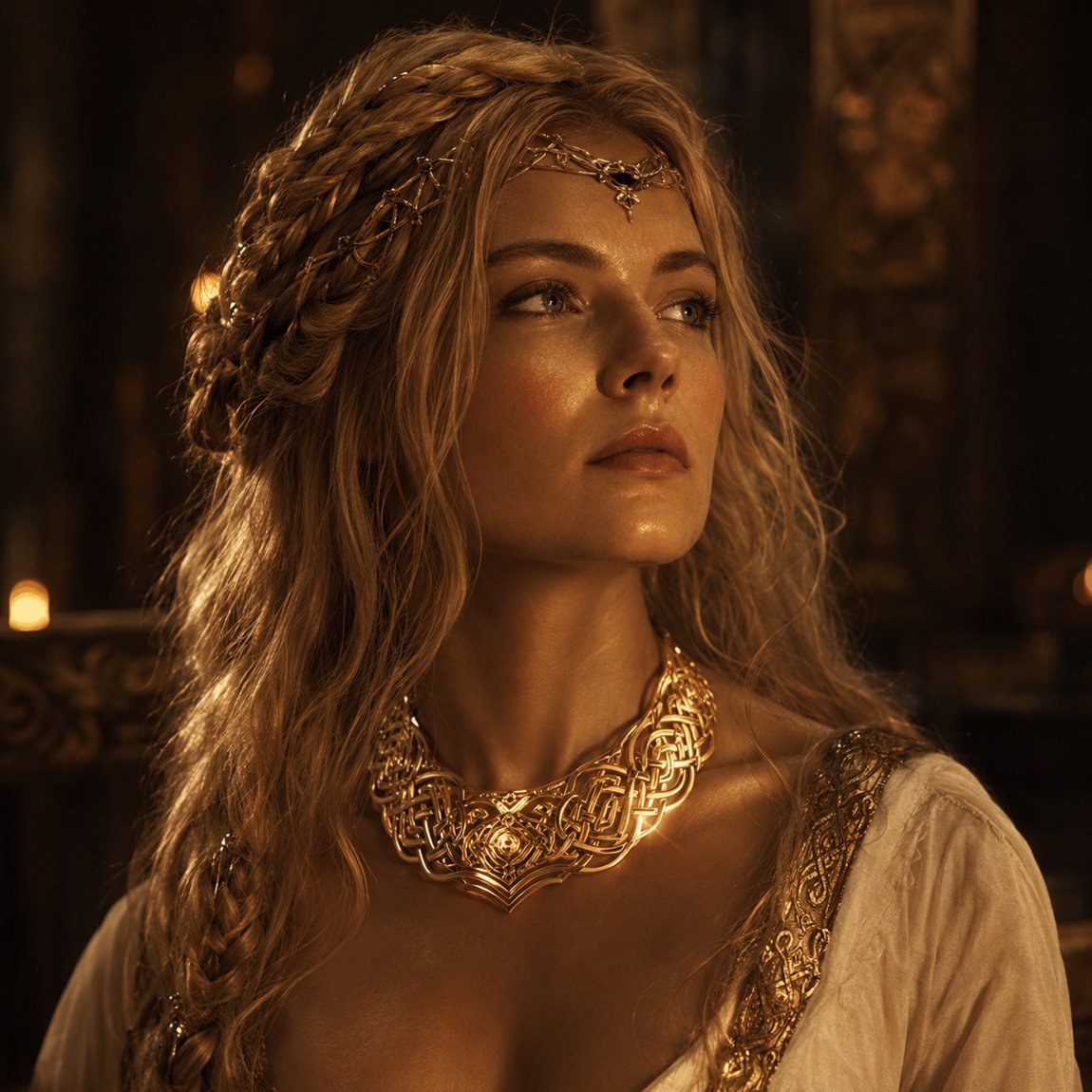
Brísingamen is the necklace of the goddess Freyja and the most famous piece of jewellery in Norse mythology. The name means "necklace of the Brísings" – and nobody knows for certain who the Brísings were. In the Poetic Edda the necklace bursts from Freyja's throat when she snorts with rage, and later it is fastened around Thor's neck when he poses as a bride. Skalds tell of Loki and Heimdall fighting for it as seals; a late saga adds four dwarfs and four nights. Here is what is old, what is late, and what came out of the ground.
A necklace that makes the hall of the gods shake. A necklace two gods fight over in the surf, disguised as seals. A necklace hung around the neck of a bearded thunder god so that a giant will mistake him for the loveliest woman in the world. Few objects in Norse tradition turn up in such different stories as Brísingamen, and few are so hard to pin down. We do not know what it looked like. We are not even sure what its name means. What we do know, quite precisely, is who wrote about it and when. That is where we start – and it is reason enough to count Brísingamen among the great treasures of the gods.
The word is a compound. Its second half is clear: Old Norse men means a neck ornament, often a neck ring of precious metal. It is an old, common Germanic word. Old English has mene, Old Saxon meni, Old High German menni, and Latin monile, "necklace", is a distant cousin.
The first half is the puzzle. The Eddic poem Þrymskviða does not actually use a single compound. It says men Brísinga, "the necklace of the Brísings", with a genitive plural. That sounds like a group of people – a clan, a tribe, perhaps a family of smiths. No source tells us who they were. Modern retellings often turn them into "the Brísing dwarfs", but that is an inference, not something any medieval text says.
The second trail leads to fire. In the þulur – medieval mnemonic lists of poetic synonyms appended to many manuscripts of Snorri's Edda – the word brísingr appears among the words for "fire". Cleasby and Vigfusson's great Icelandic-English Dictionary (1874) adds that in Norway brising meant a beacon or bonfire, such as the midsummer fire. On that reading, Brísingamen would be the "fire necklace" or "ember necklace", a jewel that glows like coals. It is an attractive idea for a piece of gold. It is not proof of what the poets meant.
The two explanations need not exclude each other: a group name can be derived from a word for fire, and a poet can play with both. Reference works such as those by Rudolf Simek and John Lindow therefore leave the question open. Henry Adams Bellows, in his 1923 translation, glossed the Brísings tentatively as "Twiners" – another guess. Jan de Vries even suggested that the jewel was originally an amulet worn at the hip, only later understood as a necklace. A hypothesis, nothing more.
The best-known scene comes from Þrymskviða, the Lay of Thrym, in the Poetic Edda. It begins with a disaster. Thor wakes up and his hammer is gone. The giant Thrym has stolen it and buried it deep in the earth, and he will hand it back for one price only: Freyja as his wife. Loki, who flew to Thrym in Freyja's feather cloak, brings the news home. Thor and Loki go to Freyja and tell her to put on the bridal linen.
Her answer is one of the great moments of the Edda. Stanza 13 reads in Old Norse:
Reið varð þá Freyja ok fnasaði,
allr ása salr undir bifðisk,
stökk þat it mikla men Brísinga.Þrymskviða 13 (Old Norse, Neckel's edition); our own rendering: "Wrathful was Freyja, and she snorted, / the whole hall of the Æsir shook beneath her, / and the mighty necklace of the Brísings burst."
Three lines and everything is said. Freyja is not a commodity to be traded for a hammer. She tells them she would be called the most man-mad of women if she drove off to the land of the giants. Her fury is so great that the hall trembles and the necklace bursts – or springs off; the Old Norse verb stökk allows either. Whether the chain snaps or flies from her neck, the image ties Brísingamen to Freyja's body and dignity. When she seethes, her jewellery reacts.
How old the scene is, nobody can say for sure. Some scholars see Þrymskviða as a genuinely heathen poem; others read it as a witty twelfth- or thirteenth-century composition playing with old motifs. Either way, the scene is older than its one thirteenth-century manuscript.
Since Freyja refuses, the gods gather in council. It is Heimdall, "whitest of the Æsir", who comes up with the saving and deeply embarrassing idea: dress Thor himself as the bride. Stanza 15 runs: Bindum vér Þór þá brúðar líni, / hafi hann it mikla men Brísinga – "Let us bind Thor in the bridal linen, / let him wear the mighty necklace of the Brísings" (our rendering). Add jingling keys at the belt, a woman's dress falling over his knees, broad stones on his chest and an elegant headdress.
Thor objects, as you would expect: the Æsir will call him unmanly. Loki drily reminds him that the giants will soon be living in Asgard if the hammer does not come back. In stanza 19 the plan is carried out: Bundu þeir Þór þá brúðar líni / ok inu mikla meni Brísinga – "They bound Thor in the bridal linen / and in the mighty necklace of the Brísings."
One small detail is worth a pause. The Icelandic philologist Finnur Jónsson pointed out that in Þrymskviða Brísingamen sits at the throat, while the "broad stones" lie on the chest. Snorri, in Skáldskaparmál, remarks that in heathen times a "stone necklace", steinasörvi, was part of a woman's dress and was worn around the neck. That is a remarkable comment: a thirteenth-century scholar remembering the bead strings of the pre-Christian past. As we will see, archaeology bears him out.
Snorri Sturluson mentions Brísingamen almost in passing. In Gylfaginning, his dialogue on the gods, he introduces the goddesses and notes simply that Freyja owned the necklace Brísingamen. More revealing is Skáldskaparmál, his handbook of poetic language. Here Snorri lists the circumlocutions – kennings – a skald could use for each god, and those lists show which stories were still known around 1220.
Freyja, Snorri says, may be called "possessor of Brísingamen", alongside "possessor of the slain", of her hall Sessrúmnir and of her cats. Loki may be called "thief of Brísingamen", in the same breath as thief of a goat and of Iðunn's apples. And Heimdall is the "seeker of Freyja's necklace" and the "visitor of Vágasker and Singasteinn", where he contended with Loki for Brísingamen.
How old this knowledge is becomes clear from a skaldic verse Snorri quotes. Þjóðólfr of Hvinir, a Norwegian court poet working around 900, describes a painted shield in his poem Haustlǫng ("Autumn-long"). In it he calls Loki the "thief of Brísingr's girdle" – a kenning that only works if the audience already knew the story of the stolen necklace. The theft was evidently familiar some three hundred years before Snorri.
The strangest episode comes to us from a feast in Iceland. Laxdæla saga tells how the wealthy farmer Óláfr pái, "the Peacock", built a magnificent hall at Hjarðarholt whose wooden walls were carved with scenes from the myths. At a wedding feast in that hall, the skald Úlfr Uggason performed a poem in its honour, the Húsdrápa or "House Poem". It described the carvings: Baldr's funeral, Thor's fishing trip – and a fight between Heimdall and Loki. Scholars date it anywhere from about 978 to the early 990s.
Only fragments of Húsdrápa survive, again in Snorri's Skáldskaparmál. One stanza shows the "wise defender of the gods' road" – Heimdall as guardian of the rainbow bridge – wrestling with Loki at Singasteinn. Heimdall is called the "son of eight mothers and one", a nod to his nine mothers, and he reaches the beautiful hafnýra, the "sea-kidney", first. In his prose, Snorri adds that the two were in the shape of seals.
Two gods as seals, scrapping over a jewel on a rock in the sea: it is odd enough that nobody is likely to have invented it to tidy up a story. But what exactly was Singasteinn? Opinions differ widely:
None of these readings is proven. What is certain is that around the year 1000 Icelanders told of a fight between Heimdall and Loki in the sea, and that Snorri explicitly tied it to Freyja's necklace. It is worth noting that Heimdall and Loki meet again at the end of the world and kill each other. The seal fight reads like an early chapter in that feud.
Most modern retellings open with the story of how Freyja got her necklace. That story, however, survives in just one source, and a late one: Sörla þáttr, also called the Tale of Heðinn and Högni, a short narrative in the Flateyjarbók. This splendid manuscript was written by the priests Jón Þórðarson and Magnús Þórhallsson between about 1387 and 1394 – some four centuries after Iceland became Christian.
The þáttr opens like a chronicle. Odin is a king in Asia, Freyja a mortal woman and his mistress. One day she comes upon a rock where four dwarfs live: Alfrigg, Dvalinn, Berlingr and Grérr. She watches them at their forge and sees a golden necklace, the most beautiful she has ever seen. She offers gold and silver. The dwarfs refuse. Their price is that she spend one night with each of them. Freyja agrees, and after four nights the necklace is hers.
Loki finds out and tells Odin, and Odin orders him to steal it. Loki turns into a fly and slips into Freyja's locked bower through a tiny hole. She is asleep with the clasp of the necklace beneath her, so Loki becomes a flea and bites her cheek. She rolls over, he opens the clasp and vanishes with the jewel. Odin will return it on one condition: Freyja must drive two kings, each ruling twenty kings, into an endless war. The fallen rise again every day – until a follower of the Christian king Óláfr Tryggvason releases them.
You do not need to be a theologian to see the agenda. The heathen goddess of love becomes a woman who can be bought, Odin a scheming prince, and the eternal battle a demonic curse that only a Christian king can break. Sörla þáttr is a skilful piece of storytelling, but it is not evidence for heathen belief. It shows how Icelandic clerics of the late fourteenth century placed the old gods.
An older taunt is worth mentioning. In Lokasenna, the Eddic flyting, Loki accuses the goddess Gefjon of having been given a jewel by a "white youth" and of laying her thigh over him in return. Bellows suggested in a note that a lost Brísingamen story echoes here. That cannot be proven, but the motif of "jewellery for a night of love" was clearly already circulating as an insult in Eddic poetry.
The second half of Sörla þáttr, the endless battle between Heðinn and Högni, is far older than the tale itself. The skald Bragi Boddason described it in the ninth century in his Ragnarsdrápa, Snorri retells it in Skáldskaparmál, and Saxo Grammaticus knows it too. In these older versions Freyja plays no part. Heðinn abducts Hildr, Högni's daughter, and her father gives chase. According to Snorri, Hildr offers her father a necklace on Heðinn's behalf as a peace offering. Högni refuses, and every night Hildr wakes the dead to fight again, until the end of the world. The author of Sörla þáttr evidently wove together two stories that both turn on a necklace; the link with Freyja is first attested in the fourteenth century.
The most surprising witness is not Norse at all. It is the Old English Beowulf. After Beowulf kills the monster Grendel, Queen Wealhtheow presents him with a magnificent neck ring. The poet calls it the greatest necklace he has ever heard of, and compares it to a famous model (lines 1197–1201):
… syþðan Hama ætwæg
to þære byrhtan byrig Brosinga mene,
sigle ond sincfæt; searoniðas fleah
Eormenrices, geceas ecne ræd.Beowulf 1197–1201 (Old English); our own rendering: "… since Hama carried off to the bright city the necklace of the Brosings, jewel and precious setting; he fled the treachery of Eormenric and chose eternal counsel."
Eormenric is the historical Gothic king Ermanaric of the fourth century, who lives on in Germanic heroic legend as a tyrant. Hama corresponds to Heime in the legends of Dietrich of Bern. In the Old Norse Þiðreks saga (thirteenth century, based on German material) Heime quarrels with King Erminrikr, robs him and finally enters a monastery with his treasure; the saga does not mention a necklace. The phrase "chose eternal counsel" in Beowulf may allude to just such a retreat into the cloister – a common interpretation, not a certainty.
What does this mean for Brísingamen? First of all, that the Anglo-Saxons knew a famous necklace "of the Brosings" too. Whether it is the same jewel as Freyja's is debated. The names correspond well, and in both cases the name is a genitive plural, which points to a people or a family rather than the word for fire. But the Beowulf poet links his necklace to heroic legend, not to a goddess. Perhaps a famous treasure circulated through different bodies of story, attached now to a goddess, now to a hero.
Beowulf later gives the neck ring to his lord Hygelac, who wears it on his last raid into Frisia and falls there – a raid that Gregory of Tours also records. You can read more about Beowulf's people in our article on the Geats.
Bead strings between oval brooches. Many Viking Age women wore a strap dress held at the shoulders by a pair of oval brooches. In numerous graves, strings of beads hang between those brooches, sometimes with a third brooch in the middle. The beads were made of glass, amber, rock crystal or red carnelian, some of them carried along the trade routes from the east. Many glass beads, though, were made in Scandinavian workshops – we tell that story in our article on the beadmaker.
A Norwegian example: private individuals handed jewellery to the Museum of Archaeology in Stavanger that probably comes from a woman's grave at Frafjord in Rogaland. It includes two oval bronze brooches with traces of silver plating, an equal-armed brooch and a necklace of more than fifty beads, among them silver- and gold-foil beads and a mosaic bead that dates the find to around 850. That is exactly the kind of necklace Snorri meant by the steinasörvi of heathen women.
Neck rings of gold and silver. Massive neck rings are mostly known from hoards. The most famous one near us is the Hiddensee gold treasure, found in 1872–73 on the Baltic island of Hiddensee: sixteen pieces of almost pure gold weighing around 600 grams in total – a brooch, fourteen pendants and a neck ring. It is dated to the tenth century and kept in the Stralsund Museum; the attribution to the circle of Harald Bluetooth is a probability, not a certainty. Silver neck rings turn up again and again in the great silver hoards, often hacked into pieces – in the Viking Age, jewellery was wealth you could weigh. More in our article on Viking jewellery.
Female figures with necklaces. This is where it gets exciting for our topic. In a richly furnished grave at Hagebyhöga in Aska, Östergötland, a woman was buried around the year 1000 with a staff, horses, a wagon and Arabic bronze vessels; the National Museum of Denmark counts her among the seeresses. Among her grave goods is a small silver pendant: a female figure wearing a strikingly broad necklace. It is now in the Swedish History Museum in Stockholm and is often interpreted as Freyja wearing Brísingamen. The link with seiðr magic, which the sources attribute to Freyja, makes the reading tempting. But the figure carries no inscription.
The same caution applies to the small silver-gilt figure from Revninge on Funen, found by a metal detectorist in 2014. It is only 4.6 centimetres tall, dated to around 800, and wears a heavy necklace with a bulbous ornament at the throat. At first it was hailed as Freyja; since then there has even been debate over whether it shows a woman or a man.
In our workshop in Alsdorf, Brísingamen comes up again and again in customer requests – usually as a gift for women who see Freyja as a role model: strong, self-determined, not up for negotiation. A few ideas that stay historically honest:
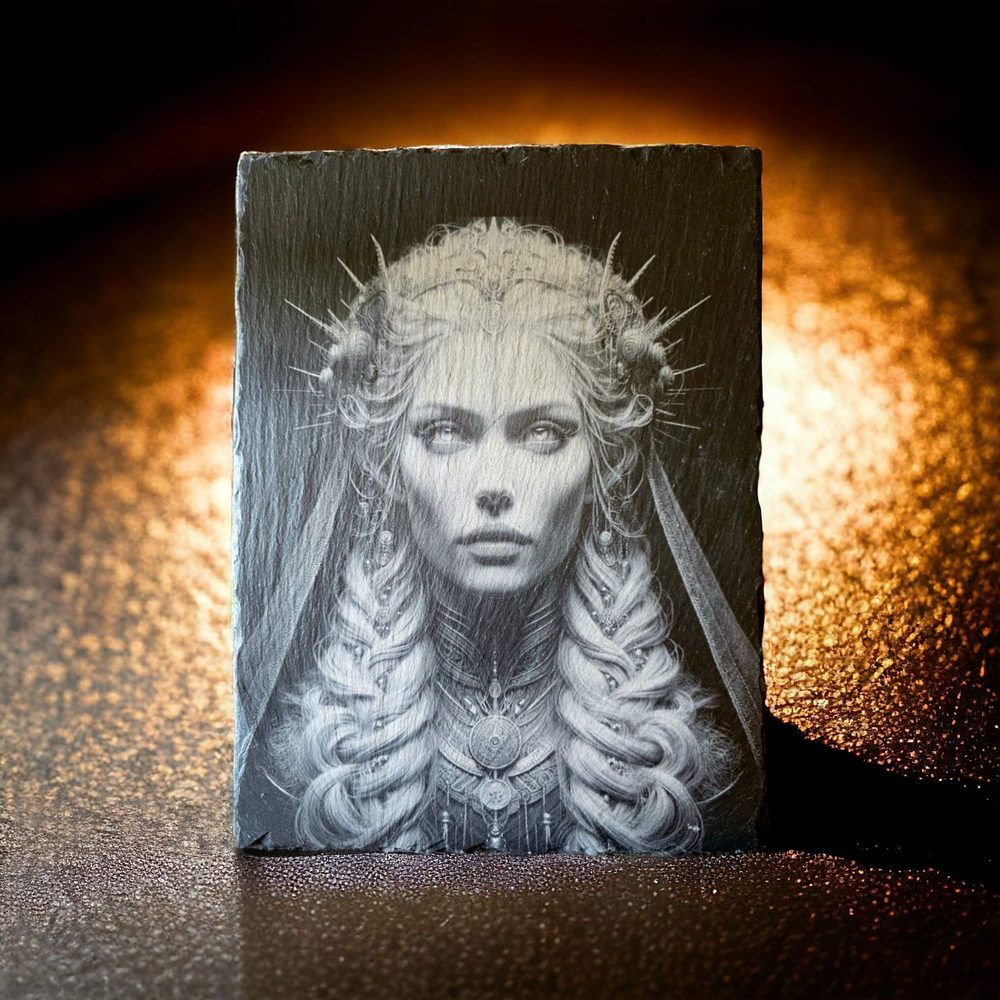
A slate plaque with the Eddic line stökk þat it mikla men Brísinga and a translation beneath it – on slate, the pale engraving looks almost like embers on dark stone. Or a Freyja figure inspired by the silver pendant from Hagebyhöga, with the broad necklace as its only ornament. What the real Brísingamen looked like, nobody knows, and we will not pretend otherwise. Have a look at our slate plaques or send us your own idea as a custom engraving.
What is Brisingamen? Brísingamen is the famous necklace of the goddess Freyja. It appears in the Poetic Edda, in tenth-century skaldic verse, in Snorri's Prose Edda and in the late Sörla þáttr.
What does the name Brisingamen mean? Men means necklace, Brísinga "of the Brísings". Who the Brísings were is unknown; in poetic language brísingr also means "fire", hence the reading "fire necklace".
Who made Brisingamen? According to the late fourteenth-century Sörla þáttr, the four dwarfs Alfrigg, Dvalinn, Berlingr and Grérr. Older sources name no maker.
Who stole Freyja's necklace? Loki. Around 900 a skald already calls him its thief; according to Húsdrápa, Heimdall won it back in a fight in seal form at Singasteinn. In Sörla þáttr, Loki steals it on Odin's orders.
Is Brisingamen in Beowulf? Beowulf mentions the Brosinga mene, which the hero Hama carried off from the Gothic king Eormenric. Whether it is the same necklace as Freyja's is debated among scholars.
Has Brisingamen been found by archaeologists? No. But Viking Age neck ornaments survive – bead strings from women's graves, gold neck rings like the one from Hiddensee – along with small female figures wearing broad necklaces that some interpret as Freyja.
For courage. For remembrance. For legends that live on.
All the treasures of the Edda in overview · Freyja · Heimdall · Loki · Draupnir.
We like to imagine valkyries as noble riders escorting the fallen to Valhalla. The Darraðarljóð shows them quite …
Read more →Some sayings are older than you would guess. What may be the finest words of consolation in the Germanic world sit …
Read more →A ring from which ever new rings arise: Draupnir is Odin’s golden treasure and one of the most striking images of Norse …
Read more →A tree carries the world – but what waters the tree? Beneath the roots of Yggdrasil lie three springs, and each tells a …
Read more →