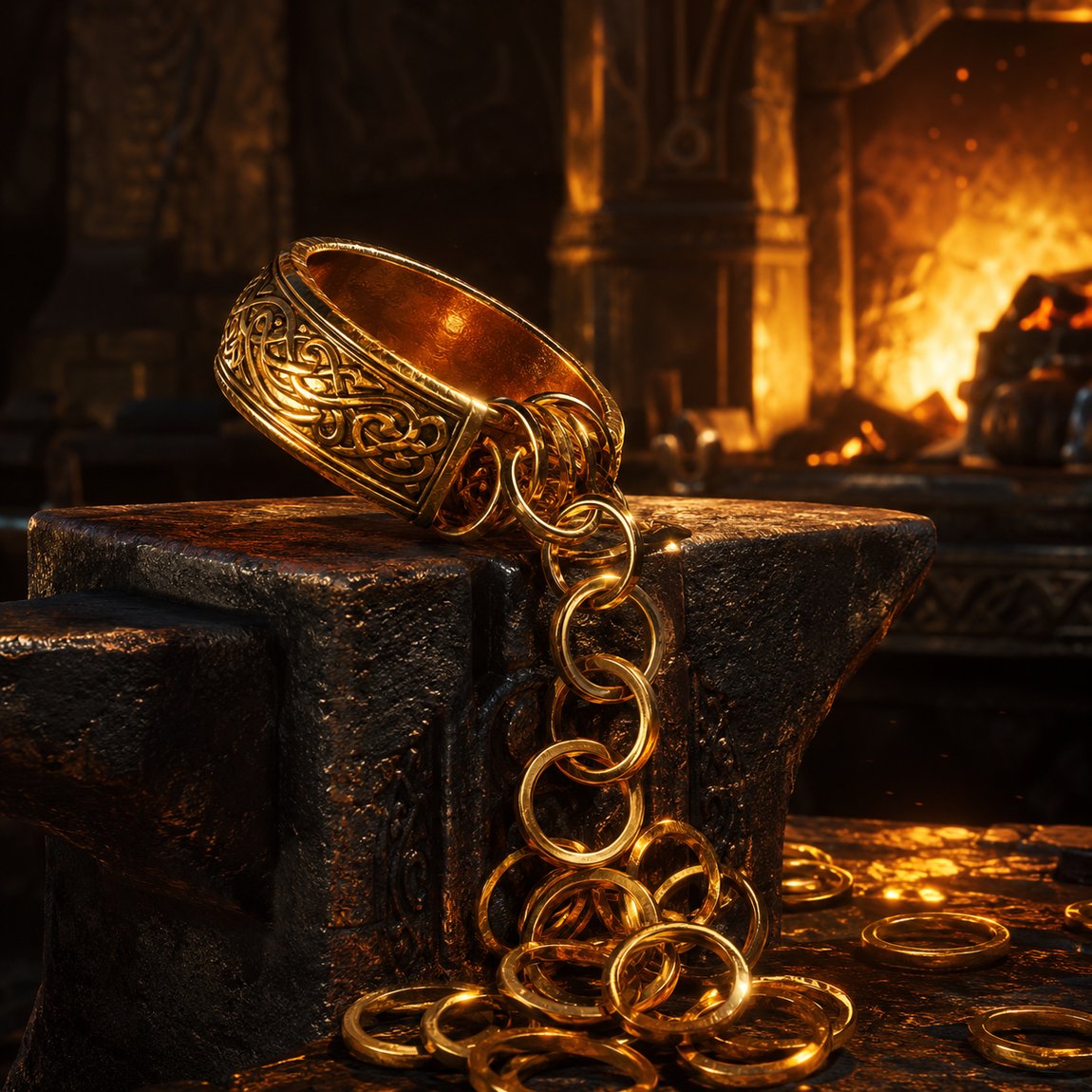
Draupnir is Odin's gold ring, and every ninth night eight gold rings of the same weight drip from it – which is exactly what its name, “the Dripper”, means. According to Snorri Sturluson, the dwarf brothers Brokkr and Sindri forged it; Odin laid it on the funeral pyre of his son Baldr, and Hermóðr brought it back from the realm of the dead. This article sets out what the Eddas really say about Draupnir, how it turns up in the wooing poem Skírnismál, and why a ring of all things became the image of kingship, oaths and generosity – right down to chopped-up silver on a merchant's scales.
Picture a ring that never runs dry. You give one away, and nine nights later eight new ones lie beside it, each exactly as heavy as the original. No interest, no bank, no loan. Just gold dripping from gold.
That is Draupnir, Odin's ring and one of the great treasures of Norse mythology. It does not fight, it does not fly, it does not smash giant skulls. It simply lies there and multiplies. And that is precisely why it tells us more about the Viking world than many a sword: about kings who had to hand out gold to stay kings, about oaths sworn on rings, and about an economy in which silver was not counted but weighed.
In our workshop in Alsdorf, near Aachen, Draupnir is a quiet favourite because it is so unshowy. A plain band, one single idea: wealth that is meant to be passed on.
The name is transparent. Draupnir belongs to the Old Norse verb drjúpa, “to drip, to trickle”. Its past tense is draup, “it dripped” – and that is the word hiding in the name. Draupnir is “the Dripper”, which is also how Henry Adams Bellows glossed it in a note to his 1923 translation of the Poetic Edda.
The name already tells the whole story. The new rings are not forged, not born, not conjured: they drip off. Snorri uses the same verb in the Prose Edda: eight rings of equal weight are to “drip” from it.
There is a curious side note. Draupnir is also the name of a dwarf. In the long catalogue of dwarves in Völuspá, the opening poem of the Poetic Edda, stanza 15 (in Neckel's numbering) contains the line “Þar var Draupnir ok Dólgþrasir” – “There was Draupnir and Dolgthrasir”. Whether the dwarf and the ring are connected is not attested anywhere. It is simply worth knowing that the name was at home among the smiths of myth.
An honest inventory first. Draupnir is not an archaeological object, and no runic inscription mentions it. Everything we know comes from Icelandic texts of the thirteenth century, written down in an Iceland that had been Christian for some two hundred years.
The main source is the Prose Edda of Snorri Sturluson, composed around 1220. Snorri talks about Draupnir in two places. In Skáldskaparmál, his handbook of poetic language, he tells how the ring was made in the dwarves' forge. In Gylfaginning, his account of the gods, he describes Baldr's funeral and the return of the ring. Only in Snorri does the ring explicitly bear the name Draupnir.
The second source is the poem Skírnismál in the Poetic Edda, preserved above all in the Codex Regius of around 1270. There Freyr's servant Skírnir offers the giantess Gerðr a ring from which eight rings of equal weight drip every ninth night, and which had been burned with Odin's son. The poem gives no name. That it is Draupnir follows only from comparison with Snorri.
We tell the forging story in full in our article on Sindri & Brokkr, so here are only the essentials.
It all starts with one of Loki's pranks: he secretly cuts off the hair of Sif, Thor's wife. To make amends he has the sons of Ivaldi forge new hair of gold, the ship Skíðblaðnir and the spear Gungnir. Then, in a fit of bravado, he bets his own head with the dwarf Brokkr that Brokkr's brother cannot make three treasures as good.
The brother's name depends on the manuscript and the edition. In many translations, including Anthony Faulkes's English version, he is called Eitri; in other versions of the text he is Sindri. In German retellings, “Sindri” has largely won out.
The smith puts three pieces into the forge one after another, and Brokkr has to work the bellows without a break. Loki interferes in the shape of a fly: he stings Brokkr's hand, then his neck, then his eyelid. With the first piece, a pig's skin, Brokkr holds on, and out comes the boar with golden bristles, Gullinbursti. For the second piece the smith lays gold in the fire – and out comes the ring Draupnir. Only with the third piece, the iron, does Brokkr pause for a moment to wipe the blood from his eye. That is why the handle of the hammer Mjölnir turns out a little short.
When the gifts are presented, Brokkr explains each one. Odin receives the ring, and Brokkr says that every ninth night eight rings will drip from it, “equally heavy as itself” – in Old Norse jafnhöfgir. The gods judge the hammer to be the best piece, and Loki loses the wager. He keeps his head thanks to a quibble, but Brokkr sews his lips shut.
The boar carries Freyr, the hammer guards the world of the gods. The ring does only one thing: it makes more gold. For the king of the gods that is no toy. It is the very tool of rulership.
The numbers are hardly random, even if we cannot fully decode them. Nine is a strikingly frequent number in Norse tradition. In Hávamál, Odin hangs nine nights on the windswept tree to win the runes. In Snorri, Hermóðr rides nine nights through dark valleys before he reaches the bridge to the underworld. Draupnir fits that pattern.
Old Norse liked to count time in nights rather than days. “Every ninth night” therefore describes a fixed rhythm, a calendar of wealth. Eight new rings plus the mother ring make nine – whether that is deliberate, no text tells us.
The inconspicuous word jafnhöfgir, “equally heavy”, matters a great deal. These are not just any rings but rings of exactly the same weight. That is the mindset of a society that valued gold and silver by weight. A ring was not only jewellery; it was a statement of value. We will come back to that.
Draupnir's great moment comes in the saddest story in Norse mythology. Baldr, Odin's radiant son, is killed through Loki's scheming by the mistletoe dart thrown by his blind brother Höðr. The whole build-up is told in our article on Baldr's death.
In Gylfaginning Snorri describes the funeral in rich detail. Baldr's body is carried onto his ship Hringhorni, which is so heavy that the gods cannot launch it; only the giantess Hyrrokkin gets it moving. Baldr's wife Nanna dies of grief and is laid beside him on the pyre. Thor hallows the fire with his hammer. Baldr's horse is led into the flames with all its harness. And Odin lays the ring Draupnir on the pyre.
At precisely this point Snorri explains the ring's power: “afterwards” it had the property that every ninth night eight gold rings of equal weight dripped from it. That “afterwards” sounds as if the funeral fire gave the ring its power – even though Brokkr already describes it at the presentation. Most likely Snorri is simply explaining it again for readers who do not know the forging story.
Odin sends his son off with the source of all gold. That matches a practice archaeology knows well: Viking Age graves often contain jewellery, weapons, tools and animals. Whether such grave goods were meant to serve the dead in the afterlife or to display the status of the living is debated – probably both.
For the funeral Snorri partly draws on Húsdrápa, a poem by the skald Úlfr Uggason. Its surviving stanzas show the gods on their way to the fire but do not mention the ring.
Frigg wants her son back. Hermóðr the Bold, a son of Odin, volunteers to ride to Hel and ask for Baldr's release. Odin lends him his eight-legged horse Sleipnir. For nine nights Hermóðr rides through deep, dark valleys until he reaches the river Gjöll and the bridge Gjallarbrú, guarded by the maiden Móðguðr. More on the messenger in Hermod – the ride to Hel.
Hel sets a condition: Baldr may return if everything in the world, living and dead, weeps for him. Before Hermóðr sets off home, Baldr gives him something. According to Snorri he takes the ring Draupnir and sends it to Odin til minja – “as a keepsake”, in remembrance. Nanna sends Frigg a linen cloth and other gifts, and Frigg's handmaid Fulla a gold finger ring.
The ring that produces endless gold comes back; the son does not. The giantess Þökk refuses to weep – and Snorri suggests that she was Loki in disguise.
Why does Baldr send the ring back? The sources do not say. The Danish encyclopedia lex.dk reads the return as a sign that Baldr, unlike the ring, cannot be renewed. Other readers see a pledge, a promise of return – and according to Völuspá, Baldr does indeed come back after the end of the world. Both are modern interpretations. The only certain thing is the word minjar, keepsake: a token of memory sent from the world of the dead to the world of the living.
The second major Draupnir scene has an entirely different tone. In the eddic poem Skírnismál, the god Freyr has fallen in love with the giantess Gerðr. He sends his servant Skírnir to woo her on his behalf – and gives away his self-swinging sword to do so. The whole story is in Skírnismál – how Freyr lost his sword.
Skírnir tries gifts first. He offers Gerðr eleven golden apples. She refuses. Then comes the ring. In Bellows's public-domain translation (1923, stanza 21) it runs:
“Then do I bring thee | the ring that was burned / Of old with Othin's son; / From it do eight | of like weight fall / On every ninth night.”Skírnismál 21, translated by Henry Adams Bellows (1923)
Gerðr's reply in stanza 22 is magnificently cool:
“The ring I wish not, | though burned it was / Of old with Othin's son; / In Gymir's home | is no lack of gold / In the wealth my father wields.”Skírnismál 22, translated by Henry Adams Bellows (1923)
The most precious ring of the gods leaves a giant's daughter unimpressed – the giants are old, wealthy lineages, not paupers. Only threats and a terrible runic curse finally break Gerðr's resistance.
To understand Draupnir you need to know how much weight a ring carried in the North – and not just in grams. Rings carried oaths. Whoever swore on a ring bound themselves before gods and people.
Odin himself supplies the most famous example of a broken ring-oath. In Hávamál, the wisdom poem of the Poetic Edda, he tells how he tricked the giant Suttung out of the mead of poetry and seduced his daughter Gunnlöð. Then comes a remarkably self-critical stanza:
“On his ring swore Othin the oath, methinks; / Who now his troth shall trust?”Hávamál 110, translated by Henry Adams Bellows (1923)
The Old Norse word is baugeiðr, “ring-oath”. The owner of Draupnir is also the god who broke an oath sworn on a ring – lord of gifts and lord of cunning at once.
The Icelandic Eyrbyggja saga describes, in its fourth chapter, the temple of the settler Þórólfr Mostrarskegg. On the altar, it says, lay a ring without a join, a tvítøgeyringr – a ring of twenty ounces, roughly half a kilo of silver depending on the ounce weight you assume. All oaths were to be sworn on it, and the temple priest had to wear it on his arm at every assembly. Landnámabók, the Icelandic Book of Settlements, similarly describes a ring on the altar of every principal temple, on which oaths were sworn at law.
A caveat: both texts date from the thirteenth century. How accurate their temple descriptions are is disputed; some of it may be antiquarian reconstruction.
More in our article on Viking oath rings.
In northern poetry the ideal ruler is the one who hands out rings. Skalds and eddic poets name princes with poetic circumlocutions, so-called kennings, that say exactly that. One such word is baugbroti, “ring-breaker”, attested in one of the Helgi poems of the Poetic Edda. The king breaks rings to share the pieces among his followers. In the Old English Beowulf, King Hrothgar is likewise called beaga brytta, “distributor of rings”, and the lord is the ring-giver in the mead hall.
Behind this lies a hard-nosed principle. Gifts created obligations of loyalty; a lord with nothing left to give soon had no one left to lead. Hávamál puts it plainly, in paraphrase: friends should gladden one another with weapons and clothes; those who give and give back stay friends the longest. How such retinues worked is the subject of our article on Lið, Hird and Leiðangr.
Against this background, Draupnir is the divine amplification of the royal ideal. An earthly ring-giver had to plunder, trade or levy gold before he could distribute it. Odin has a source that never runs dry. He can give without growing poorer. Draupnir is therefore not a symbol of greed but its opposite: a treasure made to be handed on.
Nobody is ever going to dig up Draupnir. But the rings the storytellers had in mind sit in our museums. Arm rings, neck rings and finger rings of gold and silver are among the most common precious-metal finds of the Viking Age.
Denmark's most spectacular piece is the gold neck ring from Tissø in West Zealand. A farmer ploughed it up in 1977. It weighs 1.83 kilograms, and since a small piece is missing it was originally somewhat heavier still. It belongs to the setting of a great Viking Age magnate's residence by the lake and is now on display at the National Museum in Copenhagen.
Equally revealing are the silver rings of the so-called Perm' or Glazov type – twisted neck rings that circulated mainly in the ninth century between the foothills of the Urals and the Baltic. In 2016 the Lund archaeologist Birgitta Hårdh showed that their weights cluster around roughly 100 and 200 grams, occasionally 300 or 400. She cautiously interprets them as payment rings made to fixed weight ratios. On Gotland many were found bent into spirals – jewellery that was also money.
A foreign eyewitness confirms this double character. The Arab envoy Ibn Faḍlān described the Rus on the Volga in 922. According to his account, their women wore neck rings of gold and silver; every time a man's wealth grew by ten thousand dirhams, he had another neck ring made for his wife. A neck ring was a wearable bank statement. You can read the account on our site here.
Many surviving arm rings bear small nicks. Traders struck them with a knife point to check whether the metal was silver all the way through or just a plated core.
This brings us back to the word jafnhöfgir. Across large parts of the Viking world people did not pay with coins at face value but with silver by weight. Coins, ingots, jewellery: everything went onto the folding scales. Whatever was too much was chopped off. That is how hacksilver came about, which turns up by the kilo in the great hoards.
The largest of these is the Spillings hoard on Gotland, packed with coins and arm rings. In England, the Cuerdale hoard from Lancashire, buried around 905, contains some forty kilograms of silver, among them numerous whole and hacked arm rings.
An arm ring could adorn a warrior today, be given away as a reward tomorrow and lie chopped up on the scales the day after. Draupnir pushes this logic into myth: it delivers standardised rings of identical weight, perfect for any balance. The ring of the gods is also a silver trader's dream.
Draupnir is often confused with another famous ring: Andvaranaut, the ring of the dwarf Andvari. Loki seizes it together with Andvari's gold, and Andvari lays a curse on ring and hoard that works its way through Fáfnir, Sigurd and the Nibelungs. More in Andvari's cursed gold. Bellows points out in his note on Skírnismál that Andvari's ring also had the power to produce gold.
The two rings are mirror images. Draupnir is given freely – as reward, as grave good, as keepsake, as bridal gift. Andvaranaut is taken by force and brings ruin to every owner. Gold that flows against gold that is clutched – gift against greed.
And Tolkien? Caution is in order. Tolkien knew the Eddas well – the dwarf names in The Hobbit come from Völuspá. But he never linked his One Ring to Draupnir, and a ring of generosity has little in common with a ring of domination. If anything, Andvaranaut would be the closer comparison. What Tolkien really took from the North is the subject of Tolkien and the Edda.
Whenever we engrave a ring or a ring motif on slate or wood, Draupnir is somewhere in the back of our minds. In the North a ring was a promise: loyalty for a gift, an oath for trust. That is why the motif suits weddings, anniversaries and keepsakes so well.
And perhaps that is the finest lesson of this myth: wealth that keeps dripping onward is worth more than wealth locked in a chest. Odin even laid the ring in the fire – for someone he loved.
What is Draupnir in Norse mythology? Draupnir is Odin's gold ring, from which eight gold rings of equal weight drip every ninth night. It is described in Snorri's Prose Edda and mentioned without a name in the eddic poem Skírnismál.
What does the name Draupnir mean? The name comes from the Old Norse verb drjúpa, “to drip”, and means “the Dripper”. It refers to the ring's power to drip new rings.
Who made Draupnir? According to Snorri's Skáldskaparmál it was forged by the dwarf Sindri (Eitri in other versions) while his brother Brokkr worked the bellows. Brokkr then presented the ring to Odin.
Why did Odin put Draupnir on Baldr's pyre? The source gives no reason, but the gift matches the custom of giving the dead precious objects. Odin gave his son the most valuable thing he owned.
How did Draupnir get back to Odin? Hermóðr rode to the realm of the dead to plead for Baldr's return. Baldr gave him the ring to take to Odin as a keepsake.
Is Draupnir the same as the Nibelung ring? No. The cursed ring of the Nibelung legend is Andvaranaut, the ring of the dwarf Andvari. Draupnir is a ring of giving; Andvaranaut is a ring of theft and curse.
For courage. For remembrance. For legends that live on.
All the treasures of the Edda at a glance · Gungnir – Odin’s spear · Mjöllnir – Thor’s hammer · Odin (Wotan) · Sigurd & the hoard of Fafnir.
A tree carries the world – but what waters the tree? Beneath the roots of Yggdrasil lie three springs, and each tells a …
Read more →Almost everything we know about the Norse gods we owe to two books from medieval Iceland. A look at the sources – and …
Read more →He was warrior and poet, killer and grave-robber, farmer and man skilled in magic – and probably the greatest skald of …
Read more →They are the chosen of the fallen: warriors who died in battle and were carried by the Valkyries to Valhalla. The …
Read more →