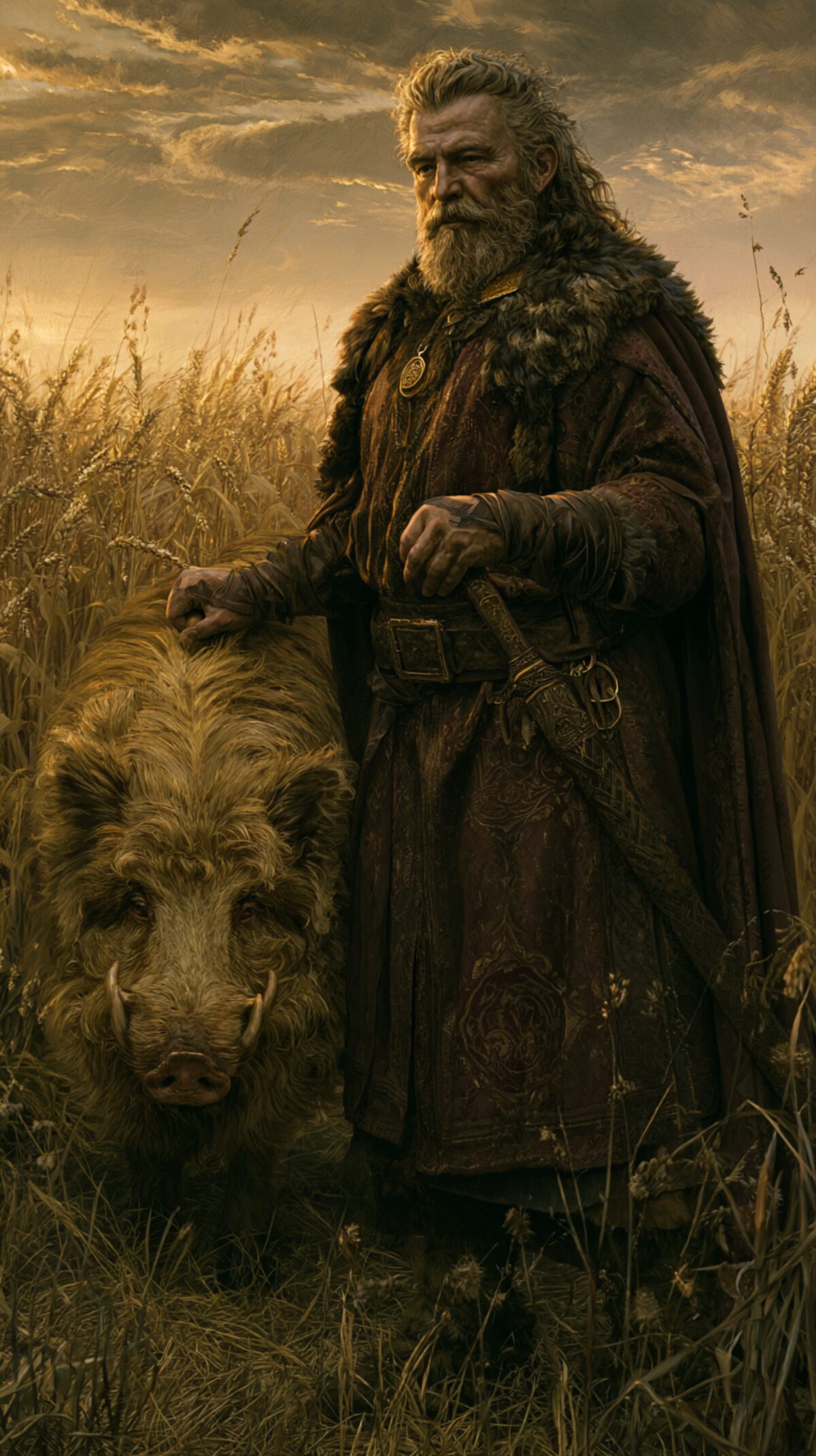
It is one of the strangest love stories of the North: a god falls for a single glance, grows sick with longing, and sends his servant to woo on his behalf. The price of that courtship is steep, because Freyr hands over his finest possession – a sword that fights by itself. And that very gift becomes his undoing at the end of the world. The Skírnismál, the "Lay of Skírnir", tell this story in harsh stanzas full of yearning, gold, and curse. Anyone who wants to understand why Freyr must go into battle at Ragnarök with a stag's antler has to start here.
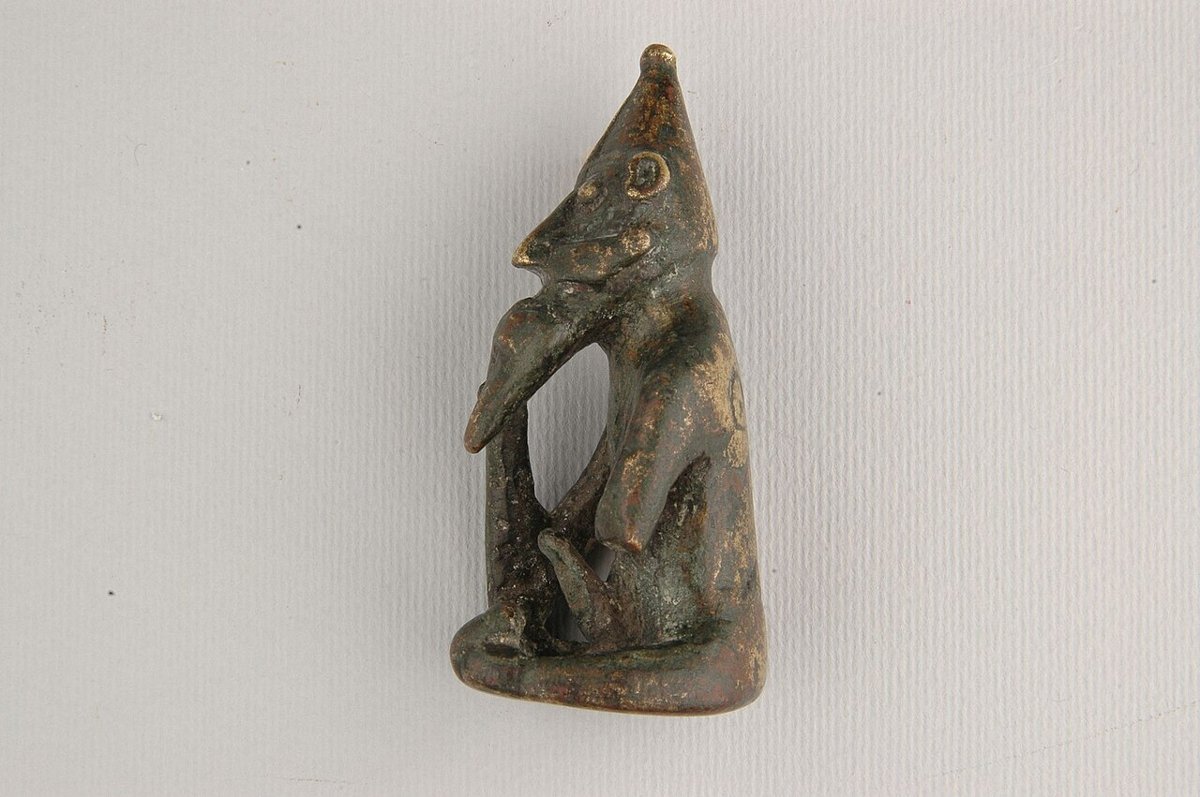
It all begins with a broken taboo. Freyr, lord of the Vanir, sits down on Hlidskjalf, Odin's high seat, from which one can look into all the worlds – a place reserved for Odin and Frigg. From there Freyr sees, far in the north in the land of the giants, a woman stepping out of a homestead: Gerðr, daughter of the giant Gymir. As she raises her arms to open a door, air and sea gleam with her radiance. Freyr climbs down, but he carries away something he never wished for: a lovesickness that leaves him silent and downcast.
The prose frame of the Skírnismál puts it plainly: he went off full of grief, would not speak, sleep, or drink, and no one dared address him. His father Njörðr finally sends Skírnir, Freyr's servant and confidant, to find out what torments the god. The name Skírnir means roughly "the shining one" or "the cleanser" – a fitting messenger for a god of light and fertility.
Freyr admits the truth, and Skírnir agrees to woo for him. But a journey to Jötunheim, through flickering fire and over giant ground, is dangerous. Skírnir asks for two things: a horse that will carry him safely through the wall of flame, and a sword that fights of itself against the race of giants. Freyr gives up both without hesitation.
This is the decisive moment, easily missed among the love verses. Freyr parts with his weapon. In the sources this sword is no ordinary iron: it fights "by itself" if he who wields it is wise. Snorri Sturluson picks up this thread in his Prose Edda and draws the line all the way to the end of the world: because Freyr once gave the sword to Skírnir, he later stands unarmed. The wooing of Gerðr and the fall at Ragnarök hang on the very same object.
Skírnir rides out, crosses the fire, and reaches Gymir's courts, where dogs bark and a herdsman sits on the burial mound. He comes to Gerðr, and at first she receives him with hospitality, offering him the clear mead. Then the real wooing begins – and it runs in two very different gears.
First Skírnir tries the gentle way. He offers her eleven golden apples if she will grant Freyr her favour. When that fails, he raises the stakes: Draupnir, Odin's ring, from which eight rings of equal weight drip every ninth night. It is a royal gift that would raise Gerðr to the rank of a goddess. Yet she calmly refuses. She has gold enough in her father's courts, she says in effect, and will not share it with him.
Here the poem turns. Skírnir shifts from suitor to threatener. He draws a sword and threatens to strike off her head. When even that does not move her, he reaches for his strongest weapon: the curse. And this curse of the Skírnismál is among the most detailed passages of magic in the entire Poetic Edda.
Skírnir lifts the tamsvǫndr, the "taming wand", and proclaims to Gerðr a future that sounds worse than death. She will sit on an eagle's mound, turned away from the world; food will fill her with disgust; everyone will stare at her; she will waste away in longing and despair, married to a three-headed thurs or left without a man at all. Rage, unbearable torment, and restlessness he will conjure upon her. As the seal of this curse he carves for her the Þurs rune and three further magic staves. He threatens that he can scratch them away again just as readily if she relents.
A thurs I carve for thee, and three staves also: / lewdness, frenzy, and unrest. / Yet I can grave them off as I graved them on, / if I find good cause to.Skírnismál 36, adapted from Henry Adams Bellows 1923 (public domain)
Gerðr gives in. Whether from fear or from insight the poem does not expressly say. She hands Skírnir the cup of old mead and promises to meet Freyr – not at once, but after nine nights, in the windless grove called Barri. Skírnir rides home and delivers the message. Freyr, still sick with longing, answers with perhaps the most famous verses of the lay: one night is long, two nights are long, how shall he bear three? Often a whole month has seemed shorter to him than half such a night of waiting. And there the poem ends – without our ever seeing the meeting itself. Whether Barri brings a happy wedding or a coerced conclusion is left open.
The Skírnismál say nothing of the world's end. But Snorri Sturluson closes the circle. In the Gylfaginning he describes how, at the end of the world, the fire giant Surtr advances from Muspelheim, his sword blazing like the sun. Freyr stands against him – and falls, because he no longer has the sword he once gave to Skírnir. Snorri remarks in effect that it went badly for Freyr then to lack the good weapon he had handed over. In some retellings Freyr fights with what remains to him: a stag's antler. So a love story becomes a prologue to the world-fire. The god who gave everything for a single yes pays in the end with his life.
Anyone who wants to dive deeper into Freyr's nature as a Vanir god will find more in our portrait of Freyr and in the overview of the Vanir realm at Vanaheim. How Freyr's fall fits into the larger picture of the end of the world is shown in our article on Ragnarök. And whoever is curious about the Þurs rune and the other signs of the curse should take a look at our rune lexicon.
Attested: The Skírnismál survive in the Codex Regius (13th century) and in the manuscript AM 748 I a 4to. The loss of the sword is set up within the poem itself (Skírnir demands it as his reward) and is explicitly linked by Snorri Sturluson in the Prose Edda (Gylfaginning) to Freyr's fall against Surtr. The curse with its tamsvǫndr, the Þurs rune, and the three additional magic staves ranks among the longest passages of magic in the Poetic Edda.
Myth-check: The popular reading as a "sacred marriage" – Freyr as sun or sky god wooing Gerðr as the personified earth, a fertility rite – comes from scholarship (among others from Magnus Olsen) and is NOT stated in the text; the poem names neither the sun nor the harvest. Likewise, the curse is a rich witness to the literary imagination of rune magic, but it is NOT a surviving ritual manual – we do not know whether anyone ever actually proceeded this way. And whether Gerðr's yes is free courtship or coerced submission is debated to this day; the poem deliberately leaves it open.
Before we trust a tale of wooing, it helps to know what we are trusting. The poem is called Skírnismál in the manuscript (also För Skírnis, "Skírnir's Journey") and stands in the Poetic Edda, the Codex Regius (GKS 2365 4to), written in Iceland around 1270 and today kept in Reykjavík. Part of the text also survives in the fragment AM 748 I a 4to – a welcome second witness, for manuscripts err, and where two copies agree we stand on firmer ground. Snorri Sturluson summarised the same story more than half a century earlier in his Prose Edda (Gylfaginning 37); he already knew it as a settled narrative.
In form the poem is a hybrid. By far the largest part is in Ljóðaháttr, the "song metre" of Eddic wisdom and charm poetry – the same measure in which the Hávamál dispenses its counsel. Between the verses sit short passages of prose that set the frame and read almost like stage directions: "Njörðr said", "Skírnir rode off". This mixture has led scholars to see in Skírnismál something close to an early piece of dramatic poetry. How old the verse itself is remains disputed – estimates range from the 10th to the 13th century; all that is certain is that it predates the manuscript preserving it.
Skírnir does not arrive empty-handed. First he offers Gerðr eleven golden apples (epli ellifu … gullin) – no random prize, but an image of abundance and, as many read it, of youth and endurance, kin to the apples of Iðunn. Gerðr declines: apples she will not take in order to live with a man she does not love.
Then Skírnir plays the heavier card: the ring Draupnir, treasure of the god Freyr, that golden band which every ninth night drips eight equally heavy rings from itself – pure, self-multiplying wealth. And this very ring carries a dark memory: it lay on Baldr's funeral pyre before it returned to the gods. Yet Gerðr stays cool: in her father Gymir's halls there is gold enough, and she shares it as she pleases. This is the decisive narrative turn of the poem – wealth, the usual courting-gift of the heroic sagas, fails. Gerðr cannot be bought. Only when Skírnir switches from gift to threat does the scene tip; it is not gold that wins her, but fear. That is anything but romantic, and the poem knows it.
The shift from wooing to coercion is the most famous part of the poem. Skírnir draws a wand – in the text it is the tamsvǫndr, "taming rod" – and heaps curse upon curse: Gerðr shall sit on the eagle's hill, an object of loathing to all, gnawed by longing, married to a three-headed giant or forever manless. As a seal he sets a rune-charm upon it all:
A thurs I carve for thee, and staves three:
lust and frenzy and unrest;
yet off I can scrape it, as once I cut it,
should there be need.Skírnismál 36, after Henry Adams Bellows 1923
The carved Þurs rune (ᚦ) stands here for the giant himself and for all that is baleful; the "three staves" are the three ills ergi (lust to the point of debasement), œði (frenzy) and óþoli (restless unease). Note the second half-verse: the spell is reversible – just as Skírnir cut it, so he can scrape it away again. That fits exactly the thinking about runes found in the rune stanzas of the Hávamál: signs work if one carves, reads and colours them rightly – and one can overreach with them. What real curse and protection formulas looked like is shown by stones such as Björketorp and Stentoften or the many rune-carvings from Bergen; more on that in our rune lexicon. But the point stands: Skírnismál is poetry, not a ritual record. It shows what people credited runes with, not how a curse was actually performed.
Gerðr is no minor figure to be wooed away and forgotten. She is the daughter of the giant Gymir and the giantess Aurboða – she belongs, then, to the world of the jötnar, while Freyr counts among the Vanir around Njörðr. This union across the divide of kinds is more than a love story: from it, according to Snorri's Ynglinga saga, grows the royal line of the Ynglingar, traced through the son Fjǫlnir down to the kings of Uppsala. Gerðr is thus an ancestress, not merely a bride.
Her name speaks too. Gerðr belongs to the word-family of Old Norse garðr and gerði – "fence", "enclosure", "enclosed field". To scholars this is a hint: to marry a shining giant's daughter whose name means "the enclosed land" to the fertility god Freyr may tell of more than a courtship. This is not certain – name interpretations are slippery ground – but the trail is old and is still taken seriously today.
Few Eddic poems have been read so differently. The Norwegian Magnus Olsen interpreted it in 1909 as the myth of a sacred marriage (Greek hieros gamos): the bright sky- or sun-god Freyr woos the earth; the union of god and field brings growth. Great names carried this line forward – Ursula Dronke in her Edda edition and above all Gro Steinsland, whose book "Det hellige bryllup" (1991) explains the union of god and giantess as the founding pattern of Norse kingship: rule is born from the tension of opposites. Whoever shares this reading finds in the poem a myth of fertility and rule, rooted deep in the belief of the Vanir and their world Vanaheim.
Others object – rightly and with force. For a sober reading shows no festive wedding but blackmail: Gerðr consents only when madness and endless misery are threatened upon her. Scholars such as Carolyne Larrington have stressed that the poem should not be explained away into a pretty sun-and-earth picture without naming the violence at its heart. Both are probably true at once: an old fertility motif in which the wooing has long since become coercion. And in the end more hangs on this scene than it seems. In the Lokasenna the servant Byggvir mocks Freyr's following; and because Freyr gave away his sword for Gerðr, in the last battle the blade will fail him. What happens here on the eagle's hill thus reaches all the way into the doom of the gods, Ragnarök – a god surrenders, for one night of longing, the weapon he will need most desperately at the end of the world.
Attested: Skírnismál stands in the Codex Regius (~1270) and partly in AM 748 I a 4to; Snorri summarises it in Gylfaginning 37. Gerðr as daughter of Gymir and Aurboða, and Freyr's loss of his sword, are attested in the Edda; the Ynglingar descent through Fjǫlnir is named in Snorri's Ynglinga saga. The curse stanza with the Þurs rune and the three ills ergi, œði and óþoli stands verbatim in the poem.
Myth-check: Whether the poem means a "sacred marriage" of sky/sun and earth is interpretation (Olsen 1909, Steinsland 1991), not the source's own testimony – as is the etymology "Gerðr = enclosed field". The age of the composition is disputed. And the curse verses are poetry, not a ritual manual: they show what people credited runes with, not how a spell was actually performed.
The Vikings before Aachen · Hedeby · Dorestad – the great trading place · The North Frisian ring forts · The Viking winter camps.
All History & Finds articles →
The Vikings came, raided – and stayed. Over the winter, at least. Instead of sailing home after every raid, they …
Read more →Many call the Varus battle the „big bang of Germany". Yet another battle shaped our lands far more deeply – one in …
Read more →High above the world of humans, beyond the burning rainbow bridge, lies Asgard – the fortified home of the Æsir. It is …
Read more →Almost 1,500 years before the first Germanic peoples entered Roman history books, a highly developed Early Bronze Age …
Read more →