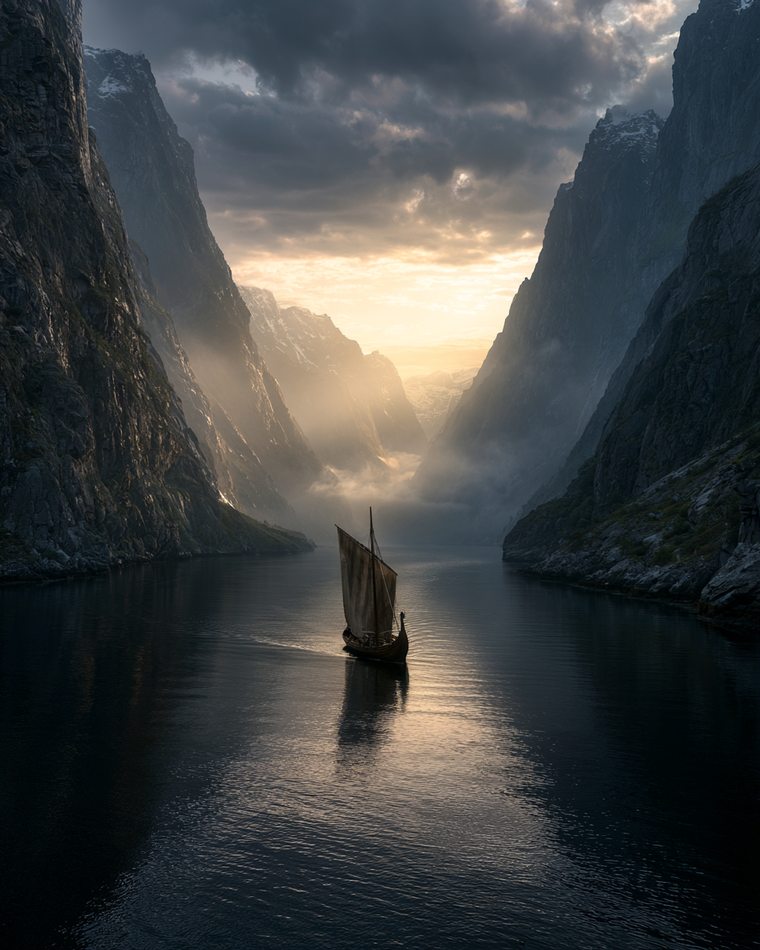
We remember the Vikings as raiders and coastal plunderers – yet their greatest feat was a quiet one: they crossed the open North Atlantic. Without a compass, without a sea chart, and long before Columbus, they sailed from Norway by way of the Faroes to Iceland, on to Greenland, and finally to the coast of North America. This overview page gathers what we know for certain about the westward expansion – and what remains legend to this day. For the people and individual stories behind it, we link to our detailed articles.
Two things made the North Atlantic crossing possible at all. The first was the clinker-built ship: a light, flexible hull of overlapping planks that did not resist the waves but worked with them. The seagoing freighter of the Atlantic routes was not the sleek longship of the raids but the broad, high-sided knörr – loaded deep with livestock, timber, tools and people looking for a new life.
The second was the art of holding a course without instruments. The Norse sailed by latitude: you ran up the coast to the latitude of your target and then held that latitude by the height of the midday sun, the height of the Pole Star at night, and a thousand small signs – bird flight, cloud banks over unseen land, the colour of the water, drifting debris. It was neither magic nor secret lore, but patient, handed-down experience. Anyone wanting to see how much origin and direction of travel differed will find it in the article on the regional differences among the Vikings: it was above all Norwegians who sought the westward path across the Atlantic.
Iceland was the first great step into the void. According to tradition, the actual land-taking began around the year 874, when Ingólfr Arnarson settled by the bay he named „Smoke Bay" after its rising steam columns – Reykjavík. Within a few decades a whole island filled up: farmers, their families, their servants, their livestock. Among the earliest settlers were remarkable women too; one of the most impressive was Aud the Deep-Minded, who fitted out her own ship and led an entire household across the sea.
For dating, we have an unusually hard anchor: volcanic ash. A major eruption around 877 left a thin ash layer across all of Iceland, found again in soil profiles and peat – the so-called landnám tephra. The oldest settlement traces lie directly above this layer. The arrival of the first farms can thus be placed by natural science, independently of the sagas written down much later. Around the year 930 the free farmers gave themselves a common assembly, the Althing – one of the oldest surviving parliaments in the world, though not a modern parliament in today's sense, but the legal assembly of a chieftain society.
From Iceland the gaze turned further west. The man who dared this step was an outlaw: Erik the Red, banished for manslaughter first from Norway and then from Iceland, used his three years of exile to explore the icy coast in the west. What he found was harsh, but green enough at the sheltered fjords of the south-west for cattle and pasture. His farm Brattahlíð in Eiriksfjord became the heart of the Eastern Settlement.
The name „Greenland" was, by tradition, an early marketing trick: Erik is said to have named the land favourably on purpose, so that more people would follow him. Around the year 985/986 a whole emigration fleet set out; only part of the ships arrived. The Greenland settlement was no lonely outpost but a working community with farms, churches and its own bishop's seat, which endured for centuries at the very edge of the known world – sustained above all by the trade in walrus ivory.
Greenland was not the end but the springboard. Around the year 1000, Erik's son Leif Eriksson sailed from Greenland further west and came upon land unknown until then. The Vínland sagas – the Saga of the Greenlanders and Eiriks saga rauða – tell of several voyages and give the discovered coasts names: Helluland (land of flat stones), Markland (forest land) and Vínland (the mild wine land). More about the voyages, the names and the question of the wine grapes can be found in the article on Vinland.
The sagas are magnificent literature, but they were written down only two centuries after the events and contradict each other in details. Who was there first, how many voyages were there, how far south did they reach? That cannot be answered with certainty from the texts alone. Which is precisely why it weighed so heavily when a spade finally confirmed the story.
Cattle die, kindred die, every man is mortal: but the good name never dies of one who has done well.Hávamál 77, after Henry Adams Bellows (1923), public domain
In 1960 the Norwegian couple Helge and Anne Stine Ingstad found, at the northern tip of Newfoundland near a fishing village called L'Anse aux Meadows, the remains of a Norse settlement: turf houses of Scandinavian type, a smithy, boat rivets, a spindle whorl, a bronze cloak-pin. It remains to this day the only archaeologically secured proof of Norse people on the American mainland – a workshop and repair base from which they sailed further south, not a great colony.
In 2021 research then delivered a date of astonishing precision. A team led by Margot Kuitems and Michael Dee showed on felled timbers from the settlement that the trees were cut in the year 1021 – to the exact year. This was made possible by a known solar storm that left a globally measurable carbon spike in tree rings in the year 993; from that marker one only had to count the rings outward. So it is certain: by 1021 at the latest, Norse people stood with iron tools at the edge of America – about 500 years before Columbus. How the origin of the Greenland and Iceland populations can also be traced genetically is covered in the article on Vinland and DNA.
Vínland remained an episode; the Greenland settlement, by contrast, held on for centuries. But in the late Middle Ages it died out. The Western Settlement was probably abandoned as early as the 14th century, the Eastern Settlement followed in the 15th. Why is disputed to this day – and the honest answer is: for many reasons at once. The climate cooled and shortened the already scarce grazing season. The European market for walrus ivory, the economic lifeline, collapsed as ivory from Africa grew cheaper. The shipping links to Norway and Iceland broke off. Add to that isolation, competition with the Arctic Thule culture, and a shrinking, ageing population. No single culprit can be named; it was an interplay that gradually pulled the ground from under the small community at the edge of the world.
Looking at the North Atlantic story as a whole, the image of the Viking shifts markedly. Anyone who settles an island, ferries livestock across the sea, founds farms, speaks law and works for generations at the very edge of the bearable is above all one thing: farmer, trader and navigator. The raids were loud, but the land-taking was the lasting achievement. It is exactly this legacy – craft, foresight, courage and remembrance – that still moves us today and that we let flow into our motifs at Glanz & Gravur.
Attested: The landnám tephra (around 877) dates the first Icelandic farms by natural science. The Norse settlement of L'Anse aux Meadows in Newfoundland is archaeologically secured; the felling year of its timber is fixed to 1021 via the solar storm of 993 (Kuitems et al., Nature 2021). The Greenland farms (Brattahlíð, Eastern and Western Settlement) are proven by excavation.
Myth-check: That Vikings reached America about 500 years before Columbus is true – but only L'Anse aux Meadows is secured; the exact location of Vínland remains open. The famous „Vínland Map" at Yale University is a proven forgery, as is the Kensington Runestone from Minnesota. Other alleged proofs such as the Newport Tower are considered refuted (post-medieval structures or mistakes). And „Greenland" as a name was, according to the sources, advertising, not description.
The Vikings before Aachen · Hedeby · Dorestad – the great trading place · The North Frisian ring forts · The Viking winter camps.
All History & Finds articles →
The Vikings came, raided – and stayed. Over the winter, at least. Instead of sailing home after every raid, they …
Read more →Many call the Varus battle the „big bang of Germany". Yet another battle shaped our lands far more deeply – one in …
Read more →High above the world of humans, beyond the burning rainbow bridge, lies Asgard – the fortified home of the Æsir. It is …
Read more →Almost 1,500 years before the first Germanic peoples entered Roman history books, a highly developed Early Bronze Age …
Read more →