When we picture Vikings, we see mist, fjords and the grey North Sea. Yet the same men who plundered monasteries on the English coast also sailed where the sun stands straight overhead: through the Strait of Gibraltar, along the shores of Al-Andalus and North Africa, past the Balearic Islands as far as Italy. The Mediterranean was no distant legend for the Northmen but a real, if risky, destination. Whoever knows only the North knows only half the story — and anyone who loves the far-ranging voyages will also find our overview of the different Viking regions.
The earliest well-attested Viking thrust toward the Mediterranean led in 844 to Iberia's Atlantic coast and up the Guadalquivir. A Norse fleet appeared off Lisbon, plundered Cádiz and finally pushed on to Seville, then part of the Emirate of Córdoba. The city was taken and sacked for several weeks before the troops of Emir Abd ar-Rahman II drove the Northmen back.
What makes this campaign remarkable: we know it not only from Christian annals but above all from Arabic sources. The Andalusian chroniclers called the attackers al-madjus — a word that originally meant the Zoroastrian "fire-worshippers" and was here transferred to the heathen strangers from the North. To the Muslim scholars these raiders were a new, unknown people who had come out of the grey ocean. After the defeat at Seville, Córdoba began to strengthen its coastal defences and its fleet — a clear sign of how seriously the new threat was taken.
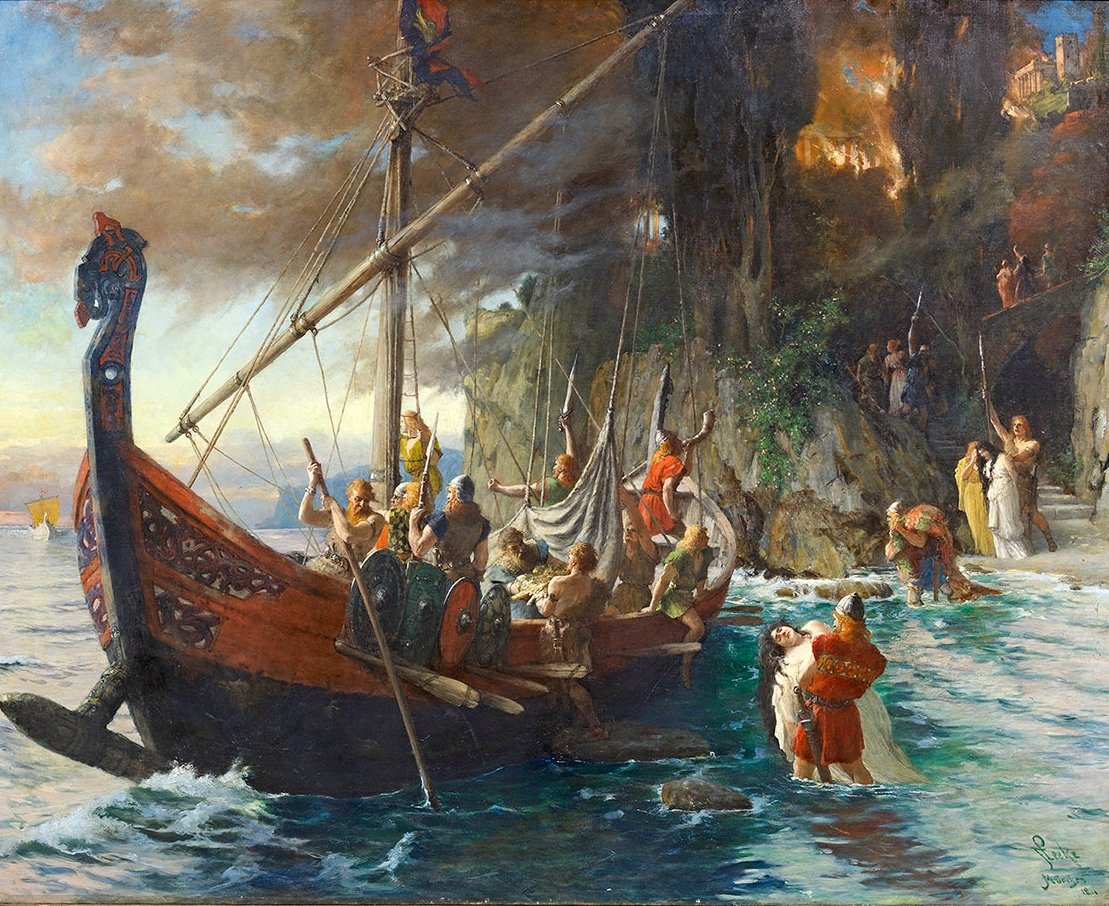
Some fifteen years later came the most ambitious venture of all. Led by Hástein and Björn Ironside, a fleet put to sea whose goal was no longer merely the Iberian coast but the whole Mediterranean. The voyage began on the Loire, struck again at Al-Andalus and then passed through the Strait of Gibraltar into the ancient "inland sea".
The route, as the sources suggest, reads like a grand tour of violence: attacks on the Andalusian coast, a thrust into North Africa against the town of Nekor (in present-day Morocco), where the Northmen took captives, then the Balearics, the southern French coast with the Rhône delta and the Camargue, where they wintered, and finally Italy. It was less a campaign with a clear plan than a raid-and-trade voyage lasting several years, working its way from prize to prize.
One especially fascinating detail concerns Nekor. After the raid on the North African coast the Vikings are said to have carried off captives who are called blámenn in the Norse sources — literally "blue men", an Old Norse term for dark-skinned people from the south. According to tradition, some of these captives were taken all the way to Ireland.
This is one of the earliest points of contact between the Norse world and people from North Africa at all. One should, however, beware of colourful embellishment here: the report is brief, the numbers are missing, and what became of these people soon vanishes from the sources' view. It remains a real but narrow trace.
The most famous episode of the entire voyage is also the most doubtful. According to tradition, Björn and Hástein came to a rich Italian city that they took for Rome — the great goal, the city of cities. Since the walls were too strong to storm, the Vikings resorted to a ruse: Hástein had it proclaimed that their leader was gravely ill and wished to be baptised. He was baptised in a sham ceremony. Shortly afterwards word went out that he had died, and the Northmen asked to be allowed to bury him in consecrated ground inside the city.
Once the funeral procession with the "dead man" had passed the gates, Hástein sprang from the bier, and the secretly armed retinue fell upon the startled city. Only afterwards, so the story goes, did the Vikings realise that they had taken not Rome at all but the smaller town of Luni on the Ligurian coast — a bitter aftertaste to so cunning a coup.
After the Italian adventures the badly reduced fleet set out for home. Once again the way led through the Strait of Gibraltar — the narrows that for the Northmen were the gate between their familiar Atlantic world and the alien south. On the return journey there were said to be fresh clashes with an Andalusian fleet that was by now far better prepared for such intruders. Of the originally large fleet only a fraction returned to the North. The Mediterranean expedition was spectacular — but it was also dearly paid for, and it remained a one-off enterprise, not the beginning of a lasting presence.
There was another, quite different way by which Northmen reached the Mediterranean — not westward through Gibraltar, but eastward along the Russian rivers. Swedes and Rus travelled south down the Dnieper and the Volga until they reached the Black Sea and the gleaming metropolis of Constantinople, which they called Miklagard, the "great city". Many entered the imperial bodyguard there, the famous Varangian Guard, and so saw the eastern Mediterranean from an entirely different vantage point: not as raiders before the walls but as highly paid mercenaries of the emperor. We explore this eastern world in detail in the article on the Varangians and Miklagard.
The story of the Northmen in the Mediterranean does not end with the raids of the ninth century. Some of them settled on the French Channel coast, and over the generations these Northmen became the Normans — the path from Viking leader to duke can be traced well in the example of Rollo and the founding of Normandy. In the eleventh century their descendants returned to the Mediterranean, this time not on longships but on horseback and as mercenaries. The house of Hauteville conquered southern Italy and Sicily and built there a flourishing Norman kingdom in which Latin, Greek and Arabic culture stood side by side. So the circle closed: what began with heathen sea-raiders off Seville led two hundred years later to a Christian royal crown on a Mediterranean island.
Cattle die, kinsmen die, / you yourself die the same; / but a good name / never dies / for the one who earns it well.Hávamál, stanza 76 (rendered after Karl Simrock, 1851; public domain)
Attested: The raid on Seville in 844 and the term al-madjus are well attested by Andalusian-Arabic as well as Frankish sources. The great expedition of 859–862 and the thrust to Nekor with the abducted blámenn are recoverable from a few but independent sources. The route of the Rus through Byzantium into the eastern Mediterranean, and the Norman conquest of southern Italy and Sicily in the eleventh century by the Hauteville family, belong to the secure record of history.
Myth-check: The famous Luni episode — feigned death, sham baptism, attack during the burial and the realisation that it was not Rome after all — appears only late and heavily embellished in Dudo of Saint-Quentin and in Norman legend-building; a contemporary source is lacking, and the same motif is also ascribed to other leaders. The often-cited fleet strength of around 60 ships is uncertain and varies from source to source. The blámenn carried off to Ireland are only briefly attested, and the details remain vague. And in general: the whole Mediterranean voyage is tangible in only a few sources — much of what circulates today as colourful narrative is later embellishment, not eyewitness record.

The Vikings before Aachen · Hedeby · Dorestad – the great trading place · The North Frisian ring forts · The Viking winter camps.
All History & Finds articles →
The Vikings came, raided – and stayed. Over the winter, at least. Instead of sailing home after every raid, they …
Read more →Many call the Varus battle the „big bang of Germany". Yet another battle shaped our lands far more deeply – one in …
Read more →High above the world of humans, beyond the burning rainbow bridge, lies Asgard – the fortified home of the Æsir. It is …
Read more →Almost 1,500 years before the first Germanic peoples entered Roman history books, a highly developed Early Bronze Age …
Read more →